

A note on this series: This is Part Six of an eight-part series drawn from the book I’m developing, Dark Tarot: Unleashing the Power of the Tarot for Dark Magick and Self-Discovery. Across the series, I am exploring the Dark Tarot as a practical system of magical divination, moving beyond fortune-telling into the operative formula of Sigil, Spell and Sorcery. Each article offers part of the larger method, while the paid practicum sections provide exercises, ritual frameworks and working material for those who want to engage the Dark Tarot as a lived magical practice.
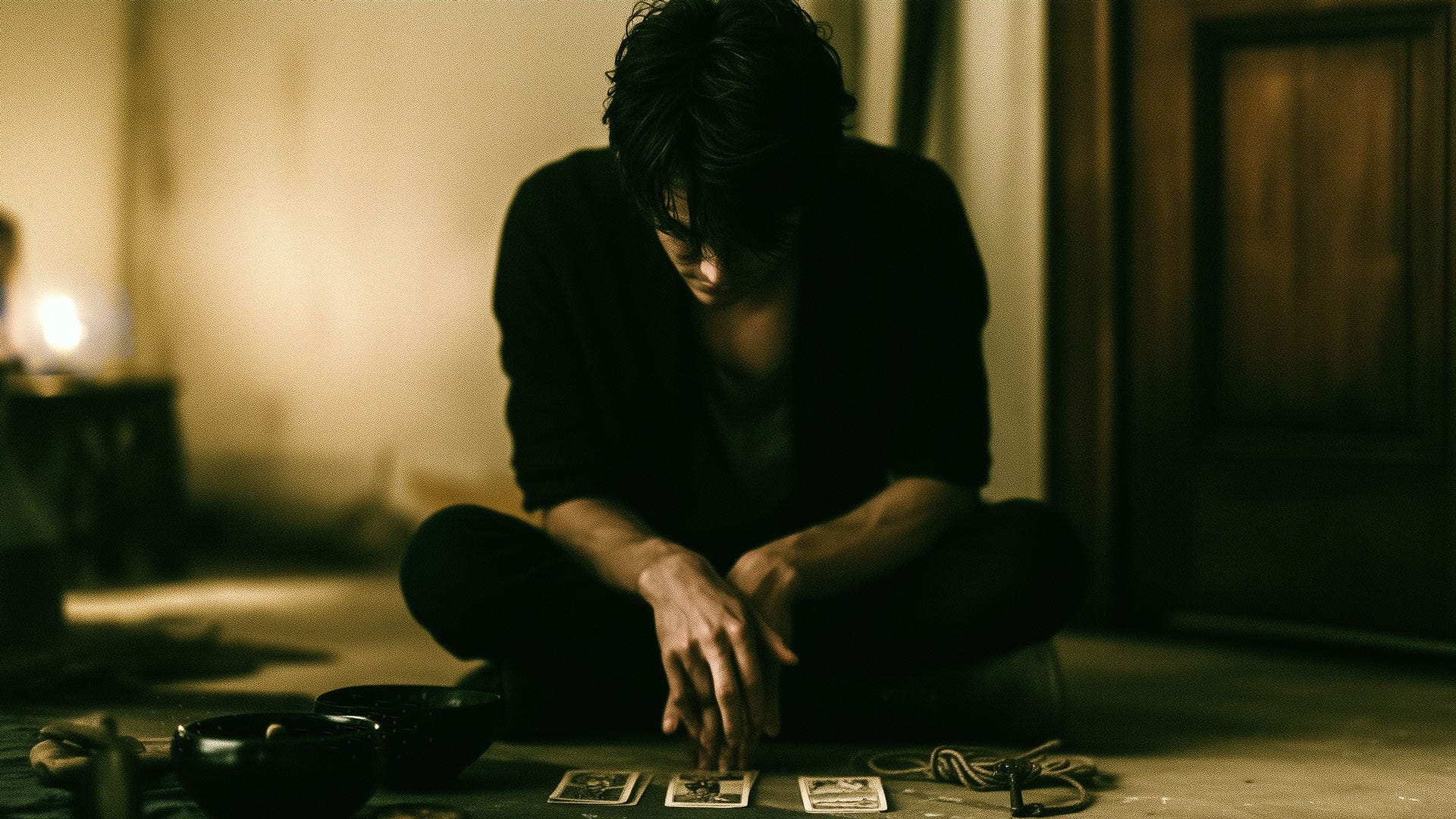
The third card is where the reading becomes dangerous, because it removes the last refuge of passivity. Once the act is known, the Witch must decide whether to perform it.
It is possible to admire a symbol without allowing it to change us. We may speak beautiful words, construct elaborate theories and spend years studying correspondences while remaining essentially untouched. The psyche is capable of turning almost anything into an abstraction, including initiation. Even the Tarot can become a sophisticated way of circling life without entering it.
The Sorcery card interrupts this tendency.
In the three-card Dark Tarot operation, the first card is Sigil: what must be formed. The second is Spell: what must be spoken or sounded. The third is Sorcery: what must be done.
The Sorcery card reveals the ritual act that completes the operation. It may indicate a gesture, movement, offering, ordeal, consecration, release, journey, destruction or beginning. It may ask the practitioner to burn something, bury it, wash it, carry it, speak it publicly, return it to the earth or place it upon an altar. Just as importantly, it may reveal the worldly act that must follow the ritual: the letter sent, the boundary drawn, the application submitted, the conversation begun, the old obligation ended or the new work made visible.
The Dark Tarot does not end in insight. It demands embodiment.

There is an important difference between understanding a card and enacting it.
To understand The Alchemist (Temperance), for example, may be to recognise the need for healing, integration or the reconciliation of opposites. To enact The Alchemist might mean preparing a ritual bath, blending an oil, mixing two waters, creating an elixir, reconciling two estranged parts of a project or patiently distilling a complicated experience into something medicinal.
To understand The Phallus (The Tower) may be to recognise rupture, liberation or the destruction of a false structure. To enact The Phallus might mean tearing up a vow that has become a prison, dismantling an altar belonging to a completed phase of life, speaking the truth that breaks an untenable arrangement, or physically removing the object through which an old authority continues to occupy psychic space.
Understanding observes the force. Enactment gives it a body in time.
This is why the third card is called Sorcery. I am not using the word merely to indicate theatrical ritual or the manipulation of invisible forces. Sorcery here means the deliberate translation of an occult current into an act. It is the point at which psychic reality is brought into relationship with matter.
The act may be ceremonial, but it cannot remain merely decorative. Lighting candles, dressing an altar and reciting an invocation may help prepare the magical atmosphere, but they are not automatically the sorcery revealed by the card. The question is always more exacting:
What must actually be done?

The title Dark Tarot does not indicate evil, morbidity or a preference for sinister decoration. The word dark refers to what is hidden, unconscious or occulted from ordinary awareness.
When the cards are first drawn, their real significance for the operation is not yet known. The traditional meaning offers a background. The Dark Tarot title intensifies the atmosphere. Tables of correspondence may suggest colours, sounds, substances and magical powers. Yet none of these, by themselves, reveals the personal meaning of the card for this particular practitioner, question and moment.
That meaning remains dark until it is encountered.
This is why the trance journey is essential to the Dark Tarot practicum. It is not an optional embellishment added to make the reading feel more mystical. It is the means by which the practitioner enters the psychic reality behind the card and discovers what the title, image and correspondence are concealing.
Each of the three cards should therefore be entered separately.
The practitioner journeys first into the Sigil card to discover the form or magical body of the working. They enter the Spell card to hear its voice, rhythm, word, breath or silence. Finally, they enter the Sorcery card to encounter the required act.
Without this descent into the image, the practitioner remains dependent upon traditional forms of interpretation. They may produce an intelligent ritual, but it will tend to be assembled from what they already know. The operation will remain inside the circle of the conscious personality.
The purpose of the Dark Tarot is to discover what the conscious personality does not yet know.
The trance journey allows the card to become an environment rather than an illustration. The practitioner does not stand outside it asking what it signifies. They cross the threshold, enter its landscape and allow something to happen.
A figure may approach. An object may be given. A path may open. A gesture may be demonstrated. The practitioner may be asked to wait, descend, break, wash, carry, feed, surrender or speak. The vision may be beautiful, disturbing, absurd or initially incomprehensible. What matters is that it arrives with the autonomy of an experience rather than the neatness of an invented explanation.
The card ceases to be something looked at.
It becomes somewhere the Witch has been.
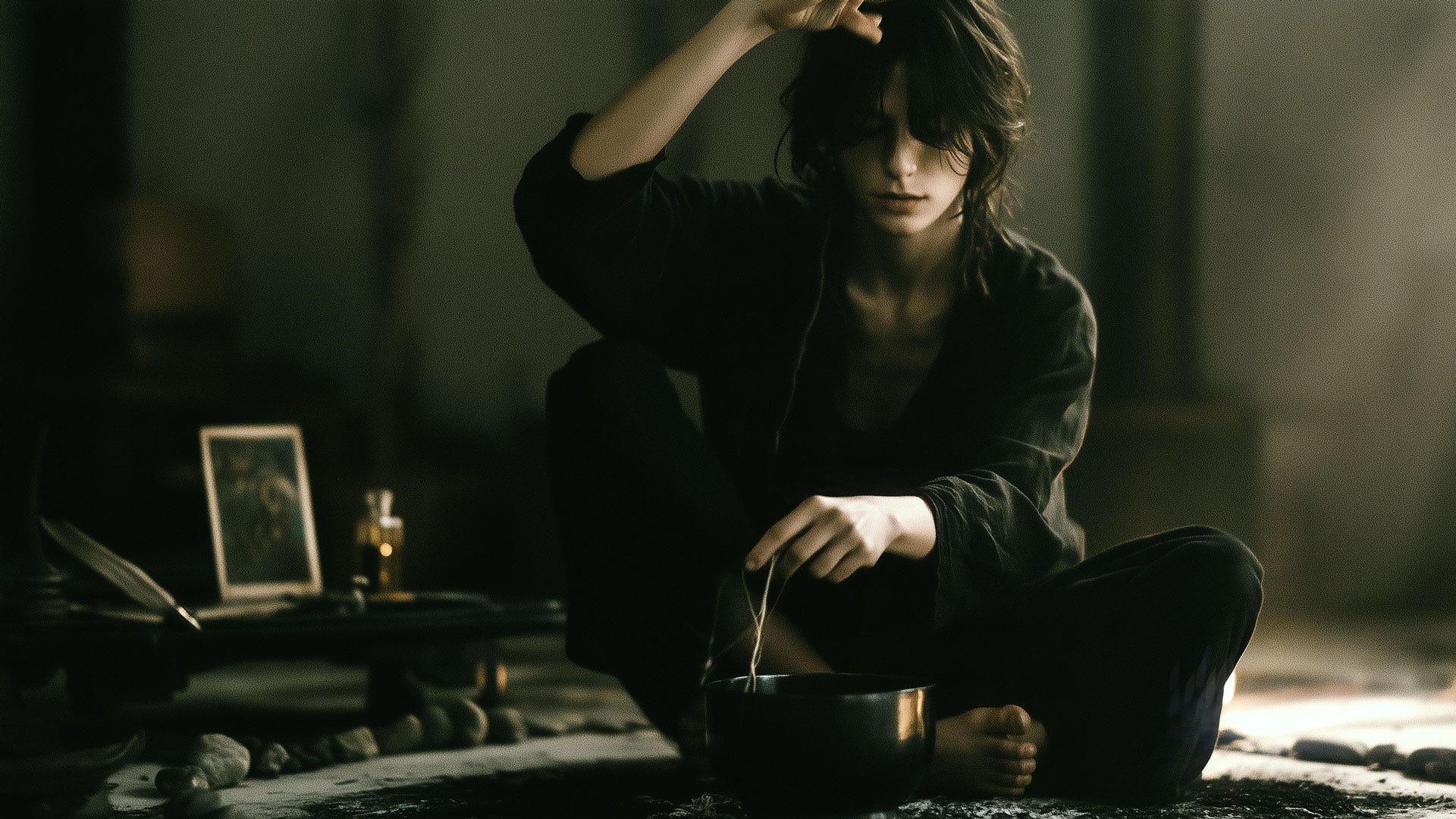
The Sorcery card is not read only through the intellect. It is read through the body.
What does the card make the body want to do? Does it demand stillness or movement? Does the spine straighten? Does the breath deepen, stop or become ragged? Does the card suggest kneeling, dancing, walking backward, lying upon the earth, crossing water, turning in a circle or standing at a threshold?
These responses should not be followed blindly, but neither should they be dismissed. The body is one of the places where the unconscious first announces itself. Long before an image has been explained, it may already have entered the muscles, breath and posture.
The Sorcery card may reveal an action through:
a gesture performed in trance;
an object handled or received;
a change in bodily posture;
a journey through a particular landscape;
an encounter with an animal, spirit or ancestral figure;
a repeated movement;
a task given by a figure within the card;
an ending, sacrifice or exchange;
an instruction that appears mundane but carries unusual psychic force.
The practitioner’s task is to bring the action back from the journey without either trivialising it or taking every visionary event literally.
If The Abyss (The Hanged Man) shows the practitioner suspended in a web, the necessary act may not be to reproduce physical danger. It may be to bind a written intention, postpone a decision, submit to a period of waiting, reverse an habitual method, fast from an addictive behaviour or remain deliberately inactive until the hidden pattern becomes visible.
If The Necromancer (Death) reveals a half-open cemetery gate, the act may involve honouring an ending, speaking the name of the dead, returning something to the earth, closing an unfinished ancestral matter or acknowledging that a relationship, identity or project has already passed beyond recovery.
The vision must become action through discernment.

Ritual occupies a curious place between imagination and matter. It is neither merely internal nor simply external. A ritual act may be physically small—a thread cut, a cup poured, a letter burned—yet carry an immense interior weight. Conversely, an elaborate ceremony may produce very little if it has no living relationship to the psychic current.
The Dark Tarot uses ritual as a bridge.
On one side stands the unconscious image revealed through the cards and trance journeys. On the other stands the material world of bodies, relationships, labour, money, homes, communities, promises and consequences. The ritual allows something to pass between them.
This is why the magical act should be symbolically accurate. The form of the act must answer the card.
A rite of The Geomancer (The Emperor) may require boundaries to be marked, plans to be drawn, stones to be placed or territory to be consciously claimed.
A rite of The Witch (The Empress) may require a charm to be made, herbs blended, oils prepared, a fetish awakened or a desired force embodied in physical matter.
A rite of The Alchemist (Temperance) may require substances to be mingled gradually, a bath prepared, a medicine created or two conflicting aspects of life brought into a disciplined exchange.
A rite of The Underworld (The World) may require descent, dream incubation, a night vigil, entry into an enclosed space or the symbolic completion of a cycle through an encounter with what has been buried.
The ritual does not need to imitate the card’s imagery in an obvious manner. It must, however, carry the same psychic function.
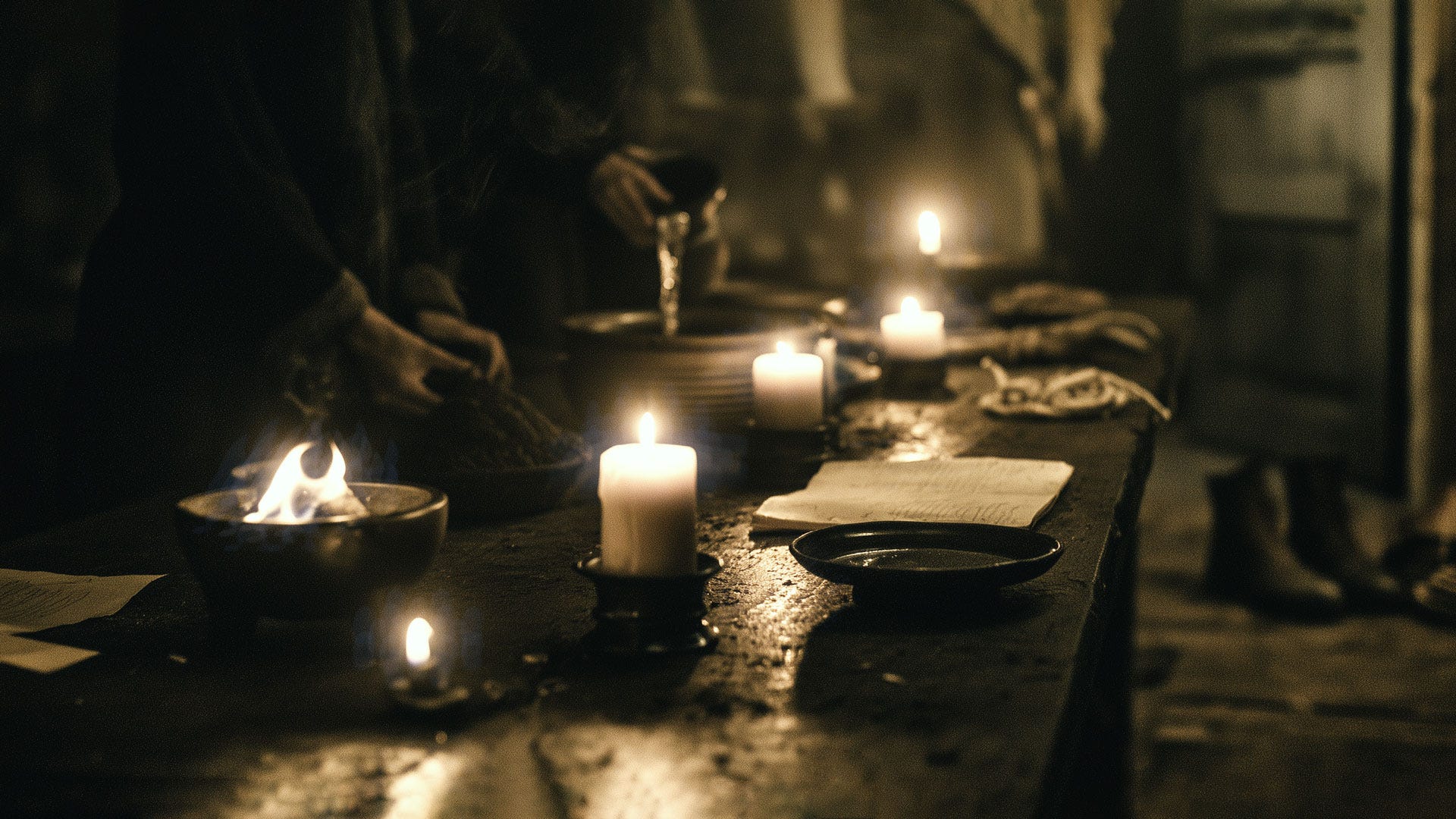
The Sorcery card may indicate almost any form of deliberate action. Some cards suggest dramatic gestures, while others reveal that the true act is patience, discipline or restraint.
The card may ask the practitioner to burn something. Fire can release, transform, illuminate or consume. A written fear, name, vow or image may be offered to flame, but the meaning depends upon the card. The same act of burning may be purification under Awakening (Judgement), wrathful rupture under The Phallus (The Tower) or the freeing of a spirit under The Necromancer (Death).
It may ask for burial. An object may be returned to earth, planted as a seed, hidden at a boundary or laid to rest. Burial can end a matter, contain a force, establish a foundation or begin a slow gestation.
It may ask for bathing or washing. Water may cleanse, soothe, consecrate, dissolve, receive or restore. Under The Alchemist (Temperance), bathing may blend medicine with the body. Under Familiar Spirits (The Moon), it may invite entry into lunar, dreamlike or shapeshifting consciousness.
It may ask for walking. A path may be travelled at night, a boundary circled, a crossroads visited or a threshold crossed repeatedly until its meaning alters. The Lunatic (The Fool) may call the practitioner onto an uncertain road. Initiation (The Chariot) may require a disciplined pilgrimage or ordeal of endurance.
It may ask for fasting. The abstinence may concern food, speech, alcohol, social media, sexual activity, spending or any habitual consumption that obscures the current. Fasting creates an absence into which another perception can enter.
It may ask for offering. The offering might be food, drink, incense, music, labour, money, flowers, water, service or the surrender of an attachment. An offering is not payment in a crude commercial sense. It acknowledges relationship and exchange.
It may ask for speaking or writing. A declaration may need to be made, a boundary stated, an apology offered, a contract prepared, a name invoked or a truth placed into the world where it can no longer be privately avoided.
It may ask for destruction. Something false, exhausted or imprisoning may need to be broken, cut, dismantled or discarded. But destruction should never be assumed merely because the imagery is dramatic. The Witch must identify precisely what structure has become untrue.
It may ask for consecration. An object, room, body of work, relationship or new phase of life may need to be formally recognised and dedicated.
It may ask for sending. A charm may be released, a message delivered, a proposal submitted, an application completed or a spirit dispatched upon its errand.
It may ask for ending or beginning. These are often more difficult than the ceremony itself. The final candle may be extinguished, but the true sorcery may be resigning from the role, opening the door, enrolling in the course, making the appointment or beginning the work the following morning.
The ritual act is discovered through the card. Its effectiveness is proven through life.
Certain Dark Tarot trumps demonstrate the range of the third position particularly well.
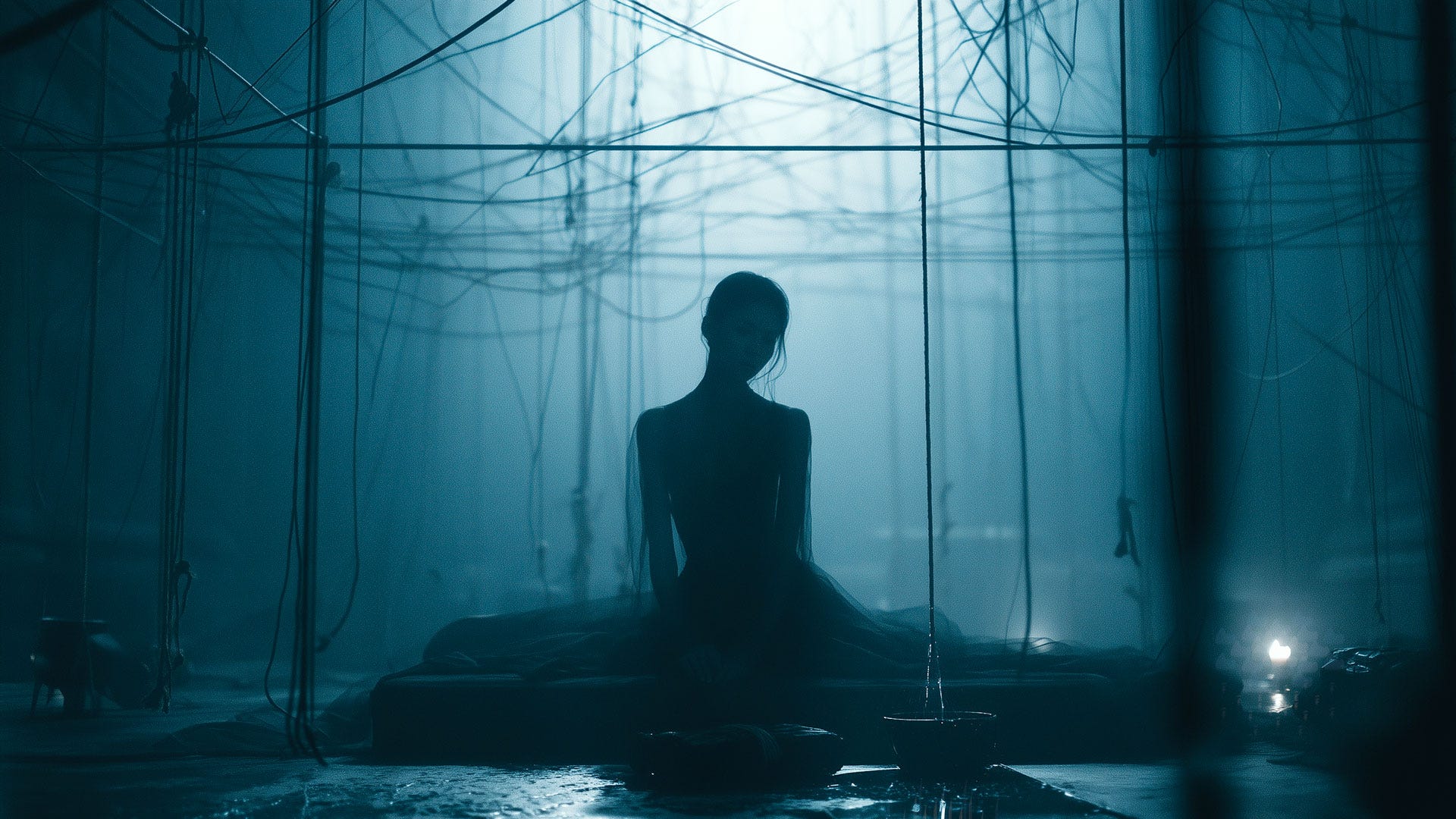
As Sorcery, The Abyss may indicate suspension, reversal, delay, binding, ordeal or surrender. Its Spider Sorcerer holds the practitioner within a web where immediate movement may be impossible or unwise.
The required act may be to stop struggling. A cord might be tied around a written question and left unopened for a lunar cycle. A decision might be deliberately postponed. An habitual posture might be reversed. The practitioner may need to submit to uncertainty rather than force premature resolution.
The challenge of The Abyss is that waiting must not become avoidance. True suspension is conscious. It is a chosen submission to another angle of vision.

As Sorcery, The Phallus calls for rupture and release. Its force is Dionysian, blasphemous and destructive of forms that can no longer contain the life moving within them.
The ritual may involve breaking a symbolic object, tearing apart an old declaration, dismantling a shrine, sounding a thunderous note or speaking against an authority that has become internalised and oppressive.
Yet the act must be exact. The Phallus does not grant permission for indiscriminate chaos. The practitioner must know which structure is false and what living force has been imprisoned within it.

As Sorcery, The Alchemist asks for mixing, healing, distillation and transformation. Its act is often gradual. Two forces are brought together so that something new may emerge between them.
The practitioner may blend an oil, prepare a bath, create an elixir, combine soil from two places, reconcile conflicting schedules, bring two people into mediated conversation or transform a painful experience into teaching, art or medicine.
The Alchemist reminds us that not all sorcery is forceful. Some operations work through patience, touch and the careful regulation of heat.
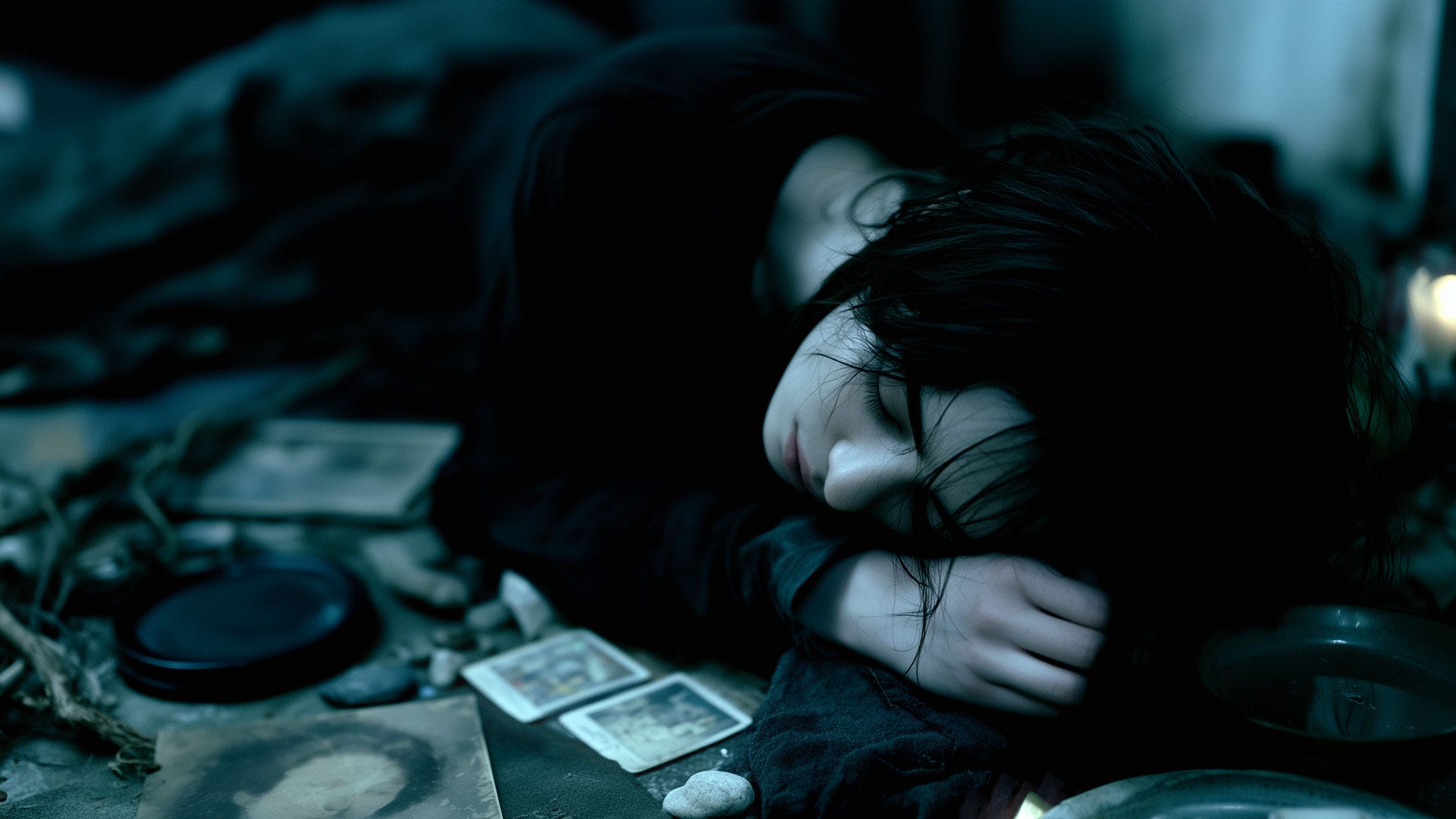
As Sorcery, The Underworld may require descent, dream incubation, vigil, shadow work or the completion of a cycle through encounter with the rejected or forgotten.
The act may involve sleeping beside the cards, keeping watch through part of the night, entering a darkened room, recording dreams, visiting an ancestral place or constructing a ritual descent followed by a deliberate return.
Completion under The Underworld does not mean everything has been made bright. It means what was excluded has been brought back into the circle of the whole.

One of the easiest mistakes in magical work is to perform the ritual while neglecting the ordinary action through which the desired change might enter life.
A spell for employment that is not followed by an application remains psychically incomplete. A rite for reconciliation that avoids conversation may be a refined form of cowardice. A prosperity ritual performed while invoices remain unsent has severed symbol from matter. A working for creative manifestation that is not followed by writing, rehearsal, editing, publication or display remains enclosed within imagination.
The mundane act is not less magical because it appears ordinary.
Indeed, it may be the most difficult component of the operation. Ritual space can feel numinous, controlled and protected. The world beyond the circle is less compliant. There are emails to send, prices to name, risks to take, refusals to face and habits to change.
The Sorcery card may therefore reveal two linked actions:
the ritual act that embodies the psychic current; and
the worldly act that gives the current a path into material life.
These actions should be performed in close relationship. As a practical rule, the mundane follow-through should usually occur within forty-eight hours of the rite. The time limit prevents the operation from evaporating into good intentions.
The ritual opens the road. The worldly action steps onto it.
Sometimes the Sorcery card is immediately intelligible. At other times, the required act remains obscure.
This is often a sign that the card has not yet been entered deeply enough. So return to the trance journey. Do not ask merely what the card means. Ask to be shown the act.
Enter the scene again and observe:
What is happening?
Who is acting?
What is being handled, changed, opened or destroyed?
What does the central figure do?
What happens immediately before the vision ends?
What task are you given?
What are you prevented from doing?
What do you carry back?
The answer may appear indirectly. A door that refuses to open may reveal that the sorcery is not yet action but preparation. A figure washing its hands may suggest cleansing, release or refusal of responsibility. An animal leading the practitioner away from the temple may show that the necessary act belongs in nature rather than ceremonial space.
The unconscious does not always provide instructions in the language of a ritual manual. Its images must be lived with, amplified and tested.
This is part of the discipline. The Dark Tarot is not a machine that converts cards into instant spells. It is a relationship with the hidden.
Sorcery has consequences because action has consequences.
Before performing the operation, the practitioner must ask whether the act respects the autonomy of others, whether it arises from genuine need or inflamed compulsion, and whether ritual is being used to avoid accountability.
A working may be symbolically brilliant and still ethically distorted.
The Sorcery card should therefore be examined through several questions:
What would make this act ethical?
What would make it manipulative?
Am I attempting to control what does not belong to me?
Does this act deepen relationship with reality, or help me escape it?
Does it place anyone at risk?
Am I interpreting a symbolic image too literally?
What responsibility will I carry if the operation succeeds?
The final question is often neglected. Desire tends to focus upon obtaining the result, but every manifestation creates new obligations. The job requires labour. The relationship requires honesty. The power requires discipline. The initiation changes what can no longer be unknowingly ignored.
To ask for change is to accept responsibility for the changed world.
The Sorcery card completes the movement that began with the question.
The question opened the gate. The Sigil gave the current a body. The Spell gave it breath. Sorcery gives it movement through the world.
The third card may ask for ceremony, but ceremony is only the visible threshold. The deeper work is participation. The practitioner must allow the act to alter their relationship with the question.
A ritual of release is incomplete if the released object is immediately replaced by a similar attachment. A rite of authority is hollow if the practitioner continues surrendering every decision. An invocation of creative power becomes theatre if the work remains unwritten. A spell of awakening fails when the Witch repeatedly chooses sleep.
Sorcery is not what we perform instead of living.
It is the point at which the magical and the lived are forced into contact.
Sorcery is where the Witch stops asking for signs and becomes one.
Steps into the Practicum
Dark Tarot: Unleashing the Power of the Tarot for Dark Magick and Self-Discovery is my current book-in-development, drawn from decades of work with Tarot, Witchcraft, ritual magick, trance practice and the NOX current.
This eight-part series is adapted from the developing manuscript and offers a first public exploration of the Dark Tarot as a practical system of magical divination. Rather than treating the cards as a device for prediction alone, the Dark Tarot approaches them as operative images through which the practitioner may divine a Sigil, Spell and Sorcery: the form, voice and act of a magical working.
The trance journey is essential to this method. The true meaning of the card remains dark—hidden within the unconscious—until the practitioner enters the image and encounters its psychic reality firsthand.
Paid subscribers can continue below with a complete ritual-construction exercise, turning a three-card Dark Tarot reading into a practical magical operation and identifying the worldly act that must follow.
Comments
Nothing yet. Say the first thing.
Sign in to join the conversation.