
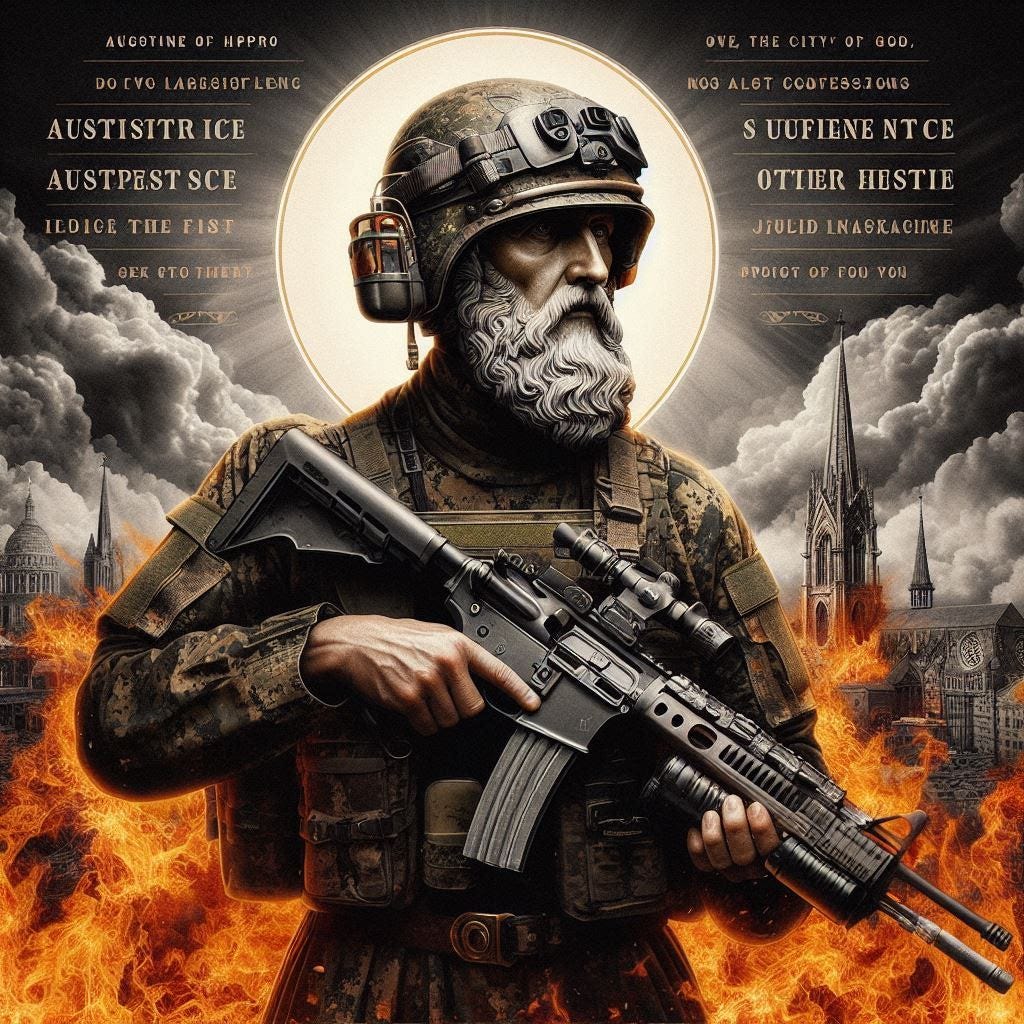
Thanks to Bridgette for inspiring this piece. I might quibble with some aspects here and there but I highly suggest you read her “Techno Shieldmaiden” as it gets at something—at someone—that is beautiful and mystical and unfortunately, strange in our time. Here, I clumsily try to grasp at my generation’s male corollary of that. This is not an explicitly Christian article of mine, but you will be able to clearly see where this agrees with Christian belief.
“I wish it need not have happened in my time,” said Frodo.
“So do I,” said Gandalf, “and so do all who live to see such times. But that is not for them to decide. All we have to decide is what to do with the time that is given us.” — The Fellowship of the Ring, J.R.R. Tolkien
But the dreamers of the day are dangerous men, for they may act their dreams with open eyes, to make it possible. — T.E. Lawrence
Something is different now.
Everyone can feel it. The world is perceptibly more perilous and in every dimension, on the brink of something cataclysmic. A shadow, a malaise, a dark time has settled. Systems which used to work are strained and cracking; people, once fairly normal, now are going insane; deaths of despair are skyrocketing everywhere; our leaders show they are both incompetent and vicious, that they hate those they govern and hate those they would replace us with.
Our fathers failed us, and the inheritance of our generation is marred and diseased, the walls broken down, and the fields overgrown. The Greatest Generation is now gone and has left its fair share of triumphs to look back on and emulate, but even they left their follies. Their children, the Baby Boomers, likewise grow aged and pass off the scene, leaving behind a terrible record shot with financial, political, and international ruin. Generation X and the Millennials have yet little to show for their day, but indicate that they will likewise fail, their excesses only restrained by their mediocrity. Our Generation Z indicates a capacity and a likelihood to outstrip the others in failure, decadence, and psychopathy.
But even in this day, these generations hold a sliver of hope that they can be better. This sliver is contained in the few who understand the times.
Enter Stage Right.
We are the sons of William Wallace, of Elrond, of Rudyard Kipling, of King David and King Arthur Pendragon, of George Washington and Teddy Roosevelt. We are few among the Zoomers and Millenials and X-ers, the Devotees of scorned ideas, the Patrons of unfashionable arts, the Pages and Squires of long-dead knights. But those of us who exist are straining for something better.
We are coming into our own in a time of decay. We understand the folly of generations past and acknowledge that of our present day. We do not unequivocally condemn nor mindlessly elevate our ancestors; we assess and respect them for their accomplishments, and forgive and resolve to avoid their failings. We seek not to merely reign in the excesses of the post-modern world, but to turn a page and forge something completely new in its crucible.
We simply choose to be different.
We did not choose the era in which we live.
But we do choose to react against it.
Code of the Neo-Warrior-Poet
We respect the wisdom of those long past. We stand astride Athens and Jerusalem (and, I would submit, Antioch.) We know that what is evil is always evil, and that the wickedness of the past is not gone; it mutates and adapts.
We seek the truth of life. Some of us embrace Christianity,1 some of us embrace other theologies or philosophies; all of us believe that there is right and wrong.
We embrace virtuous warfare in all its forms.
Literal combat is acceptable and even sought, but not merely for its own sake; like Faramir,2 we love only what the sword can defend. We understand that to take life ought to be a serious affair but can be justified and is not always the worst option or outcome. Sometimes it is the best choice. Sometimes it is the only choice.
We recognize that warfare is also a matter of the intellect. We attest that the pen and the sword are co-requisites. The pen represents thought and ideas and belief systems, and the sword is the physical manifestation of these belief systems through threat or act of violence. Warfare devoid of virtue is condemnable, and ideas that cannot inspire just feats of arms are to be discarded. We know that they are each mighty in their own ways but necessarily must be synthesized, and are formidable in the hands of the skillful practitioner. We seek to be such a practitioner.
We further understand that warfare is a matter of public virtue and the moral compass. Spiritual and cultural matters do not merely influence warfare, but are theatres of battle in their own right. In an age of fifth-generation warfare and the mass manipulation of the psyche, in a day of internet and social media and mass sociopathy as well as drones and nerve gas and nuclear weapons, in a day of apathetic fellow-citizens and tyrannical governance, where our leaders gather at Davos and Washington to concoct evils as terrible and deadly as Sodom or Mordor, the Neo-Warrior-Poet knows he must practice multidisciplinary warfare in his private and public life, in his mind and with his hands, for battles of many type are all around him.
Thus we understand that war is fought not only with the sword or the F35 or the M4, but at the voting booth, on social media and news outlets, at the school board meeting, at the city council open mic, during the block party, in the Sunday school, and in individual conversations between human beings a million times over. The Neo-Warrior-Poet fights most of all in these arenas by honing virtue, rhetoric, and a moral compass, that all his wars when waged may be good.
Warfare is also inescapable. The virtuous man, the warrior, the poet, the man who is all of these at once—he does not flee.
We seek to build strength. Like warfare we understand that it is multi-dimensional; that the armed and physically strong man can be a coward, that the brilliant or brave man can still fail to grip a weapon for killing an active shooter or drag a person from a burning car. We work out at the gym, we run on trails, but we occasionally listen to thoughtful podcasts while doing so. We sit and read, think and discuss, yet we do so in balance with physically strengthening pursuits of work or recreation. We cultivate physical strength, intellectual strength, and moral strength in harmony—not opposition—with one another.
We embrace Tonic Masculinity.3 We do not break others down, nor do we allow them to stagnate; we build each other up. The Neo-Warrior-Poet is aware of the interdependence that humanity was designed for, and does not chafe against it.
Since we know from experience that that no man is an island, we gather together. We gather in houses of food and drink, in homes with roaring hearthfires, on back porches, in university dormitories and libraries, in warehouses and on military bases. We gather in houses of worship. We gather on planes, in trains, in the backs of vans and buses.
We seek to be Renaissance Men. Alone or when we gather, we learn and sharpen all manner of technical skills. We spar and fight, and we train with all manner of vehicles and weights and weaponry. We gather for song and laughter. We think on and discuss writings of old; history, literature, poetry, science, medicine, mathematics, philosophy, theology; nothing is out of our wheelhouse. The more well-rounded we are, the better.4 We recognize that the accumulated wisdom of the past is a lighthouse beam breaking through the fog of time to illuminate the shores of good sense and sound living.
In all these things we build physical and intellectual strength, cultivate camaraderie, maintain mental health, and take joy in each other’s company.
We understand from experience, some tragically, that the men’s mental health crisis is real, and manifests itself in different ways from that of women. We seek to prevent late night calls about a suicide or overdose, not just of those we know, but of all we come in contact with. We will guard each other as we guard ourselves. We will bear one another’s burdens.5
We rejoice and make merry. If laughter is good medicine, we are among the land’s most skilled physicians.6 We are mirthful even in—especially in—these dark times. We understand that expressions of joy are especially needed now.
What our generation shrinks to mock and make light of, we joke about and laugh at with relish. We speak implicit and explicit truth through our jests so that people may see their own ridiculousness and understand that the world around them is more than slightly crazy.
We reject political defeatism, personal nihilism, and the “blackpill” as pathetic excuses to do nothing in the face of difficult times. We know these mindsets produce weakness in us and others. We do not “cope.” We adapt and orient to the times and the circumstances of our day, and bend our will towards improving our lives and serving those who surround us. We organize and create systems and networks that will endure challenges.
The Neo-Warrior-Poet maintains hope in his heart. It is tempered by realism, but is a dogged, determined hope of a future that will not be perfect but which exists and will be lived in by his descendants and thus must be seized upon
We scorn the trap of safetyism. We assert that life is better lived well than long, and we believe that even in our day, there are adventures still to be had worth dying in, and ways of living that are more hazardous but are more worthy. We understand that a feminized culture run by HR departments and weak education systems have created an inordinate hesitancy about previously ordinary dangers.
We know that hard work is a universal value and is to be respected regardless of the manner in which it is applied. We do not denigrate a man based solely on his trade; we do not sneer at the garbageman or vilify the office worker or mock the male registered nurse. Those who fulfill their jobs with skill and honor are our frens and will be esteemed regardless of their job description.
We love our wives7 with genuine and expressive passion.
We are chivalrous towards all women, but reserve our closest attentions to those we’ve joined with for life. We take time to consider their needs and desires. We do not look to others for intimacy or comfort. We don’t overburden them with our problems but we ask for and take their counsel seriously.
We delight in their natural beauty. We do not ask them to put on excessive makeup, go under the knife for cosmetic surgery, or sell themself to an algorithm of virtual filters. We believe these to be unnecessary, degrading, and disrespectful of their true selves. Their beauty is not diminished in our eyes by age or childbirth, for these are the natural marks of time and life, and we are privileged to know these marks intimately through decades spent together. We encourage them to work out and exercise for the sake of their health and their confidence, but not so that they must earn our love or constantly compete for our attentions.
We respect their role as mothers and homemakers and do not diminish or discard it by demanding work outside of the home, or inflicting unnecessary or or unseemly concerns or duties. Nations rise and fall in large part due to the state of the home, and we understand that the mothers of our day must be allowed the ability to nurture and raise children in a physically sheltered, morally clean, and financially protected environment.
But, we also enable them to grow and impact the world beyond the white picket fence, in accordance with their time and desire and ability. We enable them to stay home, but we encourage them to also develop their passions. We shower praise upon their academic achievements. We boast to others about their business acumen. Their handiwork we eagerly display. If they wish to and are able during or after caring for the family, we encourage them to work outside the home.
We love our children8 and will raise them well. They will be allowed to be children; we will take all measures to shield them from the decadence of the culture around them. They will be raised imperfectly but cleanly. They will read and listen to books by fireplaces, they will eat healthy meals and ask honest questions and receive honest answers, they will not be sullied by the world around them but will be gently readied to face it without fear.
We raise our sons and daughters to value life, including their own. We will encourage them to forever seek adventure and push the boundaries of the world. Our children will run barefoot outside and get muddy. They will raise animals and hike steep mountains and play contact sports unpadded. They will not shrink from blood or weather or fatigue. They will shoot nerf and BB-guns and will quickly graduate to .22s and bows and arrows. They will come home howling with delight and babbling with stories of seashells found or peaks ascended or dead game slung over their shoulders. They will grow up to be businessmen and doctors, authors and academics, policemen and firefighters, engineers and soldiers, pilots and sailors. They will someday be husbands, wives, fathers and mothers. Our daughters will be Jane Greys, Eowyns, Esthers and Jaels. Our sons will be Charles Kellys, Joshua Chamberlains, Paul Atreides, bold prophets and preachers like Nathan and Stephen.
In all of these things we begin showing them by our example even before they can walk or talk that they can and must be brave, strong, resourceful, resilient, and joyful. That the times they live in are defined by them alone.
We utterly despise the virulent pornographication of our culture. We recognize that this is one of the greatest foes of virtue, that it saps men (and women) of their moral and physical strength, erodes relations between the sexes, destroys homes, and is one of the chief culprits of modern downfall. We seek to destroy those who propagate this institution. We seek to shield our wives and sons and daughters from it’s acidic influence.
Almost all of us in some way have been touched or tempted or burned by this vice; many we know have fallen completely to it. The neo-warrior-poet lets this fuel his hatred; which he pathologizes and spreads to others, hoping for the day when this curse is banished from all the land. We begin with our hearts, and then our homes. There can and will be no quarter for this enemy.
We acknowledge our mistakes. Warriors understand that everyone who wields a sword or fires a gun has struck an unskillful blow, or failed to strike true when needed. Poets have read the halting or blasphemous verse from their own pen and their lives as a whole. Life is messy, man is flawed, sin abounds. We are not of unknown stock. We understand that to be humble is not to be self-deprecating, but simply to accurately acknowledge your personal state.
We remember that we will die.9 Old and quietly, surrounded by family; young and violently, in war10 or in an act of heroism or in an accident, perhaps even dreadfully alone—we are at peace regardless, for the day or circumstances of our death are not really ours to determine, and they matter little if our life is worthy of it and our heart has been diligently prepared for it. We know that we have only to take a breath and transition from one thing to the next.
The Neo-Warrior-Poet is not afraid of death, because he truly lives.
All of these things we aspire toward. We rarely fit them all to a “t”; But we strive for them, we want them. We—I!—want something different, something real, something worth living and learning and fighting and dying for.
So many of the good things outlined here this I did not have as a child, and I am only now beginning to articulate their absence as an adult. But I was blessed to see around me many good qualities of good men and women, I was blessed to read many good books which cultivated in me a romantic and literary streak that has since grown into this determination outlined above. I’m young, unmarried, childless, and not as well-read as I should be; I can’t talk about the role and problems of a husband or a father. I can’t articulate with precise clarity what exactly these things should always look like.
All of these are simply things I want to have or become. I would like to grow and mature as time goes on.
I will talk about some of these things at length in other posts. For now, this exhausts most of my thought on the subject without starting to plagiarize others, but I may update this later on (feel free to suggest things.)
Thanks for reading.
I am a college student, an EMT, and Northern California native intent on improving my writing skills. I’ll gladly consider all feedback, which you can direct to my email. You can also find me on Instagram @tduncanr and Twitter/X @tduncanr327
I am a Christian and would certainly beg the reader to repent of their sins and believe the Gospel.
“War must be, while we defend our lives against a destroyer who would devour all; but I do not love the bright sword for its sharpness, nor the arrow for its swiftness, nor the warrior for his glory. I love only that which they defend:” — Faramir, The Two Towers
“A human being should be able to change a diaper, plan an invasion, butcher a hog, conn a ship, design a building, write a sonnet, balance accounts, build a wall, set a bone, comfort the dying, take orders, give orders, cooperate, act alone, solve equations, analyze a new problem, pitch manure, program a computer, cook a tasty meal, fight efficiently, die gallantly. Specialization is for insects.” — Robert Heinlein
“…and so fulfill the law of Christ.” — Galatians 6:2
“A merry heart doeth good like a medicine: but a broken spirit drieth the bones.” — Proverbs 17:22
Merely hopeful thinking on my part, as I am not married or even dating yet. But this is what I am endeavoring to prepare for, and what I picture. This is what I want.
Again, aspirational on my part. But I have a baby brother, and I will seek to be this kind of man for even him.
“…till thou return unto the ground; for out of it wast thou taken: for dust thou art, and unto dust shalt thou return.” — Genesis 3:19
One of my father’s close comrades-in-arms.
No posts
Comments
Nothing yet. Say the first thing.
Sign in to join the conversation.