

In Paris, there is no escape. The heatwave is omnipresent. A beautiful city with few air conditioners, fewer green spaces, and almost nowhere to swim. The Metro is down to half its usual reliability, because only six of its sixteen lines were ever built with air conditioning, and RATP has spent the summer cancelling trains rather than cooking its passengers alive in steel tubes. The roads are buckling — asphalt softening and deforming under a sun that pushed the national average past 40°C on 24 June, the hottest day France has recorded since measurements began in 1947. Even the phones aren’t reliably working; a national mobile network outage hit right in the middle of it, one more system built for a climate that no longer exists. Where can you go? The city’s own answer is 1,400 designated cooling centres — shaded parks, climate-controlled museums, a hotline you can call. That is what adaptation looks like in one of the wealthiest cities on Earth: not a solution, a triage list.
More than two thousand excess deaths have now been recorded across Europe since late June. Wildfires are burning in Croatia, Albania and Bosnia. Hungary came within a tenth of a degree of its all-time record. The World Health Organization has called Europe the fastest-warming continent on the planet — warming at twice the global average — and its director-general has taken to describing extreme heat as “the silent killer,” because European homes, schools and workplaces simply weren’t built for the climate their continent now has.
Across the Atlantic, the same heat dome that scorched Iberia and the Balkans settled over the Eastern United States during the very week America is meant to be celebrating 250 years since its founding. The flagship “Great American State Fair” on the National Mall in Washington, DC — built as a centrepiece of the semiquincentennial celebrations — had to shut its gates in the middle of the day as temperatures broke 100°F, with fairgoers overheating in unshaded, un-air-conditioned booths and being carried out by first responders. And here is where the irony curdles into something deeper: this is happening in the same year the current US administration has been dismantling the very agencies built to measure and forecast exactly this kind of climate emergency. The National Center for Atmospheric Research is being broken up. A $370 million ocean-floor observatory network — nine hundred deep-sea sensors that have spent a decade tracking how the ocean absorbs greenhouse gases and drives marine heatwaves — is being physically pulled out of the water this year. NOAA’s climate research arm faces a proposed 74% cut that its own former director says would eliminate it outright. You can defund the thermometer. You cannot defund the fever. The heat does not read press releases, and it does not care whether the agency that used to track it still has a budget.
If you’ve been paying attention, none of this is unexpected. We have a century of climate science that predicted this — from Arrhenius’s 1890s equations linking carbon to heat, through the Keeling Curve’s relentless climb, through Hansen’s 1988 congressional testimony, through thirty years of increasingly desperate IPCC reports — has told us almost exactly what would happen and roughly when. We are now living inside the answer, on the news, in real time, and the conversation keeps sliding off it within a day. Maybe it’s a decade of culture war that has left people flinching from the subject on reflex, sorting it instantly into “sides” rather than sitting with it as physics.
Maybe it’s that the political emergency of the Trump era is so loud, so constant, so engineered for outrage, that a genuine planetary emergency simply can’t compete for attention with the next scandal, the next indictment, the next 3am Truth social post. Probably it’s both. Either way, the outcome is the same: the crisis a century of research diagnosed with total clarity is happening, right now, to people dying in Europe, and it is still somehow not a global headline that stops us all in our tracks.
If there’s one group of people who should have no excuse for looking away, it’s the handful of trillion-dollar technology companies that spent the last two decades recruiting the most credentialed engineers, physicists and climate scientists money could buy — and then telling the rest of us, repeatedly and publicly, that they had this handled.
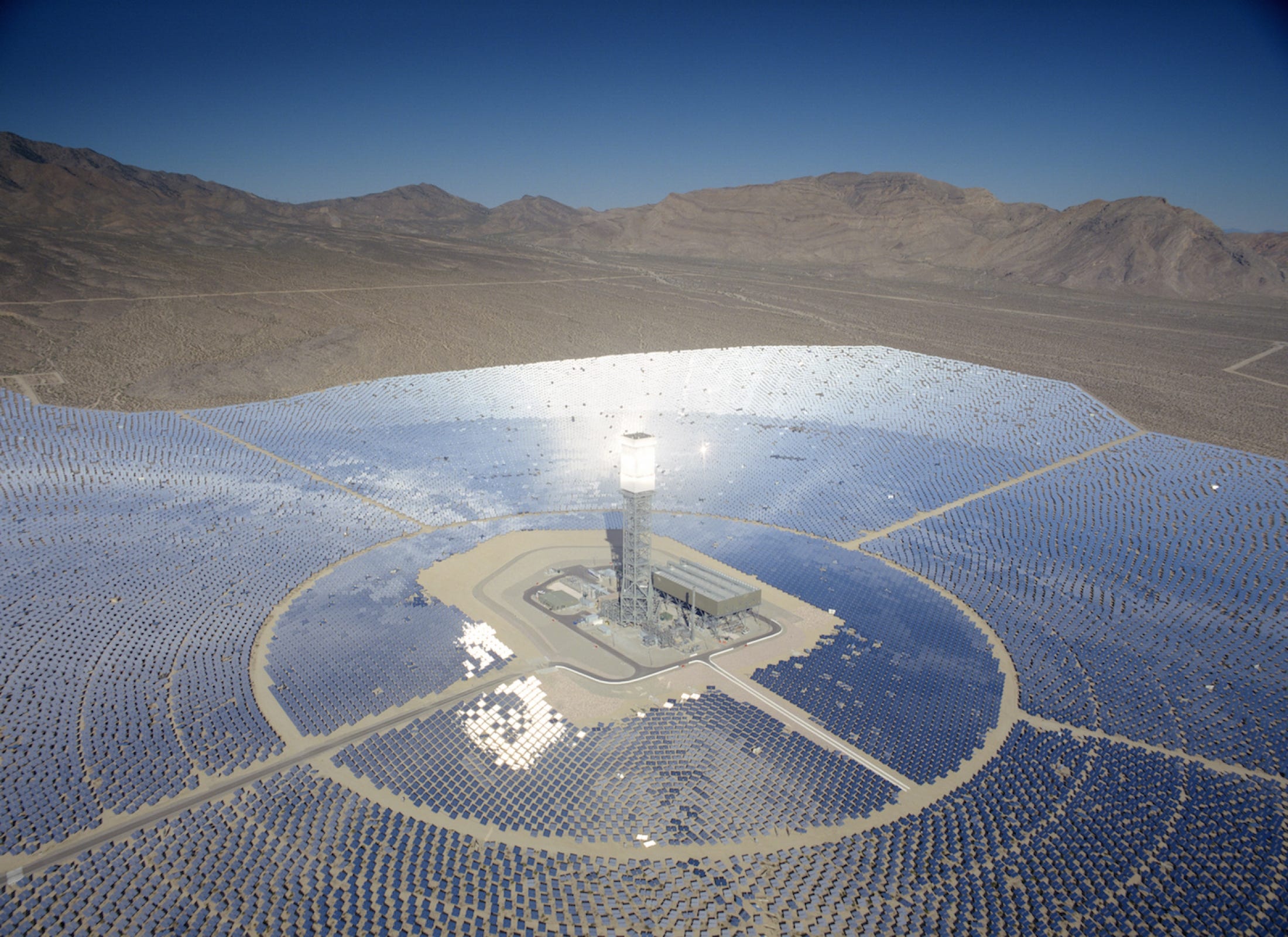
Google was the standard-bearer. As far back as 2007, its philanthropic arm launched a program called “Renewable Energy Cheaper than Coal,” pouring billions of dollars into clean energy startups like BrightSource Energy in an era when almost no one believed solar could compete on cost. In 2011, Google backed BrightSource’s Ivanpah project in the Mojave Desert with $168 million — a genuinely audacious bet on 170,000 mirrors focusing sunlight onto three towers, built to prove that solar thermal power could operate at utility scale. In the end, cheaper photovoltaic panels and batteries overtook the technology within a decade, and Ivanpah is now being decommissioned years ahead of schedule, its utility contracts cancelled because the power simply costs too much next to newer alternatives. That’s not a scandal — that’s what a genuine research bet looks like, some of them don’t pay off — and it’s part of a two-decade record that also includes real, durable wins: corporate solar and wind power-purchase agreements across multiple continents, a pledge to run on round-the-clock carbon-free energy, and, as recently as this year, a $20 billion tri-party partnership with Intersect Power and TPG Rise Climate to build new clean generation directly alongside new data centre campuses, with the first phase due online this year.
All of this progress is what makes what happened next so much harder to excuse. In 2023, buried in a sustainability report, Google quietly announced it was “no longer maintaining operational carbon neutrality.” Its emissions have risen by roughly 48% since 2019, and in 2024 alone its data centre electricity consumption grew by 27% year-on-year even as the company managed a 12% cut in data centre emissions through clean energy deals — a case study in efficiency gains being outrun by growth. Then, more quietly still, the net-zero headline vanished from Google’s own sustainability webpage entirely, restyled from a commitment into what one industry publication called “more of a moonshot than a guarantee.”
Microsoft’s story runs in parallel. Overall emissions up more than 23% since its 2020 baseline, driven almost entirely by the embodied carbon in the concrete, steel and silicon of new data centres and the electricity to run them — this from a company that had pledged to be carbon negative by 2030. Reports now suggest Microsoft is weighing whether to quietly scale back its most ambitious pledge of all: matching its electricity use with genuinely carbon-free power, every hour of every day, by decade’s end. Amazon’s emissions are up 58% over the same window it set its own carbon-neutral target.
Apple’s record is more complicated, and deserves to be treated that way. It has genuinely cut emissions by more than 60% since 2015, and its 2030 carbon-neutrality target is real and independently tracked. But the company has quietly dropped the ESG modifier that used to tie executive pay to those climate goals, its chief sustainability officer has since retired, and by Apple’s own admission the climate cost of its “Apple Intelligence” push remains unmeasured — an odd gap for a company that prides itself on measuring everything. New EU rules will force Apple to drop the term “carbon neutral” from its marketing outright in 2026, regardless of what it actually does operationally, because the label was judged to be doing more marketing work than climate work.
These are not small companies making earnest, underfunded attempts. These are the wealthiest, most technically capable organisations in human history, staffed by people routinely described as some of the smartest on the planet, telling the world they had this handled. Yet the moment a more profitable, more prestigious technology arrived, the commitments turned out to be a bunch of hot air.
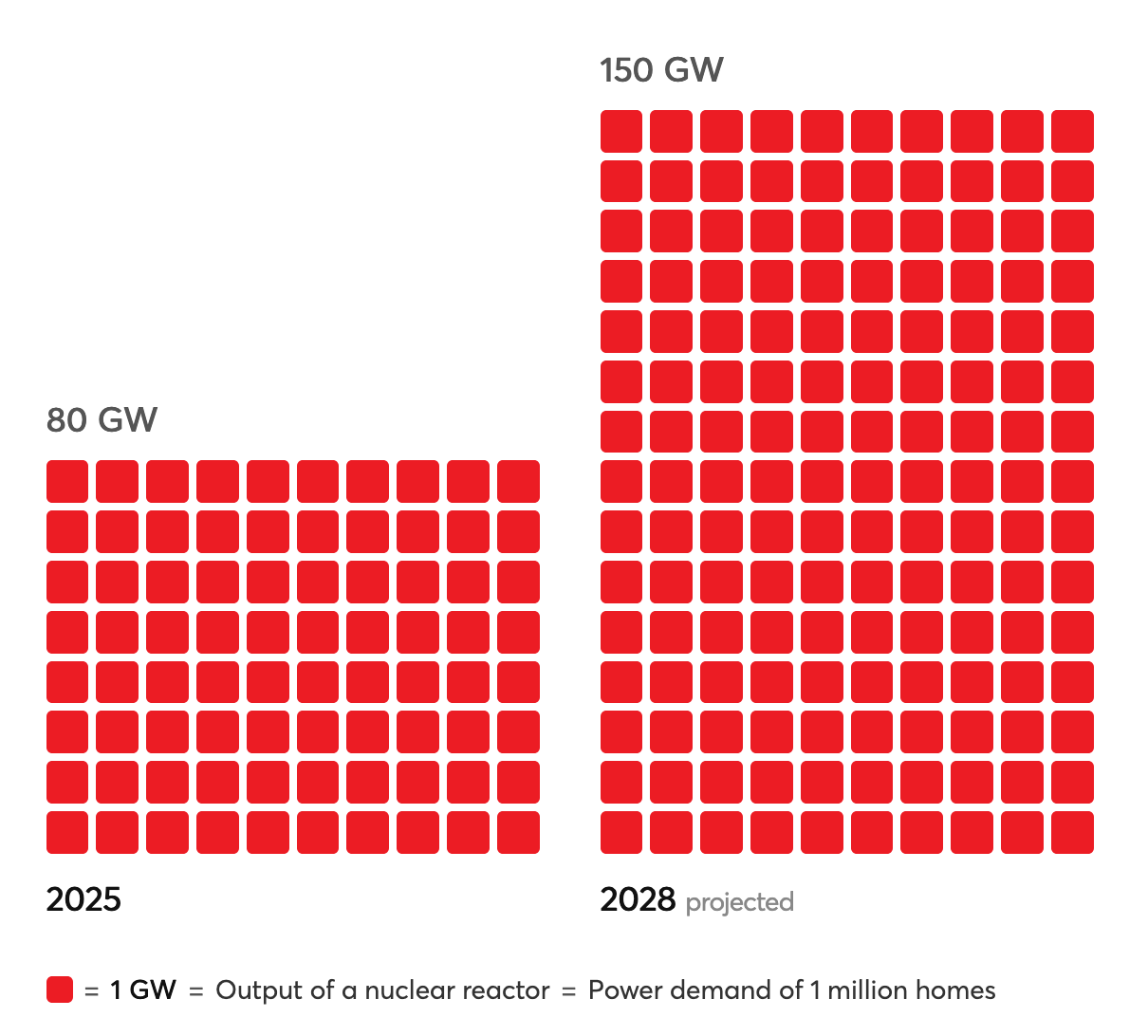
In 2025, global data centre electricity demand reached somewhere between 460 and 490 terawatt-hours. The International Energy Agency’s base case has that figure very close to doubling by 2030, hitting roughly 945 terawatt-hours — climbing further to around 1,200 terawatt-hours by 2035 — which the IEA itself describes as slightly more than the entire current electricity consumption of Japan, a country of 124 million people. And AI isn’t just riding that growth, it’s the reason for almost all of it: electricity demand from AI-focused data centres specifically surged by around 50% in a single year, 2025, while overall data centre demand grew a comparatively modest 17%. Major AI providers reported a threefold increase in active users and a fivefold increase in revenue over the same period — the kind of exponential curve that makes every projection written six months ago look conservative by the time it’s published.
The emissions attached to that demand are following the same trajectory. Electricity-related emissions from data centres are expected to climb from roughly 180 million tonnes of CO2 today to somewhere between 300 and 500 million tonnes by 2035, depending on how aggressively the buildout continues. At the moment, data centres are still a modest slice of the global total energy consumption, around 1% of electricity demand and 0.5% of emissions. What matters isn’t the current share — it’s that data centres are now one of the very few sectors on Earth where emissions are still rising while almost everything else is being asked, correctly, to fall.
And this is not evenly spread, it is landing hard in specific places, right now. In the US state of Virginia, data centres already consume more than a quarter of all electricity generated in the state. In Ireland, the figure is around a fifth of national demand today, projected by the IEA to reach nearly a third within the next year or two. US data centre electricity use, roughly 4% of the national total as recently as 2023, is projected by the Lawrence Berkeley National Laboratory to reach 7–12% by 2028 — an entire additional slice of a nation’s grid, conjured in under half a decade, to run servers most of the public will never see and can’t opt out of living near.
John Steinbach has lived in his home in Manassas, Virginia for nearly forty years. In January this year his electricity bill arrived at $281 — nearly triple what he’d paid the month before, with nothing in his household changed. He isn’t alone, and he isn’t imagining a connection. Virginia is now home to roughly 600 data centres, with another hundred-plus proposed or under construction, and the state’s own legislative watchdog has warned that residential customers could increasingly be left picking up the tab for grid infrastructure built to feed them. Areas with heavy data-centre concentration have seen wholesale electricity prices climb by as much as 267% over five years. Nearly three-quarters of Virginia voters now blame data centres for their rising power bills. This isn’t confined to one state, either — Pennsylvania, New Jersey, Maryland, Ohio, West Virginia, west Texas and eastern North Carolina are all flagged by grid analysts as next in line for the same squeeze, with regional power prices projected to rise by as much as 57% by 2030 in the most exposed markets.
And that’s before we even get to water — a genuinely separate crisis running in parallel, with the largest hyperscale campuses drawing on local supplies for cooling in places that can least afford to lose it, a story that deserves its own reckoning entirely.
Here’s why this matters beyond Virginia: these facilities are being sited everywhere, chasing cheap land, cheap power and compliant regulators, and more than 300 pieces of state legislation have already been filed this year trying to catch up with a boom nobody planned for. If you don’t live near a data centre yet, that’s a description of your near future, not a reason for comfort. The industry isn’t asking permission to arrive in your town. It’s simply arriving.
In 2010, I was researching a documentary into renewable energy technology breakthroughs when I found myself genuinely startled by what was already happening — not in a distant future, but in progress, right then, across the world. Communities running entirely on renewables. Battery chemistries that would make the grid genuinely flexible. The coming collapse in the cost of solar, already visible in the data if you knew where to look. The more I looked, the more I found, and the more I found, the clearer it became that this wasn’t a fringe experiment. It was a revolution, and it was extraordinarily well documented — filmmakers all over the world had been quietly building an archive of it, one carefully researched, hard-won film at a time.
That research became the seed of the Transitions Film Festival. I chose the name deliberately, for its double meaning: “transition” was already the word the renewable energy movement used to describe the shift away from fossil fuels, but it’s also a cinematic term — the move from one scene to the next, the cut that carries you somewhere new. That felt exactly right for what I wanted the festival to do: take a collection of scenes most people hadn’t been shown yet, and cut them together into something the audience couldn’t unsee. A decade ago, all of that still read as hopeful speculation to most people who watched it. It wasn’t. It was a preview.
The numbers now are extraordinary. Global renewable capacity additions hit a record 800 gigawatts in 2025 — the twenty-third consecutive year renewables have set a new expansion record. Solar alone passed 600 gigawatts of new capacity in a single year, more than three-quarters of all new renewable build worldwide, with thirty countries each installing over a gigawatt in twelve months. Wind additions jumped nearly 40% globally. By the IEA’s own reckoning, renewables were set to overtake coal as the world’s single largest source of electricity generation by the end of 2025 or by mid-2026 at the latest — a genuine changing of the guard in how humanity powers itself, achieved not through sacrifice but because solar and wind are now, in most of the world, simply the cheapest electricity available.

This is the Clean Industrial Revolution — call it the fourth industrial revolution if you like the framing — and it has been under way for two decades, quietly, doggedly, funded and engineered by people who never stopped believing the physics could be made to work in our favour. It is real, it is deployed, and it is still accelerating. This is not a hypothetical future we’re waiting on. It’s an industry that already exists, already employs millions of people, and is already larger than most of the fossil fuel sector it’s replacing.
The reason why it never quite feels like enough is because it’s still very much a work in progress. Each of these innovations arrive as a gigawatt figure in an IEA report, a percentage point in a footnote, a plant switched on somewhere you’ll never visit. Revolutions built out of twenty-three consecutive years of incremental record-breaking don’t generate the same attention as a single dramatic disaster, even when the incremental thing is, in aggregate, one of the most consequential technological shifts our species has ever pulled off. We already knew what this was for. We had the proof of concept, the falling costs, the exponential curves, running for two decades in plain sight. It’s the kind of thing that makes me optimistic about the future.
What we didn’t expect was a multi-trillion-dollar industry about to plug directly into the grid without first asking whether the electrons it draws are clean ones. That’s the problem now sitting on top of decades of hard-won progress.
Does the arrival of AI mean that all of our progress is going to become redundant? Not entirely, because AI is not sitting idle on the problem. There are people working on the solutions, and they are using AI to help them. It’s just mostly outside the headlines of your social media algorithm and has become almost invisible in the public as a result. Do a bit more research and there’s a lot happening behind the scenes.
Let’s start with materials science. AI’s pattern-recognition capabilities are now being turned on the problem of finding better battery chemistries and superconductors — screening thousands of candidate crystal structures computationally, at a speed and scale no human research team could match, before handing the most promising few to physical labs to synthesise and test. This is exactly the kind of brute-force search-and-filter problem machine learning is built for, and it’s already compressing years of trial-and-error into months.
Then there’s the nuclear pivot. Google has signed what’s believed to be the first corporate agreement in the US to develop a fleet of small modular reactors, backing Kairos Power’s molten-salt-cooled design for up to seven reactors and 500 megawatts, with the first unit targeted for 2030. Amazon has led a $500 million funding round for X-energy’s gas-cooled reactor design and separately committed more than $20 billion to converting its Susquehanna site into a nuclear-powered AI campus. Microsoft has signed a twenty-year deal to restart a reactor at Three Mile Island — not the unit involved in the 1979 accident, but its neighbour, shut down in 2019 for economic reasons and now being brought back specifically to power AI infrastructure. Meta has issued its own request for proposals seeking up to four gigawatts of new nuclear capacity and is working with Oklo on a 1.2-gigawatt “power campus” using small reactors whose waste heat will double as a cooling source for the data centre it feeds. None of this existed as a serious commercial category three years ago. It exists now because AI’s own electricity appetite forced it into being.
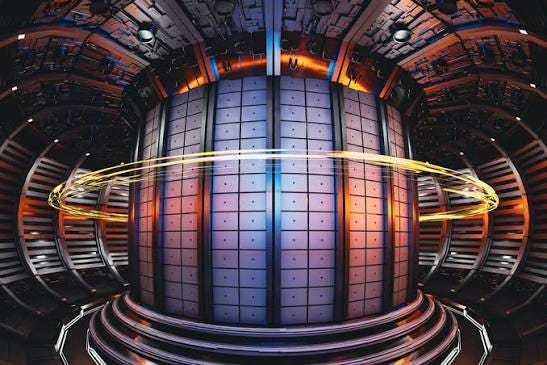
And then there’s fusion — which deserves to be treated with both excitement and tempered with skepticism. Fusion’s hardest remaining problem — holding a superheated plasma stable long enough to extract more energy than it took to create — has always been less a physics problem than a control and data problem, and control and data are exactly what modern AI is good at.
Google DeepMind spent years working with the Swiss Plasma Center to show that reinforcement learning could shape and stabilise plasma inside a tokamak, a feat that had resisted conventional engineering approaches for decades. That research has now graduated from a lab demonstration into an active partnership with Commonwealth Fusion Systems, the MIT spinout building the SPARC reactor, using a fast differentiable plasma simulator called TORAX paired with reinforcement-learning models trained on synthetic plasma data to find the most efficient path to net energy gain. Nvidia and Microsoft have also put money into Commonwealth Fusion, which tells you something about where at least part of the industry believes its own future has to come from. If it works then it will create clean, essentially limitless power, delivered because artificial intelligence finally cracked the hardest problem in ending it. The reality is that fusion has been the golden goose of clean energy for the better part of seventy years, the thing that’s always been “twenty years away,” the bet that generations of nuclear physicists and energy investors have made and re-made without a single watt of net-positive fusion power ever reaching a public grid. There is every reason to be wary of another round of “this time it’s different.”
All of this — the materials science, the reactors, the fusion bet — is proof that AI, pointed correctly, can operate at exactly the scale and speed this crisis requires. Which makes it all the more damning that AI’s overall development remains almost entirely unregulated, and almost entirely detached from the carbon-reduction commitments that a century of climate science has already told us are non-negotiable.
And herein lies the true potential of this technology, the thing that would let it truly prove itself to all of the skeptics. AI is, by its own industry’s telling, the most capable problem-solving technology our species has ever built. If it cannot be pointed at the literal survival of the biosphere that hosts it — if the smartest thing we’ve ever made can’t be bothered to help fix the one crisis a century of science has already fully diagnosed — then what the hell is it actually for? If not this, then what?
But there’s always a catch. AI is only as good and as useful as the people prompting it. Like a gun or a telescope, it does exactly what it’s pointed at, and nothing more than that. It has no independent will to go looking for the fusion breakthrough or the grid-scale battery if nobody with the money and the authority tells it to. If our political systems keep failing to regulate this industry, and if our cultural attention stays fixed on the next spectacle rather than the deteriorating physical world underneath all of it, then the extraordinary capability sitting inside these companies simply won’t be pointed at the right problem. It won’t compute the answer, because nobody in charge asked it the question.

In December 2015, the nations of the world gathered in Paris and signed a pledge to hold warming well below 2°C, and to pursue every effort to keep it under 1.5°C. It was, at the time, treated as historic: the moment humanity finally agreed, on paper, to do something about exactly this. This summer, the city that lent that agreement its name spent weeks with its Metro shut down, its roads buckling, its residents queuing for cooling centres, while the average national temperature broke a record set the year the Marshall Plan was still being drafted. The irony writes itself, and it isn’t subtle: the accord meant to prevent this is the one now watching it happen to its own namesake, a decade later, nowhere near on track.
Which brings me to the actual point of this essay. If artificial intelligence is the smartest machine humanity has ever built, why isn’t it being deployed to help meet the climate commitments the world already promised itself in this very city? And if it were, how much faster could it get us to the clean energy economy we already agreed, ten years ago, that we needed?
There is no coherent reason AI infrastructure — now drawing electricity on a scale that rivals mid-sized nations, and now visibly pushing up the power bills of people who never asked to live near it — should be held to a lower standard than a paper mill. If a technology’s own existence depends on an energy footprint the planet cannot absorb, and the companies building it have demonstrated, in writing, that they will abandon their own climate commitments the moment growth demands it, then self-regulation has already failed. What’s left is the tool every other industry has eventually had applied to it: make the licence conditional.
If AI companies will not make clean energy and net-negative infrastructure a hard, binding, board-level priority — not an aspiration but a condition of operation — they will lose the moral licence to build data centres at all. It’s the same logic we already apply to every other heavy industry that touches the shared atmosphere or the shared grid. We don’t let a chemical plant discharge into a river on the strength of a sustainability pledge; we require permits, audits, and enforceable limits, with the licence to operate contingent on compliance.
Artificial Intelligence will prove its potential only if it can deliver a better standard of living for humanity. In the age of climate change reality, that means that clean energy procurement needs to keeps pace with compute growth, the fusion and fission bets described above scaled up rather than treated as side projects, and AI’s own formidable capabilities pointed, deliberately and at scale, at the clean energy transition that was already under way before it arrived. A century of climate science has taught us that industries do not self-correct on a timeline the atmosphere, or a heatwave, can survive. They correct when the cost of not correcting exceeds the cost of correcting. Right now, for the AI industry, it plainly does not.
That’s the real barrier standing between AI and the revolutionary promise it claims for itself. Not model capability, not alignment, not even regulation in the abstract sense most people worry about. It’s energy — clean, abundant, genuinely carbon-negative energy, built at the same pace and with the same urgency as the compute it’s meant to power, and pointed there deliberately by the people holding the controls. Clear that barrier, and AI has a real claim to being the most revolutionary and positive technology of its era — not because it wrote better emails or generated mind blowing computer graphics, but because it helped our species finally finish the practical work of saving the only atmosphere it has.
Unless we clear that hurdle, then all the “productivity gains”, the breathless keynote demos by tech bros, and the trillion-dollar valuations — are just more noise, generated by people that could have been solving the one problem that actually mattered.
Perhaps that’s part of why so many people already distrust a technology sold to them as the most transformative of our time: it was promised as revolutionary while the one genuinely civilisation-scale problem sitting in front of it goes largely untouched.
Honestly, what greater test could there be for the most powerful machines we’ve ever built?
If not this, then what?
No posts
Comments
Nothing yet. Say the first thing.
Sign in to join the conversation.