
In early 2024, I made a conscious decision that I feel validated about now. I didn’t want to watch Alex Garland’s “Civil War” because, in the frayed-nerve times leading up to the presidential election in this country, I already felt overwhelmed and flamed out and annoyed about being a citizen in this shit show. . But I knew that a better time to watch that film would be later.
And I appreciate the film more by giving it (and myself) space, from the kind of in-the-moment reaction it was likely to get then — and got in spades — to a not-less-fraught time right now, but one that at least avoids the embers of a hot take.

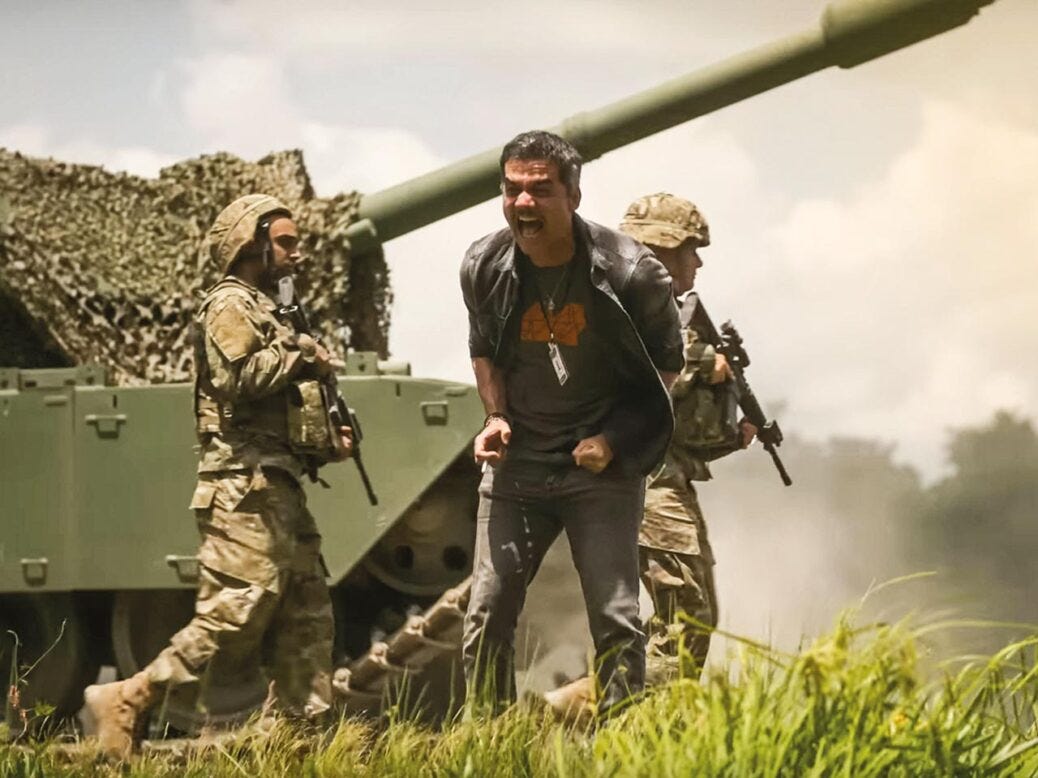
Before that, how about a sharp corner pivot to a film I’d argue got lost in its gloss, its remake ties and its own erratic but entertaining leanings — Edgar Wright’s 2025 film, “The Running Man” — and say it might be the better reflection of modern America?
Not a better film, but maybe a sharper vivisection of our battered, beleaguered and failing country.
Which wasn’t what I was expecting.
Other than films which are straight-up depictions of war, like the Ray Mendoza/Alex Garland co-directed “Warfare” in 2025, and others of that kind, four relatively recent films all seem to successfully and differently reflect back the modern American image of this country — “One Battle After Another,” (2025), “Eddington,” (2025), “Civil War,” (2025) and, yes, “The Running Man,” (2025).
Let’s start with the last one, the least expected one.
If Wright wasn’t attached to direct the remake, I probably wouldn’t have circled back to it after being completely disinterested in experiencing it after the trailers and then a lot of “meh” reviews. Remakes aren’t my thing — are they anyone’s thing? There might have been a wee bit of saturation of Glen Powell in the zeitgeist of my own picky mind, and the over-the-top aspect of it, recalling less the original than, say, something like “The Hunger Games,” put me off.
That’s not the film I experienced. Yes, it was over the top, but it had some glory in that effort, immediately conjuring up a line from a great song by Okkervil River:
“This film we once saw/Was reviled for its flaws/But its flaws/Are what made us have fun.”
Exactly.
A little bit removed from the oh god not a remake of it all, and calculating the films’ weaknesses, it’s hard not to come away thinking that maybe Wright and co-writer Michael Bacall — and of course Stephen King’s 1982 book — kind of effortlessly balanced the snark and cynicism and ridiculousness of our gluttonous country, surprisingly well.

Maybe expecting less from it, and gleefully leaning into Powell’s all-in performance, plus a surprising amount of funnier than you’d think elements (particularly those involving Michael Cera and Colman Domingo, both respectively excellent), make “The Running Man” underrated. I have it on my Letterboxd board as 3.5 stars, and that’s probably more than I was expecting.
As for sending up our American culture — greed, violence, exceptionalism, television, etc. — it’s more like four stars. It also happens to be massively fun, laced with adrenaline (after it gets going) and the kind of movie you watch when you’re tired of looking for something else. Because that’s when it sneaks up on you.
“Civil War” is the better film, I doubt anyone will question, but I would argue it’s also a better film than maybe a lot of people thought when they watched it in the spring and summer heat of a shit-filled American election. Given a couple of years’ space, “Civil War” is looking like it fits just fine in the same breath as “One Battle After Another” and “Eddington.”
I loved those films, and I don’t always love Garland’s films, so that’s something.

The latter films, while vastly different, spoke to counter-culture threads and smartly spoofed divisions, not just between political parties, but how people view the world and where it’s headed. They were thrilling and funny without waving their Big Statement banners, weaving interpretive layers of meaning and intent into what is essentially a black and white, you vs. me, red vs. blue, yell-fest of our current divide.
You get more richness from creative stories that wrap around issues than you do from blockbuster movies about Issues. It’s not rocket science; it’s art. But isn’t that a lot harder to pull off when you call your movie “Civil War”?
I certainly think so.
Especially when it comes out roughly seven months before that election. And, unlike the other three films discussed here, “Civil War” walks directly and intentionally into a partisan world, eager to tell a partisan story.
My guess is Garland’s “Civil War” will grow in appreciation as it ages. Even with that ending, (which I would counter-argue is merely the culmination in a linear story that isn’t much interested in variance or surprise, so it fits); even accepting that there were missed opportunities and lots improbability; and even if it might be accused of cynically trying to find box-office in “our situation” without enough distance for reflection.
Though it wasn’t a film I wanted to see in the moment of its release, Garland tackling our national divide as it happens seems less opportunistic to me now and more like a filmmaker doing what he or she should be doing — putting a lens on the moment, “documenting” a story without making it a documentary, as it smartly uses journalists as heroes when they are currently seen as villains, as enemies of the state. It seems the exact right approach at the exact right time, even though I wanted no part of it then.
If you avoided “Civil War” for similar reasons, take a look at it now. This film is visceral in a grittier way than Garland normally is known for (minus “Warfare”), and where parts of the story are less than some might have hoped, you might find, as I did, that the bulk of the films is more than expected, and is primed to rise in stature over time.
The Times Are Tough Summer Sale

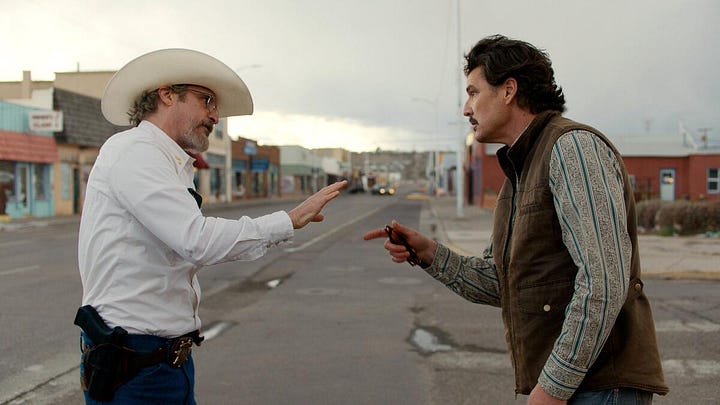

All told, I think these four films — “Civil War,” “The Running Man,” “Eddington” and “One Battle After Another,” are indicative of filmmakers, especially in the last two years, not waiting (or flinching) as they seek to hold up a mirror to this country, in a historically crucial moment of self-definition.
That’s encouraging. It doesn’t happen in every era.
Comments
Nothing yet. Say the first thing.
Sign in to join the conversation.