
Fourth District Republican Club and First Monday’s SC runoff forum gives Upstate voters something more useful than another political cage match: a chance to hear how two Republicans would actually govern.

Political campaigns are usually very good at telling voters whom to fear, whom to blame and whose name to remember on Election Day. They are not always as good at explaining and proving what a candidate intends to do after winning.
Monday's Senate forum in Greenville was different.
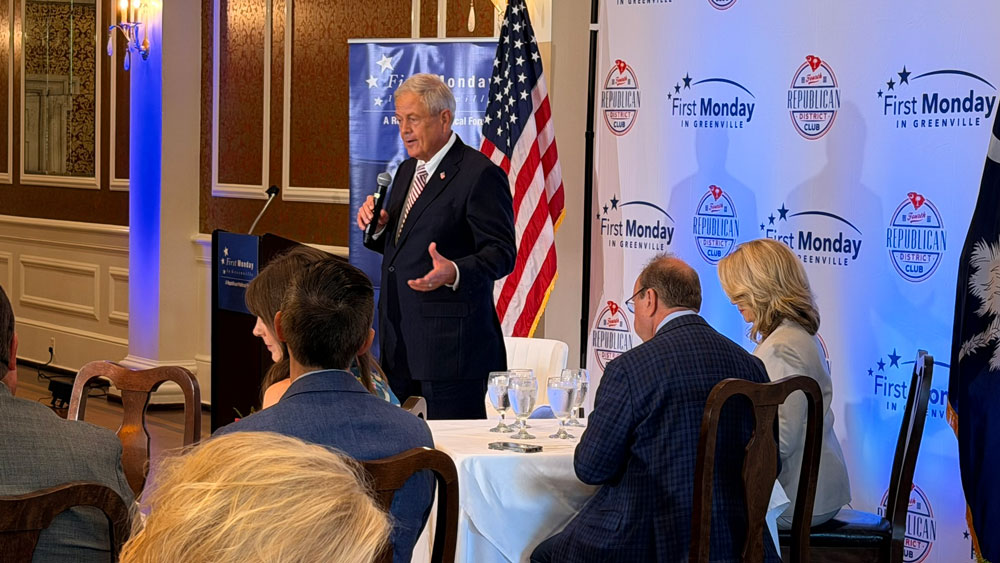
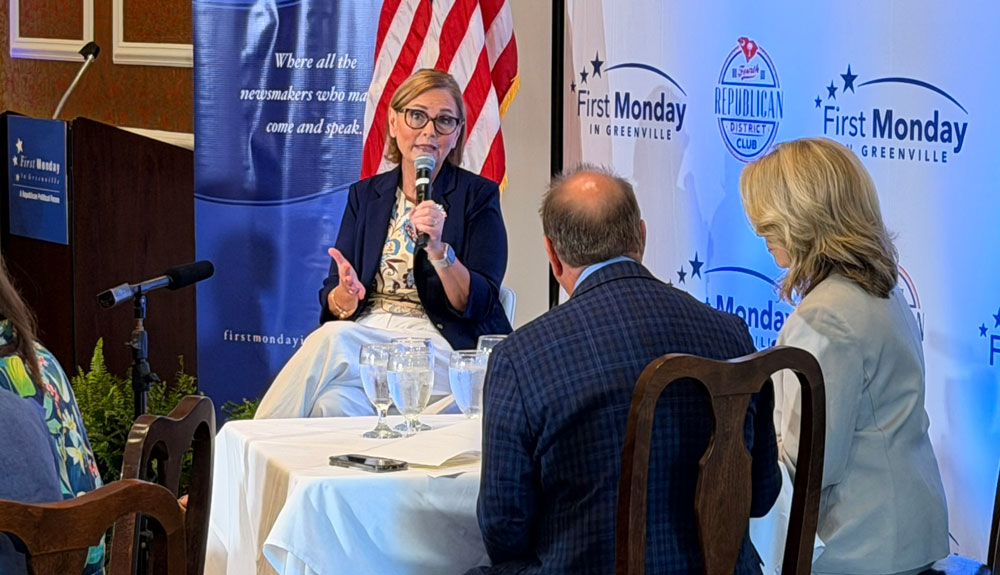
With South Carolina Republicans only days away from choosing between U.S. Sen. Darline Graham and U.S. Rep. Ralph Norman in the August 25 Republican runoff, the Fourth District Republican Club and First Monday in Greenville essentially turned the luncheon into a job interview. There were no podium-to-podium attacks, no candidates talking over one another and no television-style race to manufacture the afternoon's most viral moment. Graham appeared first, Norman followed, and moderators WYFF News anchor Jane Robelot and 98.9 FM talk show host Joey Hudson spent their time asking about what senators eventually have to deal with after the campaign signs come down: spending, war, China, energy, immigration, Social Security, veterans and the everyday business of representing South Carolinians.
The candidates did not receive identical questions, so the forum was not a debate in the traditional sense. In some ways, however, that made the differences more interesting. South Carolina voters are interviewing two Republicans for the same job, but Graham and Norman brought noticeably different résumés into the room.
And sometimes a résumé tells you as much about how somebody thinks as it does about where somebody has actually worked.
Graham: Government Through the Eyes of Those It Serves
Graham's unusual path to the Senate is impossible to separate from her campaign. She was appointed by Gov. Henry McMaster in July following the death of her brother, longtime U.S. Sen. Lindsey Graham, and became the first woman to represent South Carolina in the U.S. Senate. Before that appointment, her career was primarily in state government and vocational rehabilitation rather than elective politics. She most recently led the South Carolina Commission for the Blind, where she had served as commissioner since 2019, and was president-elect of the National Council of State Agencies for the Blind at the time of her Senate appointment.
That became an important part of her argument Monday.
When questioned about her relative lack of elected experience, Graham did not pretend otherwise. Instead, she pointed to roughly 30 years of public service, including seven years leading a state agency, and argued that political longevity should not be the only qualification for the Senate.
Her broader message throughout the forum was consistent. Graham repeatedly returned to the people on the receiving end of government decisions.
She talked about growing up with financial struggles. She spoke about the value of work and wages. She described helping South Carolinians with disabilities move into employment and away from dependence upon benefits. When Social Security came up, the issue became personal. Graham recalled that she and Lindsey relied upon Social Security after their parents died and noted that an elderly aunt still depends upon the program.
Her emphasis was not simply on balancing Washington's books, but on remembering the people whose lives are represented by the numbers in those books. That distinction would appear several times during the forum.
Norman: Government Through the Eyes of the Ledger
Norman came to the same job interview carrying a different résumé.
The Fifth District congressman repeatedly referenced more than four decades in business and his experience in Congress. When the discussion turned to spending, Norman sounded less like an administrator explaining a government program and more like a businessman examining an invoice.
That was particularly apparent when he was challenged on earmarks.
The question was not theoretical. Lindsey Graham used congressionally directed spending to help secure money for major South Carolina projects, including the Port of Charleston. Norman has been an opponent of earmarks, but a senator represents an entire state. Would he continue bringing federal money home?
Norman said he would support an investment such as the port because of its economic importance, but insisted that expenditures should be scrutinized for return on investment and for how much the recipient has put into the project.
Then he returned to what may be the central theme of his campaign: the national debt.
Norman called the debt the country's biggest crisis and argued that Congress cannot continue spending without offsets. He pointed to his resistance to portions of President Donald Trump's spending legislation as evidence that he is willing to challenge even his own political allies over money.
That answer produced one of the more revealing distinctions of the afternoon.
When “No” Means Telling Your Own Side No
Republican candidates routinely explain how strongly they support a Republican president. A more revealing question may be what happens when they disagree with him.
Both candidates were given an opportunity to answer that in different ways. For Graham, the issue was offshore drilling.
Asked whether she would oppose President Trump if she believed a policy was wrong for South Carolina, Graham immediately identified offshore drilling. She said protecting South Carolina's coast was important enough that she would oppose the president on the issue.
Norman's example was spending. He recalled being among a small group resisting provisions of Trump's major spending bill and described being called in by the president. Norman's account of the exchange was simple. When Trump asked what he was doing, Norman said he responded, “Mr. President, I'm making it better.”
The issues were different, but the answers provided voters with something campaign advertising often does not: a boundary.
For Graham, one boundary is protecting South Carolina's coast.
For Norman, one boundary is spending without sufficient offsets.
Whether voters agree with either boundary is their decision. At least the forum helped locate them.
Immigration, AI and the Problems Arriving at South Carolina's Door
Graham was particularly direct when the questioning turned to illegal immigration.
Asked about people who have lived illegally in the United States for years and whether she would support a pathway to citizenship, Graham rejected the premise. Her answer was essentially that if a person is in the country illegally, that person broke the law and should return.
“To me, it's very simple,” she said.
The discussion then moved toward another issue increasingly difficult for South Carolina to avoid: data centers and artificial intelligence.
Graham expressed concern about data centers being placed too close to residential communities and argued for community involvement, environmental protections and attention to the enormous power and water demands associated with such facilities. But she separated concerns about local development from the larger technological race. Artificial intelligence, she said, has national-security implications, and the United States cannot afford to lose that race.
Norman was not asked the same data-center question, but his broader position points in a similar direction with a different emphasis. He opposes government subsidies for data-center development, arguing that South Carolina's limited water and power resources must be protected and that large technology companies should pay their own way without shifting costs onto utility customers or nearby communities. At the same time, Norman strongly supports the United States winning the artificial intelligence race against China as a matter of national security, while favoring local control and fiscal restraint over centralized federal solutions.
Both candidates, however, treated China as a serious strategic concern. Graham tied the Chinese challenge to jobs, technology and America's ability to remain ahead. Norman went further into Chinese land ownership, technology and Chinese influence in American higher education, recounting his objections to Chinese government-backed Confucius Institute programs and raising concerns about Chinese students gaining access to sensitive American knowledge through U.S. colleges.
Different questions. Similar warning lights.
Peace Through Strength, But What Happens After “Strength”?
When it came to foreign policy, both embraced the familiar Republican principle of “peace through strength.” Graham emphasized a strong military and the deterrent effect of American power. She described Iran and China as serious threats and argued that a stronger United States makes adversaries less likely to act.
But the question was pushed one step further: What test would she use before voting to put American men and women on the ground in combat?
Graham responded by emphasizing her deep respect for military service and for the men and women willing to put their lives at risk for the country. She referred to her brother's 33 years of military service and his commitment to serving the country and protecting veterans, leaving the specific threshold she would use in making such a decision less clearly defined.
Norman received essentially the same question later. He referenced congressional authority involving extended military deployments, said he would rely heavily upon military commanders and defined peace through strength as maintaining a strong military while possessing “the courage to use it.”
On Israel, Norman was equally direct. He described Israel as America's democratic ally in the Middle East and said he would continue supporting it. He also defended previous votes against Israel aid packages by arguing that his objection concerned the absence of spending offsets, not opposition to Israel.
Graham likewise strongly supports Israel and advocates continued legislative aid to strengthen the U.S.-Israel alliance. Following her appointment in July 2026 to succeed her late brother, she pledged to continue his legacy as a staunch ally of Israel.
Foreign policy is one of the areas where Lindsey Graham built a national reputation. The senator South Carolina voters ultimately choose will face many of the same weighty decisions involving war, sanctions, military appropriations and America's alliances. Those decisions are considerably harder than saying one supports a strong military.
The Kitchen Table Versus the Balance Sheet
Perhaps the clearest difference between Graham and Norman was not ideological at all. It was the direction from which they approached the same economic problem.
Graham approached affordability from the kitchen table.
She spoke about families living paycheck to paycheck, people without sufficient savings to absorb an emergency and the need to bring good-paying jobs back to the United States. She connected controlling inflation with cutting federal waste, growing the economy and increasing employment.
Norman approached the economy from the balance sheet.
He talked about debt, offsets, regulation, return on investment and the burden government places on businesses. He described regulations weighing down businesses across South Carolina and pointed specifically to costs affecting restaurants and other employers.
Neither approach excludes the other. Government spending ultimately lands on somebody's kitchen table, and a family's grocery bill eventually lands on somebody's balance sheet.
But the difference in emphasis was hard to miss.
Graham's case to voters increasingly emphasizes understanding what happens when government fails the people who depend upon it.
Norman's case emphasizes understanding what happens when government spends money it does not have and how that cost eventually lands at the taxpayers' feet.
That may be the most useful distinction to come out of the entire forum.
The Part of a Senator's Job Nobody Puts on a Bumper Sticker
For all the discussion about China, Iran, tariffs and trillion-dollar budgets, both candidates eventually arrived at something far less glamorous: answering the telephone.
Constituent service rarely makes national news, but for a South Carolinian waiting months on a Social Security matter, veterans claim, passport or federal agency problem, it may be the only part of a senator's work that matters. A senator can have influence in Washington, but representation also means remaining accessible to the people back home.
Graham said she was grateful that members of Lindsey Graham's experienced constituent-services operation would remain with her and pointed to the team's history of helping South Carolinians navigate Social Security, passports and other federal matters.
Norman likewise said constituent service would be part of the legacy he wanted to leave. He pointed to his Fifth District operation, saying his office answers calls, connects people with agencies and follows individual cases.
It was one of the afternoon's strongest areas of agreement. Both candidates understood that accessibility is part of the job.
Apparently, even in Washington, sometimes governing still comes down to somebody picking up the phone.
Nuclear Power, Tariffs and Norman's Business Lens
Norman's portion of the forum spent considerably more time on energy and trade.
He described nuclear power as central to South Carolina's energy future and warned that continued population and industrial growth will require reliable electricity. He also raised questions about Santee Cooper, the electric grid and whether taxpayers should be expected to absorb poorly scrutinized energy costs.
Asked whether Trump's tariffs could interfere with international nuclear-energy partnerships, Norman stood by the president's reciprocal tariff policy. He acknowledged that tariffs can affect prices but argued that American producers should not be disadvantaged by countries imposing unequal trade barriers. He also pointed to exemptions for products that cannot readily be sourced domestically.
Again, the businessman's vocabulary surfaced with words such as price, investment, regulation, return and competition.
Graham was not asked the same tariff or nuclear questions, so the forum did not provide a direct comparison on those issues. Outside the forum, however, she has expressed support for President Trump's use of tariffs as an economic and geopolitical tool and has backed his firm position that Iran must not be allowed to acquire nuclear weapons.
Two Candidates, One Conservative Electorate
There were plenty of reminders that this remains a Republican runoff.
Graham emphasized her pro-life position, opposition to DEI, opposition to biological males competing in women's sports and support for President Trump's immigration agenda. She said she had already co-sponsored seven measures related to abortion and taxpayer funding.
Norman emphasized border security, fiscal conservatism, support for Israel, business deregulation and congressional term limits. His congressional record also identifies him as strongly pro-life and supportive of stricter border enforcement, although those issues were not explored with him in the same way during this forum.
Norman, who has represented South Carolina's 5th Congressional District since 2017, also reiterated his longstanding support for congressional term limits, describing his proposal as three terms in the House and two in the Senate. His proposed constitutional amendment would apply those limits prospectively, meaning terms served before ratification would not count.
In previous public statements, Norman has also described three House terms as a starting point for negotiations, acknowledging that congressional experience has value and that the final number could be adjusted. Asked at Monday's forum whether Congress would ever willingly vote to limit its own careers, he acknowledged the political difficulty but argued lawmakers should continue forcing the issue.
Both candidates presented themselves as conservatives broadly aligned with President Trump's agenda, but the forum provided voters an opportunity to look beyond those shared political labels and listen to the priorities each candidate chose to emphasize.
That is where their different experiences, governing approaches and résumés began speaking for themselves.
A Forum That Let the Candidates Finish a Sentence
There was another winner Monday that will never appear on the August 25 ballot: the format itself.
Although heated debates and chaotic forums often make headlines and draw attention, the Fourth District Republican Club and First Monday in Greenville managed to produce something increasingly unusual in American politics. They put candidates in front of voters, gave experienced moderators room to ask substantive questions and follow-ups, and then allowed the candidates enough time to reveal not simply their positions but occasionally the thought processes behind those positions.
There was humor. There were uncomfortable questions. There were answers that landed cleanly and others that probably created additional questions. That is what a useful political forum should do.
Sometimes democracy runs on a very strict lunch schedule. But voters in attendance left with considerably more than just a campaign brochure.
Same Job. Two Résumés.
South Carolina Republicans now have a choice that cannot be reduced very well to a campaign slogan.
Darline Graham brings the résumé of a longtime state administrator who talks naturally about the people at the receiving end of government. Her political identity is still being formed in public, but her emphasis on affordability, Social Security, employment, constituent service and the practical effects of government reflects the career she had before suddenly entering the United States Senate.
Ralph Norman brings the résumé of a businessman and experienced congressman who instinctively asks what something costs, where the money is coming from, whether there is an offset and what taxpayers receive in return. His emphasis on debt, spending, energy, regulation and congressional accountability reflects both his business career and his years in the U.S. House.
There is considerable overlap between them. There are also questions the forum did not settle, and voters deserve those blanks filled before Election Day.
But perhaps that is the real accomplishment of Monday's event. The Fourth District Republican Club and First Monday did not tell Republicans which candidate should get the job. They did something considerably more useful.
They conducted the interview.
On August 25, the hiring committee is the Republican electorate of South Carolina.
And after all the speeches, endorsements, commercials and campaign mailers have been tossed aside, voters may want to remember one simple distinction:
Campaigns are applications. Governing is the job.
Comments
Nothing yet. Say the first thing.
Sign in to join the conversation.