
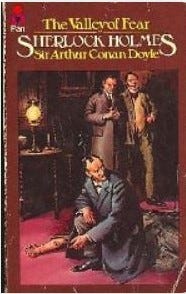
Like A Study In Scarlet, The Valley of Fear is pretty much two books in one--the first half is Holmes solving a complex murder case. The second half is an extended flashback to give us the complicated background for the crime. As in A Study in Scarlet, the flashback story is by itself a cracking good adventure story. This time, Doyle writes what can be seen as an early prototype of the hard-boiled detective novel later perfected by Hammett and Chandler. Set in a remote mining town in the American West, it's a tale of violent crime and corruption with a nifty twist ending. The first half is classic Holmes as he looks into a brutal murder that ends up being tied into the events in America, deducing what happened from the starting point of "why is there only one dumbbell?" We also get a nice example of how effectively Doyle gives Holmes' world real weight, so that we can easily think of it as real. Holmes teams up with a Scotland Yard detective named MacDonald. It is "Mr. Mac's" only appearance in the Canon, but Watson has this to say about him: "Those were the early days at the end of the ’80’s, when Alec MacDonald was far from having attained the national fame which he has now achieved." That one sentence does indeed give weight to the world of Sherlock Holmes, giving it a tangible history. I only wish we had seen more of MacDonald. (Though I wouldn't be surprised if he's turned up in Holmes' pastiches.) There's also a nifty meta aspect to the story. Though written in 1914, the novel is a flashback to the days when Professor Moriarty was the king of crime in London. Watson is fully aware of who Moriarty is. But WAIT! In "The Final Problem," in which Moriarty is killed and his network of crime broken up, Watson did NOT know who he was! Holmes had to explain it all to him. Well, Sherlockian scholars have long since come up with explanations for this. The most reasonable-the one I choose to believe is "true"-is that Watson did indeed know about Moriarty for years. But Holmes asked him not to ever mention the professor in his accounts of Holmes' cases. This was to protect Watson from Moriarty's wrath, prevent Moriarty from learning that Holmes knew about him, and also not give Moriarty (not yet proven to be a criminal) an excuse to file a libel suit against Holmes and Watson. So when Moriarty was killed and Watson was free to write about him, he used a little bit of literary license, inserting a conversation about the professor he had actually had years earlier into the events of "The Final Problem." This was simply the best way to effectively provide this exposition to his readers. So that explains it. Holmes' world continues to have both weight and internal consistency. So we can all continue to easily believe that Holmes was a real person and the Canon is an accurate history of his detective work. I, at least, choose to believe this. Holmes merely fiction? Pfui, I say! He was real. He was. I refuse to consider any other possibility.
No posts
Comments
Nothing yet. Say the first thing.
Sign in to join the conversation.