
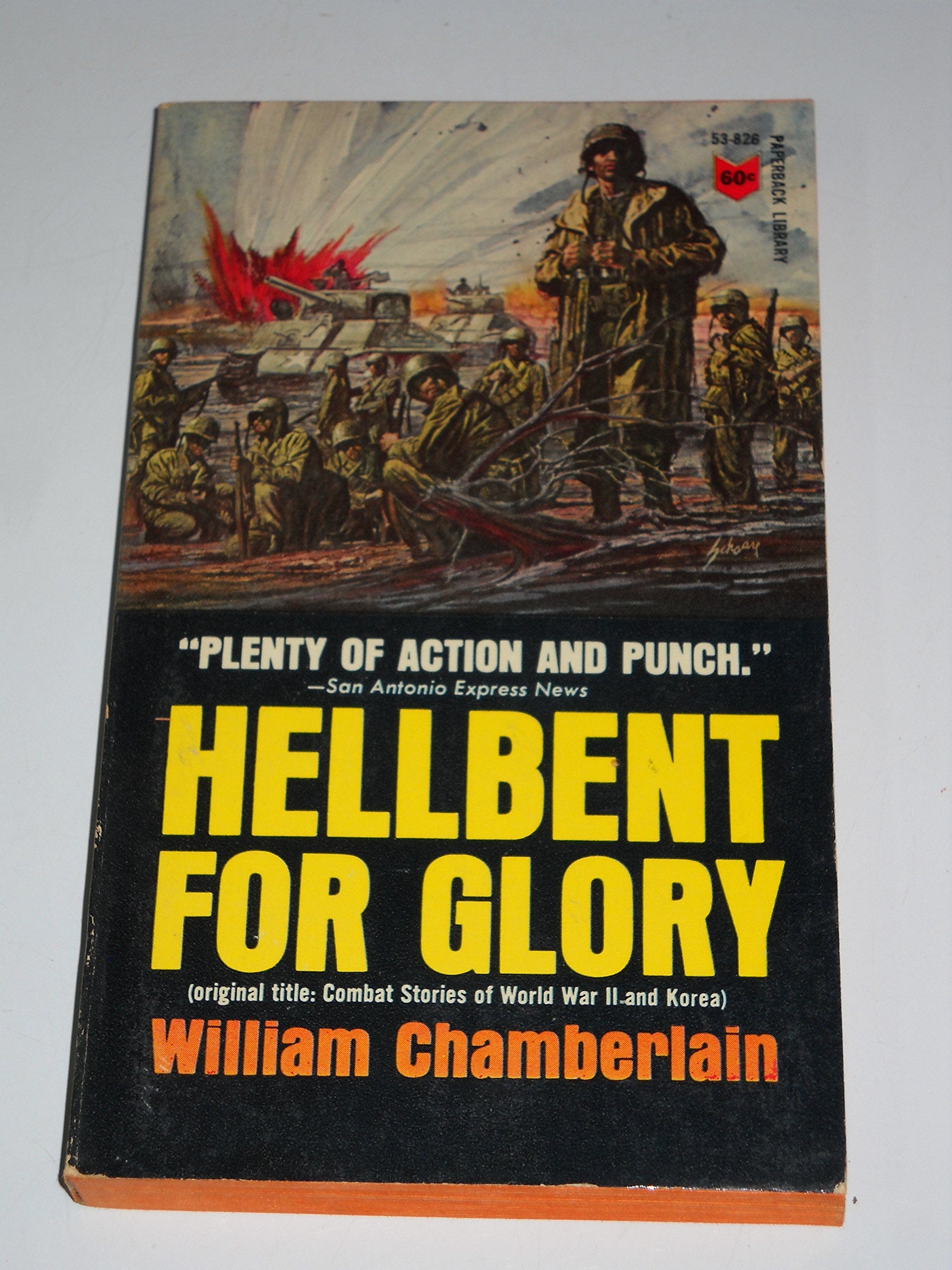
One of two anthologies that reprinted William Chamberlain’s superb war stories originally printed in the Saturday Evening Post in the 1950s and early 1960s.
The other volume-”The Zone of Sudden Death”--concentrated mostly on WW2 tales, with one Korean War story tossed in at the end. This volume is more of a mix. There are 5 WW2 stories and 4 set in Korea.
All are excellent. With a few exceptions, Chamberlain’s protagonists are officers in command positions. He does repeat general themes, with officers new to units or young or not yet experienced having to earn the trust of their men. But his clear prose, straightforward storytelling and strong characterizations give each story a unique feel.
“The Sacrificed Regiment” is set in North Africa and involves the commander of a tank regiment who must take his men and machines on a very dangerous mission to save a larger American unit.
“The Caterwauling Company” features a newly appointed company commander who teaches his men to voice the Rebel Yell when fighting and uses this to increase morale.
“Engineers Don’t Fight” is about a new officer who is given a dangerous assignment. He’s an engineer and his dad taught him that engineers don’t quit. He takes this to heart as he overcomes a series of obstacles, but then discovers his dad might have been wrong about one thing: Engineers do have to at least occasionally fight.
“The Lost Company” is about an armored unit trapped on a hill behind German lines during the Battle of the Bulge.
“Combat Cook” is one of the few stories not starring an officer. A cook is drafted and wants to fight, but is sent to cook school instead. But he eventually discovers that there is value in what he does.
“The Chaplain of Company C” and “The Trapped Battalion” are both Korean War stories about units retreating from the enemy, trying to get back to their own lines. Both are great stories, though it’s in these tales that Chamberlain tries to inject a little romance by including (in one case) a Red Cross nurse and (in the other) a woman who had been running an orphanage. The romance doesn’t detract from the stories, but it is arguable whether it adds anything. In terms of action, though the premises are similar, the stories both unfold in unique ways.
“Star Over Korea” involves the sailors on a landing craft transporting a squad of infantry to an island to round up some escaped POWs. Things go wrong, but it is Christmas Eve and there seems to be a star they can follow to get to safety.
“The Vengeance of Yat Chuen” is about a group of American soldiers and a Korean lady who escape from a POW camp. With little food, weapons with only a few rounds of ammo, and a wounded companion, the odds of getting home seem low. This one also has a dollop of romance, but it seems to a more natural part of the story than in the previous examples.
I would have to say that this volume isn’t quite as strong as “The Zone of Sudden Death,” but I wouldn’t want to live on the difference. It’s still excellent storytelling.
No posts
Comments
Nothing yet. Say the first thing.
Sign in to join the conversation.