
Important: Before considering any investments, please ensure you understand what to expect.
Here’s a way to make yourself unpopular: Try to convince people to get out of the market because we’re in a bubble. I’ve been doing that for almost a year now and, let me tell you, it works.
If you listened to me, you have since lost about 7% on TUI instead of gaining almost 22% with a simple, broad index ETF like the ACWI - not to mention direct investments in AI stocks. It feels like climbing the stairs to the 20th floor while everyone else is having a party in the elevator, rising quickly and effortlessly to the top.
For my rebuttal, I will hand it over to Warren Buffett: Everything I would like to tell you about the current market environment is in this 1999 Forbes article. Like this comparison of the dot-com hype to the early euphoria in the car industry:
“Well, I thought it would be instructive to go back and look at a couple of industries that transformed this country much earlier in this century: automobiles and aviation. Take automobiles first: I have here one page, out of 70 in total, of car and truck manufacturers that have operated in this country. At one time, there was a Berkshire car and an Omaha car. Naturally I noticed those. But there was also a telephone book of others. All told, there appear to have been at least 2,000 car makes, in an industry that had an incredible impact on people's lives. If you had foreseen in the early days of cars how this industry would develop, you would have said, ‘Here is the road to riches.’ So what did we progress to by the 1990s? After corporate carnage that never let up, we came down to three U.S. car companies-themselves no lollapaloozas for investors. So here is an industry that had an enormous impact on America-and also an enormous impact, though not the anticipated one, on investors.”
As value investors, we want to be fearful when others are greedy. That means reading about financial history when others are listening to podcasts about AI. Buffett’s article is a great place to start, and so are Howard Marks’ essays or his favorite, very short book: A Short History of Financial Euphoria. Here’s the blurb:
“As markets and economies around the world face meltdown, one man can sit back and say ‘I told you so!’. Galbraith looks at the sobering lessons from history in his witty essay A SHORT HISTORY OF FINANCIAL EUPHORIA. From ‘Tulipomania’ in 1636 to Black Monday in 1987 and numerous examples in between, he illustrates the unbroken cycle of boom and bust which we are experiencing again today. How can people be so willing to get caught up in the mania of speculation when history tells us that a collapse is almost inevitable? In this wise essay, Galbraith reviews the major speculative episodes of the last three centuries, drawing important lessons on speculative economics and demonstrates that money and intelligence are not necessarily linked.”
You don’t have to become a historian, but if there’s a highly recommended book out there that explains the last 400 years of financial history, plus an article by the world’s greatest investor that was published four months before the dot-com bubble burst - it seems almost irresponsible to participate in the stock market without having read them. The audiobook takes just two hours!
Here’s what I understood after looking at past cycles of boom and bust: Unwarranted euphoria can turn into unwarranted panic in no time, and there’s no way to predict when it will happen. That’s why hype is so dangerous. It’s not enough to be right about how AI will change our lives. It might not even be enough to be able to pick the winners: Amazon crashed 90% during the dot-com bubble and it took roughly 10 years to reach its pre-crash price.
The lesson here is not to steer clear of great companies in rapidly growing industries. It is to steer clear of hype. There will come a time when the next Amazon will be dirt cheap. It will most likely be an AI company and it might be the investment of a lifetime. But current prices are too risky.
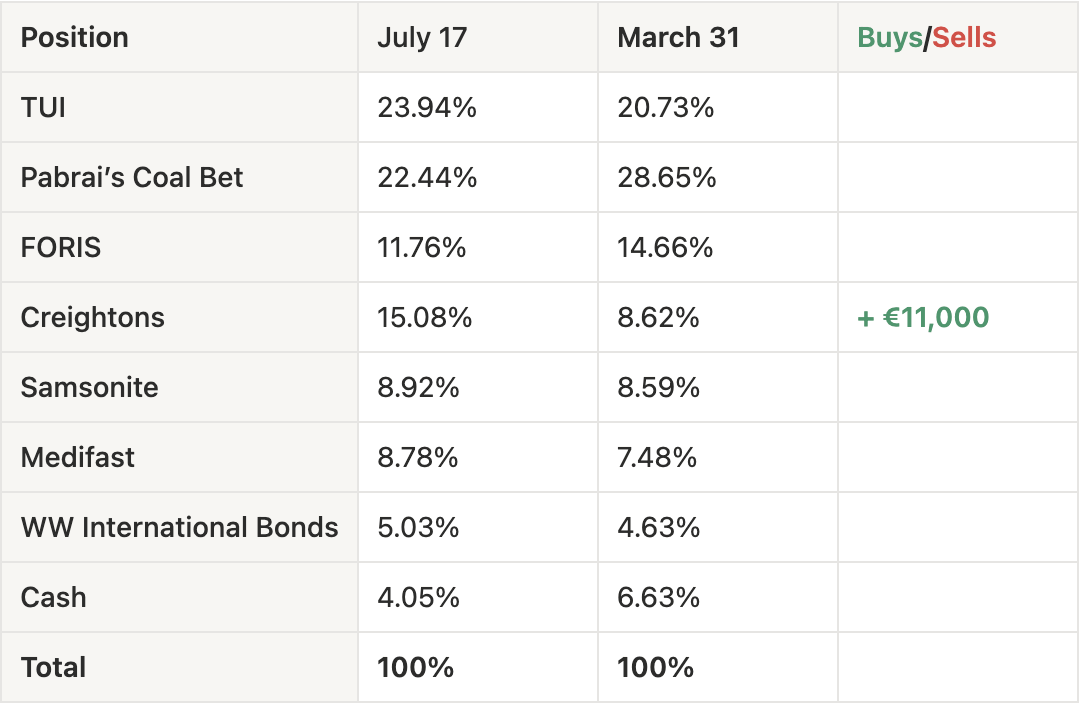
The alternative? Boring companies. Look where it’s ugly - which brings me to my mostly unchanged portfolio. Placing just six bets and holding each for at least a year does not invite a lot of movement per se, but my recent inactivity is also due to the fact that it’s hard for me to find something I like better than my current bets. Good companies are really expensive; cheap companies often have too high a probability of going to zero. Here’s one example:
I followed the planned merger of Getty Images and Shutterstock very closely, but decided against investing. It was the right decision as the deal fell through. In the aftermath, Shutterstock dropped to an enterprise value of just $430m, which is just 4x normalized owner earnings (pre-tax) with a dividend yield of 19%.
The company is not highly leveraged and it doesn’t look risky from a quantitative perspective. It definitely clears my hurdle rate (I mean, just the dividend return alone matches it). But I just can’t bring myself to invest in a stock image company right now. There’s a real possibility this business gets destroyed by AI. That’s not a “heads I win, tails I don’t lose much” scenario, so I’m out.
As I only write analyses on companies I invest in, my Substack is currently really boring. But I never promised you an interesting Substack. I promised you everything you need to mirror my performance - for whatever that’s worth.
This is my current portfolio - and your starting point, if you want to mirror my performance going forward. For details, see “How To Use”. Paid subscribers receive live updates on all transactions.
Let me know if you have any questions.
No posts
Comments
Nothing yet. Say the first thing.
Sign in to join the conversation.