
Hello.
You are reading Understanding TikTok. My name is Marcus. For a couple of days I have been chewing on a bunch of thoughts circling around generative AI content on the platform. Because we are still lacking the right tools to observe, analyse and interpret endless arrays of slop – low-quality content mass-produced using generative AI, created to farm engagement, affect emotions and normalize ideas.
Yet it was a presumably ai-generated manifesto on a scamming website called slopmaxxxing1 no longer accessible that finally tied it all together. But first it was cheese.
I met my old friend Sylvia for a drink a couple of days ago. She holds a phd in romance languages and literature. And while we were ordering a plate of cheese she started citing Julia Kristeva who in the 1960s argued that no text exists in isolation: any text is constructed as a mosaic of quotations; any text is the absorption and transformation of another. Which according to Barthes leads to the death of the author, not the actual person, yet the author as the owner and origin of meaning.

A text for Barthes is a tissue of quotations drawn from countless points of culture — not the original outpouring of a single genius, but a weaving-together of language that already existed.
Yes, that does sound like the job your AI-chatbot is doing all the time. That is why this line of thinking called intertextuality is “a valuable lens for understanding how generative AI outputs are created through the assemblage of digital and multimodal texts from vast datasets” (Tang, 2025).Human entering the loop
Tang does something interesting. He says that a paragraph from a chatbot is just a statistically probable string of words until a human enters the loop. It becomes a meaningful text only because a person imbues it with meaning. So meaning isn’t produced by the machine; it’s co-constructed between human and machine. And the human is present at both ends. At the front, the prompter “textualizes” their experience into the prompt — the prompt isn’t bare words, it’s the product of a real person in a real situation, so their context (even the language they think in) flows into what comes out.

Right after reading that, I could see it in action. The author was leaking. The video I saw was rather dull. An AI generated xenophobic propaganda video that has unfortunately become the norm on feeds by now: “Scandal in Germany! An Iranian at the children’s playground!”. What struck me was the inconsistent usage of broken German. Words that did not really match or make sense as if a non-native speaker had prompted left an eery and uncanny feel.The author is leaking
On the receiving end we can observe how the video actually works, because it never once argues. It doesn’t try to convince you that the AI generated man drinking a ridiculous large bottle of beer is dangerous, or that these strange blond children are at risk. It just borrows. It borrows the authority of a news broadcast — with a blue banner, a bold type, and an urgent AI voice — so your eye files it as fact before you’ve decided anything at all. And it borrows a story you’ve already heard a hundred times: “the foreigner” as a threat to “our” children. If you take away everything you’re meant to recognise like the news look and the familiar plot, then there is nothing left but a man on a bench and a huge bottle. The whole “scandal” lives in the perceived references.
Surely, I did feel clever thinking I’m not being fooled here guys. The critic Johannes Franzen has a name for that flicker — the ai ick. Franzen argues this is hardening into an entire way of reading — a hermeneutics of suspicion, where is this ai? now runs quietly underneath everything we watch, a permanent background hum of doubt. It even sorts us: the good reader is the one who can smell the machine, the bad reader the one who can’t.AI Ick Detector
The ick is a detector wired to a single question: real or fake, human or machine. And detecting the fake often feels like enough, a small hit of “done” that tempts you to scroll on before the harder reading has even started. And a feed is built, end to end, to keep you scrolling before the harder reading starts. Catching that something is fake, it turns out, is not the same as refusing what it says.
Aidan Walker has a name for the infrastructure underneath this. He calls it Cuck Internet Theory: the idea that the internet is no longer really for or about us, but has turned the human into a relay point between automated systems. His sharpest formulation is almost too clean — all you need is a computer, another computer, and a human who can make the computers kiss. Your outrage at the propaganda clip, your screenshot, your angry comment: that’s you making the computers kiss. You were matchmaking.Dominant logic of public communication
And now the machine doesn’t care what you think — only that you engage. So ask what kind of content best feeds the machine, and you arrive at what Ilan Manor has been describing. He calls it synthetic intertextuality, and his claim is that it has quietly become the dominant logic of public communication: the default grammar of how things circulate and persuade.
The political damage isn’t a side effect of the system; it’s what the system optimises for. It rewards content that flattens a tangled world into one villain, one hero and one set of innocents. It rewards content that travels on outrage and fear. It rewards content that brands a whole group with a single image, until “the Iranian” is a character before he is ever a person. And it rewards content that splits the world into us and them and quietly deletes the boring, complicated middle where actual politics has to happen.Make it. Maxxx it. Faced with all of it, you’d assume the only response is to fight — detect harder, debunk louder, refuse. And then I finally read the thing that had been nagging me from the start: the manifesto on that scrappy scam site, the one that quietly tied everything together. It doesn’t want you to fight. It wants you to join.
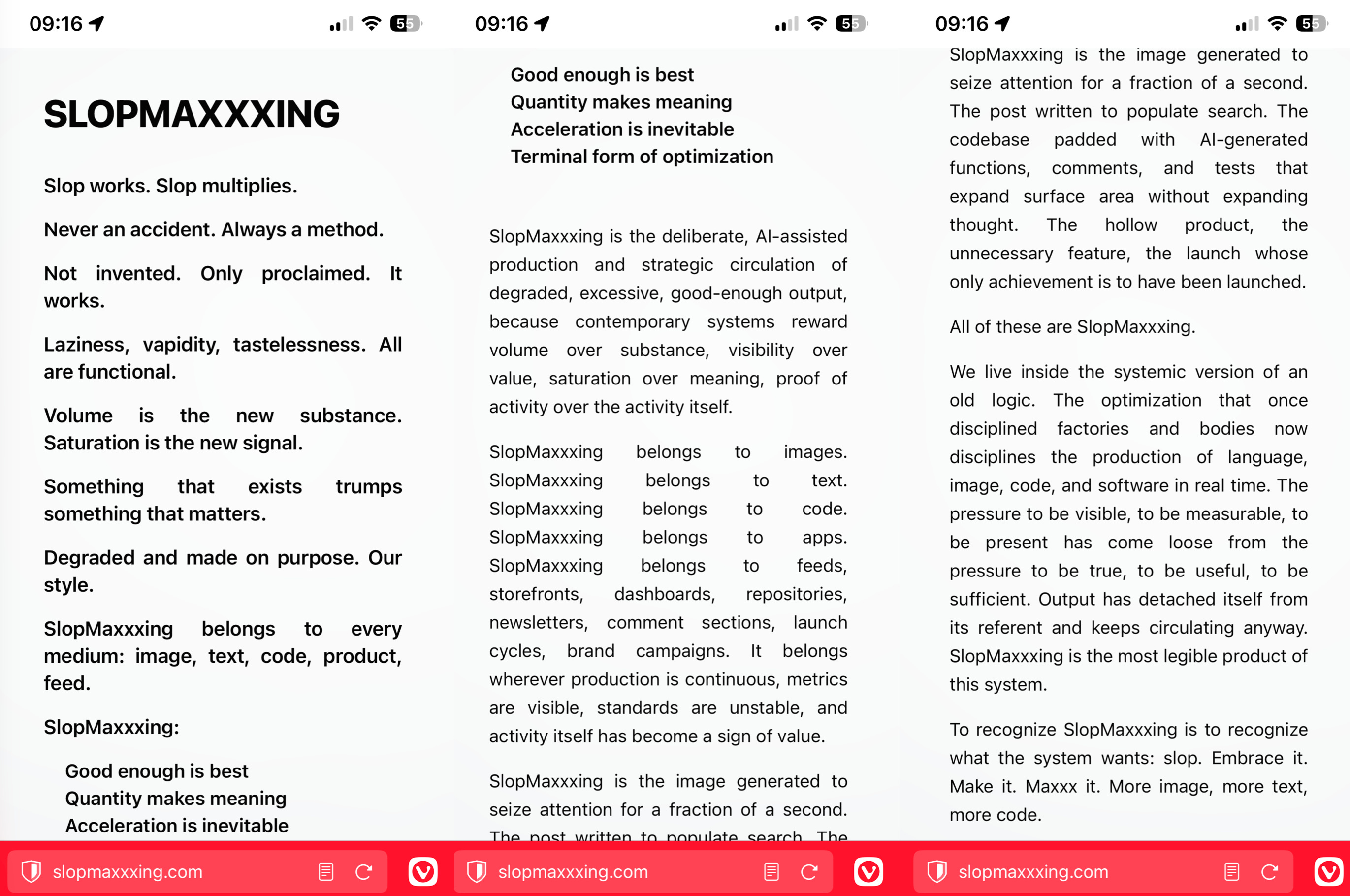
The site is called SlopMaxxxing, and it reads like a creed. Slop works. Slop multiplies. Volume is the new substance. Something that exists trumps something that matters. Its pitch is simple, and after everything above, horribly hard to wave off: the system rewards slop, so stop pretending you’re above it and make some. Embrace it. Make it. Maxxx it. Degraded on purpose. More image, more text, more code. Just like this very text that you are reading now.
Yet here i am. Writing this text. And there are you. Reading this text. We are in this text. Together with all the people mentioned above. And way more. People. Just like the scammer that set up the manifesto-website and included malware and links to porno-website. And the person who asked a generative AI to come up with a propaganda video. Let’s all have a plate of cheese. We should invite Julia Kristeva. She is still alive. And so are we. Typing ourselves into the machine.
What else? I am in Berlin next week to discuss postdigital propaganda at UdK and talk Slop at HIIG. Come to my sweet melody. Thanks for reading! If you want to support me, please send the text to a person who might be interested.

SlopMaxxxing is the deliberate, AI-assisted production and strategic circulation of degraded, excessive, good-enough output, because contemporary systems reward volume over substance, visibility over value, saturation over meaning, proof of activity over the activity itself.
Comments
Nothing yet. Say the first thing.
Sign in to join the conversation.