
Growth is often celebrated as proof that a company is doing something right.
Revenue climbs. Headcount expands. New markets open. Customers arrive faster than anyone expected.
From the outside, it looks like success.
Inside the business, however, rapid growth introduces a very different challenge. The systems that helped the company reach this point suddenly begin to strain. Communication becomes harder. Decisions slow down. Teams start pulling in different directions. Before leaders realize it, the organization itself has become the constraint.
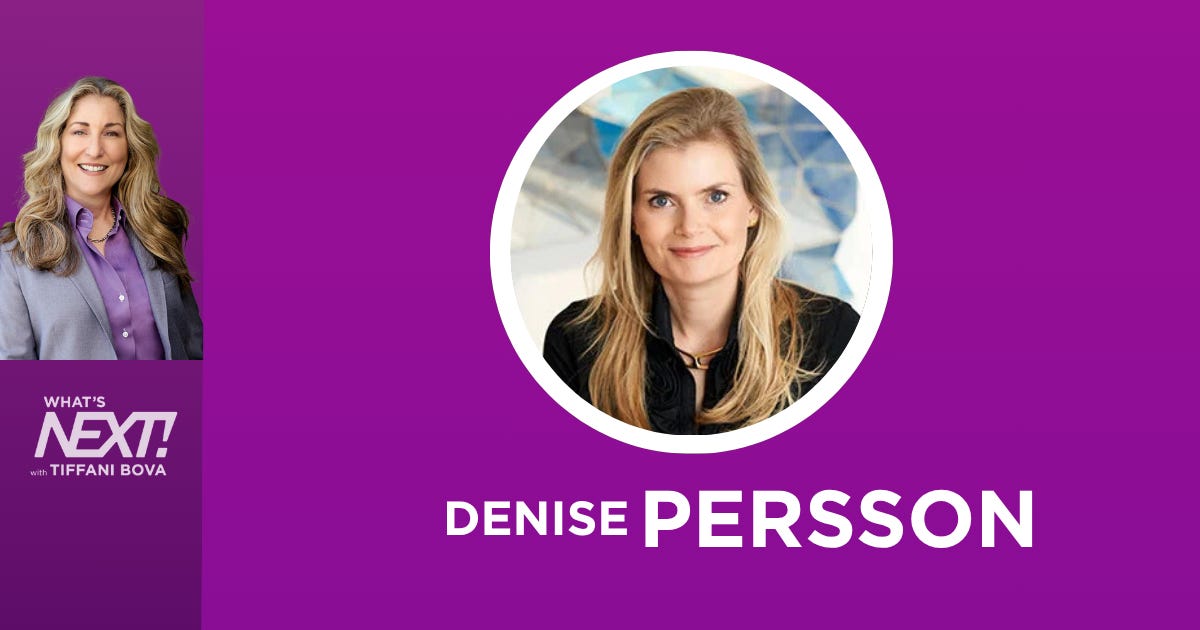
That was one of the biggest takeaways from my conversation with Denise Persson, Chief Marketing Officer at Snowflake. We talked about what it takes to lead through extraordinary growth, and why scaling a business requires much more than hiring faster or selling more.
Hypergrowth doesn’t simply test strategy.
It tests alignment.
Apple Podcasts: https://podcasts.apple.com/us/podcast/the-discipline-behind-hypergrowth-with-denise-persson/id1262213009?i=1000772264261
Spotify:
Many companies assume growth will naturally bring clarity.
It often does the opposite.
As organizations expand, new teams interpret the strategy differently. Messaging evolves independently across regions. Sales develops one story while marketing tells another. Customer success hears concerns that never make it back to product.
None of these problems happen overnight.
They accumulate.
Denise talked about the importance of maintaining a consistent narrative as Snowflake grew. Rather than constantly reinventing the company’s story, the focus remained on helping customers clearly understand what Snowflake solved and why it mattered. That consistency created trust while giving the business room to evolve.
Customers don’t need a new story every quarter.
They need confidence that you understand theirs.
One lesson I have learned throughout my career is that companies often become fascinated by their own innovation.
Customers rarely are.
Organizations love talking about features, platforms, architectures, and roadmaps.
Customers simply want to know whether you can solve their problem.
Denise described how Snowflake initially anchored itself in language customers already understood before expanding into a broader platform narrative as adoption increased. Rather than asking customers to learn an entirely new category, they met customers where they were.
That approach applies to every business.
Instead of asking:
“How do we explain everything we do?”
Ask:
“What is the one problem customers immediately recognize?”
Clarity almost always wins.
Marketing can create awareness.
Advertising can generate attention.
Neither creates credibility on its own.
The companies that scale most efficiently often benefit from something much harder to manufacture: customers who willingly tell other customers about their experience.
Denise shared how Snowflake reached a point where customer advocacy became one of the company’s greatest growth accelerators. When customers consistently achieved value, they became trusted voices in the market.
That raises an important question.
If your marketing budget disappeared tomorrow, how many customers would continue telling your story?
Those are the voices competitors can’t easily replicate.
Every new hire influences culture.
Every new manager shapes expectations.
Every new executive reinforces, or weakens, the operating principles of the company.
As growth accelerates, leadership decisions carry even greater consequences.
Denise spoke about hiring leaders who could scale not only their own teams but also the culture of the organization. Skills matter. Experience matters. The ability to build trust across functions matters just as much.
Culture doesn’t disappear during hypergrowth.
It becomes easier to dilute.
That’s why hiring should never be viewed simply as filling open roles.
Every hire either strengthens alignment or creates another point of friction.
One part of our conversation particularly resonated with me because it reflects something I’ve believed for years.
Sales and marketing shouldn’t measure different definitions of success.
When one team celebrates lead volume while another is accountable for revenue, tension becomes inevitable.
Denise explained that Snowflake shifted marketing’s accountability toward business outcomes, including qualified customer meetings and pipeline creation, rather than isolated marketing metrics.
That kind of alignment changes conversations.
Instead of debating attribution models, teams begin solving customer problems together.
A few questions every leadership team should regularly ask:
Do sales and marketing define success the same way?
Are incentives encouraging collaboration or competition?
Would every customer-facing team describe your value proposition the same way?
Alignment isn’t a meeting.
It’s an operating system.
Every executive conversation eventually arrives at AI.
For good reason.
The opportunities are enormous.
But Denise offered an important reminder.
AI is only as good as the information feeding it.
Organizations with fragmented customer data create fragmented customer experiences.
Organizations with reliable, connected data create faster decisions, stronger personalization, and better business outcomes.
Before asking how AI will transform your organization, ask whether your data foundation is ready to support it.
Technology magnifies whatever already exists.
That applies to strengths.
It also applies to weaknesses.
As your organization grows, take time to evaluate whether the business is scaling as effectively as revenue.
Ask yourself:
Is our message becoming simpler or more complicated?
Are customers advocating for us without being asked?
Are our teams solving for shared business outcomes?
Is our culture becoming stronger as we add people?
Revenue may tell you how fast you’re growing.
Those answers tell you whether your organization can sustain it.
Hypergrowth creates incredible opportunity.
It also creates incredible pressure.
The organizations that navigate it best don’t simply hire faster or launch more products.
They become more disciplined.
More aligned.
More intentional about how every part of the business works together.
As Denise reminded me throughout our conversation, sustainable growth isn’t built by moving faster than everyone else.
It’s built by ensuring the entire organization is moving in the same direction.
If this resonated, share it with a leader preparing their organization for its next stage of growth. Scaling successfully isn’t just about building a bigger company. It’s about building one that stays aligned as it grows.

Tiffani Bova is Chief Strategy and Research Officer at The Futurum Group.
Ranked for the last six years in the Top 50 Business Thinkers in the world by Thinkers50, Tiffani Bova is a thought leader who Forbes says “reshapes our perception of growth.”
As both a practitioner and academic she offers a unique perspective and has helped lead the tech industry through several evolutions over her nearly 30-year career as Salesforce’s former Growth and Innovation Evangelist, and previously as a Distinguished Analyst and Research Fellow at Gartner and a sales, marketing and customer service executive for start-ups and Fortune 500 companies. She is the author of two Wall Street Journal bestsellers: GrowthIQ and The Experience Mindset.
No posts
Comments
Nothing yet. Say the first thing.
Sign in to join the conversation.