
A few years ago in Minneapolis, a mutual friend introduced me to a woman who shared many of my interests and views. We spent time together, did things as friends, and built a genuine connection. Then she left her Catholic parish for a new Catholic church, and something in her shifted. After she moved to a new church, everything changed.
I was raised Protestant in Minneapolis but had many Catholic friends and attended church services with them. I never saw one denomination as superior to another. I went to church to worship Jesus and never worried much about the rest.
After my friend moved to a new Catholic Church, however, she began harassing me almost daily. Her text messages and emails insisted that the Catholic Church was the one true Church, that the Pope was the only authority I should heed, and that if I did not recognize this I risked hell.
Her texts became more and more aggressive and hostile. At first I tried to debate with her or change the subject - but eventually it was so overwhelming I didn’t know what to do with it. At one point she made it sound like the Catholic Church predated Jesus Christ himself, as if He’d been born into it. When I asked what had changed, she said her Priest at her new church had taught her to understand the power of the Catholic Church and the papacy in a way her old parish never had — and that she was only trying to help me.
This went on for months. Eventually I told her I didn’t believe what she was saying, that Jesus is my church, not an institution, and that I couldn’t take the daily bullying from her anymore and to please leave me alone. We haven’t spoken since.
I hadn’t thought about any of that in a while — until I heard a sermon series on 1 Corinthians that brought it all back. I knew then that God wanted me to tell you this story about what “unity” really means to me.
One of my favorite pastors (yes, I go to many churches on purpose and watch different sermons online too) was preaching on how Paul wrote to the young church in Corinth, a congregation that was tearing itself apart into factions some 2000 years ago. The pastor was teaching from Paul’s letter to a young Christian community in Corinth that was fracturing into factions.
Paul’s central plea was that believers must not rally around human leaders but must unite under Jesus Christ alone.
Paul wrote that letter to the church of Corinth around 53–54 AD, barely two decades after the resurrection of Jesus Christ. Which means the forces working to divide the church weren’t a medieval problem, or a Reformation problem — they were there from the very beginning.
I want to be clear about what this newsletter is and isn’t. I don’t know Catholic doctrine well enough to argue it in detail, and this isn’t an attempt to bash the Catholic Church. It’s the opposite.
My point is that Catholics and Protestants need to stop treating each other as the enemy and unite under Jesus Christ — united we stand. But to make that case honestly, it’s worth actually walking through why the argument exists in the first place. Here’s what I learned.
What my friend told me wasn’t fringe — it’s apparently standard Roman Catholic doctrine, and it rests on a real passage: Matthew 16:18–19, where Jesus tells Simon,
“You are Peter, and on this rock I will build my church... I will give you the keys of the kingdom of heaven.”
The Catholic Church doesn’t view that passage as a metaphor. Catholics believe Jesus made Peter the first leader of the church. They believe every future Pope is also that leader. Peter became the first Bishop of Rome, and the Catholic Church says that his authority passes down through an unbroken line of successors to the pope sitting in Rome today.
Protestants have never accepted that reading. They point out that the original Greek words distinguish a small stone from the larger rock, and that the rock is Peter’s confession of faith in Jesus, not Peter himself.
The Catholic view is that Jesus gave Peter a special role to lead all believers. The Protestant view is that Jesus built the church on the truth that He is the Savior, not on one human leader.
As an American Christian conservative, I have a hard time believing that Pope Francis or the current Pope Leo (a friend of Obama) speak for Jesus Christ. They often appear to speak more for the ideas of atheist Karl Marx. But I digress…
Protestants use other parts of the Bible to argue against the idea that Peter was the unique leader of the entire church.
Jesus gave the same spiritual authority to all of His followers, not just to Peter.
Supporting Scripture: In Matthew 18:18, Jesus tells all the disciples that what they bind or loose on earth will be bound or loosed in heaven, using the exact same words He used with Peter earlier.
The New Testament shows that Peter did not have final, unquestioned control over the early Christians.
Supporting Scripture (Acts 15:13-19): At the first major church meeting in Jerusalem, James—not Peter—guided the final decision and issued the official decree.
Supporting Scripture (Galatians 2:11): Paul publicly corrected Peter to his face in the city of Antioch because Peter was acting hypocritically. Protestants argue a person with absolute, perfect authority would not be corrected this way.
For Protestants, the Bible itself is the highest authority, rather than a line of human leaders or Popes. They believe the “true church” is not an organization based in Rome. Instead, it is an invisible group made up of all true believers everywhere.
Supporting Scripture (2 Timothy 3:16): The Bible teaches that all Scripture is guided by God and is the ultimate standard for teaching and correcting.
Supporting Scripture (1 Corinthians 12:27): The Bible defines the church as the collective “body of Christ,” where every believer plays a part, rather than a single earthly hierarchy.
To recap, Protestants point out that the same authority given to Peter in Matthew 16 gets handed to all the disciples collectively two chapters later, in Matthew 18.
Protestants note that James, not Peter, presided over the Council of Jerusalem in Acts 15. They note that Paul publicly rebuked Peter to his face in Antioch for hypocrisy — hardly how you treat someone you believe holds a unique, infallible office.
Protestants believe that the one “true church” isn’t one visible institution headquartered in Rome — it’s the invisible body of every genuine believer, across every denomination, known fully only to God.
Here’s where it gets interesting, and where my pastor’s sermon hit me hard.
Corinth wasn’t a backwater. Corinth itself helps explain why those pressures were so intense. Corinth was a major Roman trade city sitting on a narrow isthmus between two seas and a magnet for merchants, freedmen, and transplants from across the empire, with a reputation for both prosperity and sexual deviancy. Sound familiar?
Corinth was a vital geographic hub because it sat on a narrow land bridge - the isthmus - that connected mainland Greece to the Peloponnese peninsula, while separating two bodies of water. This strategic position allowed the booming metropolis to control both overland travel and crucial maritime trade routes.
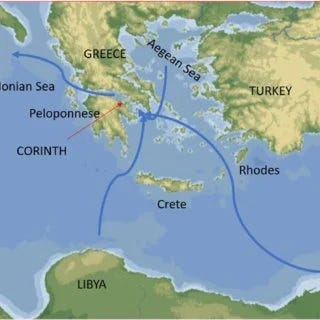
Julius Caesar refounded it as a Roman colony in 44 B.C.; by the mid-first century it was the capital of the province of Achaia and one of the wealthiest, most cosmopolitan cities in the eastern Mediterranean.
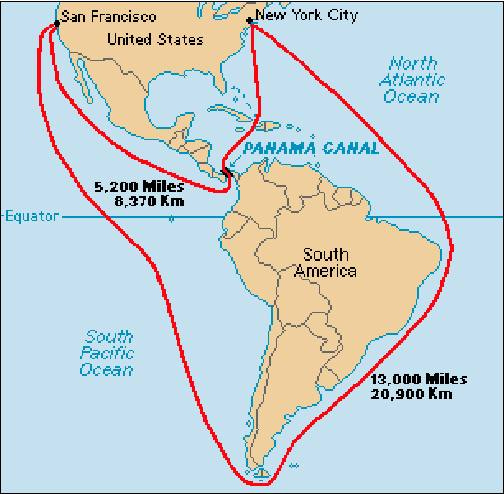
Corinth managed two major ports making it a fast-track shortcut for international commerce. Ships and cargo were dragged across the narrow strip of land on a paved stone trackway, letting merchants completely bypass the dangerous, stormy 200-mile sea voyage around the southern tip of the Peloponnese.
Geographically, the closest modern-day equivalent to ancient Corinth would be Panama which connects North and South America and bridges trade between the Atlantic and Pacific oceans.
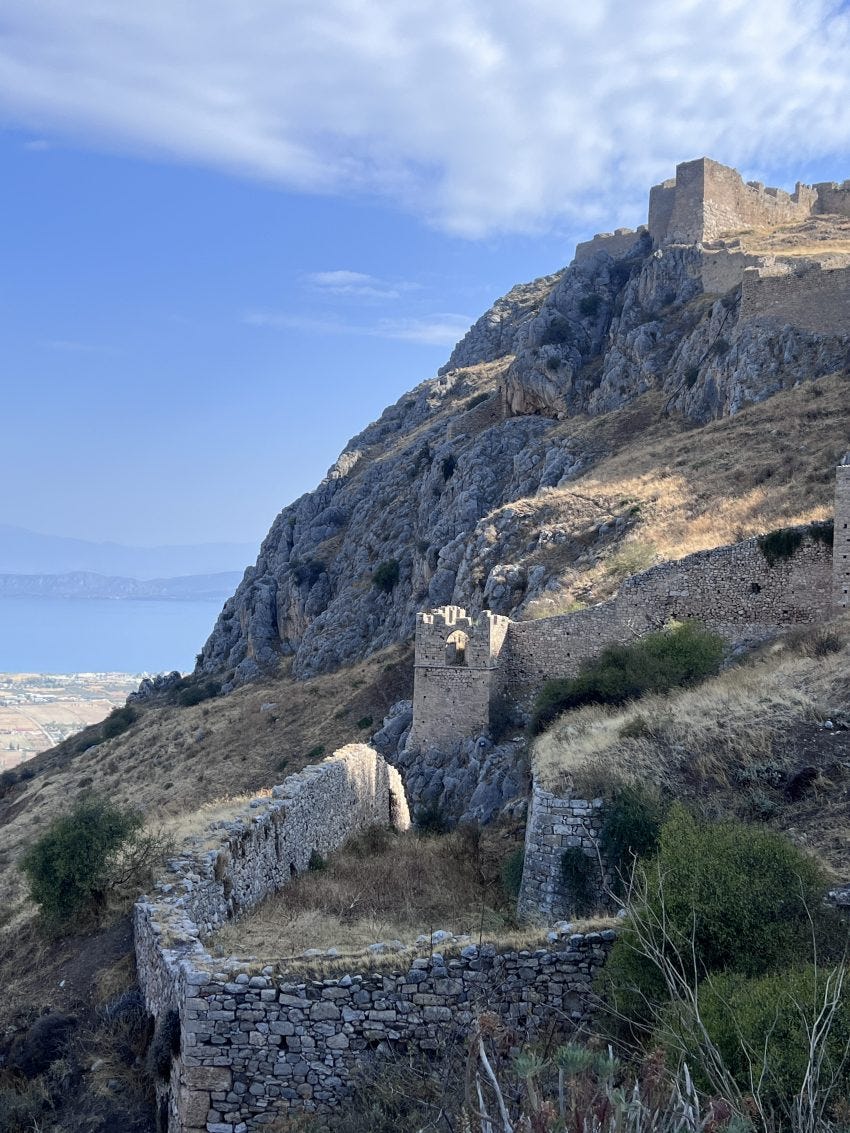
Estimates of Corinth’s population in Paul’s day range from roughly 80,000–200,000 (some older figures run higher). It was a commercial crossroads filled with merchants, sailors, freedmen, veterans, Jews, Greeks, and Romans. It hosted the biennial Isthmian Games, second only to the Olympics, and was notorious for its temples—including the famous sanctuary of Aphrodite on the Acrocorinth—and for a culture of sexual license so pronounced that “to Corinthianize” became a byword for immorality. The towering monolith of Acrocorinth provided an unmatched defensive citadel overlooking the entire plain and sea lanes below.
It’s the kind of city where status, rhetoric, and prestige mattered enormously, and that culture bled straight into the young church Paul had planted there just a couple of years earlier. Today, we would call Corinth “woke…”
Paul wrote 1 Corinthians around A.D. 53–55 from Ephesus, only a couple of years after he had planted the church in Corinth. This makes it one of the earliest surviving Christian documents—written well before the Gospels reached their final form and roughly two decades after Jesus’ death and resurrection. Already, within the first Christian generation, the forces of division were at work.
By the time Paul wrote 1 Corinthians, the church had split into camps: some followed Paul, others followed Cephas, others followed Apollos, others followed Christ.
Who is Cephas? Cephas was Peter - it’s just the Aramaic form of Peter’s name, the nickname Jesus gave him directly in John 1:42, which Paul uses interchangeably with “Peter” throughout his letters.
Apollos was a dazzling, philosophically polished Jewish-Christian preacher from Alexandria who’d come through Corinth after Paul and clearly won some admirers with his style.
In 1 Corinthians 1–4, Paul confronted exactly that fracture. Believers were saying, “I follow Paul,” “I follow Apollos,” “I follow Cephas [Peter],” or “I follow Christ.”
Paul’s response was blunt:
“Is Christ divided? Was Paul crucified for you? Or were you baptized in the name of Paul?” (1:13).
Leaders are merely servants: “I planted, Apollos watered, but God gave the growth” (3:6). Neither planter nor waterer is anything; only God matters.
Elevating human leaders is a mark of worldly immaturity (3:3–4).
The decisive inversion: “So let no one boast in men. For all things are yours, whether Paul or Apollos or Cephas or the world or life or death or the present or the future—all are yours, and you are Christ’s, and Christ is God’s” (3:21–23).
Paul said that the apostles themselves are gifts belonging to the church, not rival heads to whom the church belongs.
“Is Christ divided? Was Paul crucified for you? Were you baptized in the name of Paul?”
Paul basically reduced himself and Apollos and Cephas to field hands: “I planted, Apollos watered, but God gave the growth” - none of them were anything special, they were just workers in someone else’s field.
“All things are yours, whether Paul or Apollos or Cephas - and you are of Christ, and Christ is of God.” He didn’t say that you belong to a leader — the leaders belong to you, and you belong to Christ alone.
Both sides actually agree on what the passage says: elevating any human leader — Paul, Apollos, or Peter by name — into a rival banner is exactly the sin Paul is condemning. Nobody disputes that.
Both sides also agree that Peter held real prominence among the apostles. The disagreement is whether that prominence was personal and temporary or institutional and perpetual, and whether Christian unity was ever meant to run through a single visible human office like the Pope or the Catholic Church.
In the 50s A.D. there was no “Roman Catholic Church” or “Protestantism” - those labels did not yet exist.
1 Corinthians was written around 53–54 AD - in Paul’s own hand. Matthew’s Gospel, however, where the “rock” passage actually appears, wasn’t likely composed until decades later, sometime around 80–90 AD.
That doesn’t prove the Catholic reading wrong but it’s worth noting.
None of this is a reason to fight. If anything, it’s the opposite.
My friend in Minneapolis wasn’t wrong that the papacy matters to her tradition. She was wrong to weaponize it into a daily campaign to convert or condemn a friend who already believed in Christ. That’s not zeal. It’s the exact “I follow Cephas” tribalism Paul tore into two thousand years ago, dressed up in modern clothes.
Corinth didn’t get fixed by one side winning the argument. It got addressed by Paul telling everyone to stop building rival camps and remember who actually died for them. That’s still the answer.
As I said earlier, I do not claim expertise in Roman Catholic doctrine, and my purpose is not to attack Catholicism. My purpose is to explain why Catholics and Protestants need to unite under Jesus—everything else is secondary noise.
The early church was already being pulled apart by human names within a few years of the resurrection. Paul’s answer then remains the answer now: Christ is not divided. We belong to Him.
Catholics and Protestants share the same Lord, the same baptism, the same Scriptures, and the same hope of resurrection. The institutional differences are real and worth honest discussion. They are not, however, the ground of our unity. Jesus is. Everything else is noise.

In closing, many of you know I am an alcoholic in recovery with 31 years of sobriety.
I’ve attended 12-step recovery groups for decades and credit them with making my recovery deeper and more meaningful.
Yet the same lesson I learned in those rooms is the one I keep learning in church: the moment I make any group of people—or any human leader—my higher power, I lose the plot. Jesus Christ alone is my Higher Power. He is the One who keeps me sober. No human power, no institution, and no personality can do that. That truth holds in recovery, and it holds in the body of Christ. Food for thought.
If you value my work, please consider making a donation. My work is free for all but supported by many generous readers like you.
How can you donate? You can fund me by credit or debit card here or send a check to Peggy Tierney, PO Box 242, Spooner, Wisconsin, 54801. You can also support me by becoming a paid subscriber on Substack or by Cash App at $TierneysRealNews or by Venmo to @TierneysRealNews. Make sure to select the profile marked ‘Business’ so it goes to the right place! Thank you so much.
I accept no annoying ads to get in the way of truth. My only source of funding comes from readers like Sparky. I don’t need much to live on but it helps pay the bills.
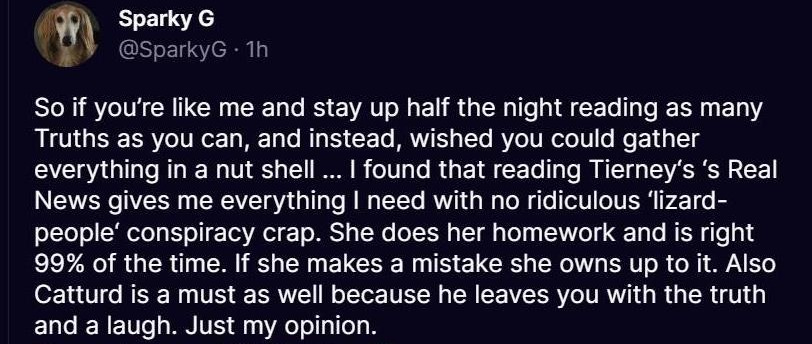
90% of those who started with me years ago are still with me. Thank you.
Comments
Nothing yet. Say the first thing.
Sign in to join the conversation.