
How Communist China Built the Surveillance System the New World Order Wants to Run
It’s always been confusing to me why the largest banks and hedge funds in the world - the puppet masters with all the money like Black Rock and their pals in the WEF - put their money behind Communist China to win the New World Order contest. They’ve even said that they want Chinese money to replace the US dollar as the world’s reserve currency. I mean, who really wants to report to Xi Jinping and speak Mandarin - but that appears to be what the Prime Minister of Canada (the former head of the Bank of England) wants for the Canadian people!
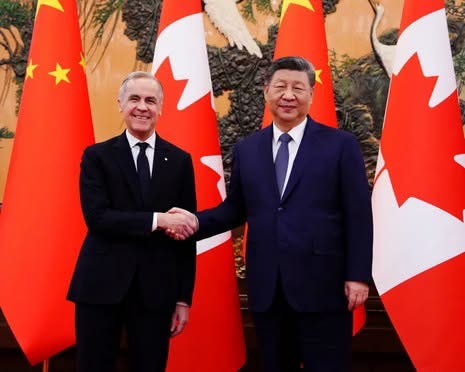
Canada literally just chose to side with Communist China against America in trade. His decision is undisputed. The question is why.
In January 2026, as Canadian Prime Minister, Mark Carney went to Communist China to meet with Xi and described the Canada-China relationship as a strategic partnership that “sets us up well for the new world order.”
Carney, in 2019, when he basically ran the Bank of England, argued that the US dollar’s dominance creates problems for the global economy. Carney back then said he wanted to replace the USD with a “Synthetic Hegemonic Currency” that would pave the way for China’s currency to gain reserve status and replace the dollar. See the play?
Chinese state-owned banks (the “Big Four”: Bank of China, ICBC, China Construction Bank, Agricultural Bank of China) have a substantial presence in London. London functions as a significant offshore renminbi hub.
So, the Bank of England is using Canada (in our backyard) to work with Communist China to destroy America and the dollar.
In 2025, Canada’s total goods exports to the United States reached an estimated $408.99 billion, with the U.S. accounting for 72% of Canada’s global export market.
In August 2026, the White House released a report titled “The Great Transshipment Scam,” which formally accused Canada of being one of China’s “biggest enablers” in bypassing U.S. tariffs.
Global transshipment fraud costs the U.S. between $34.2 billion and $303 billion annually.
In other words, because Canada allows Communist China to use them to scam us - it would likely be more profitable to cut off Canada all together if they don’t agree to stop trafficking black market Chinese goods into America!
The U.S. relies on Canada for over 4.3 million barrels of oil per day—nearly 60% of all American crude imports and Canada is the largest supplier of potash to the U.S., a core mineral needed for fertilizer. Beyond that, we don’t need Canada for much at all.
We could replace much of the crude from Venezuela and the potash from Russia in the short term.
If the United States were to completely cut off all exports from Canada, the Canadian economy would suffer an immediate, catastrophic collapse, triggering a severe domestic depression. Because Canada relies on the U.S. to buy over 70% of its total exported goods, an absolute cutoff would suddenly erase roughly 20% of Canada’s entire Gross Domestic Product (GDP).
In other words, we hold the cards and Carney is playing a dangerous game by siding with Obama and the Chinese Communist Party.
It’s obvious what’s going on. The big question is why? What is the ultimate goal here?
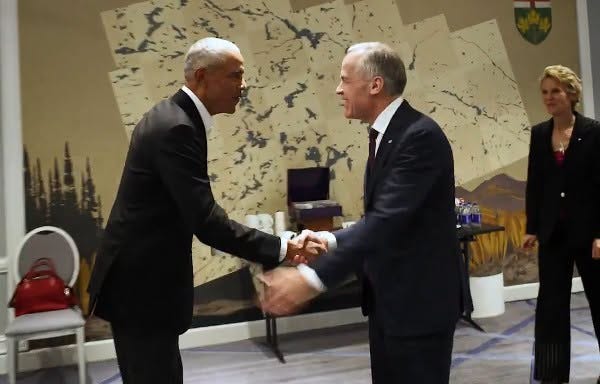
The same goes for Larry Fink of Blackrock and Klaus Schwaub of the WEF cozying up to Communist China and betting on them to win?
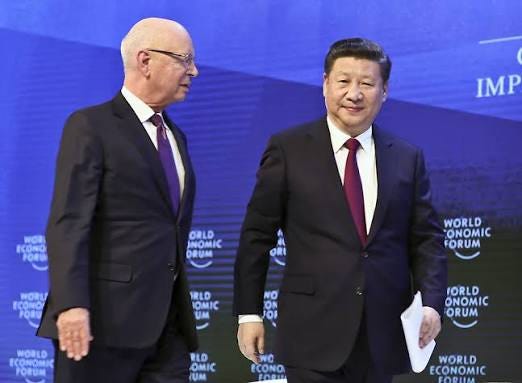
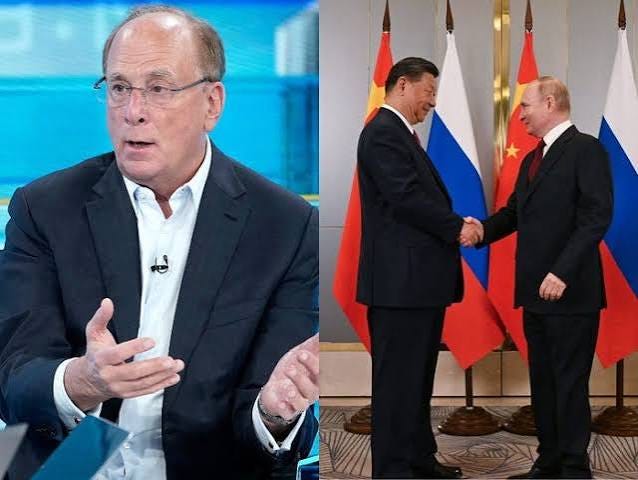
You can reason this every which way but I have finally come to the conclusion that it’s for one reason and one reason alone: that Communist China came up with a way to “track everything about everybody” - a surveillance technique that is NOT legal in the free world. That ability has been on the wish list of every tyrant who wants to control the world since the beginning of time.
The Historical Playbook
Surveillance and the drive to control information—and through it, people—is not a new ambition. In 213 BC, a Chinese emperor ordered every history book burned so no one could question his power.
Every regime built on total control follows the same three moves: rewrite what happened, decide what people are allowed to know now, and punish anyone who remembers it differently.
George Orwell watched this pattern repeat itself in the 20th century and turned it into 1984. His time reporting from the Spanish Civil War taught him something specific: he watched newspapers describe battles that never happened and stay silent about battles that killed hundreds of men; he watched cowards get reported as heroes and heroes get reported as traitors, depending only on which side was writing the story.
That experience is the thesis of the book. The “Party” in 1984 doesn’t just lie—it controls the present so completely that it can rewrite the past at will, and it uses constant surveillance plus nonstop propaganda to keep the population divided, frightened, and compliant. Orwell’s warning wasn’t really about a fictional dystopia; it was that nobody who seizes power like that ever intends to give it back, and that populations rarely revolt because they’re rarely allowed a standard of comparison—no memory of anything different to measure their situation against.

That machinery never disappeared. It just went digital. No one needs to burn physical books anymore. You edit the online file, tweak search results, quietly remove the inconvenient version, de-platform the wrong account, or pull a title from library systems. What sits on your bookshelf today may be one of the last clean copies of the truth in twenty years. Building a real physical library has never made more sense.
During COVID we got a live demo of how China’s surveillance system works: real-time tracking of where people went, what they said, and whether they obeyed—all delivered through the phones they already carried. Big Tech and major media outlets, owned by a small number of corporations and funded by the same big asset managers, do not need a formal conspiracy to move together. Shared owners and shared talking points are enough.
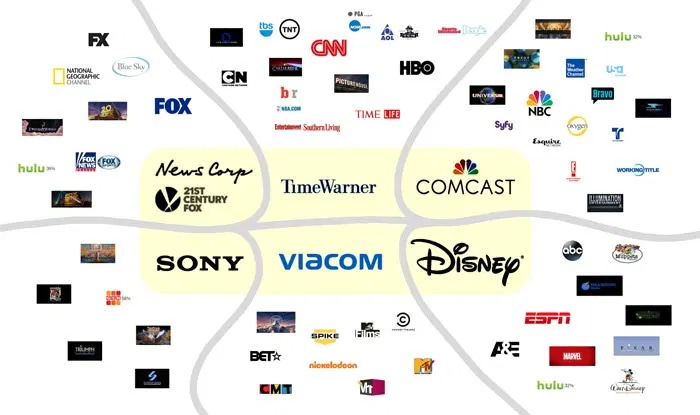
AI makes this far more powerful. It can sort through oceans of personal data, predict what people might do next, and enable control in real time at a scale Orwell could never have imagined while writing by hand in 1948. What once needed armies of informants and rooms full of paper files now runs automatically, continuously, and mostly out of sight.
China Built the Working System
Why would the biggest pools of Western capital bet on Chinese leadership, despite what that would mean for the people holding the money?
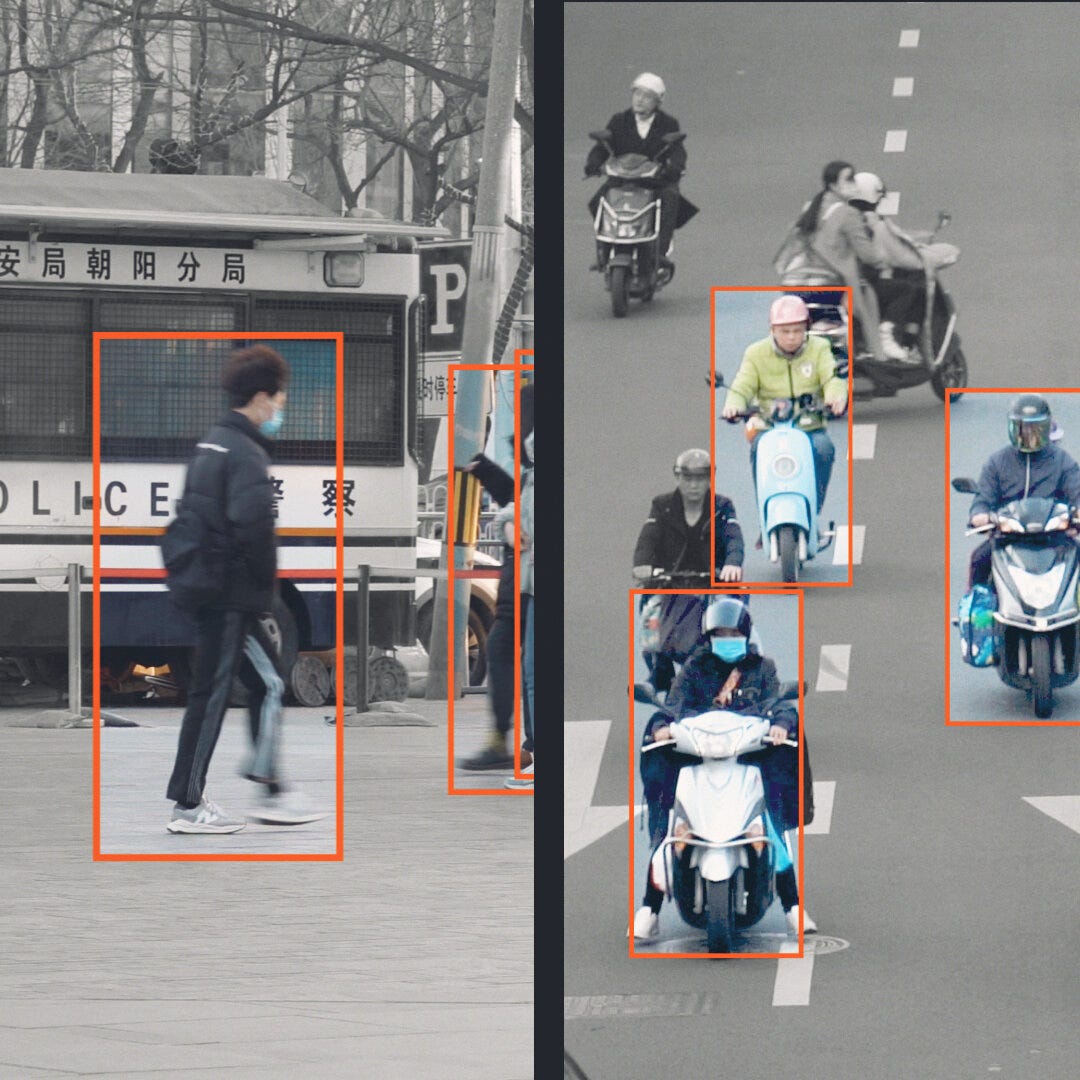
Because China built something no one else has: a working, large-scale system for tracking nearly everyone, all the time. Inside China it runs legally. Cameras, facial recognition, mandatory digital payments, social-credit scores, tight control of the internet, and AI are fused into one apparatus that watches almost every important action a citizen takes. It is coercive and state-run. Everyone inside it knows they are being watched. That is not a flaw—it is the design.

The remaining question is who gets to run the next version of it, and under what name.
The United States, through the NSA and the Pentagon, first perfected the technical ability to track people on a massive scale. China took the idea and flipped the philosophy. The U.S. approach mostly tried to intercept data from the shadows. China built an open, multi-layered system designed to be seen and used to shape behavior in real time.
China’s total-tracking state grew through big government projects over two decades.
China’s National Basic Population Information Database digitized the identities, household registrations (hukou), travel history, and photos of more than 95 percent of its citizens. Starting in the mid-2000s, major cities were blanketed with hundreds of millions of AI cameras that can do real-time facial recognition, read license plates, and even analyze how people walk.
Governments first realized they could realistically catalog and monitor whole populations in the mid-to-late 1960s, when mainframe computers and centralized databases appeared. In 1965 the U.S. proposed a National Data Center to combine federal databases. The rise of the World Wide Web and cheap digital storage (practical around 1996) meant everyday actions started leaving permanent digital footprints.
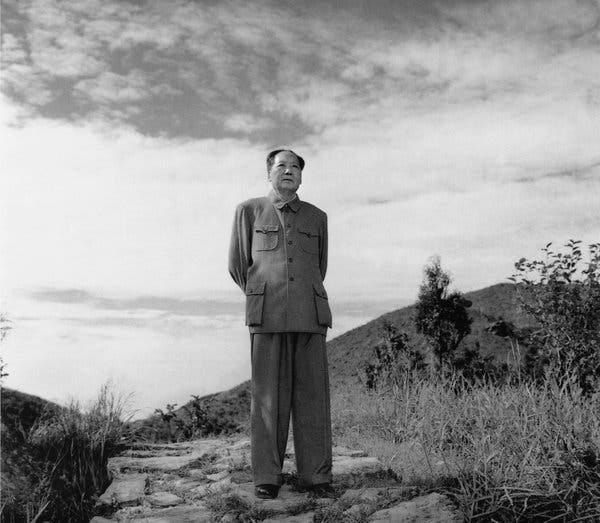
Between 1956 and 1965, Mao Zedong declared that China had a 50-60 year plan to take over the United States and catch up to (then surpass) Europe and America. The 50-year mark roughly coincided with Trump’s 2016 election. From that era onward, the argument goes, external ideological influences worked to weaken U.S. institutions from within.
After the September 11 attacks, governments expanded U.S. surveillance powers.
Laws like the USA PATRIOT Act let intelligence agencies collect phone, location, and internet data on entire populations rather than just specific suspects. By the late 1990s people were moving diaries, money, and social lives online—onto servers governments could more easily reach.
To track everything about everyone, two things were needed that did not exist before the late 1990s:
Devices that constantly broadcast location, actions, and communications (smartphones).
Cheap, almost unlimited storage so every call, email, and location ping can be kept forever.
The smartphone, launched in 2007, made “tracking everything” literal. Almost everyone began voluntarily carrying a GPS tracker and microphone 24 hours a day.
Governments could already identify people and where they lived by the 1970s. They could not track daily conversations, locations, and thoughts until the internet, cheap storage, and mobile phones came together between the mid-1990s and early 2000s.
The WEF, Communist China, and the Push for Control
What Exactly Is the World Economic Forum (WEF)?
The WEF acts as a networking platform and agenda-setter for global power players. It brings together the leaders of roughly 1,000 of the world’s largest multinational corporations, along with politicians, central bankers, tech executives, academics, and heads of major NGOs. The WEF represents the global corporate elite—often called the “Davos class”—and it represents transnational capital, big tech, institutional finance (like BlackRock and Vanguard), and international technocrats. The WEF argues that corporations should work alongside governments to shape society.
The WEF is not a government, a military power, or a sovereign nation. It is a Swiss-based non-governmental organization (NGO) and elite lobbying think tank founded in 1971 by German engineer and economist Klaus Schwab. But the WEF clearly admires Communist China’s ability to monitor and control people in ways Western systems currently cannot, and the WEF is trying to create a global rulebook to govern and control a Chinese-style Communist surveillance system for the West.
China perfected their surveillance system quickly because of civil-military fusion. In the West, companies like Apple or Google sometimes fight government data requests in court. In China, by law, big tech firms such as Tencent (WeChat) and Alibaba MUST work hand-in-hand with the state. Hundreds of millions of people use WeChat for texting, banking, paying taxes, shopping, and booking travel. That gives the government a direct window into daily life.
This is why China’s access to large amounts of American data—voter records, healthcare information, financial data—matters. China is currently the only country that can legally combine such information into one master file inside its own system, then use AI to analyze or sell it. China’s digital yuan lets the state see every transaction and, in principle, control what money can be spent on.
How is the WEF connected to the British Empire and Communist China?
When critics mention the modern “British Empire,” they usually mean the Anglo-American financial network centered around the City of London. This ecosystem of offshore banking, transnational private equity, and global finance forms a major core of the WEF’s corporate membership.
The WEF often partners with high-profile global figures to launch its initiatives. For example, the WEF’s controversial “Great Reset” initiative was officially launched in 2020 by Klaus Schwab alongside the then-Prince of Wales (now King Charles III).
Because prominent figures in British high society and European royalty actively champion WEF goals, many frame the WEF as an extension of traditional Western aristocracies and financial empires.
There are three different factions who want to use surveillance tools for total digital control:
The United States
Communist China
The WEF
How the WEF Intersects with Communist China and the U.S.
The WEF does not own a police force or a military. To implement its vision it relies on technology developed by both superpowers:
The Chinese Tech Pipeline: China has perfected the hardware and infrastructure for total population tracking (mass camera deployment, integrated digital payment rails, and social credit architecture). The WEF often praises China’s speed in deploying these modern technological systems.
The Western Corporate Pipeline: Western tech giants (primarily U.S.-based) hold the data, software, and platforms used by billions of people daily.
The WEF’s role is acting as the bridge. It encourages Western corporations and governments to adopt the capability of China’s surveillance tools, but package them inside the Western framework of safety, corporate compliance, and consumer convenience.
Hedge funds, mega-asset managers like BlackRock, and political operatives like George Soros integrate with the World Economic Forum by acting as the engine room of global policy enforcement.
While the WEF functions as a conceptual think tank, financial institutions and non-governmental networks are what turn WEF proposals into real-world realities.
Asset management giants—such as BlackRock, Vanguard, and State Street—along with prominent hedge funds, collectively manage tens of trillions of dollars. Their relationship with the WEF is built on capital allocation leverage.
If a public corporation wants investment capital, low-cost debt, or favorable credit ratings, it must comply with the WEF. Asset managers are major shareholders in almost every publicly traded company worldwide. Through proxy voting, they can push corporate boards to align with WEF-backed policies. BlackRock CEO Larry Fink has long served on the WEF Board of Trustees and was appointed interim co-chair of the WEF in 2025 following Klaus Schwab’s step-down. This directly cements the operational pipeline between private global capital and the WEF’s agenda-setting apparatus.
While asset managers use capital to direct corporate behavior, figures like George Soros and his Open Society Foundations (OSF) fund thousands of grassroots non-profits, academic fellowships, legal defense funds, and policy think tanks. Soros-backed NGO networks often act as the third leg of that stool—pressuring elected governments to codify WEF-style corporate standards into binding national law.
Soros and his successor, Alex Soros, are regular speakers and attendees at the annual Davos summit. Their role within the WEF ecosystem is to align civil society, academia, and left-of-center political movements behind transnational economic governance.
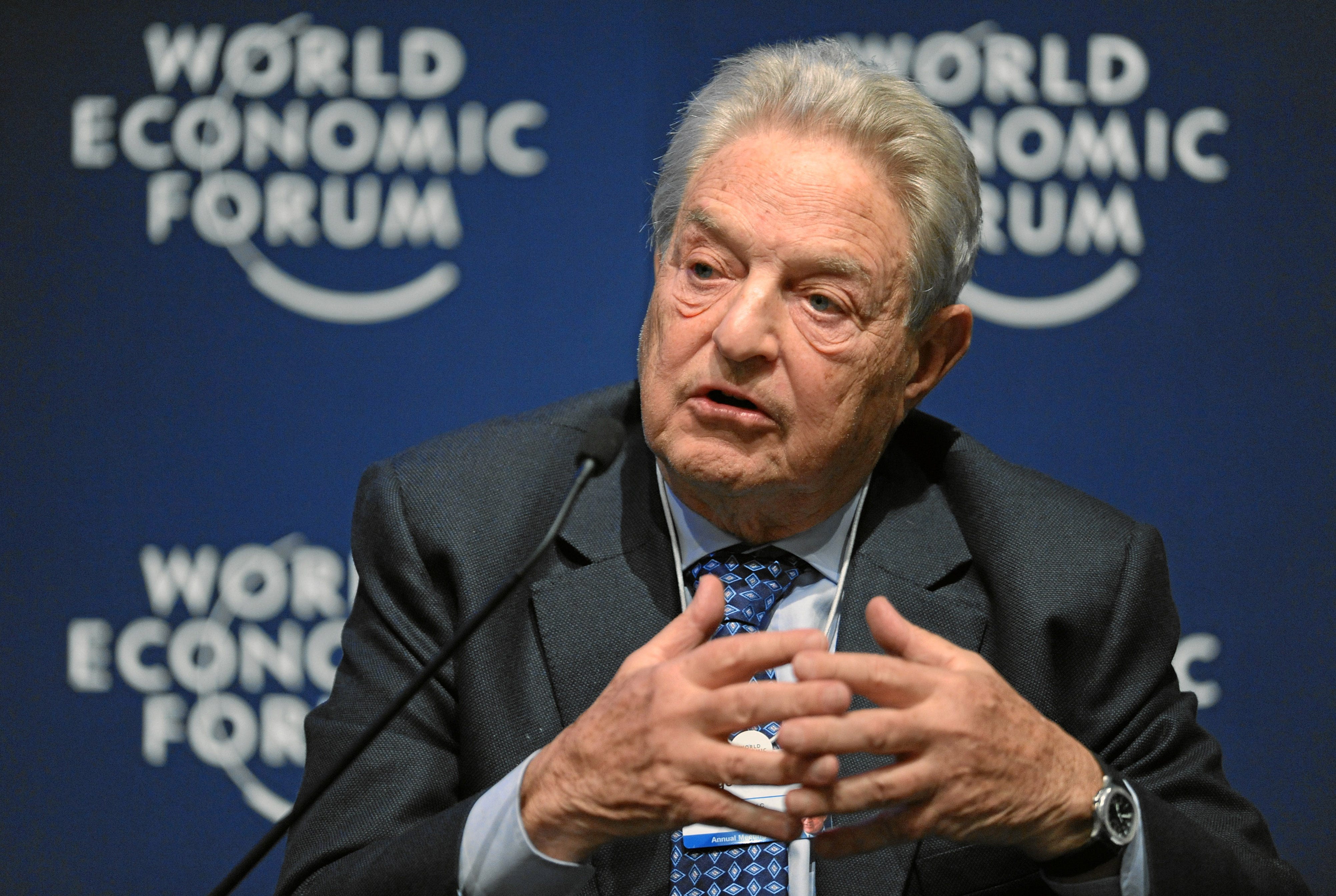
In summary, the WEF writes the script, Soros funds the narrative and legal lawfare to push it politically, and asset managers like BlackRock use their multi-trillion-dollar financial leverage to enforce corporate compliance.
The WEF is using China as an operational blueprint for the style of technocratic governance it wants to implement globally, while using American Big Tech and capital as the vehicle to deploy it.
The U.S. and China are locked in a sovereign, multi-spectrum cold war over trade, military power, microchips, and regional dominance.
China as the “Proof of Concept”
The WEF promotes a concept called the Fourth Industrial Revolution—a future governed by Central Bank Digital Currencies (CBDCs), biometric Digital IDs, carbon tracking, and AI-driven monitoring.
Western democratic systems are often seen as slow, divided, and unpredictable due to elections, free speech, and individual rights. China, by contrast, operates as a top-down authoritarian state where technological control can be deployed instantly. China can mandate a digital currency, set up mass facial-recognition grids, and enforce societal compliance without legislative gridlock or pushback.
Former WEF Chairman Klaus Schwab famously praised China’s rapid technological adoption, calling it a model for many countries. To the WEF, China represents a functional test lab for population-scale technological control. In other words, the WEF wants the people ruled under Communism because it will allow them total control!
While President Trump is locked in a geopolitical battle with Beijing, the WEF uses China to push the Western world toward its preferred policies. The hardware, algorithm models, and operational frameworks for mass digital tracking were perfected in China.
This dynamic isn’t a one-way street. Beijing actively uses the WEF to weaken Western resolve. By participating in Davos, Chinese leaders position themselves as champions of globalism and free trade, contrasting themselves with U.S. tariffs and domestic-first policies. China uses the WEF’s platform to secure Western capital while protecting its domestic sovereignty from the very WEF rules it praises abroad.
Rather than the WEF backing China to defeat America, the WEF is attempting to merge the two models: it takes the strict, technocratic social management perfected in China and applies it to the corporate platforms and financial levers of the United States.
Monetary System and Competing Goals
The question of whether China is working with the WEF, for itself, or both gets to the heart of how globalist networks align with national powers. The answer is both, but they are working together as tactical partners with different end goals, not as a single hierarchy.
China’s primary goal is using global platforms to advance the Chinese Communist Party’s (CCP) interests. China wants to dismantle the hegemony of the US dollar so the US can no longer use financial sanctions or control global clearing systems (like SWIFT) against them.
China works actively with BRICS nations (Russia, India, Brazil, South Africa) to build alternative trade settlements in local currencies and digital infrastructure.
Unlike WEF technocrats who favor transnational corporate rule, China insists on total state control over its economy, technology, and currency.
Technocrats within the WEF, the International Monetary Fund (IMF), and major central banks (like the Bank of England or European Central Bank) view the dominance of a single nation’s currency (the US dollar) as inherently unstable.
The WEF and global central bankers generally favor a transition toward Special Drawing Rights (SDRs) or a Central Bank Digital Currency (CBDC) basket.
The WEF wants China deeply integrated into international governance (ESG metrics, carbon markets, global digital standards) so that Chinese power is managed through transnational institutions rather than unilateral state aggression.
The WEF praises China’s digital payment architecture and CBDC rollout because it serves as a functional model for how global technocrats want to structure digital finance worldwide.
Why the Real Battle Is Trump Against the WEF & Communist China
The conflict between Donald Trump and these forces—Beijing’s state apparatus on one side and the WEF/central banking technocrats on the other—is rooted in philosophical, economic, and institutional incompatibility.
While China and the WEF are often at odds with each other over who should run the world (national state power vs. transnational institutions), both share a structural commitment to systems that Trump’s political core explicitly opposes.
1. National Sovereignty vs. Managed Globalism
Trump’s core doctrine is “America First” national sovereignty, bilateral trade deals, heavy use of protectionist tariffs, and restoring domestic manufacturing.
Why the WEF is an adversary: The WEF ecosystem represents managed global interdependence, borderless corporate supply chains, and multilateral bodies dictating trade, carbon standards (ESG), and regulatory frameworks. Trump views these transnational bodies as threats to national self-determination that bleed American wealth to foreign entities.
Why China is an adversary: China relies on export-led growth and asymmetric trade terms (state subsidies, IP transfer, currency management) to gain global market share. Trump’s trade policies directly challenge China’s economic model by forcing supply chains back to the U.S. or allied nations through aggressive tariffs.
2. Hegemony of the US Dollar vs. De-Dollarization
Trump’s core doctrine: Preserving the U.S. dollar as the undisputed global reserve currency. The dollar gives the U.S. massive leverage: low borrowing costs, unmatched financial dominance, and the ability to project power without immediate military action.
Why the WEF/Central Bankers are adversaries: Technocrats like Mark Carney argue that relying on a single nation’s currency creates systemic instability (the Triffin dilemma). They advocate shifting toward basket reserves, Special Drawing Rights (SDRs), or multi-currency CBDC grids.
Why China is an adversary: Beijing wants to decouple from dollar clearing mechanisms to shield itself from U.S. sanctions and build a yuan-centric trade architecture (CIPS, BRICS Pay, Digital Yuan). Trump sees any attempt to weaken the dollar’s primacy—whether by Beijing or by central bank technocrats—as a direct attack on American sovereignty and economic power.
Because both China and the WEF aim to dismantle the post-WWII American-led, dollar-dominated unipolar system, they inevitably treat Trump as a primary opponent.
Putting the Pieces Together
China has the working surveillance model. The WEF offers friendlier packaging for a similar endpoint. Brussels is building legal infrastructure that could let a Western version operate without ever needing a law that openly says “surveillance.” It only needs to be called safety, transparency, or sustainability. And the capital funding all three increasingly comes from the same small set of hands.
Much of the noise about not building data centers in America comes from the same circles that prefer a world in which American power is reduced.
Orwell observed that people who seek power rarely seize it just to fix something. They seize it because power itself is the goal. Measured against that standard, the infrastructure being built right now—on three continents, under three different names—looks less like three separate stories and more like one story wearing three different flags.
Here’s the part people keep missing: every time Americans fight AI development and data centers here at home, they’re not slowing down the surveillance state — they’re just handing the build-out to the people who already have zero qualms about running it and using it against us.
Communist China isn’t debating whether to build this infrastructure without guardrails. The WEF isn’t waiting on permits.
If we refuse to build our own AI capacity on our own soil, under our own laws, we don’t stop this technology — we just guarantee it gets built somewhere else, by someone else, with rules we had no hand in writing. Controlling our own destiny means controlling the infrastructure, not opting out of it and hoping for the best. The choice was never AI or no AI. The choice was never data centers or no data centers. The choice was never surveillance or no surveillance at all.
It’s who builds it — and whether America still has a seat at the table when the rules get written, or whether we ceded that seat because we were too busy fighting the wrong fight.

If you value my work, please consider making a donation. My work is free for all but supported by many generous readers like you.
How can you donate? You can fund me by credit or debit card here or send a check to Peggy Tierney, PO Box 242, Spooner, Wisconsin, 54801. You can also support me by becoming a paid subscriber on Substack or by Cash App at $TierneysRealNews or by Venmo to @TierneysRealNews. Make sure to select the profile marked ‘Business’ so it goes to the right place! Thank you so much.
I accept no annoying ads to get in the way of truth. My only source of funding comes from readers like Sparky. I don’t need much to live on but it helps pay the bills.

90% of those who started with me years ago are still with me. Thank you.
Comments
Nothing yet. Say the first thing.
Sign in to join the conversation.