
In the film Edge of Tomorrow, based on Hiroshi Sakurazaka’s novella All You Need Is Kill, Tom Cruise’s character is stuck in a time loop. However, the incredible character of Rita Vrataski, played by Emily Blunt, is not stuck in the loop. She’s past the loop. She’s working in a different mode, one defined by what one might call the RITA leadership method. Her “runtime” is execution only.
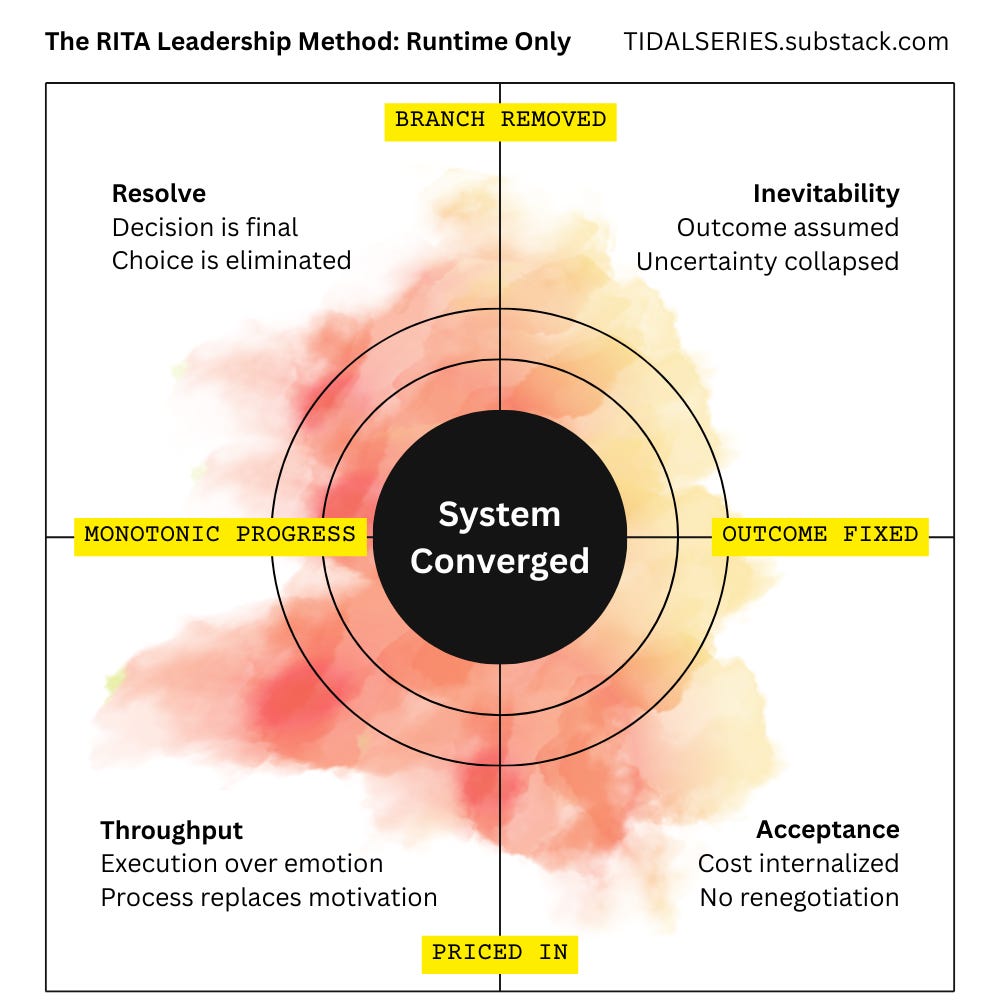
Rita Vrataski has already made up her mind. She doesn’t debate; she acts. Her ability to avoid sunk costs and past efforts is an interesting model to consider. Here, I put forward the RITA principles: Resolve, Inevitability, Throughput and Acceptance.
Resolve occurs when the internal debate ends. Decisions have been made and are final; they will not be reconsidered in response to discomfort or fear, or in response to any change in circumstances. Resolve isn’t just stubbornness: it’s the deliberate eradication of choice so that action can proceed without continual self-interruption.
This is the position that ensures the outcome is fixed, as opposed to speculative. The question is no longer whether success is possible, but what actions are required to make it happen, to force it into existence. This inevitably causes uncertainty collapse, not only for yourself, but for others too. This is not achieved through persuasion, but through behaviours that assume completeness is a given, dragging others through your wake.
Throughput is sustained action and execution over time. It replaces motivation with process and emotion with repetition. Progress is not measured by inspiration or intensity, but by constant movement that disregards fatigue or failure. Throughput enables action to persist when novelty and adrenaline have long subsided.
Throughput is sustained action and execution over time. It replaces motivation with process and emotion with repetition. Progress is not measured by inspiration or intensity, but by constant movement that disregards fatigue or failure. Throughput enables action to persist when novelty and adrenaline have long subsided.
Importantly:
RITA is a stable structure, not a sequence.
All four principles operate simultaneously.
The system converges at the centre.

Vrataski enters the story as a fully formed character. While the film hints at events that occurred prior to her introduction, it doesn’t focus on her past. There is no quaint superhero origin sequence explaining how she became this way; no formative trauma dressed up as justification. Her drive predates the film, and whatever internal argument she might have had with herself is now settled, or frankly, laid to waste. Eliminated. What remains is execution and ONLY execution. She isn’t thinking about whether or not to open that door and walk through it: she’s already marching through it, massive sword in hand.
This is what makes her seem unnatural on screen. She is not a character who grows or changes. She doesn’t need to be persuaded; she’s not on a hero’s journey. She simply, albeit dangerously, moves forward as if the end state has already been accepted and the present is merely the work required to reach it. When she tells Cage, “You don’t have time to think” it isn’t said out of panic or cruelty; it’s a description of how the world works. Thinking has already happened. Action is all that is left.
Even more unusually, the film itself is quite unflinching about this, which requires some dedication of its own. As the stakes rise, Rita doesn’t soften: she doesn’t rest, she doesn’t take it easy, she doesn’t stop to think about what she’s doing, what other people think she should do or the rules-based order around her in the “real world”. She’s not negotiating based on cost. Any moments of connection or reflection appear briefly and then just fade away because they are ultimately irrelevant to her goal, which is nothing less than saving the human race, no matter what happens to her. (Or anyone else for that matter.)
This is what focus looks like once internal deliberation is complete. Any consequences that would normally cause hesitation, such as isolation, exhaustion and fear, have been internalised and completely eradicated in advance. They don’t re-enter the live system as variables. The system as a whole has converged to a single dedicated point.
In films and novels, we often say that we want to see characters grow. But sometimes, what we really want is for people to achieve their goal, whatever it takes. That is a kind of growth in itself. And how do we accomplish goals? We eliminate choices. We price in the pain. We assume the goal has been accomplished and that we are merely moving relentlessly towards it.
No posts
Comments
Nothing yet. Say the first thing.
Sign in to join the conversation.