
Thanks to AI-assisted coding, software itself (rather than products based on it) is both expanding and devaluing.
When it comes to creating valuable software businesses, ideas have always been free. This has been written about in countless entrepreneurial works. While it’s easy to come up with an idea for a business or a piece of software, turning that idea into reality and building a viable, profitable business around it is much (much!) more difficult, as in at least a couple orders of magnitude, and much more costly in terms of time and effort. Ideas cost nothing. A real business? Thousands of hours of time and effort with no guarantee of success. This is well known and understood, though many of us still try to make money only with an idea, which simply doesn’t work.
One of the challenges of setting up a software business is the cost and effort involved in developing the software itself, not just the business, but the actual product. That required a team of people with technical skills in building software. But…what if those product development costs could be reduced? Or…what if it’s darn near zero? What would that mean for building a business and for the number of professional software developers if creating a product is almost as easy as just asking a computer to build it for you?
In terms of the value of software in the context of AI-based coding generation, a couple of clear positions are coming into focus.
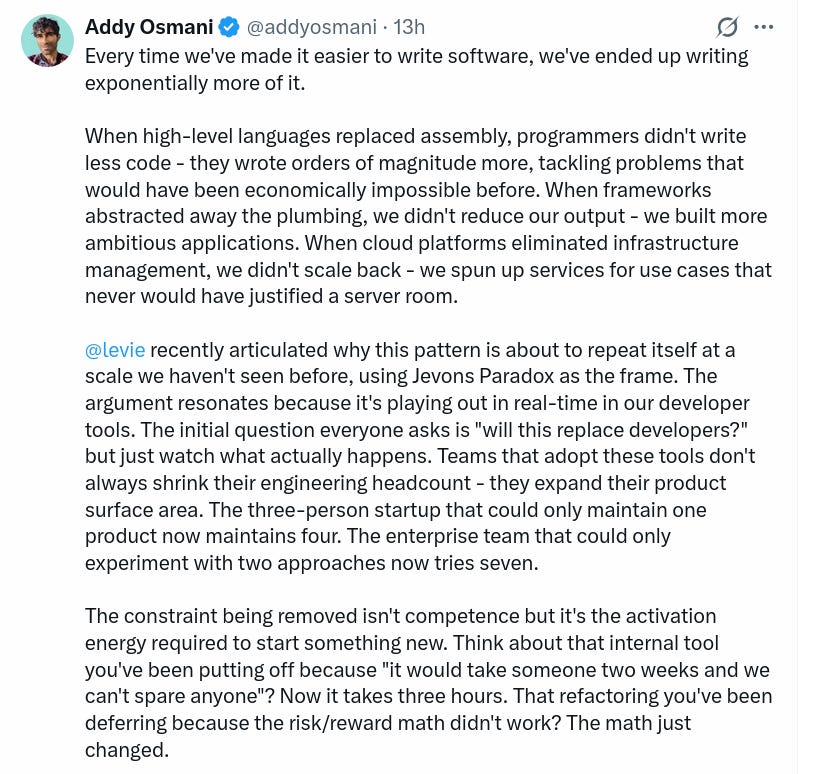
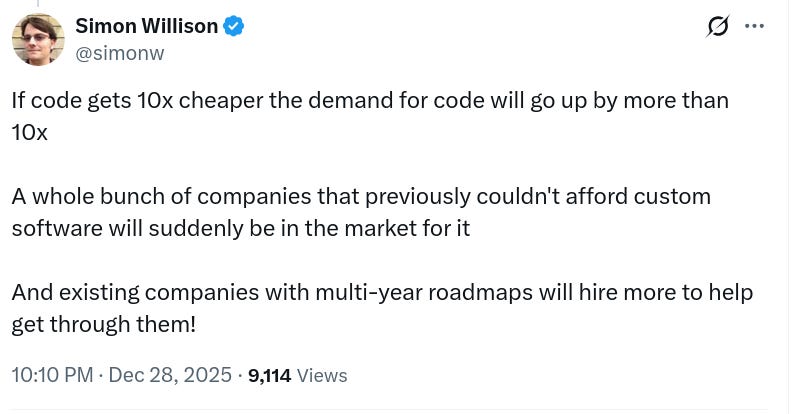
The Expansionists see AI as the greatest change to software development since it was invented; the ultimate abstraction layer. Their patron saint is William Stanley Jevons, who noticed in 1865 that as steam engines got more efficient, coal consumption didn’t fall, it exploded, because cheaper energy made previously impossible industries viable.
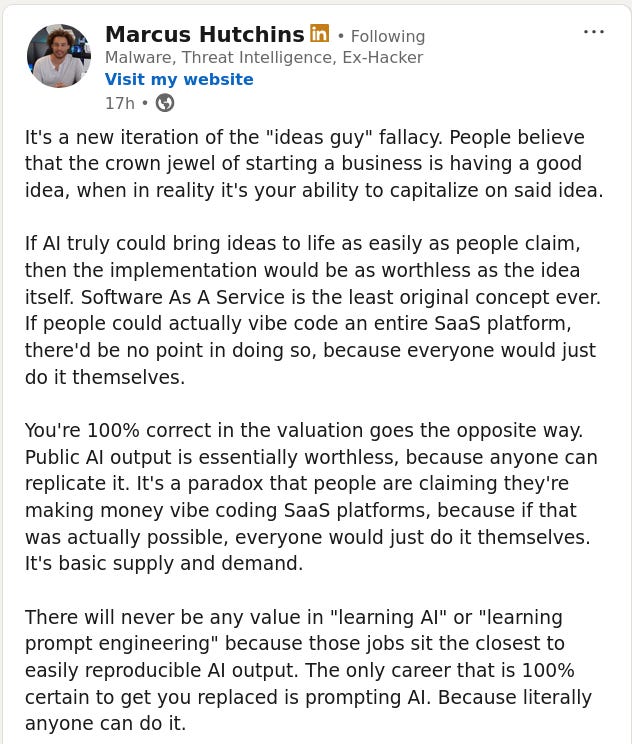
The Devaluationists see AI as a photocopier pointed at the economy. Their core insight is brutally simple: scarcity creates value, and AI destroys scarcity. If anyone can generate high-quality code from a simple prompt, then that output becomes a commodity with commodity pricing, which is to say, nearly zero.
A few selected positions:
As I continue to research these positions, it becomes clear that they actually could both be right at the same time and are not opposing. Instead they are measuring different effects. The Expansionists are measuring the size of the pie. The Devaluationists are measuring the size of an individual contributor’s slice.
Expansionists: They’re looking at the total amount of software that gets built and the number of viable businesses that can exist.
Software can be built with smaller teams; or teams can achieve much more
Niche markets that couldn’t justify development costs become viable
Internal tools that companies never built because the ROI didn’t work now get built
More MVPs get tested against real markets instead of dying in someone’s head
“Latent demand” gets unlocked
Ideas can be turned into working software simply by asking AI-assisted coding tools
Devaluationists: They’re looking at what any individual product is worth. What’s your moat? What stops someone from building the same thing tomorrow?
Simple tools have no defensibility: if you can build it in a weekend, so can your competitor
“Why would I pay for your app when I can just ask Claude to build it for me?”
The floor on pricing drops toward zero for anything that’s “just code”
Features that used to differentiate become table stakes overnight
“If anyone can generate high-quality products...”
For someone setting up a software company, this indicates that the market is growing. More software will be developed, more ideas will be explored, and more markets will be served. AI-assisted coding reduces the barriers to entry, meaning more people will be able to create software. This is real opportunity here.
However, individual slices of the market are shrinking. The same forces that enable you to build faster also enable everyone else to do the same. Anything that can easily be replicated is less defensible.
If you’re selling code, the raw implementation, you’re competing for a smaller share of an ever-growing market. This means more work overall, but less value per unit. Conversely, if you’re selling something that cannot easily be replicated, such as distribution (i.e. sales and marketing), trust, taste, speed, reliability or relationships, you can capture a larger share of the market. Have these things always been true? Yes.
However, building used to be the filter. You had an idea, but that wasn’t enough; you needed the software too. Now, you can have the idea and the software. To be clear: having software is not the same as having a product, but acquiring the software, the code, has become much easier. Perhaps so much easier that it drastically changes the equation on building a software business.
Questions remain:
Who benefits from this potentially drastic change? Individuals, or platforms? Does this affect anything other than the number of developers needed to write the underlying software of a product?
Will we get more bespoke software, or will software conglomerates take over with their incredible sales machines?
Thanks for reading TIDAL SERIES! This post is public so feel free to share it.
No posts
Comments
Nothing yet. Say the first thing.
Sign in to join the conversation.