
In finance, alpha refers to returns that outperform a baseline, where value is created not by following the market, but by personal insight, judgment, or information that others haven’t fully priced in. The use of the term is now being applied everywhere, especially in the rush to build new companies around the recent advances in artificial intelligence.
It’s possible that older computer science papers contain a lot of “alpha”. Software can seem to be in a constant state of acceleration, with new ideas, frameworks and tools appearing almost daily, seemingly out of thin air. When we are constantly bombarded with this new information, it can be easy to assume that the newest ideas are the best and that nothing done previously can apply to today’s thinking. However, this assumption may prevent us from accessing a great deal of pre-existing value.
We’ve been building software for long enough now, maybe 70 or 80 years, that we have forgotten a lot about what we used to do. Some of our computing history has faded from everyday practice and will continue to do so; it’s only natural. In fact, we must throw away some things in order to keep moving forward. However, many foundational computer science papers were written during a period when we were forced to deeply consider this new complexity and how it works with human limitations. At that time, we had to view things from a particular perspective, with a kind of newborn-like wonder. These situations produced unusually profound ideas, especially about the future of computers, what they could be instead of how we think today, in that we have our own history now.
This puts us in an interesting position where we have a modern software development industry and trillions of lines of code, but we may be repeatedly rediscovering problems that we considered decades ago, burning energy resolving solved problems. Or missing amazing ideas that already exist, hidden away in Google Scholar links.
There is an opportunity to revisit older computer science papers to recover some of that hard-won understanding.
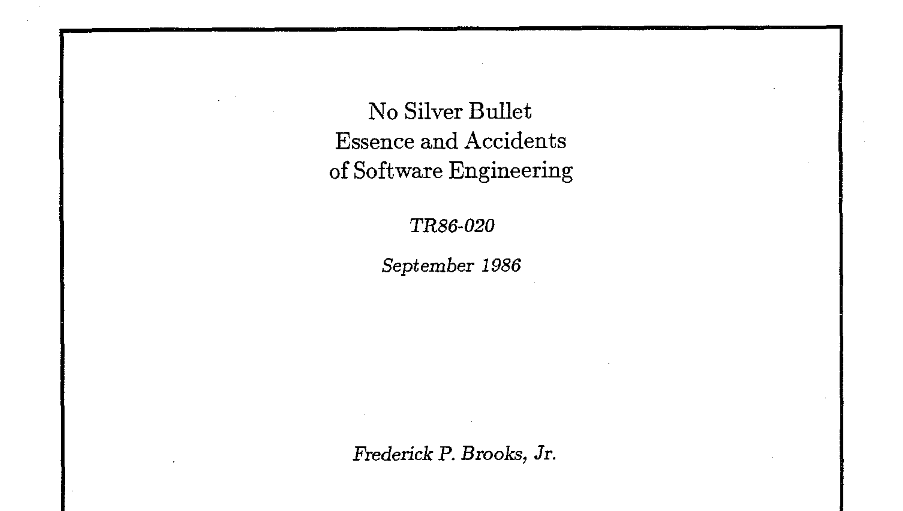
A great example of now hidden alpha is what Frederick Brooks published in 1986: “No Silver Bullet: Essence and Accident in Software Engineering”. This paper is easily readable and filled with ideas about software development that are still totally relevant today, if not more so given recent AI advances, i.e. LLMs generating tons of code.
Some of his key points around software development:
Use rapid prototyping to discover requirements
Iterate on requirements as a first-class activity
Grow software incrementally; don't try to 'build' it all at once
Design top-down while growing bottom-up
Preserve conceptual integrity
Accept that software is inherently difficult to visualise
Use tools to support thinking, not replace it
Invest in great designs, not just processes
Teach good practice, but cultivate good taste and judgement
Brooks also has some strong AI-related opinions (far back in 1986, mind you!) that apply to today's world of AI-assisted code. LLMs make it easy to generate lots of code, potentially creating the illusion of increased productivity. However, Brooks warned that productivity cannot be measured solely by output, i.e. lines of code. He was particularly concerned that building large, internally consistent systems that are conceptually wrong would be problematic, where a system can be well-structured and well-tested but fundamentally wrong because the underlying idea of the system doesn't match realistic needs. It's pretty easy, now, to generate tens of thousands of lines of code, but what is that code actually doing?
However, even with all that in mind, he did see a constructive role for AI-like systems (expert systems) in the form of advisory tools. He imagined them providing best practices, testing strategies, diagnostic support and a means of sharing wisdom (perhaps what we think of as "tribal knowledge").
I especially agree with his focus on great designers, where he says: “the central question of how to improve the software art centers, as it always, on people.” What’s more is that these people are created and nurtured, not just accidental finds.
Practice some software archaeology. Try searching Google Scholar, or perhaps Semantic Scholar, to solve your next software problem. You never know!
I’m also a big fan of computer scientist Mark Weiser:
Mark Weiser: The World Is Not a Desktop
·
January 6, 2024

Our computers should be like our childhood: an invisible foundation that is quickly forgotten but always with us, and effortlessly used throughout our lives. – Mark Weiser [1]
No posts
Comments
Nothing yet. Say the first thing.
Sign in to join the conversation.