

Do you feel that cultural shift? The trad wife influencers want us to believe they were never doing what they did—or at least, “we didn’t mean to take it that far!”
First, Hannah Neeleman’s CEO reframe and now, Nara Smith on Call Me Daddy, ready to hit the reset on expectations.
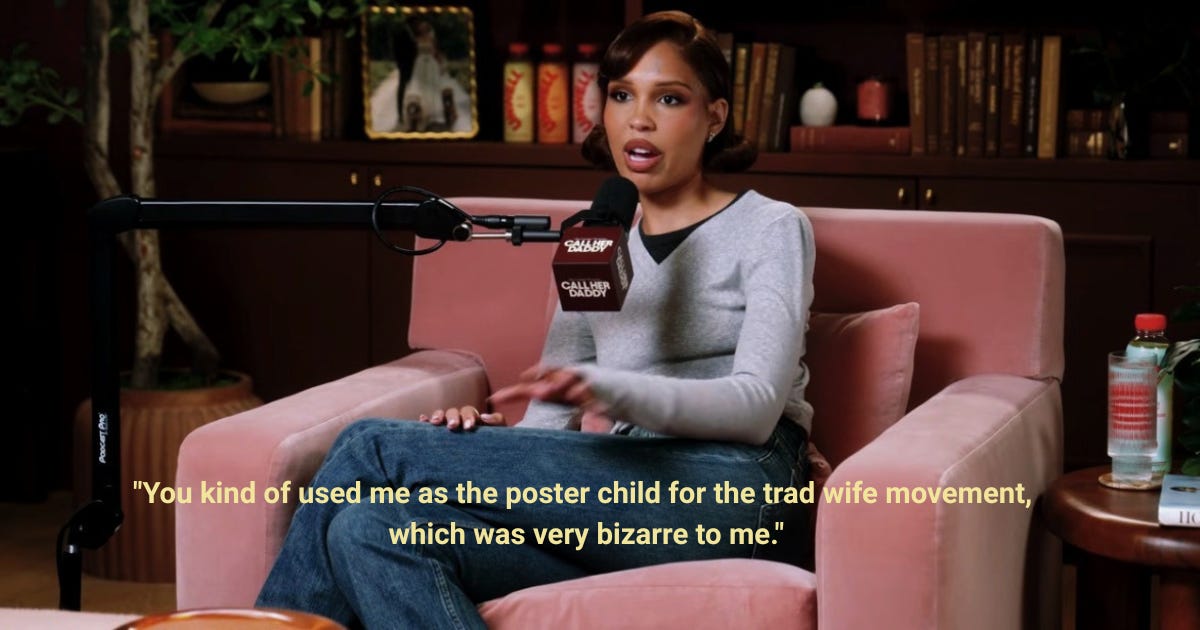
A note to those who are concerned we shouldn’t culturally discuss Nara because of her child’s cancer diagnosis: it’s precisely because trad wife and patriarchy influencers obscure harsh realities that we need to be honest about the truth beneath the veneer. We can do so with Nara’s humanity centered. I am personally qualified to discuss child illness and death, as well as the wearing grind of 4 children before 24. My experience with how I gained this perspective is in my memoir: A Well-Trained Wife.
Reframes like this interview are necessary. Trad wives age out and so do trends. Nara’s only 24, so she’s far from the mid-30’s droop Hannah’s experiencing after her ninth kiddo. But if her values are truly as equality- and intelligence-based as she claims, and so far from right-wing agenda-supporting propaganda, then her backpedaling is also appreciated. What trad wife influencers have done to women’s rights is grave and fucking dangerous.
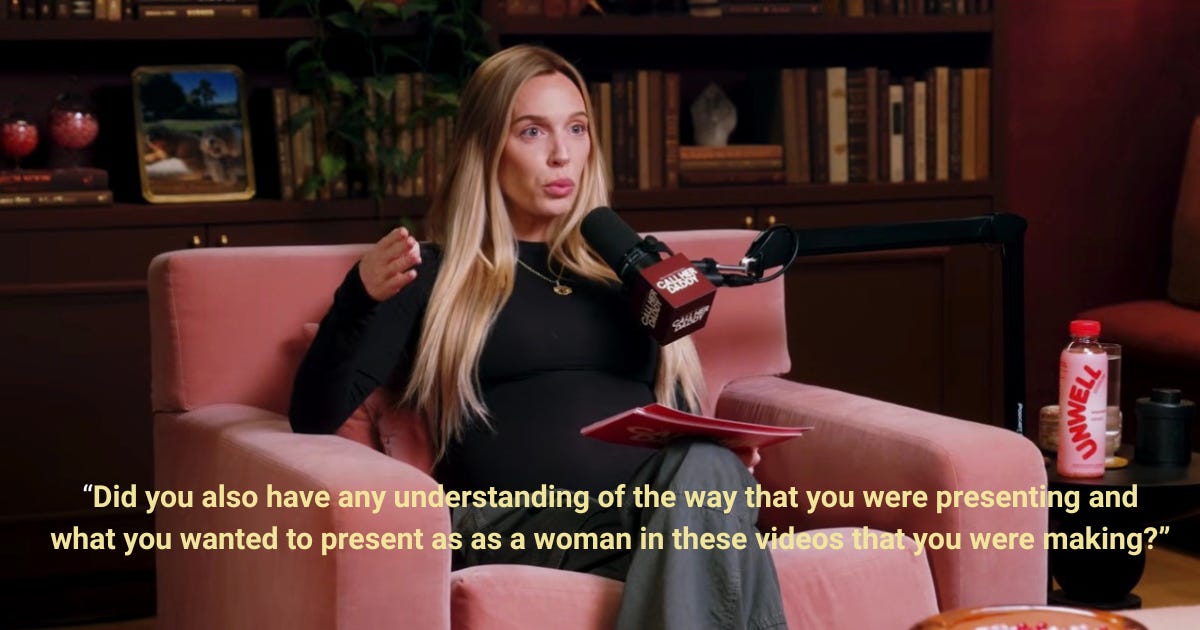
Unfortunately, this gaslit interview doesn’t ring true.
“I was never a trad wife.”
“They used me as the poster child”
“I had to look up the term”
“With that definition and those terms, I’m not a trad wife.”
Intention does not negate impact. Nara Smith is less agrarian than Neeleman, but she benefited from leaning into the trad-wife, fem, dress-for-the-male-gaze narrative of the manosphere and right wing. Was it just a trend for her brand? Where was this vocal protest 2 years ago? Does she think we don’t remember?
I heard about the Call Me Daddy interview because my old posts were being reshared by readers digging up receipts. Survivor advocates calling BS on trad wife influencers have them in spades. The internet has a long memory, and it’s bonkers to me when PR clearly thinks they can’t pretend otherwise, without meeting that memory head-on.
Nara’s not saying, “I grew this brand without recognizing the impact it was having on real women and our political direction as a country, and am now adjusting my position because I don’t believe in oppressing women or dragging civilization backward.”
She’s saying she never was that. We projected it all onto her. It was our baggage thrust onto her bubble. “I’m not the issue. Something that’s happening for you is the issue. So let’s talk about that.”
Yes, let’s.
Not quite “fundie baby voice,” but certainly a coaxing prosody that’s hypnotic; Nara’s voice is part of her package, which she says came from the innocent place of not wanting to wake up her baby. I believe her. In my experience and opinion, most women who alter their voices in patriarchy do so out of innocence. They’re fawning. Seeking protection. Coaxing and selling to stay safe. They don’t begin by realizing how it will impact their selfhood, sexuality, or agency. Her performance influenced other creators, which then impacted an entire cultural movement; her denial of that reveals how unself-aware she is. What was born of innocence did not stay that way.
Side note: the sex chapter of my book on recovery addresses the relationship between vocal modulation to sound childlike may impact sexuality
Nara shares how her autoimmune disease and eczema led to her having to be careful about what foods she ate. “I guess I’ll have to make everything from scratch because that feels the safest to me.” Again, I believe her. However, in my experience and opinion, children in Christian patriarchy often suffer from disordered relationships with food due to parental decisions around fasting, purity, and resourcing. Fetishizing food prep, extending the process and time, and using bacteria-laden raw milk are all part of the trad wife social media trend and real MAHA practices in high-control religious homes. If not high-control food disordered, why high-control food disorder shaped?
“It’s evolved into this full-scale business that I’m executing myself.” This felt like a moment of true transparency to me. Nara was a young mother; she made a reel on bread and jam that went viral; she’s smart and savvy enough to know a market when she sees one, and she started a business. And later in the interview, the level of labor post-partum is exploitative and actually heartbreaking, as well as her drive for perfectionism, which I get into down below.
But this is where a makeup influencer and a trad wife influencer differ most: transparent impact. We know the makeup influencer is making content for money and clicks. Many women did not know this about trad wife influencers; they took it to heart and followed the example. They’re adjusting their motherhood standards, changing their politics, discarding science, and reshaping society—and their influencers played a part.
“I’m a very ambitious and driven and hardworking woman,” she said. “It wasn’t even a conversation where I was asking for permission.” She then described husband Lucky’s contribution (“50/50”) and how they worked the kinks out of their schedule. “…it just kind of organically happened, but there was no other option in my mind cuz if I do something, I do it.”
This portion of the interview screamed at me in burning scars and stretch marks. This is the grift and the scam of it all. Nara utilized privilege, position, and agency while performing an illusion of submission to a market obsessed with strict gender roles and performative motherhood.
Alex said, “I think a larger conversation really started to bud from Nara Smith and who she was and what she was standing for and what she was representing for women. What do you remember just about the early commentary around you and your brand in your videos?”
'“At that point I was very much online,” Nara replied. “So I would read the comments, I’d be like, ‘Well, this is weird because I don’t feel like that. And my reality is so different to what people are assuming based off of the 1 and 1/2 minute videos they see. So I was very confused where that conversation came from. But then the more I read about it, I’m like, ‘You know what? Yeah, but I’m also correcting the narrative, but you’re not listening.’’
But, were we not listening? Hers was not a transparent, vocal platform setting the record straight. The Call Me Daddy interview to correct a narrative is happening in 2026, not 2024. We weren’t basing assumptions off a 90-second video but rather a whole feed of them, created in context of a movement, during a politically charged decade where gender performance is a top five issue for the entire country. And the controversy only courted more performative femininity.
And here’s where Nara wants it easy. Clean hands. This is a you problem, not me.
“Let’s Google what the definition of a tradife is,” she said to Alex, taking out her phone. “I had to look up the term because I wasn’t familiar with that, right? I didn’t quite know what it means.”
(This author screams in BULLSHIT to the video. It’s been her literal JOB to know what her brand is portraying, and she’s already demonstrated enough savvy at 24, surrounded by agents, teams, and even brands who refused her because of that trad wife image, that she knows EXACTLY what the term and controversy of “trad wife” is.)
“But the fast answer is a trad wife is a woman who embraces or promotes a traditional model of marriage and family life where she typically prioritizes being a homemaker and a primary caregiver for kids. Takes primary responsibility for cooking, cleaning, and managing the household. Supports her husband’s role as the primary breadwinner. Often values traditional gender roles within marriage.
“So with that definition and those points, I’m none of that. And we can go through it point by point.”
“I don’t prioritize being a homemaker. I’m a working mom. Like, I am out in LA. I travel a lot.”
“I love cooking because it’s my passion and because I kind of have to do it given my autoimmune. Absolutely. But that’s a passion of mine. It’s a hobby. It’s not something that I need to be doing for what.”
“Primary caregiver for my kids. No. My husband and I split it 50/50. Like when he works, I watch them. When I work, he watches them. And now, given everything that’s been going on, we also have help. My mom’s out. We have someone that helps us with the kids because it’s just not doable for me to do it all.”
“So, that doesn’t really work, right? Takes primary responsibility for cooking, cleaning, and managing the household. Yeah, I like to cook. Okay, sue me. I like to cook. My husband burns everything apart from a good steak, so he’ll do that. But I like cooking, so I’m doing it. Household and cleaning. He does the dishes. I don’t touch the dishes. There’s no way you’re going to see me washing and scrubbing the dishes. Also, he cleans our house…he does it perfect. So that doesn’t make any sense. Supports the husband’s role as the primary breadwinner. No, we both work like that. That doesn’t make any sense. Like I provide for our family. “
“So really, I think what’s happening is they’re taking the image of a woman in a kitchen in a gorgeous dress, and they are assuming that this is your life, and we are going back in time, and this is like very traditional. I think there’s also a bigger conversation to be had because everything that I’ve been reading online, I find it very concerning, almost that we need to put women in very specific, very narrow boxes in order to make sense of them.”
And then the question that just killed me—
“Why can’t we be a working mom that enjoys cooking, that enjoys being at home and taking care of our kids, but also is on the next plane out to LA to take business meetings with big executives? Like, why can’t that coexist?”
Patriarchy, Nara. That’s why. The personal agency, social support, education, and opportunity to allow women to contain multitudes, pursue ambition, enjoy hobbies, and even RECEIVE THE POSTPARTUM SUPPORT that this interview sadly yet powerfully exposes the need for is all prohibited by the very same patriarchal and religious forces that fund and support performative femininity and strict gender roles. Trad wife influencer content has bolstered the very oppression you’re now questioning. Your own content has bolstered that oppression.
Also, this demonstrates the limitation of definitions provided by AI. Because “trad wife” is also a pejorative term crafted in part by the manosphere podcasters and in part by Christian fundamentalists. It’s more than a Stay-at-home who takes care of her children, and it’s loaded with an agenda.
The most heart-wrenching part of this interview was the revelation of Nara within her own gilded cage, the one she’s helped build with her own hands. She shares the experience of her fourth baby in four years and how dissociated (my word, not hers) she felt for most of the pregnancy. And then there was no time off. She’s describing her suffering as post-partum anxiety, but this after describing a postnatal period of no convalescence, no rest, and with an older child’s cancer diagnosis. All while maintaining the performance and image of perfection.
The stress is extreme, and I use present tense because my body remembers so vividly I often still feel like I’m still holding a cluster of small children in my arms while leaking bodily fluids and getting almost no help, even 25 years later. And because we’re following a high-profile case of postpartum murder. And because I’m listening to women internalize the symptoms they experience from a societal and systemic utter lack of support as just their hormonal crash or new-baby exhaustion.
All that entrepreneurship and ambition and there’s no breathing space carved for Nara? No time off? No flexible deadline? Patriarchy consumes women and the capitalistic, creator economy is a voracious, insatiable beast. This is why her transparency is so needed. If she wants women to have it all—well then, welcome to feminism, where we work hard to raise the tide for ALL women to have a better experience and use our influence for good.
What’s missing in this interview is an acknowledgment of complicity and harm. Even self-harm.
I believe she’s an influencer with her finger on the pulse of our culture, and she, like Hannah Neeleman, is smart enough to stay ahead of the shift.
There’s this one section where she talks about her dad teaching her about mythology and history and how, as a child, she wanted to know the “why” behind our choices. Why are we doing this? She said even now she values curiosity, while literally displaying no curiosity or awareness about why she’s done what she’s done, and what social conversation her content entered and nurtured. Why she was creating this content, and why is she going to continue creating this content? Just for an organic hobby? Clicks online? As the face of a brand selling…what?
She convinced me she’s too smart for that. I know from experience as a once-upon-a-time trad wife would-be influencer myself that she is. Choices will need to be made, and unlike the real trad wives, Nara has the agency to make them.
Comments
Nothing yet. Say the first thing.
Sign in to join the conversation.