
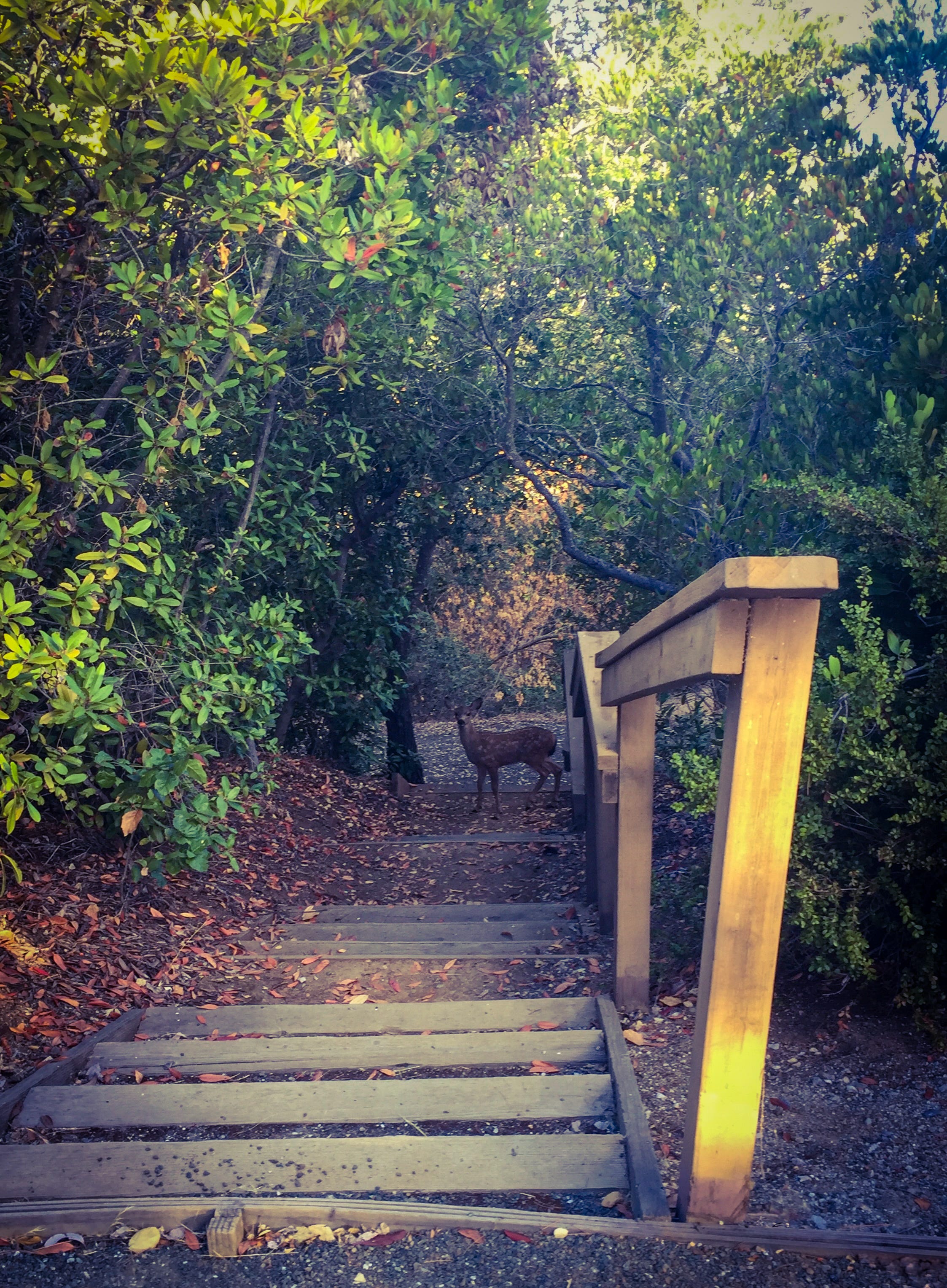
By this point in the retreat, the mornings had a shape to them. Coffee first, then the walk out to my bench while it was still cool, followed by a long stretch of sitting there doing nothing at all while the light came up and the animals started their day.
After about an hour of sitting there watching the world wake up, I turned to the assigned passage for the day. Jesus at twelve, in the Temple.
You may know the outline of it. The family goes up to Jerusalem for Passover, and on the way home Mary and Joseph get a day’s travel out before they realize he isn’t with them. Three days of searching. And they find him in the Temple, sitting among the teachers, listening and asking questions, and everyone who hears him is astonished. When Mary finally gets hold of him, in what I have always assumed was the tone every mother uses, he seems genuinely puzzled that they looked anywhere else.
That is the whole story. A boy stays behind to ask questions.
At the end of a prayer period, Ignatius has you do one more thing. He calls it a colloquy. You choose one person in the scene and you talk to them, the way you would talk to anybody, and then you listen for their answer.
I chose one of the rabbis to talk to, and I asked him what he thought of the boy. He said, “He made me think of things I’ve never thought of before. A new perspective on ancient stories. I loved his innocent, childlike curiosity. I think I learned more from his questions than he learned from my answers.”
As I pondered this prayer time, I felt the freedom to ask questions like a child. I loved observing young Jesus, who respected ancient scripture and his elders, yet was unafraid to question age-old conclusions. I wanted to be like that. Zen Buddhism calls it “beginner’s mind.” I would call it “the young mind of Christ.”
This was a large part of what I had come for, though I had not known how to say it out loud until I watched a twelve-year-old do it. I had thirty days and nothing to do in them but ponder the ancient scriptures and ask questions. Everything I had been handed and never opened. Everything I had defended in print. And here was Jesus, before he was anybody's Savior, sitting in the Temple doing exactly that, and nobody in the story treating it as a problem.
Eighteen years in one sentence
After lunch, I walked to my second favorite spot, a bench under a huge oak tree close to the farm animals.
The second passage of the day was Luke 2:51-52. “Then he returned to Nazareth with them and was obedient to them. And his mother stored all these things in her heart. Jesus grew in wisdom and in stature and in favor with God and all the people.”
Jesus from the age of twelve to thirty. Luke gives all of it one sentence. He went home with them, and he was obedient to them, and he grew. Eighteen years in a single line. Everything else, I had the freedom to just make it up.
According to this tradition, that is not heresy, it is the Ignatian way. Ignatius has you build the scene yourself and stand in it. What is the temperature. What do you see when you look up. What does the room smell like. Who else is there, and where are they standing, and what are they doing with their hands. You keep going until it stops being a page and starts being a place, and then you stay there and see what happens.
So I asked Jesus to give me a tour of his home and walk me through a typical day at those ages.
So here is what I made up. None of it is in the Bible.
It was very sweet. According to my imagination, he helps his mother, whom he adores, with his siblings, but as he got older his sisters were able to help more with that, and he helped his father in the carpentry shop.
He loved spending all day with his father. He asked him a lot of questions. Many of them Joseph was not able to answer so he took him often to the rabbis to talk to. They would also spend hours just working side by side in silence. His father taught him all about the skills of carpentry but he also gave him freedom to create his own designs.
Everyone in the home woke up early for morning chores and they all worked during the day at their different assignments. They always had dinner together and after the little ones were put to bed, Jesus liked to go off by himself to sit on the roof in silence with His Father, God. It was during these times that he felt God answer his deepest questions. His wonderful earthly father and mother helped him grow into his full humanity but his Father in heaven helped him to grow into his full divinity, especially during times of silence and stillness. Mostly alone but sometimes in the middle of the hustle and bustle of life, when he would retreat to the quiet spaces within himself that he had nurtured in the nights.
After my prayer imagination time, I had my colloquy, my conversation, with Jesus. I told him that I did not have much visceral experience with emotional intimacy. The closest I had to a frame of reference was Ney Bailey, the woman who once told me over lunch that I was too hard on myself and that she did not think I understood what grace really was, and who then spent years proving it to me. But during my impressionable, imprintable years as a child, my father was distant and detached. My mother loved me largely, but she was not always safe to let down my guard completely, so I learned to keep an armor of self-protection.
But, I long for connection and intimacy, especially union with Him, in a way that I can feel and know that goes beyond anything I’ve experienced before. I asked Him if he would make a covenant with me to continue to initiate and pursue me and consistently, untiringly open me up with his love until I was able to receive, take in, experience Him inside me in fullness, and that I would be able to fully open myself inside of Him and experience His whole self, as well.
What I was actually looking at
I want to stop here for a second, because it took me most of this month of silence to understand why this way of praying works so well for me.
When you sit down to pray a scene, the text hands you almost nothing. A road. A house. A boy. And then it leaves the room, and you are standing there with an empty stage and instructions to furnish it. So you do. You put in the smell of the wood shavings and the sisters underfoot and the father who does not know the answer. And here is the part nobody warns you about: you did not choose any of that. Not really. You reached for the first thing your hand found in the dark, and what your hand found was whatever your soul has been carrying around all these years without telling you.
The scene comes out of you. Which means when you look at it, you are looking at yourself. It is a kind of X-ray. You think you are studying a first-century carpenter’s house and you are actually reading the inside of your own chest, in a language you did not know you spoke.
I could not have gotten there any other way. If you had sat me down and asked me what I most needed, I would have given you a good answer. An articulate one. I have been articulate about my own wounds for a long time now, which is its own way of hiding. I would have said something about intimacy, or about trusting God, and it would have been true, and I would have gone on exactly as I was.
But nobody asked me what I needed. Somebody asked me to imagine a boy and his father in a workshop.
Go back and read that house again. The father who does not go cold. The father who walks him into town when he cannot answer. The other Father, waiting out in the dark every night after the little ones are asleep, where the questions are welcome too. Nobody put any of that there but me.
None of that came from the text. That is a woman building the childhood she did not get, and not noticing she is doing it, until she looks up at the thing she has made and sees her own handwriting all over it.
And that is when I saw what I had been looking at all day without seeing it.
The boy in the Temple could ask anything, because he had a father at home in a carpentry shop who let him. That boy grew up believing that a question was a way of getting closer to someone.
I grew up somewhere else. My father was not a man you brought questions to, and the church that raised me was not a place you brought them either, and between the two of them I learned the same lesson twice. A question was not a way toward anyone. If you were asking, something had gone wrong in you. Doubt was a crack to be sealed, not an opening to walk through, and the questions that mattered most were the ones already definitively answered with before you got there, which meant the only thing left to do with them was agree.
And I should be honest that it was not only them. I was afraid of the questions myself. Certainty was the floor I was standing on, and I was not at all sure there was anything under it, so I did not go looking. It is hard to tell where their fear stopped and mine started.
So it turns out I was not praying about two things at all. The freedom to question and the ability to be close to someone are not separate wishes. I have been managing my questions ever since, keeping them quiet enough not to alarm anyone. And what I was asking Jesus for, when I asked him to keep coming toward me and not get tired of it, was the thing that boy had and I never did. Someone who stayed in the room when he asked.
And it was more than staying. It was not flinching. It was hearing the question as the good part, the curious part, the part worth encouraging. It was being met as a separate person, someone to talk with rather than talk at, where we could end up in two different places and there would still be respect on the way out, and still love.
Someone who genuinely wants to know what is going on inside your head and heart and doesn’t judge it. They may even celebrate it and let it change their mind and heart!
Next week, I take that freedom out for a walk. I start my beliefs over from scratch, from the very beginning, and I get as far as the trees.
Was there a question you learned early on not to ask out loud? I would love to know what it was, and whether you have ever asked it since.
And whatever else came up while you were reading, the comments are yours. I read every one, and Thursday is where I pull up a chair and really answer.
Do you have a friend who might find this way of looking at things interesting? Feel free to…
Comments
Nothing yet. Say the first thing.
Sign in to join the conversation.