
This email may be too large for your inbox, click “View entire message” to see the full posting.

Late Spring - May 20 to June 19
The wildflowers are changing fast - the delicate ephemerals have given way to the sturdier mayapples, Solomon’s seal, the ferns have unfurled and the early summer flowers (fleabane, dame’s rocket, oxeye daisy) are starting to show up.
Seeing the fresh dark green foliage on all the trees feels like a strong hug from an old friend... not knowing how much you missed them until they show up.
“Keep close to Nature’s heart…and break clear away, once in a while, and climb a mountain or spend a week in the woods. Wash your spirit clean.” - John Muir
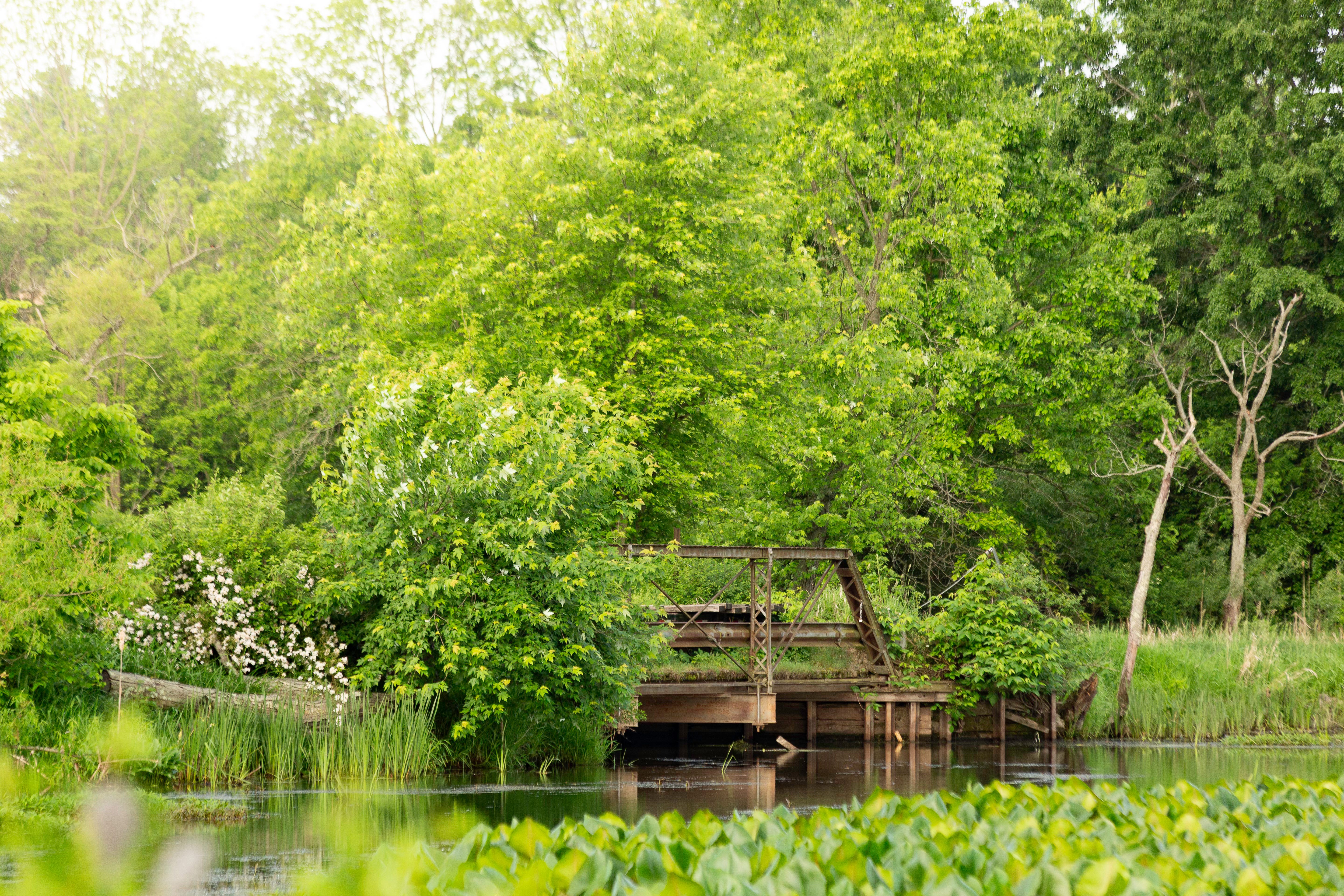
As we head closer to the brightest day of the year (June 21st) it’s important to remember there’s a place for both light and dark in our lives. We need the hard times to fully appreciate the times things are easy.
On these bright sunny days full of flowers and birds and warmth, take a moment to slow down and appreciate how light things are right now. Just as we pause to see and appreciate the darkness at the eve of the Winter Solstice it’s important we pay attention when things are bright.
Feel the warmth of the sun. Hear the birds calling. Let the breeze toss your hair. How full and lush the trees look standing tall with their crown of green.
Consider the brightness, what it means to you, what you can learn from it, then take some time to sit with it, see it, and bring the warmth into your heart.
Wild Violet Salad
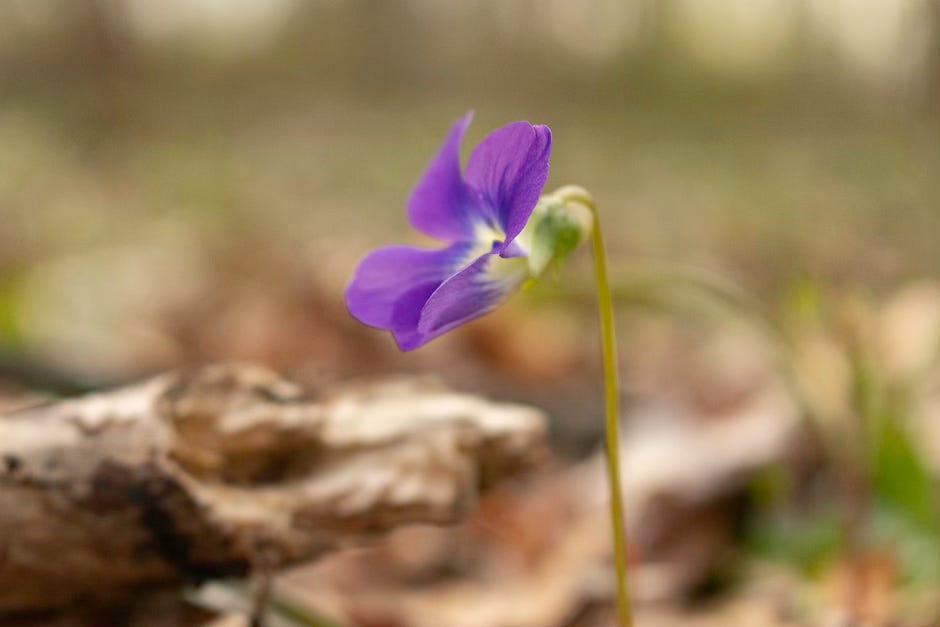
To make this salad, combine all your favorite salad ingredients, I kept mine simple so as to get the full taste.
Mixed lettuce greens
Celery
Handful of well washed violet flowers
Light oil and vinegar dressing
Voila! A new yummy addition to your spring salads.
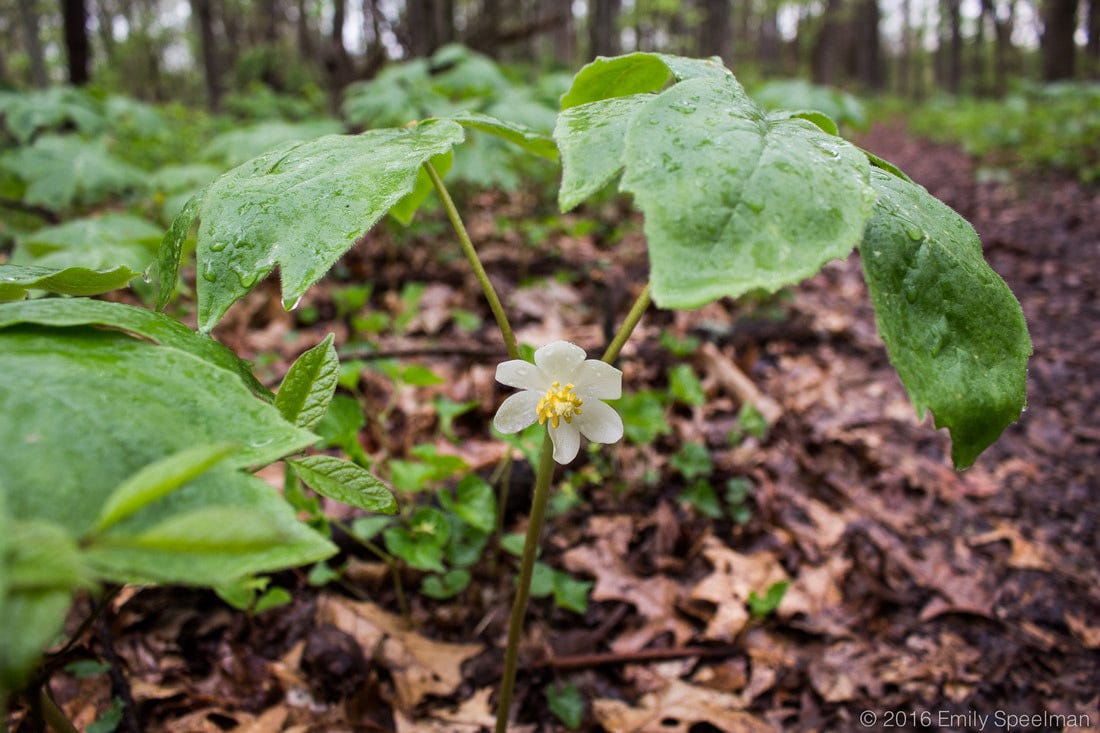
Mayapple (Podophyllum peltatum)
Mayapples are perennial herbaceous plants with thick fibrous roots that arise from a creeping rhizome. Over time rhizome branching results in the formation of large clonal colonies.
Nonflowering aerial stems bear a single leaf whereas flowering stems produce a pair of leaves, between which a single flower is produced.
The large, twin, umbrella-like leaves of mayapple are showy and conspicuous. They remain closed as the stem lengthens, unfolding 6-8 inches across when the plant has reached its 1-1 1/2 ft. height.
Flowers are solitary, nodding, fragrant, and about 2-5 cm broad.
Mayapples frequent mesic to dry-mesic upland forests, well-drained floodplain forests, and various moist, disturbed habitats.
Pollinating insects include bumblebees and other long-tongued bees, butterflies, and moths. The flowers produce no nectar, but nutritious pollen serves as pollinator reward. Mayapples are included among the several host plants utilized by caterpillars of the Variegated Fritillary; several moth caterpillars also feed on the plant.
Ripe fruits are consumed by small mammals and box turtles.
All parts of this plant are poisonous except for the golden-yellow fruit.
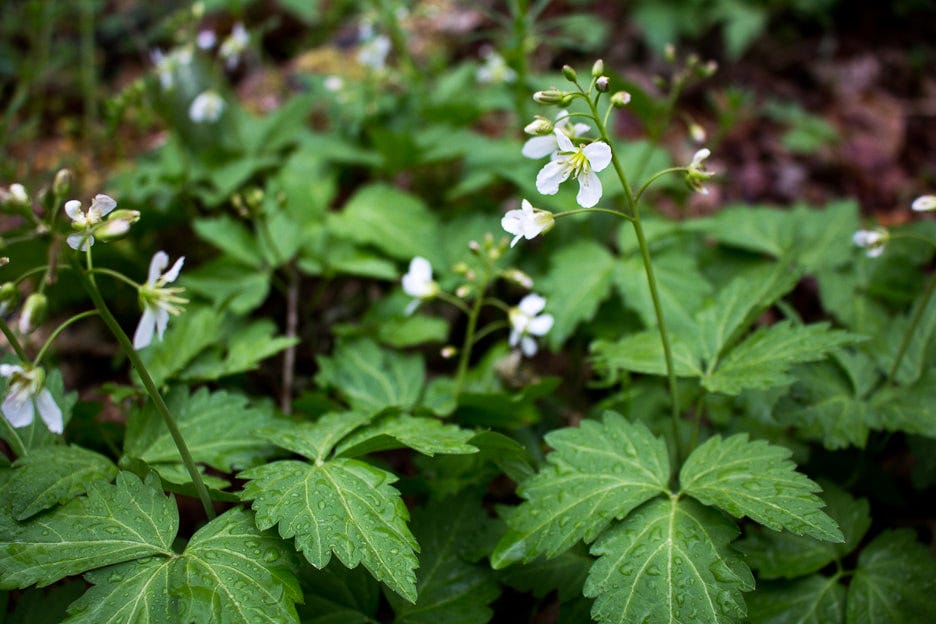
Two leaf toothwort (Cardamine diphylla)
At first glance, this seems like a mistaken name, but from the root rises two leaves with three coarsely toothed leaflets on each. A native species of the eastern half of the US, this spring ephemeral thrives in rich woods and moist soil. This flower is an important host for the native West Virginia White butterfly (often mistaken for the non-native Cabbage White). After hatching, the caterpillars feast of the leaves of this plant, however, since the introduced Garlic Mustard is overtaking our woodlands, the WVW has begun laying eggs on the Garlic Mustard, after they hatch, the caterpillars can’t survive on the garlic mustard leaves and die. This has caused a large decline in the WVW populations.
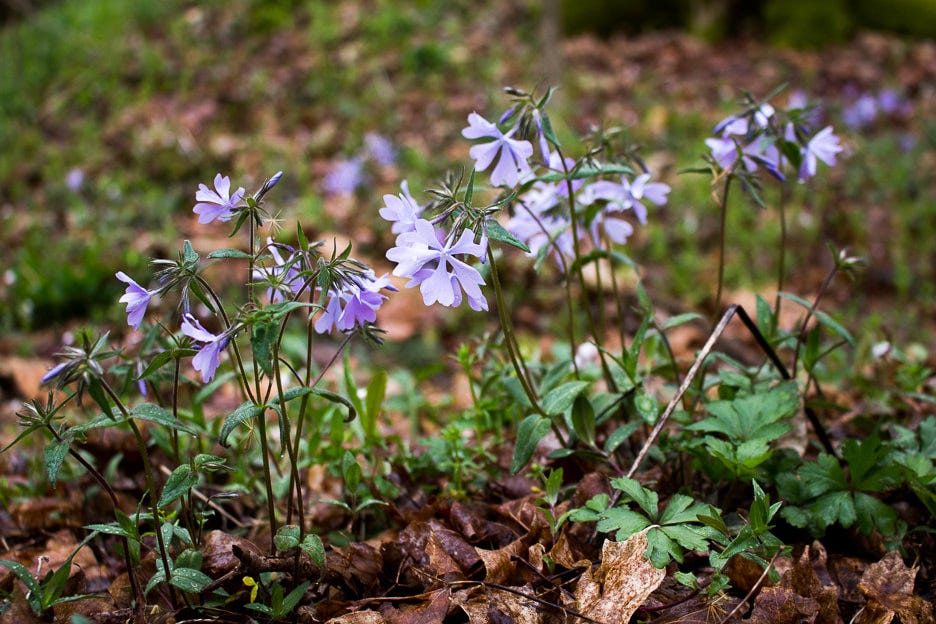
Wild Blue Phlox (Phlox divaricata L.)
Also known as: wild blue phlox, Louisiana phlox, blue woodland phlox, sweet William, wild sweet William. Calling them blue is a bit of a misnomer as they’re more commonly a lavender to whitish color. They can be found in both woodlands and in fields providing nectar for bees and butterflies.
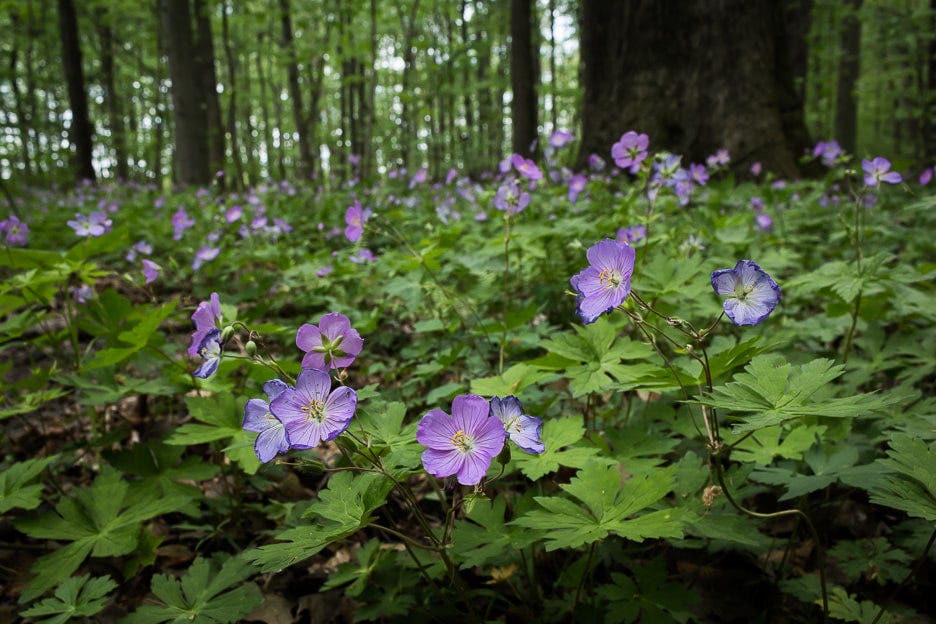
Wild Geranium (Geranium maculatum)
A native to the eastern US, this showy flower blooms from March-July Seeds attract Mourning Doves, Bobwhite Quail, and White-tailed Deer.
Up next we will be officially entering Summer, June 21st, with peak daylight hours and the Summer Solstice!
Until then, Happy Hiking!
Thanks for reading Through The Woods! If you like what you just read feel free to share it.
“Live in each season as it passes; breathe the air, drink the drink, taste the fruit, and resign yourself to the influence of the earth.” - Henry David Thoreau
Comments
Nothing yet. Say the first thing.
Sign in to join the conversation.