

If one searches “gene therapy” on Google, Gemini gives the following overview:

It’s not a surprise that the word “inherited” is emphasized - after all, the gene therapy field started with the promise of fixing broken or absent genetics. However, many in the biotech world are still treating gene therapy as if it’s still limited to patients with nowhere else to turn. But what happens when the cost drops fast enough, the technology scales wide enough, and one can reprogram the system to prevent heart disease, diabetes, or neurodegeneration? That’s a market worth trillions. At LongeVC, we see many paths converging to suggest that gene therapy for common diseases isn’t a moonshot anymore, but an inevitable next chapter of medicine. But first, let’s backtrack a little.
The idea of gene therapy emerged alongside the earliest efforts to sequence the human genome, when researchers first began to connect specific genes to inherited disease. As recombinant DNA technologies took hold, the biotech industry was born, raising a simple question: if bacteria can be engineered to produce missing proteins, why not human cells?
That logic reached the clinic in 1990 with the first gene therapy trial in a patient, Ashanthi DeSilva, with severe combined immunodeficiency (SCID), marking a milestone in translational medicine. Less than a decade later, however, the death of 18-year-old Jesse Gelsinger in a gene therapy trial fundamentally reshaped the field, triggering regulatory crackdowns, capital flight, and a long period of retrenchment. Subsequent safety concerns in the early 2000s - including leukemia cases linked to vector integration - reinforced the perception that the technology was powerful, but dangerously immature.
A quarter century on, the emotional volatility has not disappeared. In 2025 alone, patient deaths in multiple gene therapy trials - including programs at Capsida, Rocket Pharma, Intellia, and Sarepta - reignited concerns around safety and controllability.
Commercial outcomes have done little to calm the narrative - Bluebird Bio, despite bringing three gene therapies to market, was acquired for just $29 million, while Spark Therapeutics, once a flagship acquisition for Roche/Genentech, has effectively been dismantled. Against this backdrop, familiar criticisms have resurfaced - that gene therapy is broken, that capital is retreating, that the promise has once again outpaced reality.
The pessimism is understandable - but it’s wrong. Just in 2025, we’ve seen remarkable stories of progress:
Baby KJ - the first personalized CRISPR gene-editing therapy administered to a human. In early 2025, a multidisciplinary team at Children’s Hospital of Philadelphia and Penn Medicine designed and delivered a custom CRISPR-based gene-editing therapy to an infant born with severe carbamoyl phosphate synthetase 1 (CPS1) deficiency, a fatal metabolic disorder. The therapy was tailored to his exact mutation and developed in ~6 months, with early follow-up showing improved ammonia metabolism and clinical stability. This case is widely recognized as the first personalized in vivo genome-editing treatment in a human
DB-OTO gene therapy - dramatic improvements in childhood deafness. Updated Phase 1/2 data published and presented in 2025 show that DB-OTO, an investigational AAV-based gene therapy targeting otoferlin (OTOF) gene variants, produced clinically meaningful hearing improvements in 11 of 12 children with profound congenital hearing loss. Several participants achieved near-normal or normal hearing thresholds and speech perception, with sustained improvements over time.
CAR-T efficacy signals against brain cancers - encouraging early clinical data. While CAR-T therapies have historically excelled in blood cancers, 2025 clinical reports showed promising signals in notoriously resistant brain cancer, glioblastoma. Dual-target CAR-T approaches slowed tumor growth in a majority of participants and extended survival beyond historical expectations in some cases
It’s not just 2025 - despite repeated safety scares, technical setbacks, and well-publicized commercial failures, gene therapy as a field has steadily progressed from experimental science into a clinically validated therapeutic modality. While many individual programs have struggled, the aggregate signal is clear - gene therapy works, it can be regulated, and it can deliver transformative outcomes.
Ex vivo cell-based gene therapy (commonly just called cell therapy - but we still see it as a facet of gene therapy), where cells are manipulated outside of the body and then injected back, has been particularly successful, with a significant impact on the treatment of cancer. Autologous CAR-T therapies such as Yescarta and Kymriah transformed outcomes in relapsed/refractory B-cell lymphomas and leukemias, converting previously dismal survival curves into durable remissions for a significant subset of patients who had exhausted standard options, with survival improvements that were once thought unattainable in these settings. Additional products like Carvykti and Abecma have extended these gains into multiple myeloma. These therapies have not only redefined clinical benchmarks but also created a multibillion-dollar commercial category, with CAR-T market revenue estimated in the low-to-mid single-digit billions in 2025 and projected to grow strongly through the decade as indications expand and adoption rises.
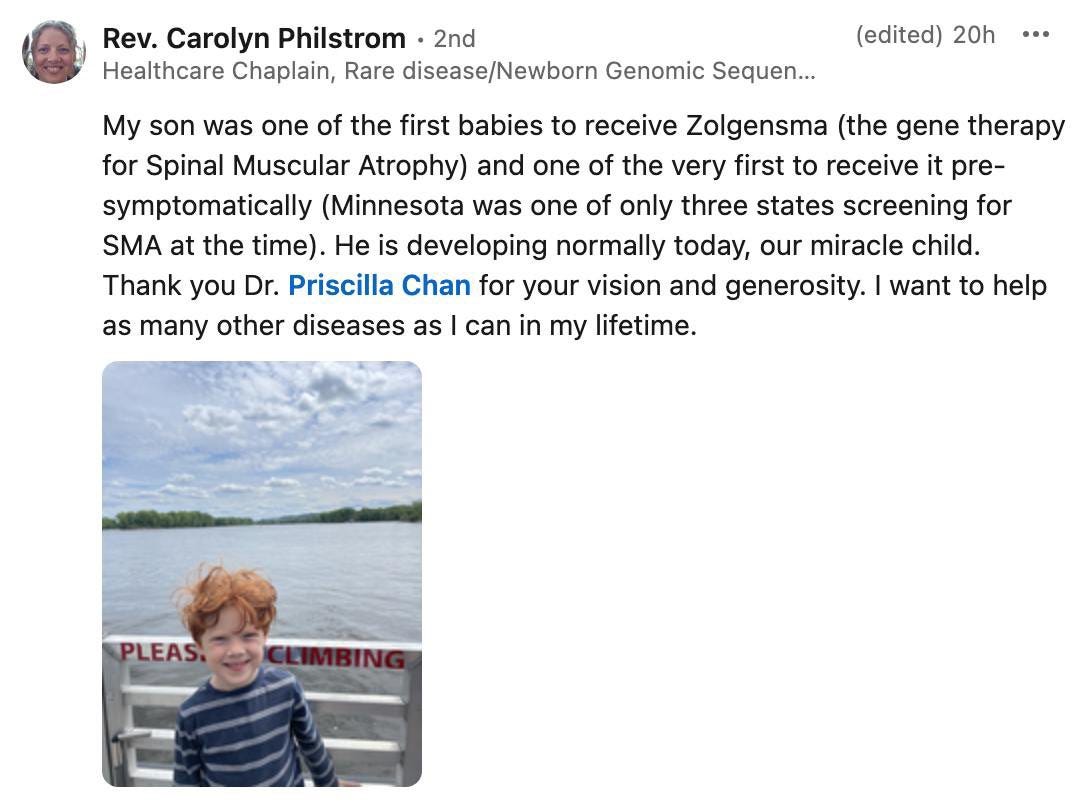
The space of in vivo gene therapies against rare congenital diseases, despite many setbacks, has also seen considerable success. Zolgensma, a gene therapy to treat spinal muscular atrophy, commonly known for its $2M price tag, has not only been a commercial success story, becoming a blockbuster in 2021, but more importantly, it has transformed the lives of babies with SMA, a disease with a life expectancy of just two years:
Despite these undeniable successes, as past and current high-profile failures show, gene therapy remains a modality defined as much by its limitations as by its breakthroughs:
Safety: high vector doses can trigger overwhelming immune reactions; off-target edits or unintended expression in critical tissues can cause organ failure or carcinogenesis; and irreversible interventions leave little room to intervene once toxicity emerges, making errors potentially fatal.
Delivery: efficiently delivering genetic payloads to specific tissues and cell types remains a central bottleneck. Many organs are poorly accessible, and achieving therapeutic concentrations without systemic exposure or toxicity is challenging, particularly for body-wide or deep-tissue indications.
Immune responses: pre-existing or induced immunity against vectors can limit efficacy, prevent redosing, or cause adverse events. Immune activation remains unpredictable across patients and indications, complicating trial design and long-term treatment strategies.
Expression control: Once delivered, genetic payload expression is difficult to finely tune. Over- or under-expression, variability across cells, and lack of temporal control can reduce efficacy or create safety risks, especially for potent or tightly regulated biological functions.
Durability: Therapeutic effects may diminish over time due to cell turnover or immune clearance. For many in vivo therapies, redosing is not feasible, turning durability from a clinical question into a hard commercial and regulatory constraint.
Manufacturing & cost: Gene therapies require complex manufacturing infrastructure, stringent quality control, and complex logistics. This results in high costs, particularly when applied to diseases with a small population
While we see the problems and agree with many of the criticisms of the gene therapy space, at LongeVC, we share a deep belief that gene therapy will play a pivotal role in the medicine of tomorrow, a medicine where we are able to engineer away disease and improve the human experience (including lifespan) with controllable updates to the body.
One way we believe this vision will play out and many of the bottlenecks in gene therapy will be resolved is by broadening the scope of where the technology is applied. Historically, taking into account how gene therapy evolved, the field has quite rightly focused on severe congenital diseases, and subsequently on cancer with ex vivo cell therapy, diseases where extreme unmet need justifies high risk and technical complexity. That work remains essential and irreplaceable. At the same time, we believe gene therapy is now mature enough to move beyond only the sharpest risk-benefit profiles and into more common, chronic, and age-associated diseases, starting with the patient subpopulations with the highest unmet need (like solid cancers without available treatments, familial hypercholesterolemia, and end-stage metabolic disease, and the like) but with an ability to expand quickly into subpopulations with a milder forms of the disease - which is essentially the whole population.
Doing so expands the addressable population, drives scale, forces improvements in safety, delivery, and manufacturability, and ultimately accelerates progress across the entire field, including for rare diseases themselves. We see several paths converging to make this happen:
Gene therapy manufacturing is becoming increasingly commoditized. If even a decade ago, producing gene therapies was a highly bespoke process, today, there are hundreds of organizations worldwide skilled in producing all kinds of gene therapy delivery vehicles and genetic payloads
While safety remains an utmost challenge, today, the industry has a much better understanding of gene therapy modes of failure, with all of the successes and failures of the past paved paths for the next generation of approaches in the space
In recent years, regulators have become more pragmatic about advanced therapies, expanding tools like the FDA’s RMAT, Breakthrough, and accelerated approval pathways to shorten review times and allow earlier efficacy signals to support approval. Agencies are also more willing to engage earlier on trial design and manufacturing expectations, lowering friction compared to a few years ago. In Europe, the recently proposed EU Biotech Act has a significant focus on streamlining advanced therapies, accelerating the start of such clinical trials and enhancing the incentives to develop such therapies. In Asia, Japan has been a leader in advanced therapies for a while, while China is quickly catching up by building out conditional approval pathways and priority review for innovative therapies. All of this now creates opportunities for regulatory arbitrage, where developers can sequence filings or choose jurisdictions with differing evidentiary requirements to de-risk programs and optimize timelines
We see this convergence on the ground already, with money being a good proxy. If a decade ago a company would need hundreds of millions to bring such a therapy into the clinic, today we routinely see gene therapies being able to reach the clinic with a fraction of that, locally violating the Eroom’s law - a good example here is EsoBiotec, which raised around EUR 22M before being acquired by AstraZeneca for $1B as they got their clinical readout.
Gene therapies for common diseases are already quietly taking over; the narrative simply hasn’t caught up yet. Some examples:
Eye disease gene therapy is moving fast: ABBV-RGX-314 (AbbVie/REGENXBIO) for treating chronic diseases like wet AMD and diabetic retinopathy, as well as 4D-150 (4DMT) and Ixo-vec / ADVM-022 (Adverum), both targeted at diabetic macular edema, are leading the charge, with many others following in the clinic
Kriya Therapeutics has “quietly” amassed nearly $1B in total funding, building a diversified common disease portfolio across ophthalmology, neurology, and metabolic disease
Verve Therapeutics, a company developing one-time in vivo gene editing therapies to knock out PCSK9, ANGPTL3 and LPA, with an aim to deliver lifelong cardiovascular risk reduction, has been recently acquired by Eli Lilly for $1.3B
We are bullish that this trend will continue to expand. Thus, all of our portfolio gene therapy companies are focused on the different facets of expanding the toolkit and applying it to common, age-related diseases. Below are some of the approaches that we are particularly excited about.
One thesis we are particularly excited about, especially in light of the in vivo CAR-T success, is human biomanufacturing - introducing genetic payloads that lead to a stable expression of biomolecules inside the body. One stealth company in our portfolio that we can’t name just yet enables this by creating localized “glands” able to produce biologic drugs directly in the patient, enabling essentially a one-time treatment of diseases that benefit from continuous application of such therapies.
Two immediate problems such an approach solves are (a) manufacturing (obviously) with its associated costs and (b) treatment adherence. Biomanufacturing, as highlighted firsthand by in vivo CAR-T, makes such therapies potentially much cheaper, as it removes many of the development-associated costs - just let the body produce the desired product. Treatment adherence is more nuanced, but producing a therapy inside the body removes the need for repeated patient action. While some therapies, particularly ones with long half-life or ones taken orally, are relatively simple, a one-and-done therapy, if safe, can massively improve uptake (and efficacy). Adherence to long-term therapies in chronic disease is notoriously low - for example, only ~50 % of patients take chronic medications as prescribed in developed countries, and rates for specific drugs like antihypertensives or antidiabetics often fall below 60 %. Even in oral oncology, adherence varies widely and can be far below ideal, with many patients struggling to follow regimens over time. This challenge is particularly pronounced for IV or infusion-based treatments (as most biologic treatments are), where logistical burdens like clinic visits and scheduling further erode consistent uptake and persistence.
Producing biologic drugs inside the body may also have benefits in terms of efficacy and safety of such therapies. Many non-antibody biologic drugs, while effective, require engineering for extended half-life, typically through Fc-fusion or PEGylation, but this stability comes at a cost. Such modifications often increase molecular size, alter tissue distribution, and change receptor engagement, which can blunt biological activity or introduce off-target effects. They also add manufacturing complexity, higher dosing requirements, and immunogenicity risk, and can lock developers into specific formulations that are difficult to optimize further. Producing such a molecule within the body removes the need for such modifications, and thus, removes these bottlenecks, and may even improve both efficacy and safety.
Long-term, this kind of biomanufacturing enables next generations of current treatments for chronic diseases - for example, by expressing adalimumab (Humira) directly in people who need it the most. Even longer-term, it enables something akin to a plug-and-play system to program the body to produce most therapeutic biologics, such as proteins with age-related declining expression, with an ability to control what and for how long something is produced, and potentially, at a patient-friendly, outcomes-based pricing model in mind, something like what Dave Ricks, the CEO of Eli Lilly (who just bought a one-and-done PCSK9 gene therapy), discussed in a recent podcast with the Collison brothers.
Many of the hardest limitations in gene therapy ultimately stem from a single problem - lack of biological precision. When powerful genetic payloads are delivered too broadly, expressed in the wrong cells, or activated at the wrong time, the result is unnecessary toxicity, immune activation, and narrow therapeutic windows. One of the most promising ways to address these constraints is not by changing the payload, but by radically improving where and when that payload is expressed.
The problem is that the healthy human body contains over 200 different cell types, with new cell types being uncovered every year. And even each particular cell type is essentially a spectrum of different states and behaviors, often ebbing and flowing between them depending on the situation, something that is particularly true in disease. What if we could target genetic payload expression to these states? In fact, we already can - cell-type specific promoters are standard in the space. However, the current approaches in the space are often quite crude, able to differentiate cell types but not cell states.
Our portfolio company Trogenix has gone a step further and developed a platform to identify key transcription factors to cell states of interest and design appropriate enhancer fragments for constructing what they call “synthetic super enhancers” (SSE) - engineered DNA regulatory elements that are only activated in diseased cell states. They act as docking stations for specific transcription factors that are exclusively expressed in aggressive cancer or diseased cells, thereby enabling precise gene control, leading to payload expression only where it’s needed.
Something we are particularly excited about is that the company chose glioblastoma. For one, one of the first gene therapy approaches in the clinic, in the 1990s, was in glioblastoma. More importantly, glioblastoma is a tumor notorious for invariably killing its two hundred thousand or so yearly sufferers, as well as for its incredible cellular heterogeneity, thought to be derived from glioblastoma’s roots in undifferentiated brain resident stem cells.
These two reasons for notoriety seem to be intrinsically linked. While surgical resection followed by aggressive chemo- and radiotherapy can debulk the tumor, glioma stem cells (GSCs), a stem-like, highly plastic subpopulation highlighting glioblastoma’s origins, largely survive treatment. These cells possess enhanced DNA repair capacity, metabolic adaptability, and resistance to cytotoxic stress, enabling them to reseed the tumor and drive recurrence, often along the invasive “spider-like” projections that infiltrate surrounding brain tissue.
In contrast to most prior approaches in glioblastoma, Trogenix’s lead therapy is designed to directly target these disease-defining cell states, inducing a dual cytotoxic and immune response specifically where it matters most. By restricting activity to a subset of malignant cells rather than the entire tumor mass, this strategy also minimizes widespread immune activation in the brain, a risk that has proven fatal in previous therapeutic attempts and remains one of the central challenges in treating CNS malignancies. Moreover, true to the company’s name, the therapy acts as a Trojan horse, opening the gates to the immune system. The combination payloads expressed from within the diseased cell reeducate the immune system, essentially as an in-situ personalised vaccination.
This approach, however, is not limited to glioblastoma. Most cancers, and as a matter of fact, most diseases, can be characterized by specific cell states, which can be harnessed to create therapies targeting such diseased states and sparing the healthy ones. Aging is also characterized by progressively changing and degenerating cell states, something an aging gene therapy of tomorrow could harness. Thus, Trogenix’s platform can allow potent genetic payloads to be expressed selectively in diseased or degenerating cells, expanding gene therapy from tissue-level targeting to state-aware precision medicine.
Taken together, these two examples illustrate what we think the next phase of gene therapy will look like. Note that we haven’t disclosed everything, as some of our other portfolio companies are quietly working on the next generation of genetic medicines. We are eager to support even more cutting-edge approaches with our Fund II.
In particular, we see significant potential in next-generation genetic payload delivery - including novel viral and non-viral delivery systems, as well as approaches that enable redosing, improved tissue specificity, and reduced immunogenicity of existing vectors, especially AAVs. In parallel, we are excited about the expansion of the in vivo immune cell reprogramming toolkit, spanning both delivery modalities and genetic payloads, as well as a broader set of immune cell types beyond traditional T cells.
Three caveats. One, while this article explicitly separated transient genetic medicines from the permanent, we are bullish on the potential of RNA therapies in enabling engineering humanity as well. Two, as you may have already thought to yourself, this article is quite light on gene editing - this is a whole different beast overall, which deserves its own super-article, and is something we are deeply excited about. Three, there are many other potential technologies that we are not necessarily explicitly aware of - but we would like to be, so if you are building in the space, do not hesitate to reach out.
Special thanks to Joseph Burns and Ken Macnamara for their reviews of and suggestions for this article
Disclaimer: This article is intended for informational and educational purposes only. Nothing contained herein should be construed as investment advice, financial advice, or a recommendation to buy, sell, or hold any securities or other financial instruments. The biotechnology and pharmaceutical sectors involve significant risks, including regulatory uncertainty, clinical trial failures, and market volatility. Readers are strongly encouraged to conduct their own research and consult with qualified financial professionals before making any investment decisions. Past performance of any company or technology mentioned is not indicative of future results.
No posts
Comments
Nothing yet. Say the first thing.
Sign in to join the conversation.