
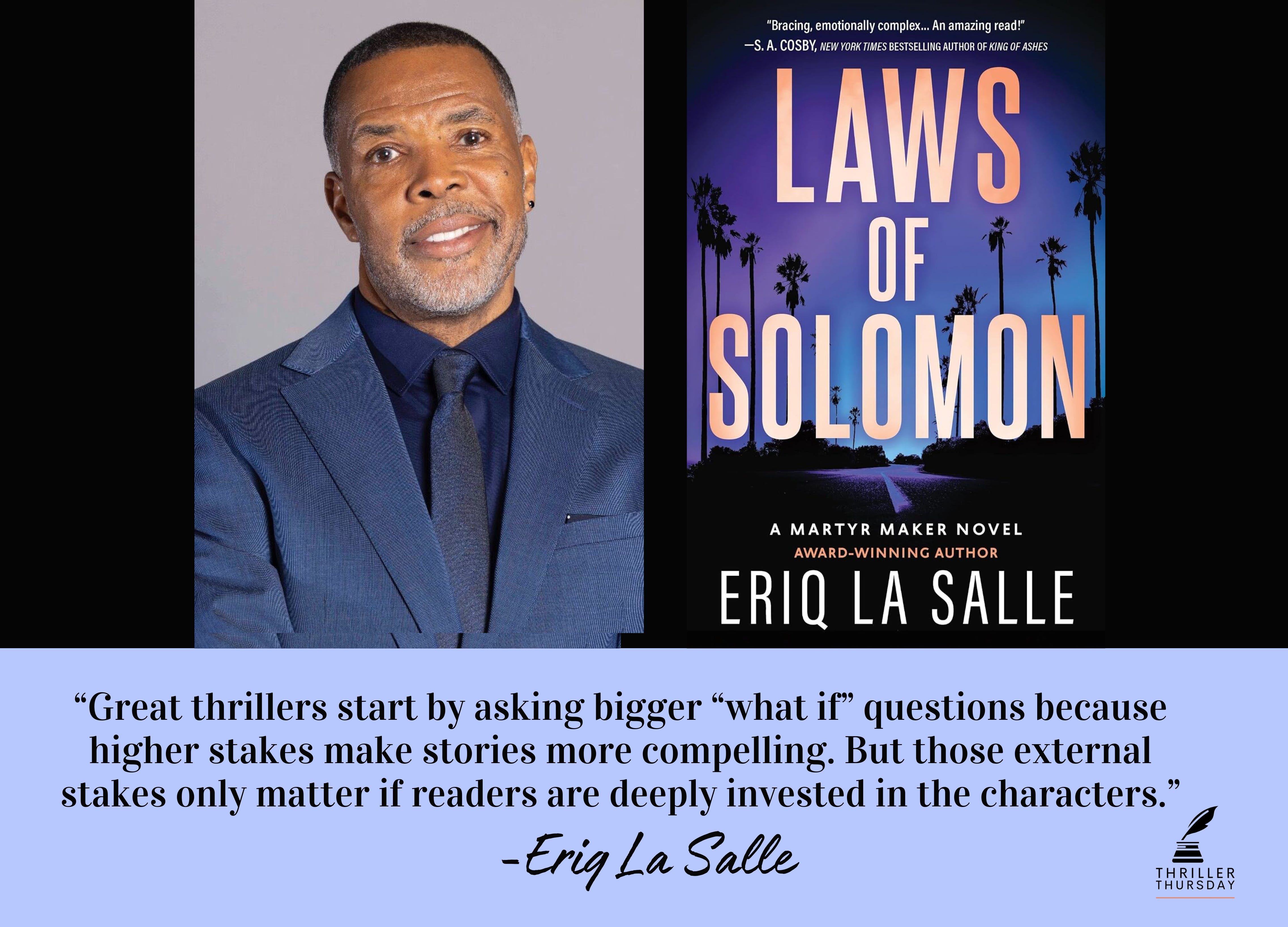
Actor, director, producer, and masterful storyteller Eriq La Salle is best known to worldwide television audiences for his award-winning portrayal of Dr. Peter Benton on the medical drama ER. Educated at Juilliard and NYU’s Tisch School of the Arts, his credits range from Broadway to film roles, starring alongside Eddie Murphy in Coming to America, Robin Williams in One Hour Photo, and Hugh Jackman in Logan. La Salle has worked as a director for HBO, Showtime, Netflix, Amazon Prime, ABC NBC, Fox and CBS productions. As a writer, La Salle is the author of several critically-acclaimed thrillers published by Sourcebooks—Laws of Depravity (2022), Laws of Wrath (2023), and Laws of Annihilation (2023).
His new novel, Laws of Solomon, is coming September 8!
For today’s interview, we have a special treat! A recorded conversation from Carter’s Making It Up interview with Eriq La Salle.
Among other things, Eriq and Carter discuss Eriq’s journey entering the writing industry when he already had a degree of fame, feeling like a “real” writer when you self-publish, and the movie The Godfather. At the end of their conversation, they make up a fascinating story using a line from Lisa Gardner’s Kiss Her Goodbye.
As someone who built a successful acting career before becoming a novelist, did you find the publishing world welcomed you?
It was a mixed experience. Sometimes having a name in another industry actually makes it harder because people don’t immediately take you seriously as a writer. There’s a perception that you’re just another actor who decided to write a book. I never felt unwelcome, but I did feel like I had to prove I was committed. Over time, by showing up at conferences, doing the work, and continuing to write, people began to see I was serious about writing. Eventually they started talking about the books instead of simply the fact that I’d written one.
Your first books were self-published before Sourcebooks picked up the series. What did that journey teach you?
Like so many writers, I went through the traditional submission process and collected plenty of rejections. I believed in the books, so I self-published rather than letting them disappear. Self-publishing comes with its own stigma because there’s no gatekeeper, and I admit I even have to catch myself making assumptions when someone tells me they’re self-published. But sometimes that’s exactly where great books come from. When I finished my third novel, my agent told me, “You’re not self-publishing again. These books are too good.” Sourcebooks bought that book and even republished my first two novels, so it ended up being the best possible outcome.
You made successful transitions from acting to directing and then to writing. What helped you navigate those career changes?
Every transition comes with skepticism. When I wanted to direct, I deliberately avoided directing ER first because I didn’t want people to think I was handed the opportunity. Instead, I made short films and worked toward earning an HBO movie as my directing debut. I approached writing the same way. You can’t control other people’s assumptions, but you can control your preparation, your work ethic, and your willingness to keep improving.
You didn't publish your first novel until you were 50. What finally convinced you to make the leap?
Writing actually came before acting. I was writing poetry as a kid, long before I ever stepped onstage. But after decades of acting and directing, I had to confront that voice asking, “Who am I to write a novel?” Novels feel like one of the most revered art forms, and I wondered whether I belonged. Then I realized that everything I’d done, whether acting, directing, producing, or writing, came from the same place. I’m a storyteller. Once I accepted that, writing a novel felt like a natural extension of the work I’d been doing all along.
Are you an outliner, or do you discover the story as you write?
I definitely discover it as I go. I love not knowing exactly where the story is headed. For my first novel, I actually knew the antagonist before I knew the protagonist. Sometimes I get stuck for a while, then I’ll take a walk, come back, and suddenly everything opens up. That’s part of the joy for me. I like being surprised by the story rather than following an outline or a stack of index cards.
What separates a good thriller from a great one?
Great thrillers start by asking bigger “what if” questions because higher stakes make stories more compelling. But those external stakes only matter if readers are deeply invested in the characters. I always think about The Godfather. Michael Corleone commits terrible acts throughout the film, but one of the most heartbreaking moments is when he lies to his wife. That quiet moment tells us he’s lost his soul. For me, that’s what great storytelling is about. The plot may pull readers in, but it’s the characters that stay with them.
Comments
Nothing yet. Say the first thing.
Sign in to join the conversation.