
Here's a fun fact to throw out at parties: the formula for the circumference of a circle is exactly the derivative of the area. If A(r) denotes the area as a function of r and C(r) the circumference, then

That's pretty neat, isn't it? We can explain it intuitively by thinking of the interior of the circle as being like infinitely many nested circles. When you increase the radius a very small amount, say Δr the added volume is basically a rectangle wrapped around the circle. The height of the rectangle is Δr, and the width is the circumference, so the change in area ΔA basically equal to Δr times the circumference C(r), so ΔA/Δr≈C(r). This approximation gets better and better for smaller Δr, so the derivative is equal to C(r)
But what about other shapes? The next simplest regular shape to compute the area and perimeter would be a square, with side length s

It's still proportional, but not equal.
What about an equilateral triangle with side length s? Computing the area requires using the Pythagorean theorem, but it's still pretty straightforward
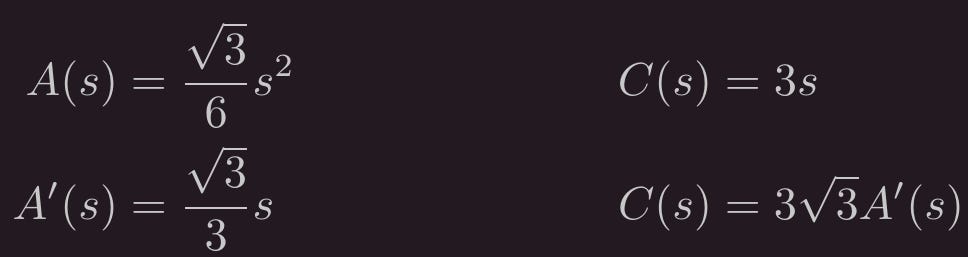
Once again they're not equal, but they are proportional. One might ask whether the area derivative and perimeter are always proportional - and the answer is yes! Let’s unpack and explore it a bit.
First, a definition: we say two shapes are similar if they’re the same except for a scale factor. Basically, they’re the same basic shape, but one might be bigger than the other. In the case of polygons, shapes made with straight lines, we can say that they’re similar if they have all the same angles.
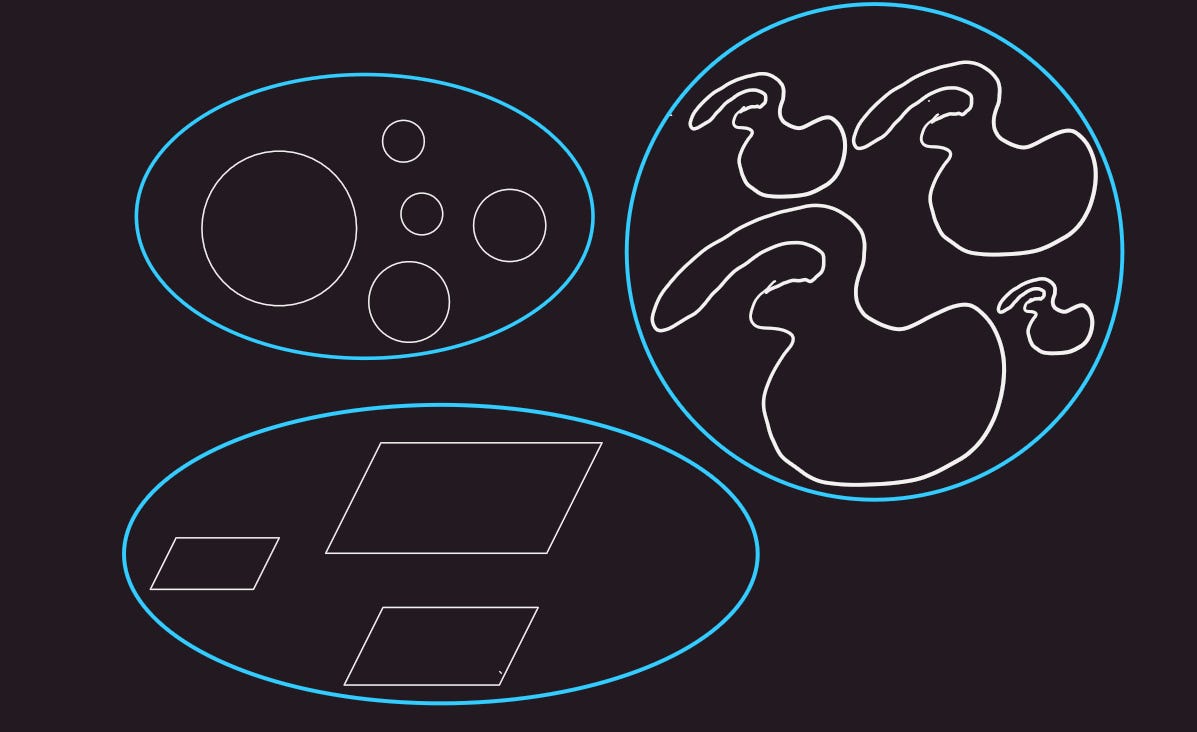
Now let’s think about a family of similar shapes: that is, pick a shape, and consider all the shapes that are similar to it. The set of all squares is a family of similar shapes, as is the set of all circles, all rectangles that have one side twice as long as the other, and all shapes that look like this
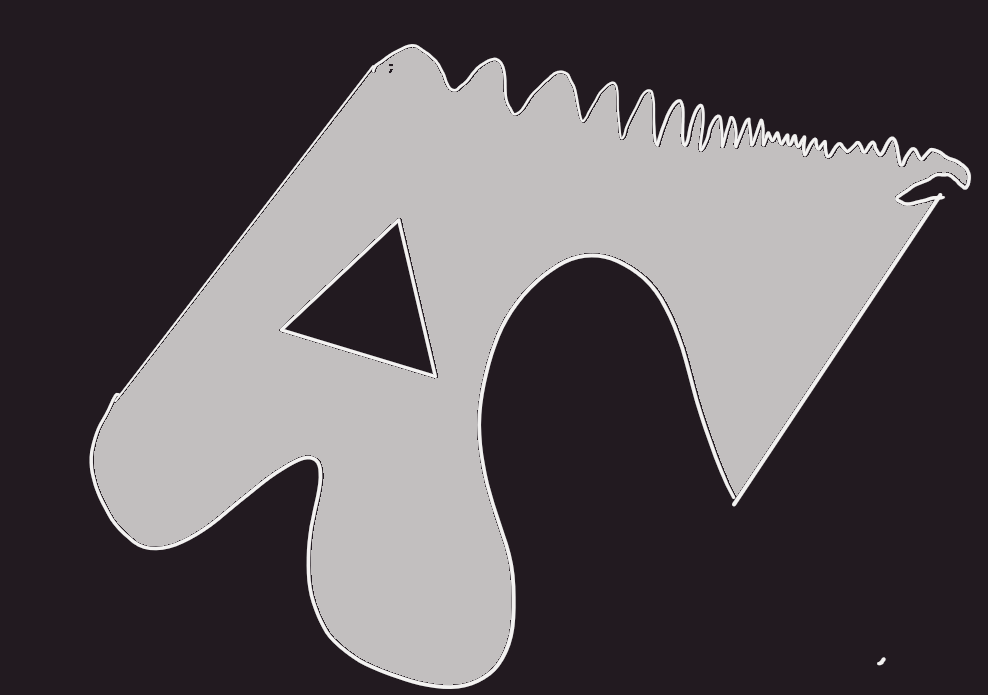
Once we have a family of similar shapes, we can specify one of them with some distance within them. For instance, we can specify a circle by its radius, or a square by its side length, or a flurgus by the distance from the triangular hole halfway to the bottom of the third bump on the squiggly bit on the top. Whatever we decide, we’ll call this the characteristic parameter of the family of similar shapes. If you make the characteristic parameter twice as long, then you make the shape twice as big.
But we need to be specific about what “twice as big” means. Consider the square. If we decide its characteristic parameter is its side length, then when we double it, we double the perimeter, but we quadruple the area
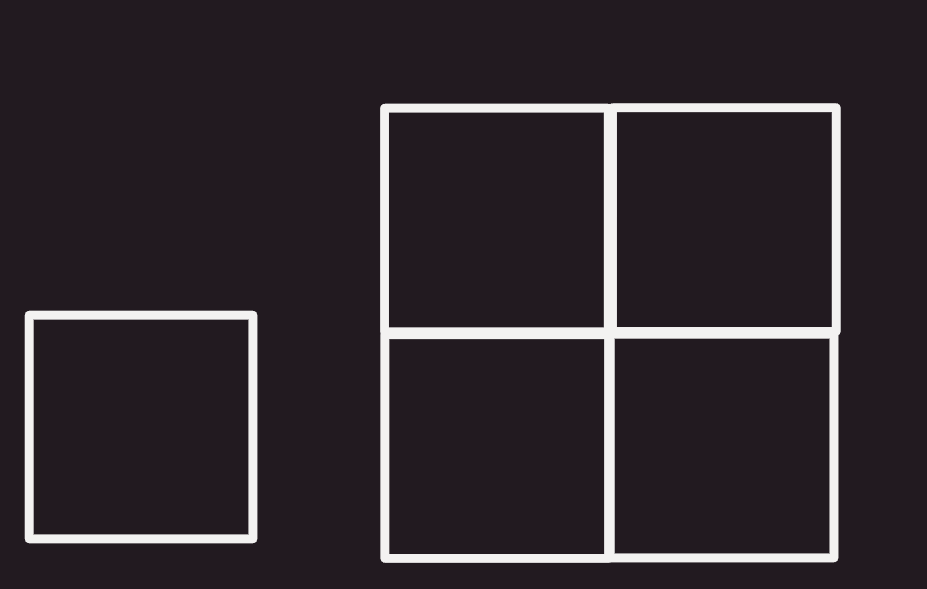
Likewise if we divide the side length by three, we divide the volume by nine.
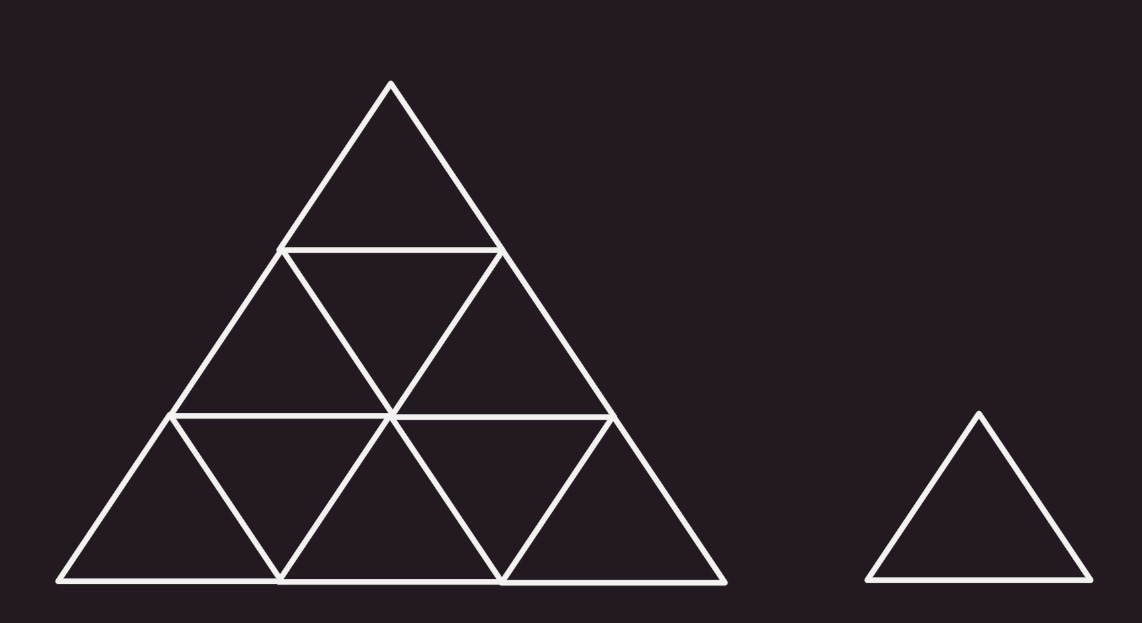
Indeed, for any shape, if you multiply its characteristic parameter by some number, call it λ, then you’ll multiply all of its one-dimensional values by λ. This includes the perimeter, but also the length of any side, diagonal, or any other line segment you can draw within the shape.
On the other hand, the area will go up by a factor of λ². If we instead considered a family of similar three-dimensional shapes, you’d see the volume change by a factor of λ³ as well, and so on and so forth. For four-dimensional space the “four-dimensional volume,” whatever that means, would scale up by λ⁴. In some sense, this is a way that you can define what it means for something to be 1,2,or 3-dimensional, or more. With this definition, there can be shapes that are 1½-dimensional, or π-dimensional, but those are a story for another time.
This is why so many area formulas look basically like A = C×x² and perimeter formulas look like P = C×x, where C is some number that depends on the shape, and x is a parameter. For a circle, you have A = πr², P = 2πr. The parameter is r, the constant for area is π and the constant for perimeter is 2π. For a square, A = s², P = 4s. The area constant is 1, the perimeter constant is 4. For an isosceles right triangle (both the legs are the same length), A = ½s², P = (2+√2)s.
Technically I should point out that not all formulas look like this. The area of a trapezoid for instance is A=½h(b₁+b₂). This is because not all trapezoids are similar. If you mandated for example that the lower base be exactly thrice the upper base; b₂=3×b₁, and that the height be equal to three fourths the upper base; h = ¾b₁, then all of your trapezoids would be similar and the formula would reduce to A = 1½ b₁².
To demonstrate this fact, let's compute the area of a non-equilateral triangle:
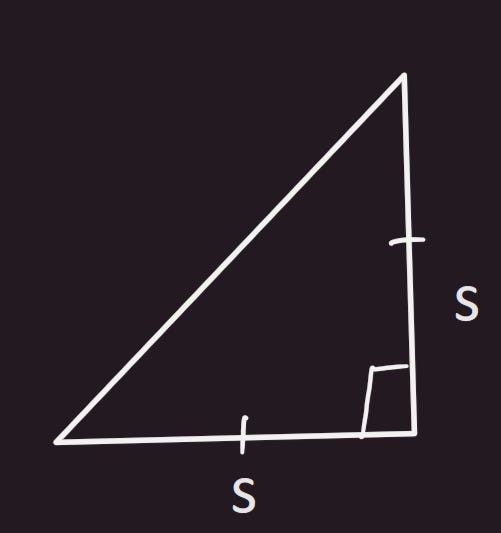
Again with a bit of Pythagoras, we can compute
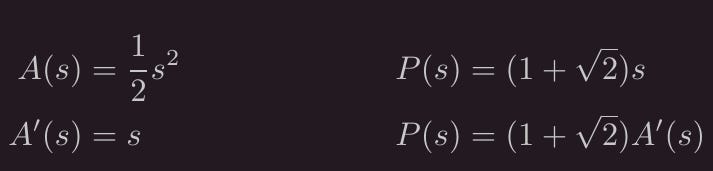
So to recap, say we have some family of similar shapes. Say we have a specific shape in that family, and call its characteristic parameter x. If we then multiply the characteristic parameter by a number, call it λ, then the area will change by a factor of λ² and the perimeter by λ. We can write that out like this

Now we can do something kind of sneaky: we can view our shape with characteristic parameter x as a scaled version of a shape with characteristic parameter 1. If we use this in light of our previous equation, we get
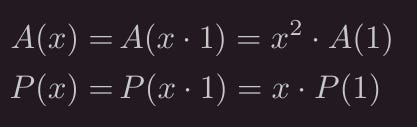
Isn't that neat! Remember earlier when I said that all area/perimeter formulas look like some constant times x² or x, now we have a way to find what that is! The area constant is the area of a shape with characteristic parameter 1, and the perimeter constant is the perimeter of a shape with characteristic parameter 1. For example, the area of a circle with radius 1 is π, so the area formula is A=πr^2. The perimeter is 2π, so C=2πr. For a square of side length 1, we have an area of 1 and a perimeter of 4, so A=s², P=4s.
But let’s not forget where we started: we were comparing the perimeter of shapes to the derivative of the area. Let’s define A_0 and P_0 to be the “base” are and perimeter of the family of shapes; that is, the area and perimeter of a shape with characteristic parameter 1. We have
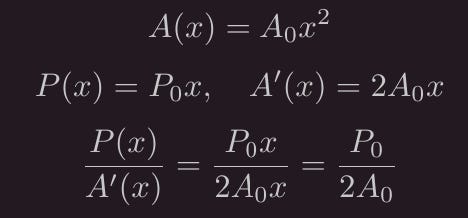
So, for any family of similar shapes, to find the ratio between the perimeter and the derivative of the area, you can just compute the area and perimeter when the characteristic parameter is 1, and then divide the perimeter by twice the area.
I for one think this is pretty neat - the perimeter and area of just one shape determine the relationship between the perimeter and area of all similar shapes, across all different scales. You only have to compute it once, and then you have the relationship forever. Let's call this the perimeter ratio of a family of similar shapes, and call it R.
But then we run into a minor snag. Remember where we started, with the circle
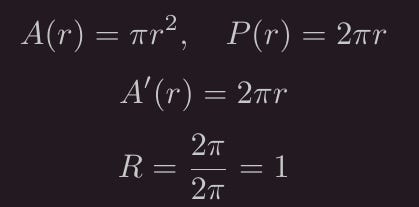
Our characteristic parameter here is the radius of the circle, but why? It seems kind of arbitrary. Why not try the diameter? We can recompute A_0 and P_0 for a circle with diameter 1 instead of radius 1. If D=1 then r=1/2, so we have
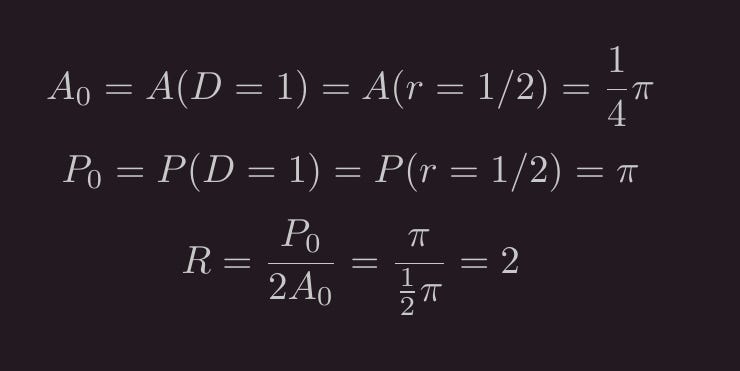
Which is a different area ratio from what we got when we used the radius. This is a bit annoying – it means that the perimeter ratio isn’t something fundamental to the shape like we originally thought. Picking a different characteristic parameter, even for th same family of shapes, will give us a different characteristic ratio. We conclude that rather than talking about “a family of similar shapes,” we should instead talk about a family of similar shapes with a characteristic parameter.
But not all hope is lost. Say we have a family of similar shapes with a characteristic parameter, like “square with side length.” We can use that to get a new family that has the same shapes, but a different length, like “square with diagonal length.”

With a dash of the pythagorean theorem, we can see that the diagonal length d of a square is √2 times the side length. Then we can compute the perimeter ratio for these two families:
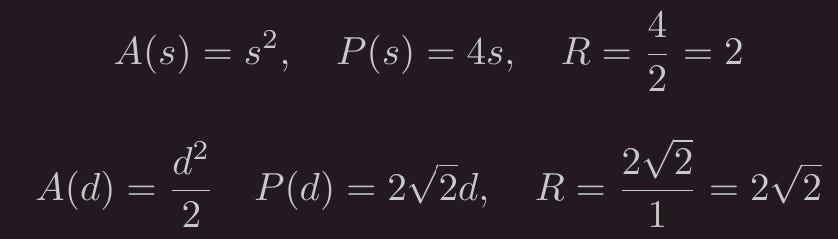
Or for an equilateral triangle, with characteristic parameter first its side length, then its height
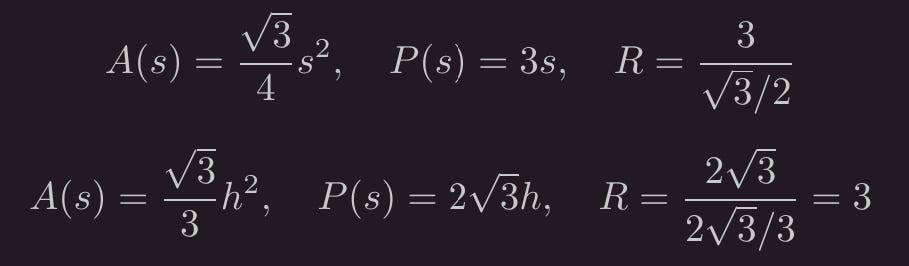
In fact, you might notice that since everything in similar shapes is proportional, any choice of characteristic parameter is just a multiple of another one. The diameter is twice the radius of a circle, the height of an equilateral triangle is √3/2 times its side length, and so on. In general, if you change the characteristic parameter to something that’s λ times where you started, what happens to the ratio?
Say we have a family of similar shapes with a characteristic parameter, call it x. Say we consider a new characteristic parameter, y = λx. The old ratio depends on x=1, and the new one when y=1, which is when x=1/λ. Let A₁ and P₁ denote the area and perimeter of the shape where y=1, so that our new ratio R₁ = P₁/2A₁:
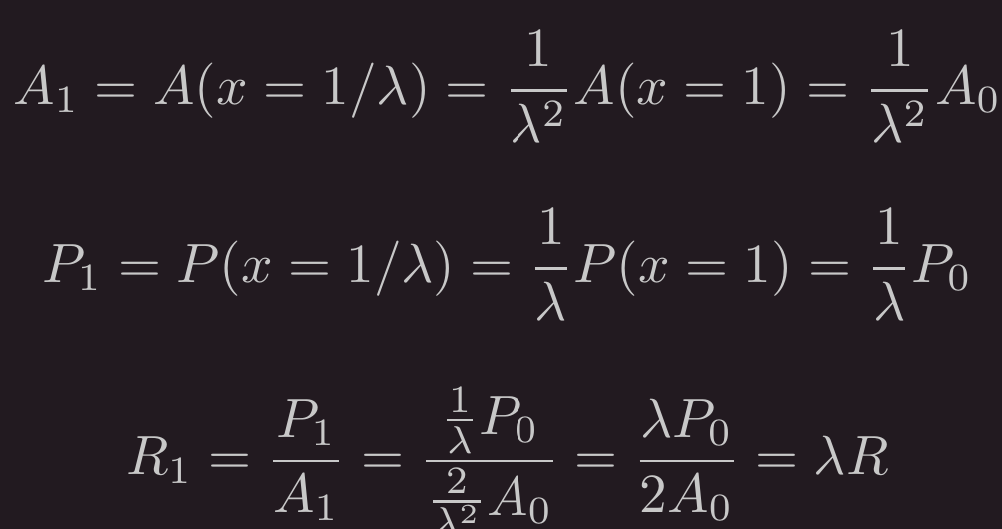
Now this is really interesting. It means that for any family of similar shapes, by picking the right characteristic parameter, you can make the perimeter ratio equal to whatever you want (as long as it’s positive of course). In particular, you can always find some length on the shape such that if you make that the characteristic parameter, the ratio is 1. This is now a new value that can be measured for a given shape. At the risk of being overly grandiose, I’ll call it the characteristic length of the shape.
For a circle, the characteristic length is the radius, which is maybe a good reason that we tend to use it, rather than the diameter, to specify a circle. The perimeter ratio for a square with respect to its side length is 2, so its characteristic length is half its side length. Similarly, the characteristic length of an equilateral triangle is 1/√3 times its side length, or one third of its height.
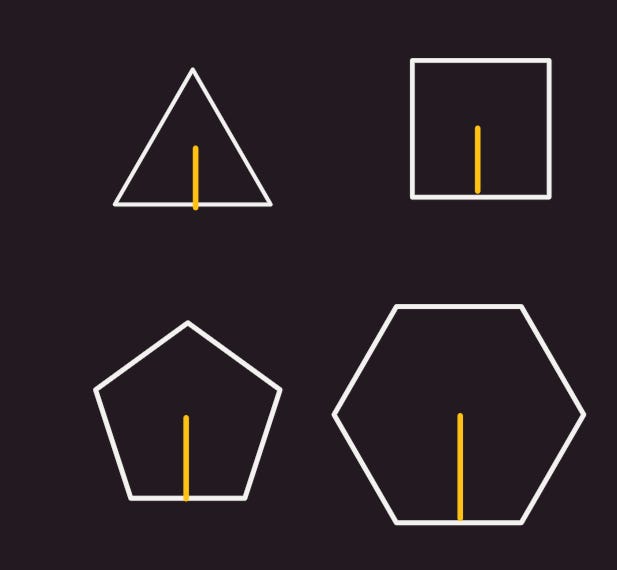
One might ask if there’s any geometric significance to the characteristic length of a shape, and the answer is kind of. For example, for a regular polygon, the characteristic length is the distance from the center of the shape to its edge, which is sometimes called the apothem.
For other families of shapes, it’s difficult to say, but I encourage you to play around with it if you’re interested. This article came about from the very open-ended question of “is there a general relationship between the derivative of a shape’s area and its perimeter,” and I didn’t expect to have nearly this much to say about it.
I also want to leave you off with a bit of a moral to this story, which actually requires us to step back a bit. Recall, describing the area ratio for a family of similar shapes requires not only the shapes, but also the characteristic parameter by which they’re measured. It’s rather common in math that you want to study or describe something, and find that there are more parameters or degrees of freedom than you might expect. For example, determining whether an expression like x² or (x+1)/(x-1) defines a function, or whether that function is injective or surjective, depends on its domain and codomain. Or, for some more high-octane examples, the quotient of a group by another group depends on exactly which isomorphic subgroup you’re quotienting by, and the sum of a conditionally convergent series can very wildly depending on what order you sum the terms in.
So if you take anything from this little expose into geometry, make sure to keep that idea in mind when you’re exploring new mathematical ideas. Remember every time you make an arbitrary choice, and see what happens if you change that. And if you’re having trouble proving or analyzing something, try fixing a parameter or two and see if that makes it easier.
No posts
Comments
Nothing yet. Say the first thing.
Sign in to join the conversation.