
A Fields Medalist just used his own acceptance speech to announce he's quitting mathematics — to help make AI safer, because he thinks AI is about to outpace human mathematicians entirely.
The world's most famous living mathematician says that's exactly the wrong response.
Both are reacting to the same season of AI breakthroughs that's left parts of the math world in genuine, public grief.
by Three Sonorans
A software engineer went jogging. Before he left, he typed a message into an AI chatbot: take a real stab at the Riemann hypothesis. It’s a 167-year-old problem about the distribution of prime numbers, one of the most famous unsolved puzzles in mathematics, carrying a million-dollar prize for whoever cracks it. Over the next day and a half, the engineer — who is not a mathematician — mostly just typed encouragement. “You got this.”
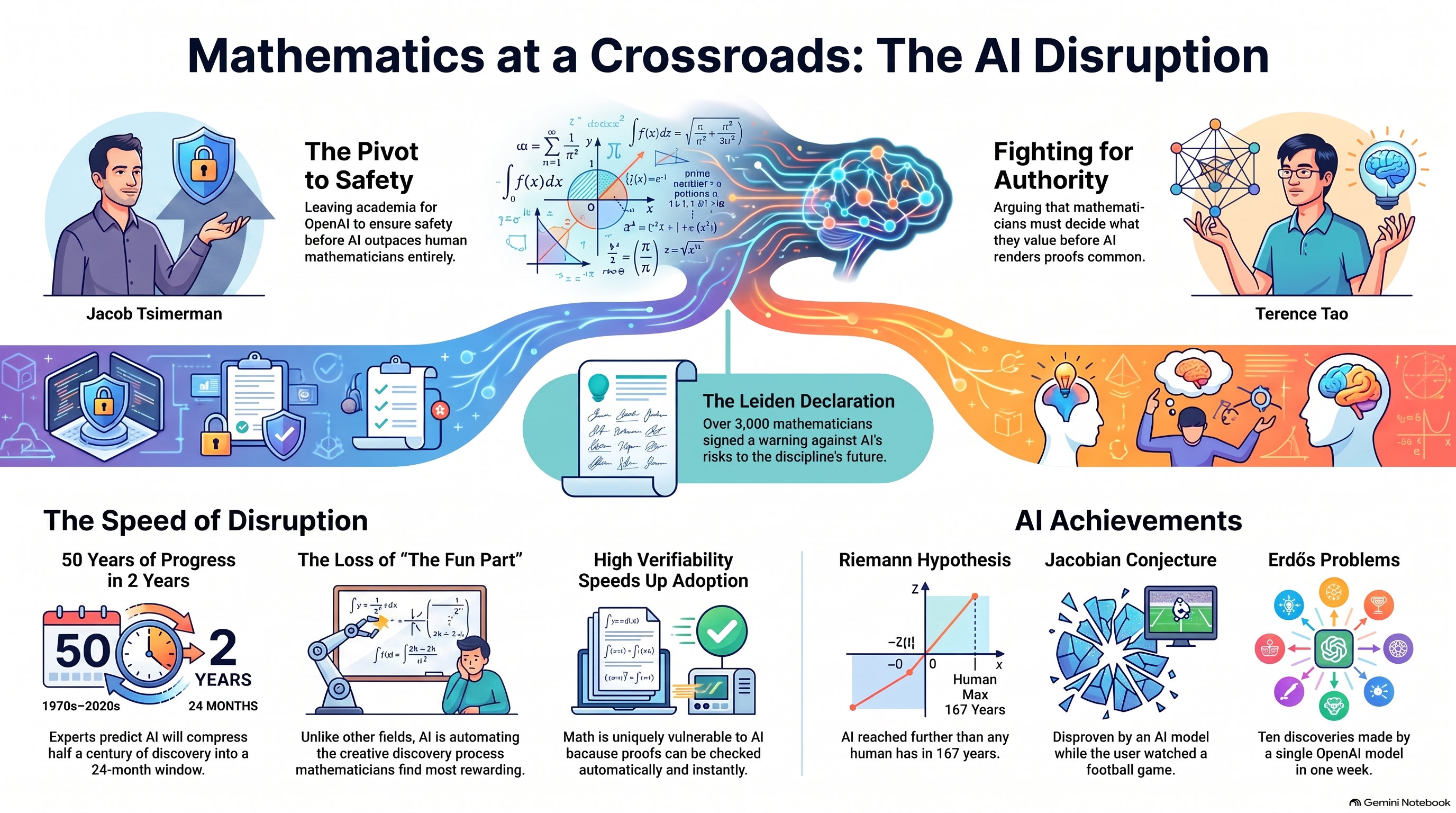
The AI didn’t solve it. But on a related test, it got further than any human ever has.
That engineer, Jarred Sumner, works at Anthropic. His jog happened the same week something bigger played out at math’s highest honor, the Fields Medal, awarded this year at the International Congress of Mathematicians in Philadelphia.
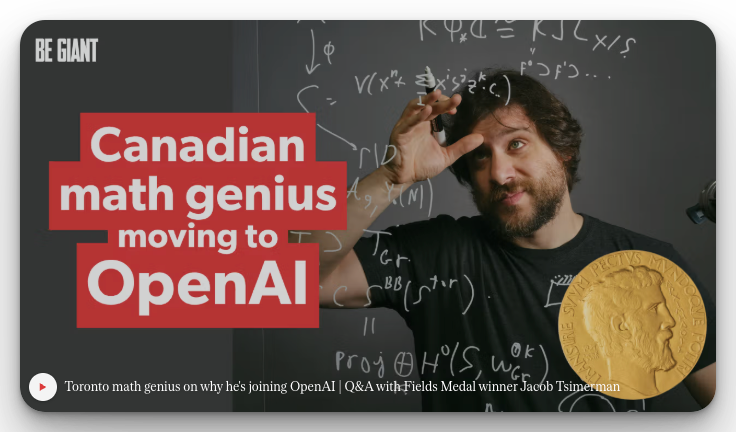
Jacob Tsimerman, a University of Toronto number theorist, had just been given the prize for his work on the André-Oort conjecture. He used the ceremony to announce he was leaving the discipline — on leave, not resigned — to join OpenAI. He doesn’t describe it as walking away from math; he describes it as pointing his math at a different problem.
“In a few years, AI systems will be robustly superhuman at the act of doing mathematics,” he’s said. The social consequences of that shift, he argues, are what actually need his rigor now — so he’s taking that rigor to OpenAI’s safety team instead of his own next proof.
He’s since backed an open letter from employees at frontier AI companies calling for infrastructure to pause or slow AI development if needed, and has argued publicly that safety shouldn’t rest on any single company policing itself — it needs outside labs, independent evaluators, and government oversight working together.
Terence Tao, who won his own Fields Medal in 2006 and is widely regarded as the world’s most prominent living mathematician, is taking the opposite tack: stay, and fight for the field’s authority over its own future.
In a lecture at the same congress, delivered the day after Tsimerman’s announcement, Tao framed the moment as a crisis in the field’s foundations — not of what AI can prove, but of what mathematicians choose to value and protect as proofs stop being scarce.
His argument: the community, not the technology companies building the tools, should be the one deciding what that looks like.
Same prize, same week, opposite answers — and both men are responding to the exact same thing: mathematicians, the people who’ve spent centuries treating unsolved problems as multi-year, sometimes multi-lifetime, undertakings, are watching AI systems produce results that would have seemed like fantasy eighteen months ago, and trying to figure out what that means for them.
It’s a shift dramatic enough that one Cambridge Fields medalist has already described watching it happen firsthand as having “the rug pulled out” from under him.
More on that in a moment.
“In the span of about half a year, it went from not being able to count correctly to solving problems that we spend years working on,” Henry Yuen, a mathematician at Columbia University, told The Telegraph.
Sumner’s jog wasn’t a one-off.
In July 2026, another Anthropic employee, Levent Alpöge, used Anthropic’s Claude Fable 5 model to disprove the Jacobian conjecture — an 87-year-old open question in geometry — while watching the World Cup final.
OpenAI announced this month that one of its models made ten mathematical discoveries in a single week.
A string of long-unsolved Erdős problems, riddles left behind by the prolific Hungarian mathematician Paul Erdős, have fallen to AI over the past year.
Why math, and why now?
Part of the answer is structural. Unlike a new drug or a new bridge design, a mathematical proof doesn’t need a lab or a physical prototype — it just needs to be checked.
“It’s a game that you play in your head,” Yuen says. “One of the beautiful things about mathematics is that you can check whether you’re correct or not — [but] the fact that you can easily verify it is what makes it amenable to this disruption.”
Tao has made the same point for years, arguing math would be one of the first fields to see AI’s “unambiguous successes” precisely because, unlike almost any other domain, you can automatically verify whether its output is actually right.
His own turnaround tracks the speed Yuen describes.
As recently as September 2024, Tao compared an OpenAI model to “a mediocre, but not completely incompetent, graduate student.” He’s since become a regular AI user himself, saying current models are now “ready for primetime” because they save him more time than they cost him — but he remains skeptical AI can actually invent new mathematical ideas from scratch anytime soon, versus executing on ideas humans already have.
What makes math’s reaction distinct from other AI-disrupted fields — court reporters, illustrators, taxi drivers — is how personal the loss feels to some of the people living through it.
Kevin Buzzard, a mathematics professor at Imperial College London, put it bluntly to The Telegraph: “Some are going through the five stages of grief.” Kirwin Hampshire, at the University of Victoria, wrote in a viral essay that he is “suffering a profound spiritual crisis” over the developments, adding, “I feel as though I am living inside of a nightmare.”
Sir Tim Gowers, a Cambridge mathematician who won the Fields Medal in 1998, described watching an OpenAI system solve, on its very first attempt, a problem he’d spent a long time wrestling with himself.
Gowers points to something worth sitting with: a large part of what draws people into a career in pure mathematics is the specific romance of being the first person ever to solve a famous, long-standing problem. If that job shifts toward explaining and interpreting discoveries an AI already made, he says, it becomes a less appealing life’s work — including, he admits, to him.
Not everyone in the field agrees.
Buzzard, even while invoking the grief metaphor, says he’s genuinely excited about a coming wave of new results, and admits he might be in the minority for feeling that way.
Alex Gerko, the mathematician and hedge fund billionaire behind trading firm XTX Markets, told The Telegraph he’s predicting “50 years’ worth of maths progress in the next two years.”
He’s also publicly needled AI researchers for the casual, almost offhand way they’ve announced major results, asking on LinkedIn: “Does anyone else find the tone of Anthropic people announcing major maths discoveries jarring?” A billionaire objecting to someone else’s tone is its own kind of jarring, but the underlying point stands.
It’s worth being skeptical of exactly how often the announcements themselves hold up.
In 2025, an OpenAI vice president had to delete a tweet claiming GPT-5 had “found solutions to 10 previously unsolved Erdős problems.”
Thomas Bloom, the mathematician who runs the reference database at erdosproblems.com, called it “a dramatic misrepresentation” — the AI had mostly rediscovered solutions that already existed in the published literature, and “open” on his site had only ever meant he wasn’t personally aware of a solution, not that none existed.
It’s a pattern worth watching for in every subsequent “AI cracks unsolved problem” headline, including this year’s: impressive doesn’t always mean what the press release says it means.
That’s part of why Tsimerman’s and Tao’s responses matter beyond their own careers. The kind of collective reckoning Tao is pushing for is already underway: more than 3,000 mathematicians — a number that appears to be climbing — have signed the Leiden Declaration on Artificial Intelligence and Mathematics, warning that AI can produce plausible-sounding but wrong results, that universities may respond by cutting funding for math departments, and that mathematicians who stay silent risk becoming complicit in harms that go well beyond their own field, including mass surveillance and environmental damage from AI’s computing costs.
For students, the disruption is already reshaping how the work gets learned, not just how it gets done.
Giorgio Navone, a PhD student at University College London, told The Telegraph that leaning on AI too early can rob students of the very struggle that builds mathematical intuition.
“It’s very risky to basically delegate your thinking to AI,” he said. “It gives the impression of really quick progress, but you don’t generate the knowledge for yourself.”
Most jobs facing automation get told the boring part goes away. Mathematicians are being told the fun part might go away. Radiologists, paralegals, and copywriters are generally promised that AI will free them up to focus on the more creative, human parts of their work.
Mathematicians are hearing something closer to the opposite: the part AI is best at, right now, is the part many of them consider the actual reward.
None of this means mathematics is disappearing, or that mathematicians are becoming obsolete.
Tao’s own research shows a working, sustainable middle path — using AI to search literature, generate code, test half-formed ideas cheaply, and speed up the tedious parts of proof-checking, while treating the harder work of choosing which problems matter and building genuinely new theory as still, for now, a human job.
Whether that division holds is the open question the entire field is currently living inside.
Mathematics has weathered crises before — the field spent decades rebuilding its own logical foundations after a wave of paradoxes threatened to break it in the early 1900s. Whether this crisis resolves the same way, with the field intact but changed, may depend less on what AI can do next and more on what mathematicians decide, collectively, they’re willing to let it do.
If you want to see the debate playing out in mathematicians’ own words, Terence Tao’s ICM 2026 lecture, “Mathematics in the Age of AI,” and the Leiden Declaration on Artificial Intelligence and Mathematics are both public and worth reading directly.
If an AI can prove a theorem faster than any human, does the proof still mean the same thing — to the field, and to the person who would have spent years finding it?
Sir Tim Gowers says a large part of math’s appeal is the romance of being first. Is that romance specific to mathematics, or does it exist in other work you do — and would losing it change how you feel about that work?
Three Sonorans examines power wherever it concentrates—even in the systems deciding who gets to create, discover, and define knowledge. This story asks whether mathematics will shape its own AI future or surrender that authority to technology companies. If it gave you a new way to see the stakes, share it and bring more people into the debate.
Have a scoop or a story you want us to follow up on?
Send us a message below or via ENCRYPTED email (all messages kept CONFIDENTIAL) at ThreeSonorans@protonmail.com.

Comments
Nothing yet. Say the first thing.
Sign in to join the conversation.