
The GIST
Rocque Perez voted to send public money to the nonprofit he was about to return to and lead, months before that return. Then he signed its state filings as CEO while he was supposedly on unpaid leave.
Here's the paper trail Pima County still hasn't explained, ahead of an August 25 vote on his organization's $122,000 contract.
by Three Sonorans
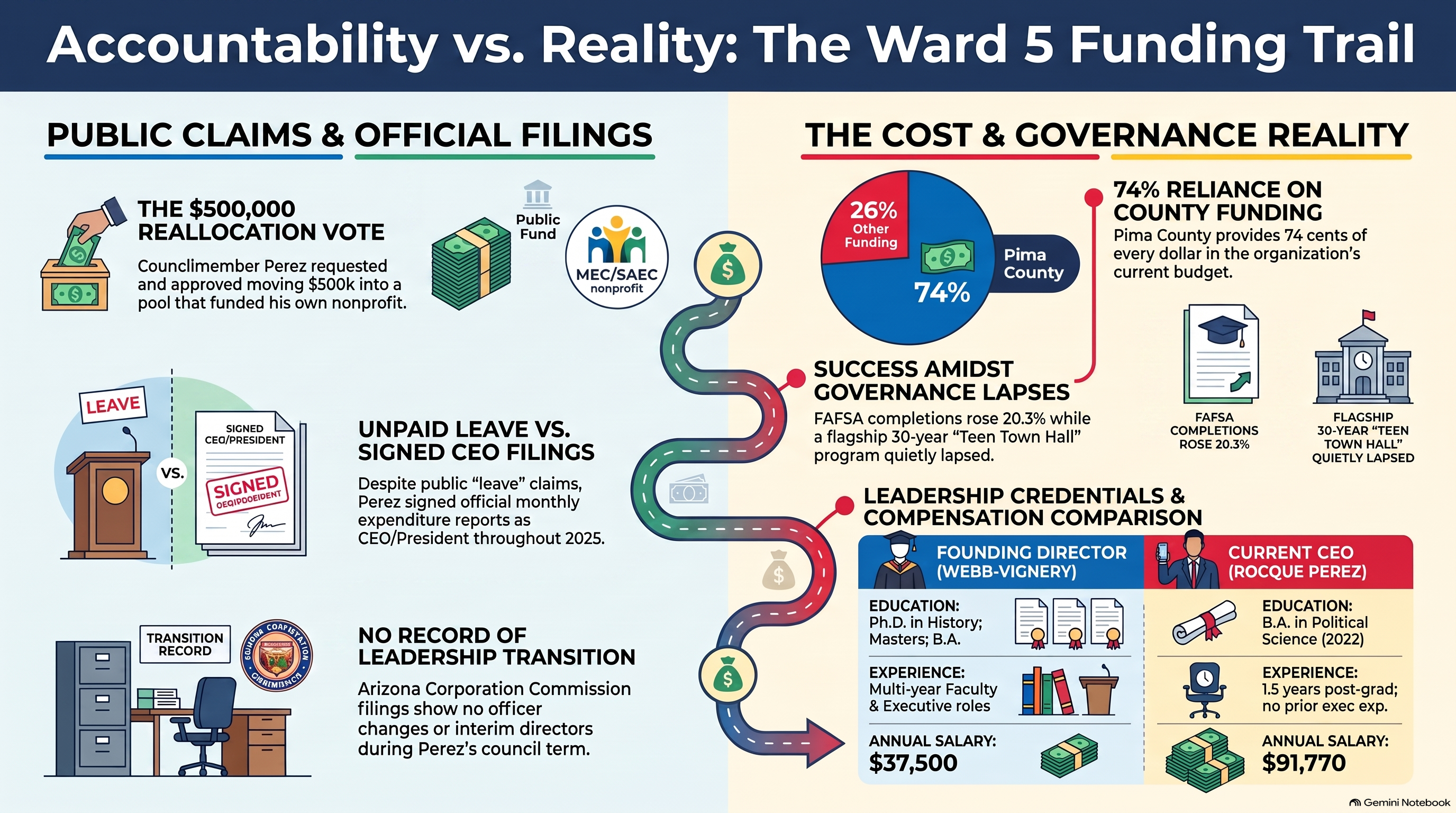
At its August 19, 2025 meeting, the full Tucson City Council approved a request from Ward 5 Councilmember Rocque Perez to reallocate roughly $500,000 in unspent discretionary and ARPA funds from his ward's office into a competitive grant process and a slate of direct investments.
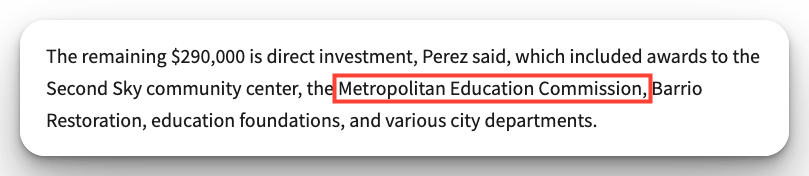
AZPM reported the breakdown directly: $150,000 split between small-business and community-organization grants, $150,000 for Safe Streets awards, and the remaining $290,000 as direct investments, which AZPM's own reporting named as going to "the Second Sky community center, the Metropolitan Education Commission, Barrio Restoration, education foundations, and various city departments."
Sit with that list for a second.
The Metropolitan Education Commission, the organization Perez had publicly committed to taking unpaid leave from while serving on Council, and the organization he'd return to lead full-time within four months, is named by a third-party news outlet as one of the recipients of a fund Perez himself requested and the Council approved on his motion. Whether that leave amounted to anything more than a title on a press release is a separate question, and the next paragraph has an answer worth sitting with too. Neither AZPM nor Tucson Spotlight's companion coverage breaks out how much of the $290,000 actually reached MEC specifically, and this outlet has not independently obtained a dollar figure.
But the structure itself doesn't need a specific number to raise the question: a sitting councilmember directed his own office's surplus into a pool of organizations that included the nonprofit he'd committed to return and lead, months before that return happened.

It gets stranger.
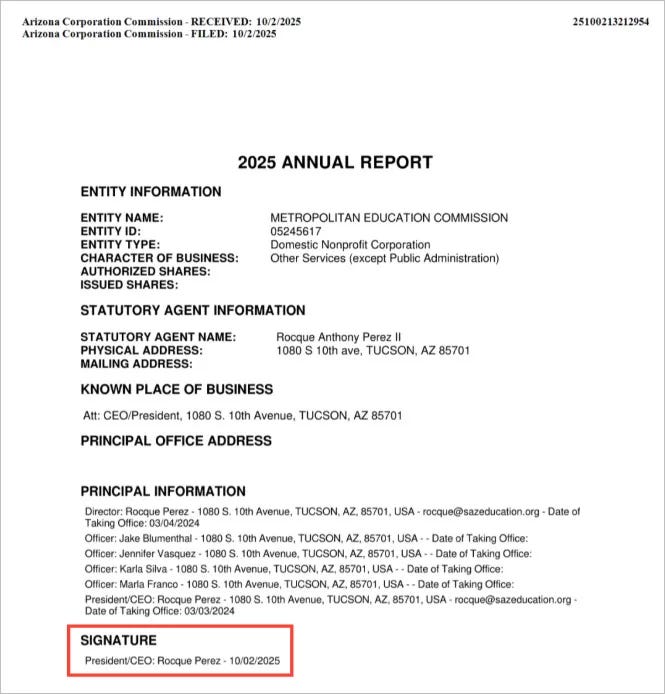
Arizona Corporation Commission records show Perez signed the Metropolitan Education Commission's 2025 Annual Report as President/CEO on October 2, 2025, in the middle of the Council term during which he had publicly committed, and the City of Tucson had publicly announced, that he would take unpaid leave from that exact role. The filing lists no officer transition, no interim director, and no title change at any point that year. That's not proof of anything beyond what the filing itself states. It's a real document with a real date sitting next to a public commitment that, on paper, doesn't appear to have been reflected in MEC's own corporate filings.
Someone with subpoena power, not this outlet, is the one positioned to find out why.
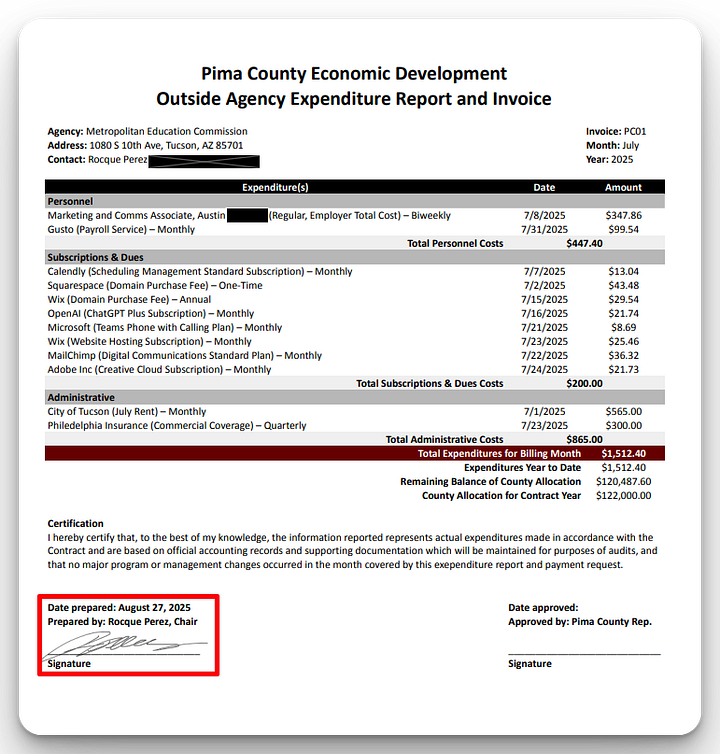
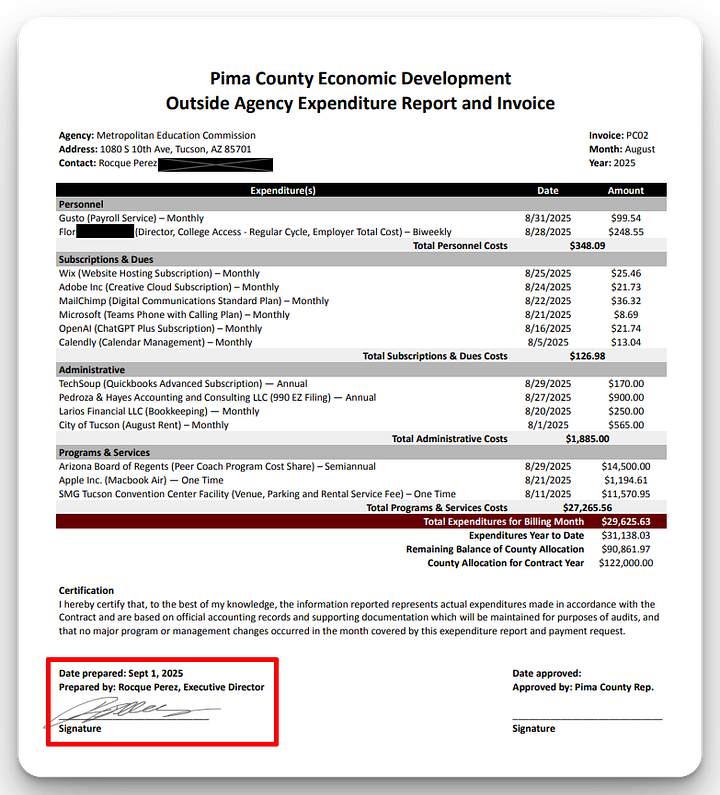
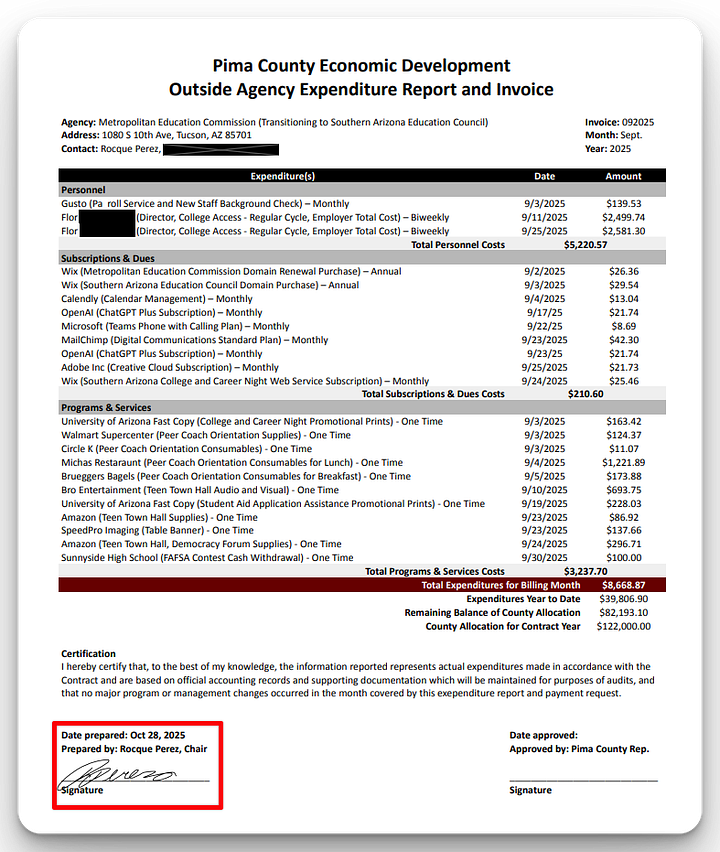
The Corporation Commission filing isn't an isolated data point either. Pima County's own Economic Development Department, which administers this contract, has monthly expenditure reports bearing Perez's signature that tell the same story in more granular detail.
The report covering August 2025 activity is signed and dated September 1, 2025, by "Rocque Perez, Executive Director."
The report covering September activity is signed October 28, 2025, this time by "Rocque Perez, Chair."
The report covering October activity, prepared December 8, 2025, lists him as "CEO & President," and its own administrative expense line includes a charge for "Arizona Corporation Commission (Annual Report) — Annual" that same month, MEC's own books confirming, independently of the ACC record itself, that the filing happened and that Perez's office paid for it.
Three different titles across three consecutive monthly filings, all signed by the same person, all while that person held a City Council seat he'd committed to stepping away from.
That’s the paper trail behind the $122,000 contract now stuck in Pima County limbo, and it’s why this outlet has kept pulling on it.
Pima County didn’t reject the Southern Arizona Education Council’s contract on August 11.
It didn’t approve it either.
Board Chair Jennifer Allen pulled Item 26 herself, citing “inconsistencies” in the paperwork, and the Board continued it 5-0. No new date, no dollar figure changed, no consequence beyond a delay.
Allen isn’t a disinterested party here. She currently sits on SAEC’s own governing council alongside Tucson Vice Mayor Lane Santa Cruz, the City’s own appointee to that same board, meaning the official who pulled the item is also, in her other capacity, a member of the body the item would have funded. Santa Cruz had no role in the Board of Supervisors’ action itself, that’s a county body and she’s a City of Tucson official, but the overlap in SAEC’s own governance is still worth sitting with.
That was two weeks ago.
Here’s what actually changed in the meantime: not what’s already been reported, but what the new paperwork adds to a story this outlet has been tracking since Perez, fresh off a primary loss to Rep. Alma Hernandez, despite the backing of nearly the entire elected Democratic Establishment, announced in the same Facebook post that he was keeping his SAEC salary and launching a political PAC.
That announcement came after a year in which the organization he runs never expanded into Santa Cruz County as promised and let a 30-year annual program lapse without consequence.
A few readers have asked why, now that the election is over and Perez lost, this outlet is still writing about him.
Fair question, and it deserves a direct answer rather than a shrug.
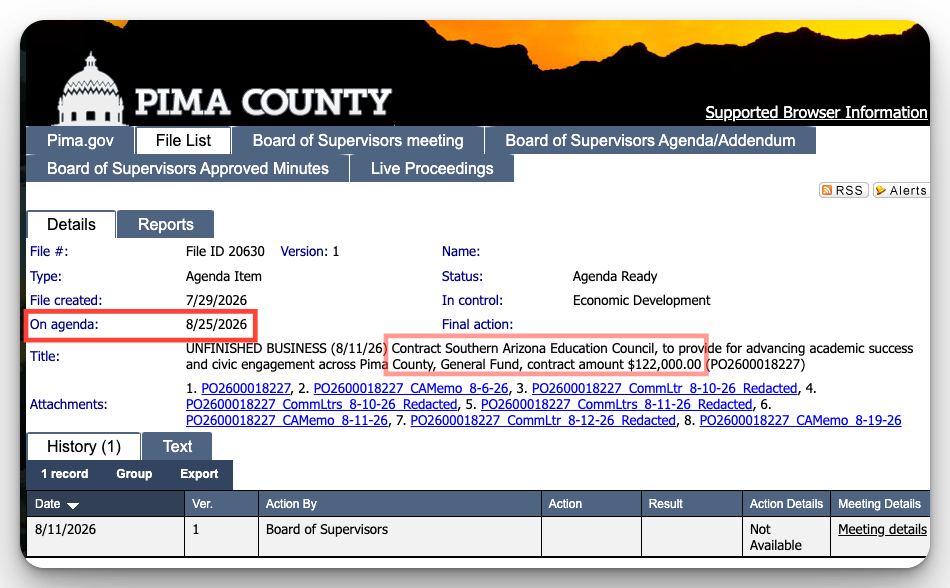
This was never about the campaign. Item 19 is a vote before a government body to fund an actual education program in a region this column has covered since it began. The election just happened to be what surfaced it.
What’s kept this going is everything the election exposed underneath: appointments substituting for elections, a Peter Principle running through Pima politics where the reward for one role is a bigger, less-scrutinized one, and a pattern of public money flowing toward the same small circle of names regardless of which office they’re currently occupying. That’s not a grudge against one candidate. It’s the actual beat.
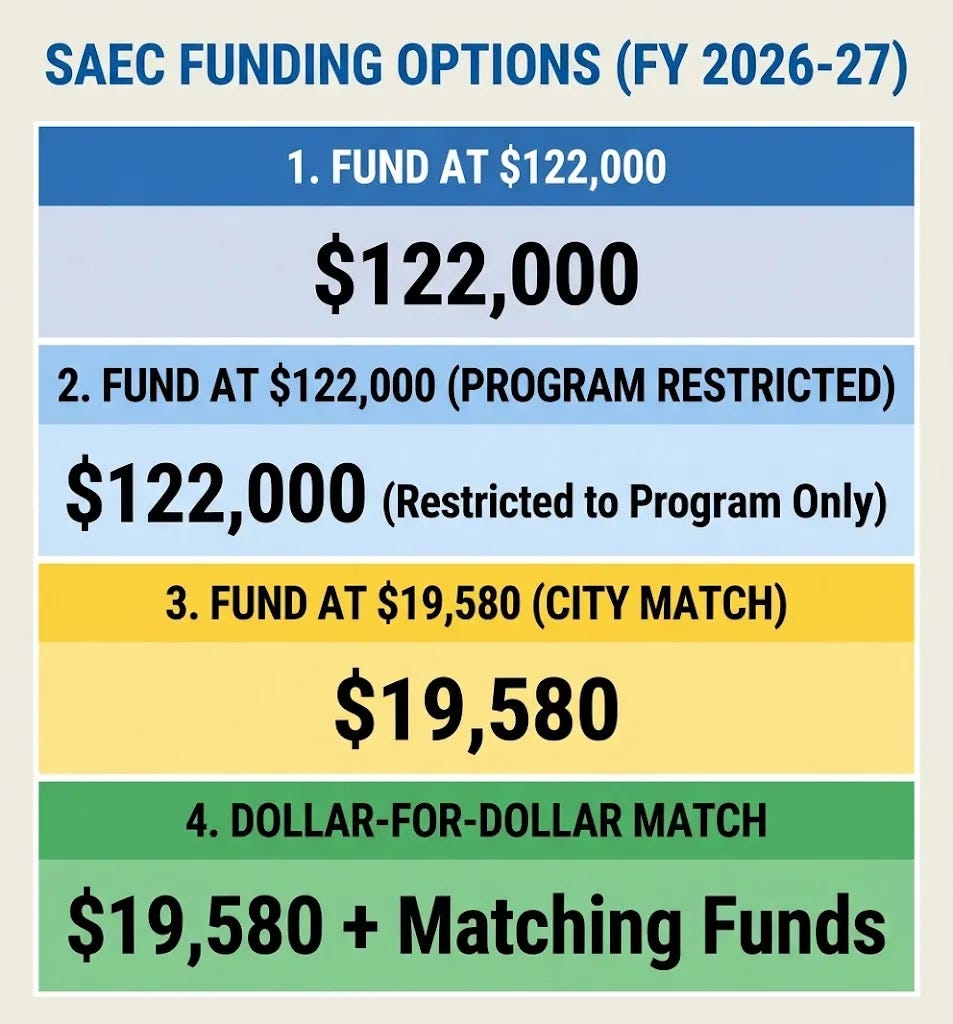
The August 19 memo’s real news isn’t in its bullet-pointed recap of SAEC’s annual report. It’s that Lesher’s office stopped presenting the Board with a binary renew-or-reject choice and laid out four:
Fund at the full $122,000, no conditions beyond what was already recommended August 5.
Fund at $122,000, restricted specifically to program expenses, personnel excluded.
Fund at $19,580, matching the City of Tucson’s City Manager’s Office allocation.
Fund at $19,580, with a commitment to match dollar-for-dollar, up to $122,000, any new revenue SAEC documents securing above last year’s total.
Choose your own adventure, Pima County: pay full price, pay for the parts that actually reach a kid, pay what the city pays, or pay for what SAEC can prove it earned. Three of the four options involve the word “accountability.” The Board has spent two weeks demonstrating it is not in a hurry to pick one of those three.
That fourth option is the one worth watching August 25.
It converts Pima County from an unconditional funder into something closer to a matching investor: the kind of structure that would force SAEC to actually diversify its funding base rather than lean on the county for 74 cents of every dollar it raised last year, the ratio this outlet calculated from SAEC’s own amended budget. It’s also the option most likely to survive contact with five supervisors who just watched two weeks of public pressure and clearly aren’t eager to zero out a program that, whatever its governance problems, is still connecting thousands of students to FAFSA money.
Because apparently there is no one else qualified in a county of one million people than a guy who spends his time running for office and starting PACs instead of doing what he is being paid $91K to do for education?
At least according to State Rep. Betty Villegas; more on that below.

Perez’s own attached memo, dated August 12, spends most of its length defending the option Lesher’s staff put on the table that would sting the most: restricting county funds to program costs only.
His argument is that personnel and programs aren’t separable: “Personnel and program expenses are not independent functions: staff recruit schools, coordinate counselors, administer incentives, manage agreements, organize events, maintain financial records, prepare required reports, support public-body responsibilities, and implement the programs themselves.”
Somewhere in that sentence is also, presumably, the job of running for state Senate, though the memo declines to itemize it.
It’s the argument every executive makes when a funder starts asking where the money actually lands, and it’s not baseless: SAEC’s own expenditure reports, cited in the same memo, show $52,222.98 of last year’s $122,000 county allocation went to personnel, out of $118,916.64 in personnel costs organization-wide.
SAEC’s net operating revenue for the year, per its own filings, was a comparatively modest $57,691.96. Restrict county funds to programs only, and that’s not much slack left to absorb a personnel gap.
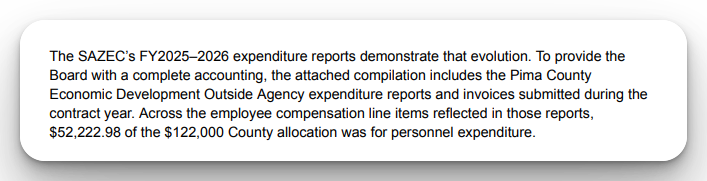
Perez closes the memo asking the Board to evaluate SAEC “on the entirety of its record, not targeted, intentional attempts to obscure the organization’s demonstrated growth and service.”
Read that sentence next to the fact that the entity making the request is the same one whose CEO announced a political PAC eight days after losing an election, and it lands less like a defense and more like a preview of how August 25 gets argued from the podium.
That framing didn’t stay confined to Perez’s own memo.
State Rep. Betty Villegas submitted a letter of support the same week, opening not with her own independent concern but by explaining she’d read Sen. Sally Ann Gonzales’s critical letter and felt “compelled to share another perspective,” a reactive posture none of the four critical letters share with each other, each of which reads as arrived-at independently rather than in response to a colleague.
Villegas’s letter pivots from compensation specifics toward “results, not politics” and closes by asking the Board to weigh SAEC’s “entirety”: the same rhetorical shape as Perez’s own memo, filed within days of it.
Worth knowing, too: Villegas’s own path to office runs through the same appointment pipeline she’s now defending for Perez. She was appointed to the Pima County Board of Supervisors in 2020 after Supervisor Richard Elias’s death, and appointed to the Arizona House in 2023 to replace Andrés Cano, winning election to the latter seat only after she’d already been placed in it.
Perez’s own résumé leans on a version of the same lineage. MEC was co-founded in 1990 by then-Supervisor Raúl Grijalva, whose daughter, Adelita, sits on the organization’s board, spoke at its 2026 celebration paying tribute to her father’s legacy, and eventually endorsed Perez’s Senate run, the Arizona Daily Star reported, only after the campaign had been underway for months.
Villegas’s letter also makes a specific claim about how Perez got the MEC job in the first place, one worth checking against the record rather than taking on faith.
She writes that he “did not simply arrive in this position through political connections,” that he “was selected in 2024 following an extensive year-long search,” bringing “experience from both Arizona State University and the University of Arizona” and a perspective few others could offer, having participated in MEC’s own youth programs before becoming a “first-generation university student.”
What she doesn’t mention: Perez graduated from the University of Arizona with a political science degree in 2022, per the Arizona Daily Star’s own reporting, and was hired to run MEC in February 2024, roughly a year and a half later, at 22 years old.
Perez holds no education degree, no teaching credential, and no prior nonprofit executive experience. The “experience” Villegas cites amounts to having attended two Arizona public universities and once been a participant in the programs he’d go on to lead.
Compare that to the woman who built the job in the first place. MEC’s founding Executive Director, June Webb-Vignery, held a B.A. in Drama Education, a master’s, and a Ph.D. in History, all from the University of Arizona, per her own University of Arizona biography, and had already spent years in faculty positions in Women’s Studies, Management, and History across two universities, published two books, and led Affirmative Action programs at the City of Tucson and Pima Community College before she ever took the MEC role.
She did that work for $37,500 a year.
If a year-long search across the state’s higher-education system produced a 22-year-old with a two-year-old bachelor’s degree as its best available candidate for the same job, now paying more than double what a public school teacher earns and not far off double what Webb-Vignery herself was ever paid to do it, that’s not an argument for trusting the outcome. It’s a reason to ask what the search actually screened for, and whether the county has confused a résumé for a credential.
Two career paths built almost entirely on someone else’s vacancy or someone else’s family name, defending each other’s résumés. Call it Pima County’s version of a mutual aid society, minus the aid part. None of that makes Villegas’s underlying point about Perez’s compensation wrong. It’s worth readers noticing all the same.
Give Perez this much: he’s right that the $19,580 figure this outlet and Supervisor Scott have both cited undersells the City of Tucson’s actual FY 2025-26 contribution. His August 19 memo notes that the city also kicked in a separate $66,000 through a Mayor-and-Council-approved allocation, bringing total city support for the year that just closed to $85,580, not $19,580. That $66,000 went through the full Council, not through any single ward’s discretionary fund, so it’s a different pool of money than the Ward 5 surplus Perez personally requested back in August 2025. Worth asking anyway: who requested it, and did it move through the same council session or the same relationships as the $500,000 reallocation that sent money toward MEC? This outlet doesn’t have that answer yet.
That’s a legitimate correction, and worth stating plainly rather than letting it slide by unchallenged just because it complicates a clean villain narrative. It’s also not the win Perez frames it as. What’s actually budgeted for FY 2026-27, going forward, is $19,580 through the City Manager’s Office (the same number Scott and this outlet cited) unless the city separately moves to renew the additional $66,000 Mayor-and-Council allocation it approved last year but hasn’t yet recommitted to.
Perez cited last year’s total as though it were next year’s baseline. The gap Scott flagged is real, and until the city actually re-appropriates that second allocation, it’s $102,420, not $85,580 wide.
Four threads have run through this contract fight. One of them just closed.
First, and now resolved: the official minutes from the June 3, 2025 Tucson City Council meeting show Perez present for the full session, with no recusal, absence, or excusal noted in the record, and voting yes on the city’s FY2026 compensation plan by a 7-0 roll call. He did not step aside from a budget vote while he was, on paper, on unpaid leave from an organization that same budget helps fund. The minutes don’t itemize MEC’s specific allocation within that package, so the exact dollar figure he approved remains unconfirmed. Whether he recused himself does not.
Second: the AmeriCorps and Arizona Serve partnership that SAEC’s own quarterly report described as active, which the county’s memo says simply “ended,” with, in Lesher’s own words back in August, “no further details” ever provided. A decade-plus partnership doesn’t dissolve into a single passive-voice sentence in a government memo, or it shouldn’t, and the Board is being asked to renew a contract without ever getting an answer to a question it already asked once.
Third: MEC’s own September expenditure report itemizes real spending on both a “Democracy Forum” and “Teen Town Hall Audio and Visual,” the same month county memos describe the 30-year Teen Town Hall tradition as not happening. Money moved. Vendors got paid. Whatever occurred that month, it apparently required a sound system. What it didn’t produce, per the county’s own account, was the actual Teen Town Hall.
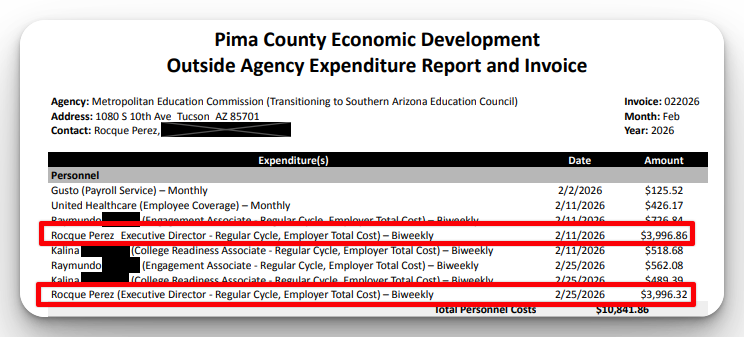
Fourth: a February 2026 expenditure report shows two biweekly “Employer Total Cost” payments of roughly $3,997 each. That annualizes to about $104,200. His employment agreement, and every public letter on this contract, including this outlet’s own reporting, has cited his salary as $91,770. “Employer Total Cost” typically includes payroll taxes and benefits load stacked on top of base pay, which could explain some or all of the roughly $12,000 gap without implying anything improper. Nobody has said which. SAEC has not been asked, on the record, to reconcile it.
Strip out the politics, and there’s a real public-benefit case sitting inside this same paperwork. FAFSA completions in Pima County rose 20.3 percent year-over-year to roughly 5,750 students, potentially unlocking $21.3 million to $42.5 million in federal need-based aid. The Peer Coach Program grew from 23 to 61 coaches across 18 host schools, with 16 posting FAFSA gains. Nobody on either side of this fight, not the four residents who wrote in demanding a freeze, not Perez himself, disputes those numbers.
What’s still unresolved is whether that growth justifies a compensation structure pegged to a Supervisor’s salary rather than to any of it, a flagship 30-year program’s quiet disappearance with zero contractual consequence, and a Board Chair who sits on the funded organization’s own council deciding, unilaterally, when the item gets pulled. Four funding options on a memo don’t answer any of that. They just give five supervisors more ways to avoid saying so out loud on August 25.
Also on the agenda: The Board is expected to revisit Resolution No. 2026-001, SAEC’s own request to amend the Council’s 2025 founding resolution and formally remove Santa Cruz County from its governance structure after Santa Cruz’s administrator confirmed, verbally and in writing, that the county was never actually joining, a housekeeping item that’s been sitting since Perez’s own July 22 request made it official.
Three Sonorans reads government memos so you don’t have to, and when the memos don’t add up, we go get the expenditure reports, the corporate filings, and the council minutes ourselves. This is the fourth installment on a $122,000 contract because the paper trail kept getting longer, not because the election did. If a nonprofit can survive four public letters, two continuances, and a signature that appears under three different titles in three consecutive months without anyone on the dais asking why, the watchdogs still reading the fine print are the only thing standing between that contract and a rubber stamp.
Have a scoop or a story you want us to follow up on?
Send us a message below or via ENCRYPTED email (all messages kept CONFIDENTIAL) at ThreeSonorans@protonmail.com.

Comments
Nothing yet. Say the first thing.
Sign in to join the conversation.