
The GIST
Tommy Schultz's side just won the fight to keep Arizona voters from regulating a billion-dollar voucher program — and then admitted less than 10% of voters actually support it as-is. Here's how 415,438 signatures became a 12,000-vote shortfall, why the union deal everyone's asking about isn't the real answer, and what's still on your November ballot.
by Three Sonorans
Tommy Schultz runs the American Federation for Children, the pro-voucher group that funded the legal fight to keep Arizonans from voting on regulating the state’s billion-dollar school voucher program. After his side won, he said this: “The status quo is supported by less than 10% of voters.”
Read that again.
The man who just killed the vote is telling you less than 10% of voters support the program as it exists right now. He didn’t beat Prop. 212 at the ballot box. Nobody did, because there was no ballot box. His side made sure of that with lawyers, not with an argument they thought they could win in public.
“He didn’t win the argument. He won the math.”
Here’s the quick version of what Prop. 212 — the Protect Education Act — actually was: a ballot measure that would have put an income cap, spending limits, and accountability rules on Arizona’s Empowerment Scholarship Account program, the state’s universal school voucher system.
It gives parents about $7,500 per student per year in public funds to pay for private school, homeschooling, tutoring, and other educational expenses, and it’s been available to every K-12 student in the state since 2022.
That’s the actual story of what happened to Prop. 212. Not the backroom union deal everyone’s been asking me about; that collapsed on its own, weeks before any of this.
What killed the Protect Education Act was math.
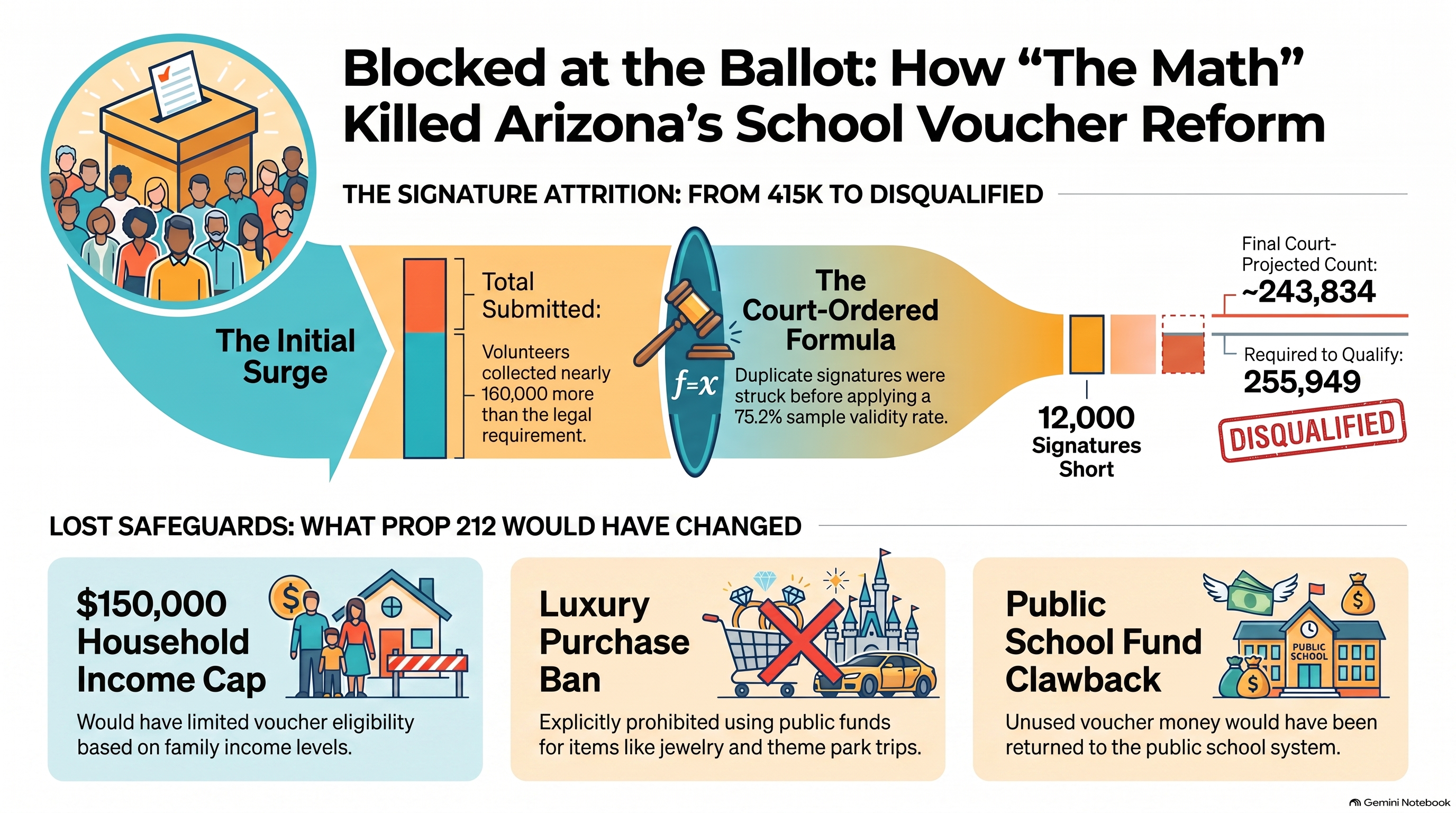
The campaign turned in more than 415,000 signatures — nearly 160,000 more than the 255,949 required. People knocked on doors in 110-degree heat for months to get there. Follow what happened to those signatures:
415,438 signatures turned in by the Protect Education Accountable Now committee
~389,000 deemed eligible for verification by the Secretary of State
255,949 valid signatures required to qualify
75.2% validity rate returned by county recorders’ random-sample review
~243,834 the final projected count under the court-ordered formula — an estimate both sides stipulated to
~12,000 short of the ballot
The legal fight centered on duplicate signatures. Challengers — the Goldwater Institute and the Arizona Free Enterprise Club, the same organizations that helped build the ESA program — got the trial court to strike duplicates directly. The campaign then argued that applying the counties’ 75.2% sample validity rate on top of those strikes effectively punished some signatures twice, since the sample already captured duplicates. Their proposed fix would have kept the measure on the ballot; both sides stipulated to that.
The Arizona Supreme Court wasn’t moved. Chief Justice Ann Scott Timmer wrote:
“The Committee’s proposed adjustments would credit the petition with signatures the Legislature has directed be removed.”
The case goes back to Maricopa County Superior Court Judge David McDowell for a final count, but both sides have already acknowledged the outcome: under the court-ordered formula, Prop. 212 fails.
The court handed the campaign two partial wins on circulator residency rules and signature-sheet technicalities, but neither was enough to close a 12,000-signature gap.
Worth knowing: the 5%-sample validity-rate check isn’t something Republicans invented to sink this specific measure — it’s the standard formula Arizona law requires the Secretary of State and county recorders to run on every citizen initiative.
What made this fight unusual was the argument over sequencing — whether duplicate signatures should be struck before or after that statutory formula runs — and the Supreme Court’s answer to that question is what cost Prop. 212 its spot on the ballot.
And it’s worth noting who else was swinging.
The same week, the Supreme Court ruled that Republican lawmakers wrote a ballot-pamphlet summary of Prop. 212 that was “argumentative, speculative, and non-neutral” — illegally slanted against the measure, in the court’s own words.
Even the voter guide was a battlefield.
Here’s the honest answer to the question people keep asking me: the AEA’s attempted backroom deal did not kill Prop. 212.
In the final days of the legislative session, House Republicans offered the Arizona Education Association modest ESA reforms — savings caps of $24,000 per account, $50,000 for some students with special needs, plus a list of prohibited purchases — in exchange for abandoning the signature campaign entirely.
Measure that against what Prop. 212 was actually asking for: a $150,000 household income cap on who could get a voucher in the first place. A savings cap limits what’s left sitting in an account; an income cap decides who gets one at all. A $24,000 savings limit doesn’t touch that question. It’s a different reform aimed at a different problem, offered as a substitute for the real one.
Three Sonorans covered this fracture back in July: nobody told Save Our Schools Arizona, the grassroots group whose volunteers were out collecting the very signatures being traded away. Glendale school board member Hector Jaramillo put it plainly:
“If there is a strategy conversation to be had, bring everyone in. Bring in rank-and-file educators. Bring in local associations. Bring in SOS. Bring in school board members. Bring in volunteers and petition circulators. Bring in the people who built this campaign. But do not negotiate around them and then call it solidarity.”
The deal collapsed anyway — not over that process breach, but because Congressman Andy Biggs, running for governor, demanded a narrower swap, Senate President Warren Petersen backed him, and Democrats walked. When the compromise bill hit the Senate floor, Petersen and Sen. Jake Hoffman helped kill it.
Republicans then pushed through Plan B: HCR 2048, the ballot referral that became Prop. 145. A second attempt at a special-session deal in late June also fell apart when Governor Hobbs declined to call it.
Both collapses happened before the July 2 signature deadline. The campaign proceeded. Volunteers turned in 415,438 signatures anyway. What killed those signatures came after — in court, not in a backroom.
It’s worth considering precisely what voters won’t have a say in.
Arizona’s Empowerment Scholarship Account program now serves more than 100,000 students at an annual cost exceeding $1 billion, according to KJZZ’s reporting on the rulings.
What started in 2011 as a targeted program for students with disabilities became, after the 2022 universal expansion, a taxpayer-funded entitlement available to every K-12 student in the state — including families already paying private school tuition out of pocket.
The Protect Education Act would have put the first real guardrails on that program: the $150,000 income cap, a ban on luxury purchases with voucher money, fingerprint clearance requirements for workers in ESA-funded programs, and a clawback of unused funds sitting in accounts — money that would have flowed back to the public schools still educating the vast majority of Arizona kids.
That last part matters, because it followed published reports of parents seeking ESA reimbursement for kitchen appliances, lingerie, jewelry, and theme park trips. Because nothing says “school choice” like a taxpayer-subsidized waffle maker.
The same day the court killed Prop. 212, it also killed Prop. 145 — and this one matters for the long game.
HCR 2048 was sold as protecting military families’ ability to save unused voucher money for college. Buried inside: a clause extending those protections to all ESA recipients, plus a provision that would have voided any law or voter-approved initiative touching vouchers passed after November 1, 2026. Had it passed, Prop. 212 would have been nullified even if voters approved it — and every future reform effort would have faced a constitutional brick wall.
The court ruled it violated Arizona’s separate-amendment requirement. Timmer again:
“The provisions do not share a logical relationship or derive meaning and effect from each other. This is the type of measure the separate amendment rule is designed to prohibit.”
Translation: you can’t wrap a constitutional shield for a billion-dollar program inside a flag-waving amendment about military kids and call it one idea. The flag-wrapping is the tell. It always is.
That means there is nothing in the Arizona Constitution blocking a future reform effort. The door Republicans tried to weld shut is open.
Here’s what too much of the coverage is missing while everyone fixates on the voucher fight: two of the three Republican anti-education referrals are still headed to your November ballot.
HCR 2040 — the union-buster — would ban payroll deduction of union dues, prohibit union activity on school resources, and strip pensions from teachers who strike. Its language is broad enough, as House Minority Leader Oscar De Los Santos has warned, to reach police, firefighters, and every public employee union in the state. SCR 1032 would force larger districts — including every big district in Maricopa, Pima, and Pinal counties — to spend at least 60% of operational budgets on “direct instruction,” with a 25% state funding penalty for noncompliance.
That’s a defunding mechanism aimed at counselors, nurses, librarians, and paraprofessionals, dressed up as classroom investment.
The voucher measure died in court. The war on the people who staff public schools did not — and it’s being waged by the same Republican legislative majority that just spent months in court making sure voters never got a say on vouchers either.
Beth Lewis of Save Our Schools Arizona didn’t mince words after the ruling:
“The lengths that the voucher lobby went to invalidate signatures with scorched-earth legal objections shows just how terrified they are of Arizona voters actually having a say in how our tax dollars are spent.”
Jaramillo mapped the downstream logic months ago, and it reads even sharper now:
“When public schools close, when districts consolidate, when RIFs happen, when support staff and educators lose jobs, there are fewer workers protected by collective power.”
Voucher expansion accelerates enrollment decline. Decline triggers closures. Closures eliminate jobs. Fewer jobs mean weaker unions. Weaker unions can’t fight the next round of cuts.
Every link in that chain is now operating without the one intervention — Prop. 212 — that 415,438 Arizonans signed to demand a vote on.
The hope here is specific: Prop. 145’s death means the door to future reform remains open, and the volunteer infrastructure that collected 415,438 signatures doesn’t evaporate — it gets a list of legislative districts.
The AEA says it’s pivoting to elect pro-education candidates in the midterms, eleven weeks of door-knocking that was already planned for Prop. 212 now, in Lewis’s words, “laser focused on candidates that support our public schools.”
The immediate work: defeat HCR 2040 and SCR 1032 in November. Follow Save Our Schools Arizona and the Arizona Education Association for coordinated “no” campaigns, and check your voter registration at the Arizona Secretary of State before the October deadline.
Support independent borderlands journalism by subscribing to Three Sonorans — the kind of reporting that was covering this fracture in June, not after the rulings made it safe.
Three Sonorans is an independent Substack rooted in Tucson, the borderlands, and the fights the powerful would rather settle in a courtroom than a ballot box. If this piece moved you, share it — that’s how the word spreads when the watchdogs get muzzled.
Have a scoop or a story you want us to follow up on?
Send us a message below or via ENCRYPTED email (all messages kept CONFIDENTIAL) at ThreeSonorans@protonmail.com.

Comments
Nothing yet. Say the first thing.
Sign in to join the conversation.