
Although the official pub date isn’t for a few more weeks, hopefully everyone who preordered Auroville: A City of Dreams by Katarzyna Boni, translated from the Polish by Mark Ordon, has already received their copy. And for anyone who didn’t preorder from us, it started shipping out to bookstores last week, so, if what comes below intrigues you, check in with your local bookstore.
To whet your interest in the latest addition to our Polish Reportage Series, I thought I’d personally try and get a handle on this book, which is mesmerizing and confounding in the best of ways, a book that’s more spatial than temporal, that has an almost ouroboric structure, with the spiritual underpinnings and pre-history of this unique experiment in living coming in the final part and looping back to the very beginning.
And, so as to not bury the lede too much: from now until the end of August, both the paperback and ebook of Auroville are 30% off via our website. (Automatically applied at check out.) If you’re a fan of Angel in the Forest: A Fairy Tale of Two Utopias by Marguerite Young—or just interested in the fine line between cult and utopia—you should definitely consider checking this out . . .
Before getting too far into this, it’s probably best to give you an overview of the book itself:
What Would You Do to Change the World?
In 1967 the Mother founded Auroville, a planned utopia that would be both self-sustaining and, through the yogic practices of Sri Aurobindo, a community that would herald the next evolution of humanity. She designed a city to resemble the galaxy, and to house 50,000 people from around the world who, through a series of utopic ideals—transforming the desert into self-sustaining farmland, eliminating the need for money, removing religious conflicts, among others—would transform the world into a more just place.
Despite the death of the Mother, contentious infighting, and the Indian government taking control of the city, Auroville has survived, and still attracts thousands of visitors every year. And in 2018, one of those visitors was Katarzyna Boni, a renowned Polish reportage writer, who wanted to try and understand what Auroville really means—as a city, as a community, as a beacon of hope for the future.
Boni merges the official history of Auroville with her experiences with the people she meets while living in this unique city, from Daniel who owns a local bakery, to Auroson, the reincarnation of the first child born in Auroville. A fascinating work that is never judgmental, Auroville: A City of Dreams looks at the successes and failures of this unique attempt at utopia, and the benefits such ambitious dreams can have regardless of outcome.
One of the biggest difficulties in editing this book was getting a handle on what it actually is. As I’ve written about before, Polish Reportage is a genre unto itself, a way of writing nonfiction in which the writer, the observer, is frequently incorporated into the text, puncturing the illusion that the text is purely objective.1 In Auroville, this is most evident in the second section, which focuses on Boni’s lengthy stay in Auroville, but is also present throughout the rest of the text in Boni’s decisions of what elements of Auroville to focus on, what threads of its past, present, and future she decided to pursue, and, most captivating to me, how this book is constructed.
Every editing process is different, and what I found particular about this one is how, each of the four times I read the book, I came away with a totally different idea of what to focus on in presenting it to friends, sales reps, and readers. There’s so much in here, and I suspect each reader will emphasize a different aspect, following a couple narrative strands, painting their own idea of Auroville based on what resonated with them personally. If you’re a spiritualist, it might be the idea of Auroville as a place to change the world through meditation and yoga; if you’re into cults, you might view “A City for the Future” as a grift; if you’re into variations of societal structures, you might focus on the communal nature of Auroville and how society could function free from some capitalist trappings, such as money.
During an early conversation with Boni, we discussed adding an index to the book that was simply a set of pathways through which you could explore the text. (Like what can be found in Ivan Vladislavic’s Portrait with Keys: The City Of Johannesburg Unlocked.) Although reading the text sequentially is still the most logical way to approach it, it’s definitely not the only way. And you might actually get more out of it by tracing each element, one by one.
We weren’t able to pull that off, but after my final read, I came up with another idea: a five-part limited series podcast exploring some of the major strands of the book, using Boni’s work to introduce those unfamiliar to this fascinating place, and helping frame Auroville (and Auroville) for those who decided to give it a go.
Well, like the best laid plans of mice and men, time fucked me, and so here we are, a couple weeks from the official pub date (7/28/26) with a bunch of notes on my phone and exactly zero recorded interviews.2
So I’m going to ask you to use your imagination a bit . . . Below you’ll find the general sketch of what I wanted this podcast to look like, how I was dividing it up in my mind, what threads I found the most interesting to pull out from the book. None of this is as rich as a podcast would’ve been, and all five deserve to be expanded into posts of their own, but this should give you a sense of the scope of Boni’s project.
Read a Sample from "Auroville"
Had this project come into being, this first episode would’ve set the scene, using that oh-so-visual medium of podcasting to describe what Auroville looked like over the years. And we would’ve started with the images on the official Auroville website, including this model of the vision for Auroville, which is meant to resemble a galaxy and would serve as a home to 50,000 inhabitants.
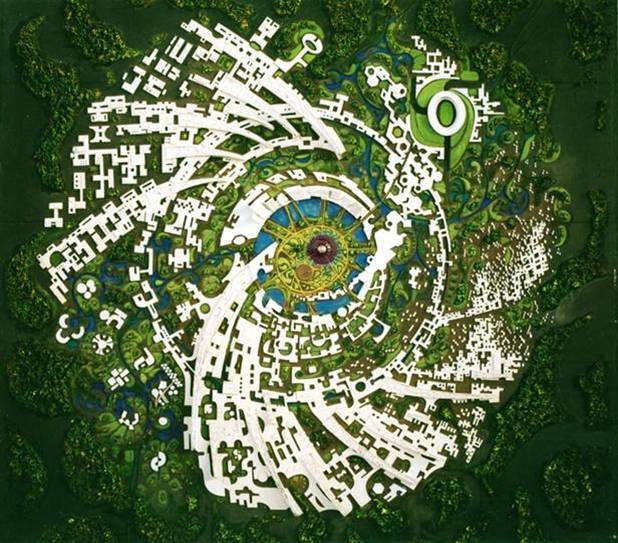
Auroville, sometimes referred to as "The City of Dawn" is conceived for 50,000 inhabitants from around the world. At the centre stands the Matrimandir, the “soul of the city,” a place for individual silent concentration, in an oval shaped Peace Area surrounded by a lake. Radiating out beyond the lake are four Zones—the Industrial (north), Cultural (north east), Residential (south/south west) and International (west)—each focusing on an important aspect of the town's life. Surrounding the township is a Green Belt consisting of forested areas, farms and sanctuaries. (Auroville.org)
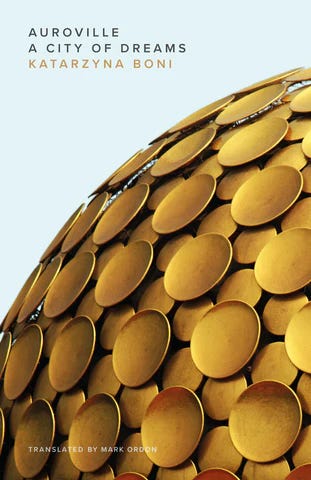
The Matrimandir—the bronze dot in the middle of the map above—is most definitely the image most associated with this place. It’s on the cover of our book, because duh and or obviously, and truly is a wild looking structure.
Given the fact that the “Inner Chamber” of the Matrimandir is meant to be completely free of distractions, it’s not surprising that there aren’t many photos of it available online. There are images of a model depicting the structure as a whole, but the only real photo (which, to me, looks weirdly enhanced) can be found in this Condé Nast Traveler essay about the “Best Things to Do in Auroville.”
But the Matrimandir is only a small part of Auroville. Sure, the vision pictured above hasn’t fully come into being, but still, if you look at Google Maps, Auroville covers a pretty large area, and there are more than three thousand people who live there, and many more who visit the city every year. And although Boni does a great job describing various spots of the city—and her apartment—it’s worth checking out Anne Schönharting’s photo essay to get a sense of the housing, the people, the lush landscape.
And to get a better sense of how the city has grown over the past sixty years, I recommend checking out this documentary in which you can see how the resilient Aurovillans have transformed this arid desert into a farmable, verdant forest.
From a purely environmental impact perspective, Auroville has been a grand success. According to their website—which I believe can be trusted, and is generally backed up by this “critical examination of a community-led ecovillage initiative”—there are now 2000+ acres of forest in Auroville, and over 2 million trees, 320 acres of farms, and enough rooftop solar systems and wind turbines to provide 41% of the city’s electricity needs.
As pointed out in that case study above, these initiatives would be difficult to scale, but, nevertheless, it is a proof-of-concept that it is possible to change our relationship to the environment—from exploitative to reciprocal—if we actually decide to do it. (Instead of trying to demolish those rat bastard communists who love their hybrid cars and their “green” initiatives. U-S-A! U-S-A!)
Just to put a fine point on it, in contrast to all the green found in the photo essay referenced above, this is Auroville circa its founding.
For me, one of the most challenging aspects of getting ahold of the concept of Auroville, was the dedication to the yogic principles (“integral yoga”) propounded by Sri Aurobindo and the Mother.3 That said, this is essential to understanding what brought people from around the world to Auroville in the first place, and why people still move there today.
In my editorial research for this book, I developed my own understanding of the beliefs of Sri Aurobindo and the Mother’s philosophy, although I know for a fact that my conception overlooks a lot of the nuances—especially the bits that seem more “out there” or “woo-woo”—which is why I wanted to interview a handful of practitioners and get a better sense of what he believes, and how those ideas have been modified and added to by the Mother and the other Aurovillans.
Even though Sri Aurobindo (1872–1950) passed away some time ago, his legacy and teachings are still quite prominent—not just in Tamil Nadu, but throughout the world. As you’ll see in the book, the Sri Aurobindo Society and the ashram in Pondicherry play a huge role in both the creation and governance of Auroville, but I’m going to leave that conflict for you to discover in the pages of the book. What I was hoping to focus on in this episode was Sri Aurobindo’s writings and beliefs, which can be described thusly:
According to [Sri Aurobindo], human beings could extend their mental consciousness, ascending from the human mind through ranges of quasi-cosmic mentality to a Cosmic Consciousness, or Overmind, which was the pinnacle of the Avidya, and then pass through an act of yoga, into the Integral Consciousness, or Supermind. Cosmic Consciousness or Overmind is the determining consciousness of our cosmos. It is inclusive of all realities of the cosmos and subjects them to the laws of Mind, which are laws of separative exclusivity—in other words, each “category” or “thing” is divided from all others and knows only itself directly and others inferentially. Supermind transcends this law. Here there can be differentiation but not division. Each “thing” is aware of itself as a form of becoming of its origin and knows all others to be expressions of that same origin, hence knowable directly due to identity of origin. Thus Overmind partakes of Avidya or Ignorance while Supermind belongs to Vidya or Knowledge. This ascent, followed by a “descent” of the law of Supermind transforming the operations of Mind, Life and Body, the instruments of Avidya, would bring about the conditions for a “divine life” in one’s own life. This could be achieved individually, but if instead the plane of Supermind could be made to “descend” into the Avidya and transform the planes of universal Nature. Like the other capitalized terms, Nature is a principle and a being. Metaphysically it is code for the Vedantic assimilation of the Sankhya category of Prakriti (see Bhagavad Gita). It could be universal or individual. Cosmic conditions for a “divine life” could appear, and a new species, a race of supermen, could arise through the yoga practice of individuals directed by the immanent Supermind. In Pondicherry, it is these last two realizations that he set himself to achieve, the realization of the Supermind and the bridging of the human consciousness with that of the Supermind through the establishment of the intervening levels of Cosmic Consciousness as part of his personal transformed nature. [. . .]
Sri Aurobindo left his physical body on December 5th, 1950. On February 29th, 1956, the Mother, who continued his work, announced the manifestation of the Supermind in the earth consciousness. This was Sri Aurobindo’s goal in yoga. It implies the hidden activity of a Consciousness established in the world and exerting a pressure on both individuals and world circumstances, to hasten a turn towards collective spiritual realization. (“Who Is Sri Aurobindo?”)
Although the idea of meditating to keep the ego in check and get in tune with the larger, more cosmic sense of connectedness is something I’m personally into, words like “Supermind” and “Overmind” and “Cosmic Consciousness” are at least partially responsible for why Auroville is viewed by some as more of a cult than a utopia. That and the pictures of the Mother displayed throughout the city. And the suspect relationship to traditional medicine . . .
Note: There is a podcast, Sri Aurobindo Studies, which presents a short (~5 minutes) lesson from Sri Aurobindo’s teachings every day. It’s quite interesting, with episode titles like “The Psychic Being and the Mechanism of Choosing Its Next Birth” and “The External Being Filters and Can Distort the Guidance of the Soul.”
Boundaries, cliques, and questionable governance are all big parts of Auroville—especially after the Mother “leaves her physical body.” A city of this sort, devoid of money (sort of), and based in communal solidarity both in the physical and spiritual realms, depends heavily on people respecting boundaries and each other. This hasn’t always been the case in Auroville, and is another powerful path to follow in Boni’s book.
Over the past six decades, these internal conflicts—between different neighborhoods inside of Auroville, and between the city and the Sri Aurobindo Society (SAS)—have surfaced in a variety of ways, and, in fact, while searching things up for this post, I found that there’s an ongoing controversy in Auroville that has thrust the city of dawn back into the news:
For decades Auroville held fast to its lofty ideals as a self-governing haven for yoga enthusiasts and seekers of spiritual freedom of “all creeds and nationalities”.
Until India’s Hindu nationalist prime minister Narendra Modi turned his attention to the lush paradise its founders created on a once arid plateau near Puducherry. [. . .]
Many say the idyll began to unravel when New Delhi appointed civil servant Jayanti Ravi to head Auroville in 2021.
Close to the prime minister and his mission to remake India as a Hindu nation, she quickly asserted government control and began pushing to expand the city as a tourist destination that would showcase Modi’s India. [. . .]
Despite the Auroville Foundation having an international advisory council and an assembly of residents, [Ravi’s] critics accuse her of having "absolute authority" over a community that had been largely self‑managed. They say she has imposed increasingly restrictive rules, dismissed employees and decides who can or cannot obtain a visa to stay. [. . .]
Dozens of other residents have had visas denied, four have been expelled and hundreds have to wait many months for the precious document to be renewed, according to several accounts gathered by AFP. Many have ended up leaving in despair, according to one resident.
For such a spiritually-based, world-changing place, it’s crazy how many sections of Boni’s book read like lost episodes of Neighbors . . .
In certain ways, Auroson II is at the heart of Auroville.
[I don’t want to get sued by Getty Images, so click here for one of the couple photos of Auroson Bystrom I was able to find.]
Again, I don’t want to spoil too much, but the Auroson who walks the earth today is, according to the Mother and Aurovillans, the reincarnation of the first born child of Auroville. As such, he’s perceived by many as the soul of the city and a representation of its promise—a burden he’s carried his whole life.
Based on Boni’s book, he’s not prone to giving interviews, or discussing his inner life in general, although it seems that he’s had a pretty remarkable go of it—he’s written plays, been involved in high fashion, is a furniture designer and sculptor, and even starred in a French documentary. (And more that I’m intentionally eliding, but can be found in the book!)
And Auroville is the only real profile of him that’s out there. He’s an intriguing, complicated person, and the thread of his life underpins a major portion of the book, and is definitely one of the threads worth tracking.
I know that this post is quite cursory and abbreviated, but without the time to talk to various people—like Boni, like Akash Kapur (whose Better to Have Gone, also about Auroville, is another must-read)—this will have to remain an outline. But hopefully it’s useful in providing a few entryways to this unique, captivating book, which is available for 30% off via our website until the end of August.
Enjoy!
Back when I was promoting Voices from Chernobyl, translated by Keith Gessen (and now out of print?!?!?)—a book that uses similar techniques by crafting monologues out of interviews rather than reporting them directly—NPR scotched a special feature on Svetlana Alexievich I had arranged because they couldn’t verify that everything in the book was true. (They wanted to verify that the text matched the interviews Alexievich had recorded.) This raises some philosophical questions about “truth” better served elsewhere, and was also fucking annoying.
While I’m here with you, I want to say that the new version of Chernobyl Prayer is wildly subpar compared to the original Voices from Chernobyl. Again, one can argue about what “definitive” means—especially when it comes to translation—but having read both, I can say, definitively, that one reads a whole lot better than the other.
Although I doubt most people understand what goes into running a publishing house of Open Letter’s size—with more than 180 titles in print, each requiring a certain amount of attention—I can tell you that doing this alone is a challenge. Add on to that the fact I teach multiple classes, oversee a healthy number of internships a year, assist with running the Literary Translation Program, write this Substack, produce several podcasts, and speak on panels around the world . . . Time may have gone wonky post-2020, but there’s definitely not enough of it to pull all this off—and add on a special new podcast about a topic as large as Auroville.
No posts
Comments
Nothing yet. Say the first thing.
Sign in to join the conversation.