
I’m a few days late getting this post up, but our Women in Translation Month Sale has been live for the past week, and your support is definitely keeping me busy!
If you haven’t heard about this, all Open Letter titles written or translated by a woman are 40% off until the end of August. This covers about two-thirds of our overall catalog, and includes all eligible forthcoming titles: the Translator Triptych highlighting works from Iceland (dropping in Sept/Oct), and The Family by Sara Mesa (Jan 2027).
In terms of Women in Translation Month itself, I’ll let the organization behind this speak for itself:
WITMonth—aka Women in Translation Month—is an annual celebration of women writers from around the world, writing in languages other than English. Started by Meytal Radzinski in 2014, WITMonth has grown to become a staple of the online literary community, as well as a prominent presence in independent bookstores around the world. Every August, readers from all continents around the world (except Antarctica, but we’ll get those penguins yet!) gather in spirit (and sometimes in person) to read, review, and discuss works by women writers in translation. The idea is to spread the word about the Women in Translation project at large, and promote individual women writers in translation specifically. Follow #WITMonth on Twitter, Instagram, Booktube, and across the world!
Every year we celebrate this with a sale and a series of posts—both here and on Instagram—highlighting as many of our titles as possible, calling out other great WIT from myriad other presses, and using the Translation Database to look into the overall state of things. (A couple years ago, the data showed that the gender gap in published translations had basically vanished, which is hopefully still the case!)
If possible, we’ll post some WITMonth specific podcasts, links to other reading and recommendation lists, etc. The core concept of WITMonth is incredibly important on a socio-philosophical level, but beyond that, it’s a time to find out about some fun books to read, some new voices to check out!
Last August, Kaija Straumanis featured every Open Letter WITMonth title on sale through a series of Instagram posts, each with its own “fun fact.” (Here’s an example.) This year, what I thought would be interesting is to post a snippet—a line, a paragraph—from every single one of these titles so as to highlight the art and craft of the writing itself.
So as to not overload your inbox—especially since I want to use this month to write some other pieces about non-OL titles—I’m breaking these up into a few long posts here, and a series of shorter ones on IG. Which is a roundabout way of saying: Do you follow Open Letter on Instagram? You should!
For today, I want to illustrate the global range of our list by covering twelve titles by authors from twelve different countries: Brazil, Bulgaria, Chile, China, Croatia, Denmark, France, Greece, Hungary, Iceland, South Korea, and Spain.1
Here goes!
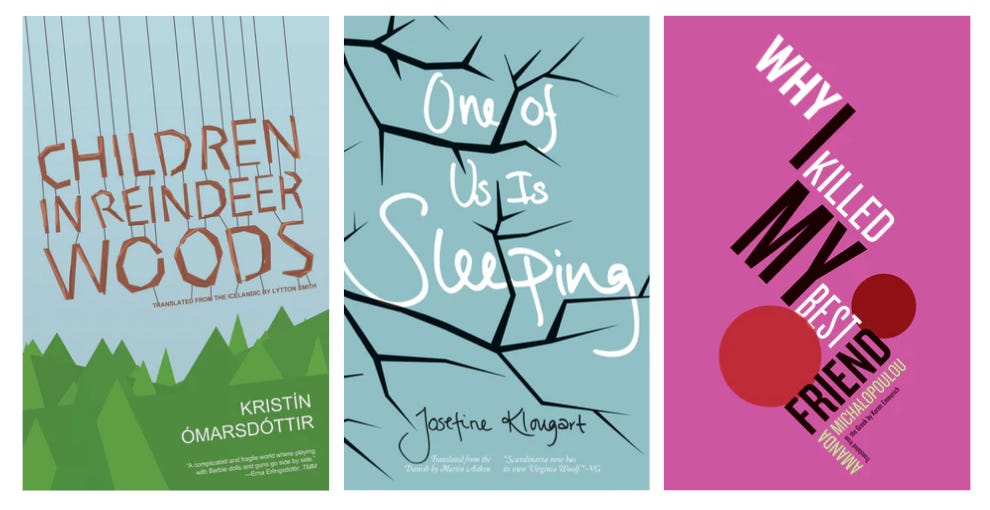
My Take: A war novel without war.
Description: Eleven-year-old Billie lives at a “temporary home for children” called Children in Reindeer Woods, which is suddenly attacked by a small group of paratroopers. As a result, Billie is forced to learn to live with the violent, innocent, and troubled Rafael, who decides to abandon the soldier’s life and become a farmer, no matter what it takes.
Short Excerpt: The chicken followed him to the shed, where he kicked open the rusty door and got a shovel. He disappeared around a corner of the house, followed by the chicken, then reappeared and walked past the bush which stood against the garden wall—on the other side of which they had often sat in the grass to drink juice, eat cookies, and play ludo, nine men’s morris, or backgammon. The chicken came back around the same corner of the house, and it took her a while, crossing the garden with smaller steps, neat chickensteps, to re-find her new friend.
My Take: VG nailed it. “Scandinavia now has its own Virginia Woolf.”
Description: As she returns home to visit her mother who is dying of cancer, the narrator of One of Us Is Sleeping recounts a brief, intense love affair, as well as the grief and disillusionment that follow its end.
Short Excerpt: The light comes creeping in over the plowed fields. Slabs of dark clay soil thrust up in disorder, bull calves fighting in the stalls, the thud of too much body in a space too small. And the snow, so gently it lies now, upon the ridges; upon the landscape, everything living and everything dead. A coat of cold, a deep, reassuring voice. The landscape, naked, unsentimental. Here is the feeling of missing you, though no one to miss.
My Take: For fans of Elena Ferrante’s Neapolitan Quartet.
Description: A young girl named Maria is lifted from her beloved Africa and relocated to her native Greece, where she struggles with the transition, hating everything about Athens. Just as she resigns herself to misery, Anna arrives, and the two girls instantly bond over their common foreignness, becoming inseparable in their relationship as each other’s best friend—but also as each other’s fiercest competition, be it in relation to boys, talents, future aspirations, or political beliefs.
Short Excerpt: Fotini and Martha are always singing a song by the child star Manos: You don’t live in my time, Mom, you don’t live in my time, Dad . . . I like it a lot but I also know it would annoy Anna. In fact we do all kinds of things that Anna wouldn’t like. We watch Little House on the Prairie and wear cherry lip gloss during our beauty contests.
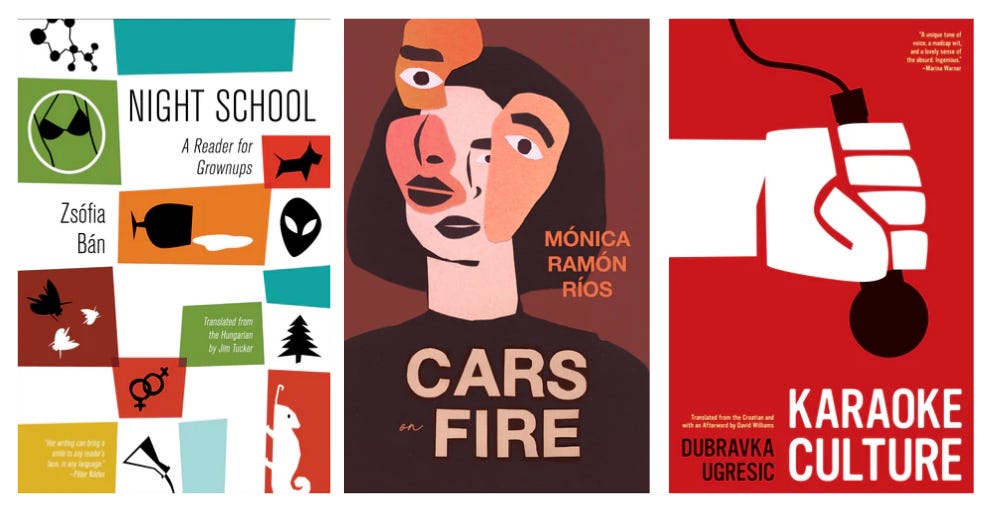
My Take: Arguably the most beautifully designed book Open Letter has ever produced.
Description: Perfect for anyone looking for a little more Nohoo (or “know-how”) in life, Zsófia Bán’s mock-textbook, Night School: A Reader for Grownups covers subjects from self-help to geography to chemistry to French, complete with a hearty dose of irony as a story collection masquerading as an encyclopedia of life.
Short Excerpt: Their hair, their T-shirt, their shoelaces—all frayed. They are playing ping-pong. It’s a heated match, as there are stakes involved. The players: Charlotte (Shatzi to her friends), Edward (Dudi), Ottilia (Oti), and Otto (the Captain). This little company is known in their circles as the Control Group. The game has been going for hours; their backs are soaked in perspiration. On this side, a serve; on the other, a switch.
My Take: Check out the Two Month Review episodes about this collection, especially the one in which Monica-Ramon joined us!
Description: A shifting story of a series of characters whose identities are messy and ever-shifting. Set in New York City, New Jersey, and Chile’s La Zona Central, these stories offer powerful remembrances to those lost to violence, and ultimately make the case for the power of art, love, and feminine desire to subvert the oppressive forces—xenophobia, neoliberalism, social hierarchies within the academic world—that shape life in Chile and the United States.
Short Excerpt: When you live in an adopted country, when you’re an exile in your own body, names are simply lists that dull the reality of death.
My Take: Open Letter’s first finalist for the National Book Critics Circle Award for Criticism.
Description: Whether it’s commentary on jaded youth, the ways technology has made us soft in the head, or how wrestling a hotel minibar into a bathtub is the best way to stick it to The Man, Ugresic writes with unmatched honesty and panache. Karaoke Culture is full of candid, sarcastic, personal, and bitingly opinionated essays on topics ranging from the baffling worldwide-pop-culture phenomena to the detriments of conformist nationalism.
Short Excerpt: The exact nature of the revolution that has occurred is difficult to put one’s finger on, because the revolution happened yesterday. Our lives are too fast and we don’t have time to look back at what happened yesterday. Our biographies are little more than a history of stuff we bought and threw out, most of it stuff that helps “power” us through a little faster: typewriters, answering machines, fax machines, scanners, desktop computers, printers, laptops, mobile phones, video players, CDs, DVDs, cameras, iPods, iPhones, microwave ovens, televisions, CD players . . . We’re barely able to catch our breath and get a handle on all this stuff, when just around the corner there’s something new, the Kindle for example.
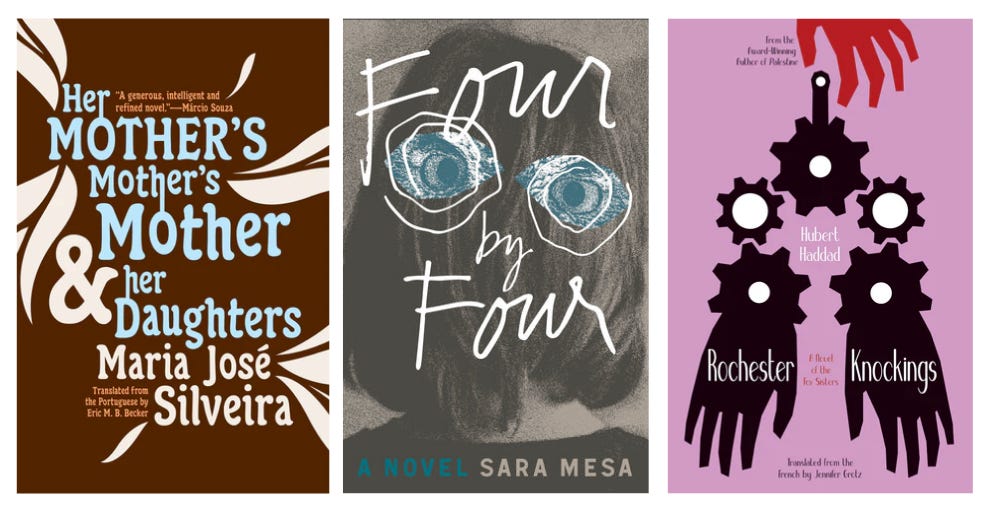
My Take: One of the rare works relating the sweeping history of a country—only through the point of view of female characters.
Description: Spanning 500 years of Brazilian history, this chronicle of a family of women begins in 1500 with the birth of Inaiá, daughter of a Tupiniquim warrior, and ends in 2001 with Inaiá’s distant descendant, Maria Flor—a journey through the formation of Brazil and the changing roles, customs, challenges, and intrigues of the women within it.
Short Excerpt: Remember, too, that whatever I tell you, it was you who asked me, this time, to recount the lives of these women. If at some point you think I’m passing over the men too quickly, don’t come to me later accusing me of feminist bias. I’ll tell you all right now that the lives of the men of the family are every bit as interesting as those of the women, and if I don’t wade further into their exploits, it’s only out of respect for your wishes.
My Take: A much more pertinent work of #DarkAcademia than the The Secret History. (Gauntlet, thrown.)
Description: Set entirely at Wybrany College—a school where the wealthy keep their kids safe from the chaos erupting in the cities—Four by Four is a novel of insinuation and gossip, in which the sinister truth about Wybrany’s “program” is always palpable, but never explicit. Mesa’s “sophisticated nightmare” calls to mind great works of gothic literature (think Shirley Jackson) and social thrillers to create a unique, unsettling view of freedom and how a fear of the outside world can create monsters.
Short Excerpt: The city is fortified. It’s surrounded by a wall three meters high. The wall is made of stone. There’s some graffiti, not much. Graffiti written in an unknown language. No one knows what it says. But even if they could understand the words, the city’s inhabitants wouldn’t be able to read them: the graffiti appears only on the outside. There’s not a single word on the inside of the wall. No drawn hearts, not a single I was here, not even a little obscene drawing. Nothing.
My Take: Rochester’s most infamous residents—and some of the most influential spiritualists of all time.
Description: The Fox Sisters grew up outside of Rochester, NY, in a house with a reputation for being haunted, due to a series of strange “knockings” that plagued its inhabitants. Fed up with the sounds, the youngest of the sisters (aged twelve) challenged their ghost and ended up communicating with a spirit who had been murdered in the house and buried in the cellar.
Short Excerpt: Margaret considered her younger sister with perplexed irritation. She liked her well enough, her little Katie, she was so pretty and sometimes quite comical, but a compartment or two was missing somewhere in her brain. Kate certainly had brains to spare; even Leah, their older sister who had gone to live in Rochester, agreed; whatever her sustained distractions and funny airs might be, when she focused her cat’s eye into space, it betrayed something more than absent-mindedness, something entirely different, as if a part of her was dreaming while wide awake.
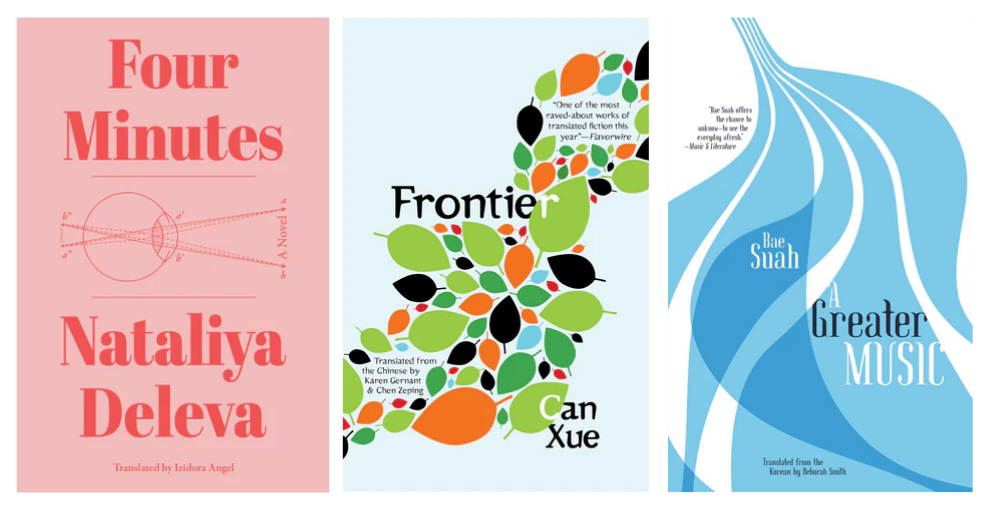
My Take: Also check out Deleva’s second novel, Arrival, which she wrote in English.
Description: Centered around Leah, an orphan who suffered daily horrors growing up now struggling to integrate into society as a gay woman, Four Minutes gives voice to people living on the periphery in post-communist Bulgaria. The title is a reference to the social experiment that one can accept and empathize with a person after four minutes of listening to them and looking into their eyes—a powerful study that ICE should be forced to implement on themselves.3
Short Excerpt: My first conscious memory: I am three, maybe four. I am sitting on the floor of a dark room inside the Home. The room is neither big, nor small, and it reeks of dust and mold. Around me are children my age and some who are older. They pull at each other, shoving and screaming. I crawl into a corner and coil up like a snail, pressing my chin over my knees. I close my eyes and imagine that I disappear, that I become invisible to the others in the room, that I am able to observe the ruckus completely unnoticed. In that moment, I wish for something that, unbeknownst to me, is inevitable. For years afterward, I was certain that I alone willed my life to unfold as it did.
My Take: Soon to be reissued in the UK by Penguin Random House! With more Can Xue in the offing . . .
Description: Exploring life in Pebble Town (or in the frontier) through the viewpoint of a dozen different characters, some simple, some profound, Can Xue’s Frontier attempts to unify the grand opposites of life—barbarism and civilization, the spiritual and the material, the mundane and the sublime, beauty and death, Eastern and Western cultures.
Short Excerpt: It was late. Liujin stood there, leaning against the wooden door. In the moonlight, the ripe grapes hanging on the arbors flickered with a slight fluorescence. Blowing in the wind, the leaves of the old poplar tree sounded lovely. The voice of someone talking blended with the sound of the poplar leaves. Liujin couldn’t hear what he was saying. She knew it was the person who had recently been coming here late every night and sitting on the stone bench near the courtyard gate. At first, this had frightened Liujin and she hadn’t dared to go outside.
My Take: Deborah Smith’s debut translation is also the most sensual and subtly provocative “German” novel in Open Letter’s catalog.
Description: A young Korean writer falls into an icy river in the Berlin suburbs, where she’s been house-sitting for her on-off boyfriend Joachim. This sets into motion a series of memories that move between the hazily defined present and the period three years ago when she first lived in Berlin, in this novel of memories and wandering with a gut-punch of an emotional ending.
Short Excerpt: It was in my teens, when I got my own stereo and learned to play the piano and violin, that I found my way in to the world of music. It was learning an instrument that opened this door, providing a deeper understanding than can be gained through passive listening. And yet I turned out to be utterly devoid of musical talent, even allowing for the fact that I was too old, by then, to be able to tap into that innate ear for music that children supposedly have.
According to my count, we’ve published women writers from nineteen different countries. (More if you include the authors in the four anthologies we’ve done.) This “fun fact” even surprises me!
I would have to do some deep Translation Database research to prove this next claim, but off the top of my head, I can’t think of another publisher who has this geographic range.
Dubravka hated being categorized as a “Croatian” author and preferred “European,” or simply “Author.” She’s not wrong about the dangers of placing writers into specific boxes.
No posts
Comments
Nothing yet. Say the first thing.
Sign in to join the conversation.