
So as to not bury the lede, I’ll state up top that to celebrate the official release of Auroville: A City of Dreams by Katarzyna Boni, translated from the Polish by Mark Ordon, we’re kicking off our annual Women in Translation Month sale a couple days early, which means that this title—along with all other Open Letter books written or translated by a woman—is currently 40% off. (Discount automatically applied at checkout.)
Before getting into that though, I want to take a second to draw your attention to an article I wrote for Words & Money and Publishing Perspectives, provocatively titled “How to Blow $50 Million on the Nonprofit Literary Arts.”

This piece is a thought experiment inspired by the Literary Arts Fund, in which I consider a handful of ways one could disburse $50 million—and the impact these different approaches might have on the field. It also considers LAF’s restrictions on which nonprofit literary arts organizations “count” and are eligible for funding under its rubrics, a theme that’s picked up by translator George Henson (who was on the Three Percent Podcast earlier this year to discuss his translations of Sergio Pitol) in his essay, “How Not to Rebuild the Literary Arts.”
It’s indisputable that the Literary Arts Fund is a net positive for the nonprofit literary arts, but it’s not a panacea . . . And in these times, when it seems like every nonprofit is on the ropes, it’s a good time to think about funding structures and how to gin up more support for the organizations that are, theoretically at least, combating “economic censorship” by providing access to literature unsustainable by the marketplace.
Thanks in advance for taking the time to read this, and if you want to support Open Letter Books and all our activities (our publications, this Substack, the Translation Database, our podcasts, etc.), please consider contributing via the University of Rochester. And thanks to everyone who has already done so! Every donation matters immensely, and I thank you personally for your support.
Now, on to some books!
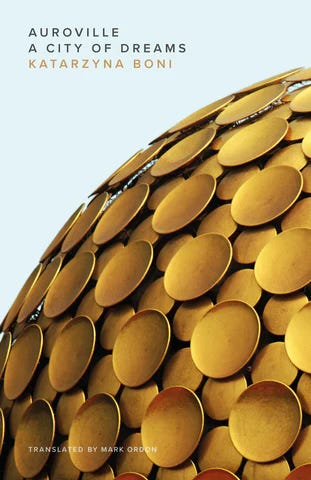
Over the past few months, I’ve written about Auroville on a few occasions. It’s referenced in “A Voyage to India,” excerpted at length in “Is it a Cult? Or a Utopia?,” and explored in depth in “Ways of Approaching Auroville.”
For anyone who missed these, or just needs a refresher, here’s the meat of the jacket copy:
In 1967 the Mother founded Auroville, a planned utopia that would be both self-sustaining and, through the yogic practices of Sri Aurobindo, a community that would herald the next evolution of humanity. She designed a city to resemble the galaxy, and to house 50,000 people from around the world who, through a series of utopic ideals—transforming the desert into self-sustaining farmland, eliminating the need for money, removing religious conflicts, among others—would transform the world into a more just place.
Despite the death of the Mother, contentious infighting, and the Indian government taking control of the city, Auroville has survived, and still attracts thousands of visitors every year. And in 2018, one of those visitors was Katarzyna Boni, a renowned Polish reportage writer, who wanted to try and understand what Auroville really means—as a city, as a community, as a beacon of hope for the future.
This is a book for anyone who is interested in utopia studies, or who enjoyed Marguerite Young’s An Angel in the Forest, or who wants to learn about positive environmental impacts, or who loves gripping nonfiction about big ideas and interesting people. It’s a marvelous book, well-researched and incredibly readable. And at 40% off, it would be foolish not to order a copy!
And, while you’re at it, you might want to consider throwing in a copy of Boni’s earlier book, Ganbare!: Workshops on Dying, a harrowing book about the aftermath of the March 11, 2011 earthquake and ensuing tsunami that wrecked Japan, leading to the Fukushima nuclear disaster. In some ways, it’s the flip-side to Auroville—its origins are in tragedy and disaster, rather than spiritual optimism—but in the end, both books are about resilience and how human beings can come together.
Some of this can be found in this wonderful interview from Culture.PL that Agnes Dudek conducted with Boni back when the book first appeared in Polish. It’s a very substantial conversation that’s worth reading in full, but here are a few bits that I found particularly interesting:
Agnes Dudek: In a previous interview, you labeled Auroville as having ‘blind idealism’. Why did you choose those words?
Katarzyna Boni: Well, those were my own assumptions about them, right? I felt as though they didn’t know history. About communism, but also about other utopian projects. For example, what Christiania in Denmark—which is one of the most famous utopian projects—looks like now with all its regulations. What happened there, what succeeded, what didn’t. Back in 2009, I met people who simply said, “This is the only place where I can be a better version of myself. This is the only place that has a chance to build a better world. If not here, then where?” And I had this feeling that they were living in denial. And also in some sort of ignorance about the dangers. And it’s precarious not to know what the dangers are. It’s dangerous not to know what Stalinism in Russia looked like. But I just assumed that, without really trying to understand what’s happening around me. [. . .]
AD: What is actually utopian about Auroville?
KB: The definition of utopia is that it’s a good place that doesn’t exist. So really, although people call Auroville utopian, it’s not utopian—it’s a social experiment. It’s a diverse place with many nuances—some aspects are stronger, others weaker. It exists firmly in shades of gray, not black and white. What’s utopian is the attempt to create a better world. I also read a lot about utopian thought, starting from projects such as Thomas More’s Utopia and Tommaso Campanella’s City of the Sun and also about more modern ideas. There’s a quote from Oscar Wilde that I really like:
“A map of the world that does not include Utopia is not worth even glancing at, for it leaves out the one country at which humanity is always landing. And when humanity lands there, it looks out, and seeing a better country, sets sail. Progress is the realization of Utopias.”—Oscar Wilde, “The Soul of Man Under Socialism”
And I think that’s the best definition of utopia—that it’s something we need in our striving for development. And this progress could be understood as market-driven progress, but also as personal development, or advancement in education or in economic thought. In this widely understood notion of progress, we’re aiming for a world where life is better for everyone. I think most people would agree with that—to make life better for as many people as possible. Because otherwise, we stagnate. We remain in the misery we’re in. The only point is in striving for something better. However, as soon as we reach something better, we must immediately look around to see where we can still improve.
And in that sense, I think Auroville is quite utopian, because it’s constantly evolving; it hasn’t fossilized into any dogmatic form or religious structure. Moreover, Auroville has no religion—it’s one of its core principles that it is a place without religion. There is freedom of belief. It continues to adapt to changing circumstances. It has changed dramatically. The place, once a completely destroyed and degraded desert, where rain would rush into the sea in torrents, carrying so much sand that the entire bay would turn red with dust, is now a green oasis—a humid subtropical forest, full of animals and plants. It’s a very beautiful place, truly rebuilt by the hands of people who believed it was worth going there and creating something different. They dug ditches to trap the water, planted trees, and built the first huts made of mud.

Auroville now features a mix of houses, from architectural experiments with ecological methods to beautiful or unusual villas built by the French in the sixties, reflecting a shift from survival to comfort. Today, one can live in a beautiful villa in the forest and focus on writing a book rather than digging, planting, or building. Auroville now attracts a different kind of person than it did 50 years ago, and many of the original pioneers are questioning whether it’s still possible to uphold Auroville’s principles in this new lifestyle. This remains an ongoing discussion: how the community can stay true to its original vision. [. . .]
AD: When examining Auroville’s evolution, what aspects do you believe have been most resilient against the changes of reality?
KB: I think we return to the question: why has Auroville survived for so long? I believe it’s because they remain open to new ideas. They have a clear sense of direction and well-defined plans. Their vision is to create a city where people from all walks of life, from every country and culture, can coexist. It’s a city designed for fifty thousand people, with human unity as its guiding principle. However, there’s no fixed path to achieving this goal—and no set timeline. Some Aurovillians even say it won’t happen within our lifetimes.
At present, Auroville is home to a few thousand residents, far from the fifty thousand originally envisioned. It’s not really a city—it’s more like a beautiful village set within a forest. Yet, the fact that it still exists and continues to attract new people is, in itself, a kind of success. These newcomers bring fresh perspectives and are bound to approach things differently from the pioneers. Because there’s no dogma dictating how Auroville’s vision should be realized, experimentation is encouraged. People are constantly trying new methods, making mistakes, starting again, and exploring what works. That’s why Auroville has endured for over fifty years—this openness to innovation has been a consistent thread from the beginning. It’s this adaptability, I think, that hasn’t changed. That said, I’m not entirely sure what it’s like there now.
We touched on the absence of dogma, but we didn’t discuss Auroville’s founders. I should mention Sri Aurobindo—a freedom fighter and visionary thinker. His writings were widely circulated in Western Europe at the turn of the twentieth century. Having studied at Cambridge, he returned to India, where he played an influential role in the resistance against British rule. Eventually, he was forced to flee British India, seeking refuge in Pondicherry, which was then under French control. There, he was joined by a Frenchwoman, Mira Alfassa, who helped him establish an ashram that attracted many Westerners—even Margaret Woodrow Wilson, the daughter of an American president, lived there at one time. Auroville was another project deeply inspired by Sri Aurobindo’s ideas. [. . .]
AD: How do you think the concept of utopia changes when it transitions from an idea to a lived experience?
KB: I think imagining things on paper is always flawed because it fails to account for how diverse people are and how varied our needs can be. This is precisely Auroville’s strength—it doesn’t assume we’re all the same or that we all share identical needs. Instead, it works from the premise that we’re collectively striving for a better world, however we choose to define it. Embedded in Auroville’s philosophy is the recognition that there’s no single path forward—no rigid set of rules that everyone must follow.
I’ve read many of the most famous utopian works from the Renaissance and Enlightenment, and I wouldn’t want to live in any of those worlds. They give me chills with their meticulous planning, dictating everything from who can sleep with whom, to how many children must be born each year, to which child is assigned to which village. These are meticulously designed societies, often with some overarching social ideal at their core. It’s worth remembering, though, that these books were usually critiques of the societies their authors lived in, rather than genuine blueprints for the future.
Later, some of these ideas were tested on smaller scales in what were called intentional communities. One of my favorites is Fourier’s phalanstère. Fourier, who was the first to use the term feminism, envisioned small communes with a division of labor, and he believed that once enough of these communities existed, even the seas would turn from salty water to lemonade. I find this both charming and utterly mad. But it’s anecdotal. What Auroville demonstrates is that there are no universal rules to follow. Instead, it’s all about embracing the chaotic mess of life and trying to piece something meaningful together.
Not to beat a dead horse, but once again, this book—along with 127 other titles published by Open Letter—is 40% off from now until the end of August in celebration of Women in Translation Month. We’ll be back next week with more information about WIT Month along with posts highlighting not just our titles, but as broad a swath of books by women in translation as possible.
No posts
Comments
Nothing yet. Say the first thing.
Sign in to join the conversation.