
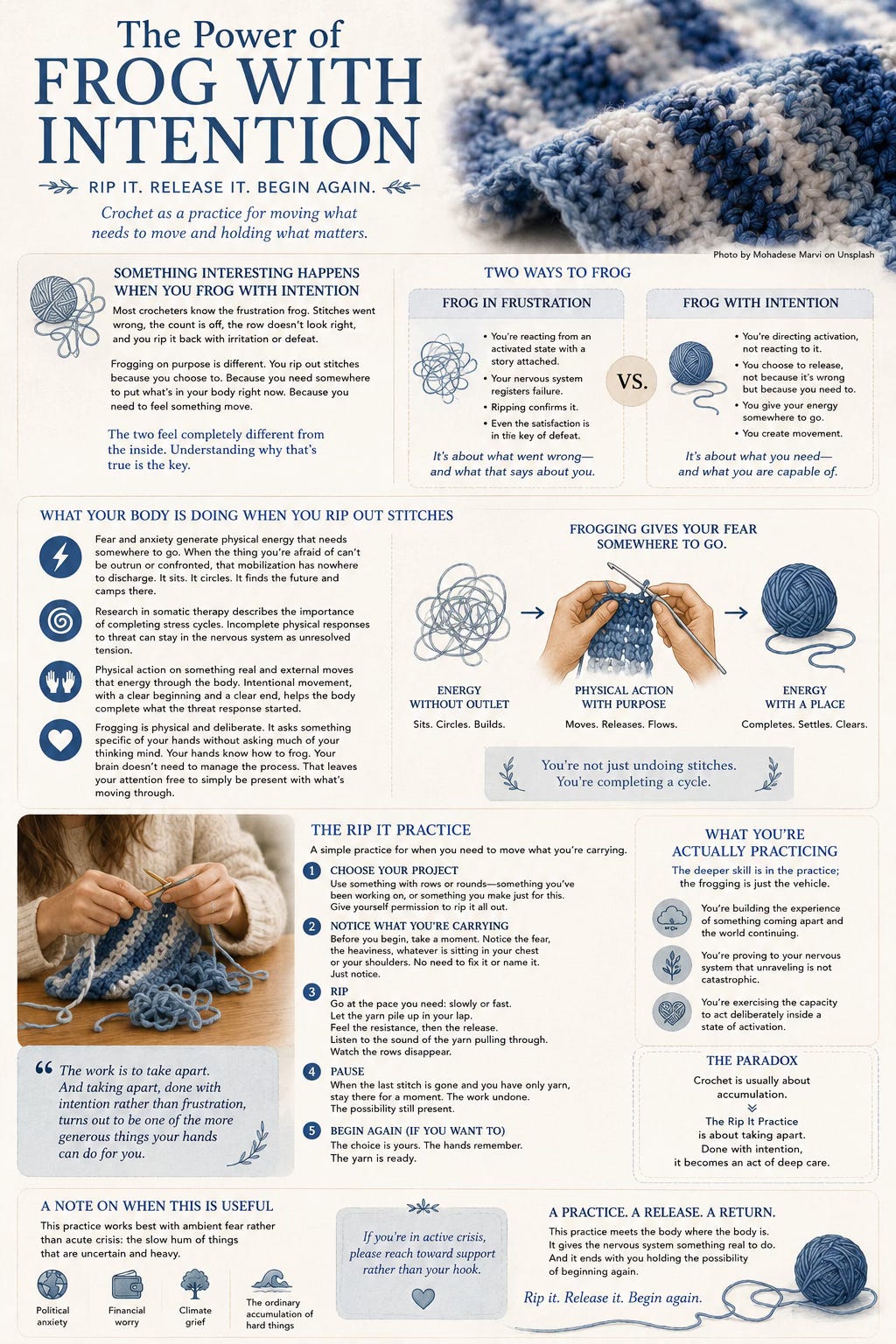
Something interesting happens when, as a crocheter, you frog with intention rather than frustration.
Most crocheters know the frustration frog well. The stitches went wrong, the count is off, the row doesn’t look right, and you rip it back with something between irritation and defeat. It tends to come with a particular quality of internal commentary, the kind that says something about you rather than just about the work.
Frogging on purpose is a different experience entirely. You rip out stitches not because something went wrong but because you choose to. Because you need somewhere to put what’s in your body right now. Because you need to feel something move.
The two feel completely different from the inside, and understanding why that’s true is the thing I want to talk about.
When you frog in frustration, you’re acting from an activated state that already has a story attached to it. Your nervous system is registering failure, and the ripping confirms it. Even the brief satisfaction of undoing a mistake is satisfaction in the key of defeat.
When you frog with intention, you’re directing activation rather than reacting to it. Fear and anxiety generate physical energy that needs somewhere to go. They’re states that evolved to mobilize the body, and when the thing you’re afraid of can’t be outrun or confronted directly, that mobilization has nowhere to discharge. It sits. It circles. It finds the future and camps there.
Physical action on something real and external moves that energy through the body differently. Research in somatic therapy describes the importance of completing stress cycles, the idea that incomplete physical responses to threat can stay in the nervous system as unresolved tension. Intentional movement, with a clear beginning and a clear end, can help the body complete what the threat response started. You’re giving the fear somewhere to go, a channel for the energy it has generated.
Frogging is particularly useful for this because it’s physical and deliberate, and because it asks something specific of your hands without asking much of your thinking mind. Your hands know how to frog. Your brain doesn’t need to manage the process. That leaves your attention free to simply be present with what’s moving through.
The exercise I’ve used in my own work, which I first shared over ten years ago in my book Hook to Heal, and which I am most recently sharing in a free PDF that I’m offering to people who attend my free Power of Positive Crochet presentation on 4/17/26, is “Rip It”.
It’s simple. Start with a piece of crochet that has some rows or rounds already on it. It can be something you’ve been working on, or something you make quickly and set aside specifically for this purpose or even something you made a long time ago that you don’t want anymore. Give yourself permission, in advance, to rip it all out.
Before you begin, take a moment to notice what you’re carrying. The specific fear, the heaviness, whatever is sitting in your chest or your shoulders right now. You don’t need to understand it or name it precisely. Just notice that it’s there.
Then begin ripping. Slowly if that feels right, quickly if you need that. Let the yarn pile up in your lap. Let the work come apart. Notice the sensation: the slight resistance and then the release, the sound of the yarn pulling through, the way it coils back into itself as the rows disappear.
When the last stitch is gone and you have only yarn again, stay there for a moment. The work undone. The possibility still present.
Then, if you want to, begin again.
The deeper skill here is in the practice itself; the frogging is just the vehicle.
What you’re building is the experience of something coming apart and the world continuing. Fear tends to tell us that undoing is catastrophic, that if a thing unravels we won’t be able to recover it. The Rip It Practice is a small and very immediate argument against that story. The stitches come out. The yarn is still there. Your hands still know what to do.
There’s also something important about the choosing. Choosing to release the work is different in quality from losing the work, and that difference matters more than it might seem to. Fear often comes with a sense of things happening to us, of control being elsewhere. Choosing to undo something, even something as small as a few rows of crochet, exercises the capacity to act deliberately inside a state of activation. That’s the capacity you’re building.
The paradox at the center of this practice is that crochet is almost always about accumulation: stitches building into rows, rows building into fabric, fabric building into something finished and whole. The Rip It Practice inverts that entirely. The work is to take apart. And taking apart, done with intention rather than frustration, turns out to be one of the more generous things your hands can do for you.
This exercise works best with ambient fear rather than acute crisis: the slow hum of things that are uncertain and heavy, the political anxiety, the financial worry, the climate grief, the ordinary accumulation of hard things that many of us carry a lot of the time right now. If you’re in active crisis, please reach toward support rather than your hook.
For the ambient kind, this practice has been one of the more consistently useful ones I’ve encountered across twenty years of thinking about crochet as a health practice. It meets the body where the body actually is, gives the nervous system something real to do, and ends with you holding the possibility of beginning again.
No posts
Comments
Nothing yet. Say the first thing.
Sign in to join the conversation.