
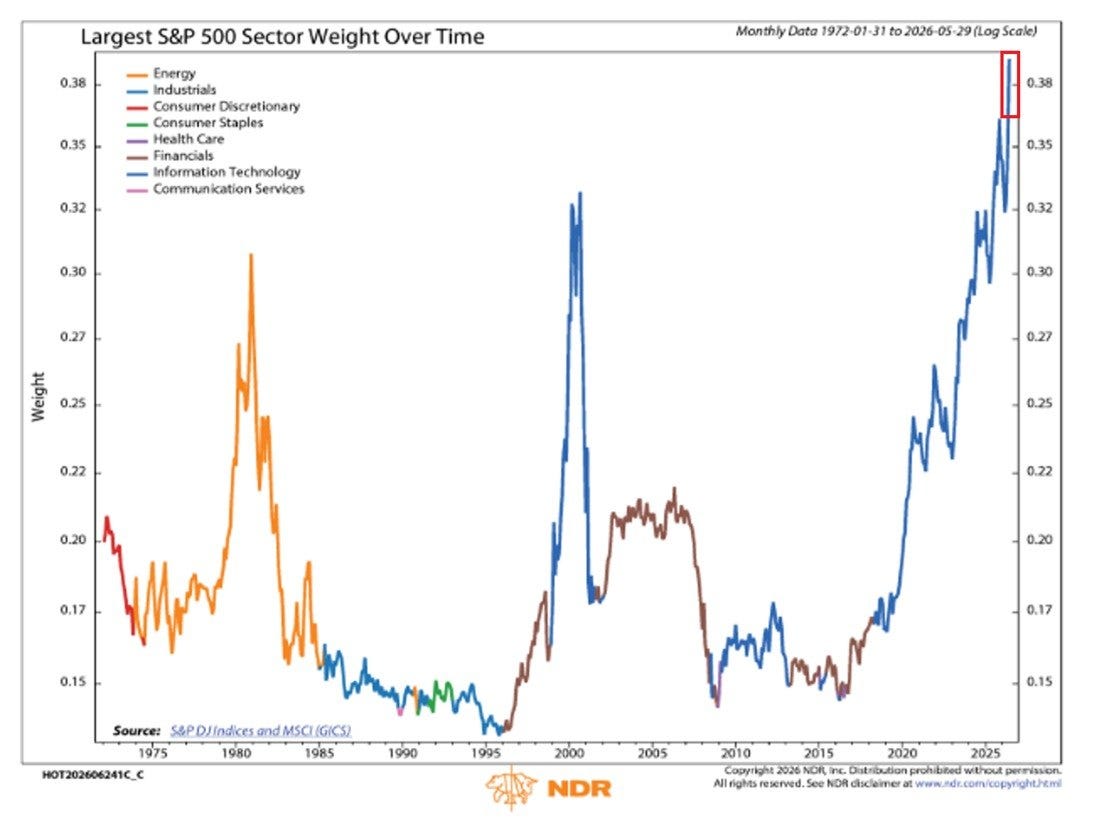
No sector in history has ever been this large:
The Information Technology sector now accounts for a record 39% of the S&P 500’s total market cap.
This percentage has more than doubled since the 2020 pandemic.
This figure is also now above the 2000 Dot-Com Bubble peak of ~33% and the ~31% peak reached by the Energy sector in the 1980s.
Including internet retailers and digital media platforms such as Amazon, $AMZN, and Netflix, $NFLX, tech now accounts for a record 50% of the S&P 500’s market value.
By comparison, this same group accounted for just 29% of the index at the Dot-Com Bubble peak.
Tech is all that matters now.
Jim Chanos, the veteran short-seller known for positions against Chinese real estate, Wirecard, and Enron, compared the decade before Netscape’s 1995 launch to the decade after, US economic growth and corporate profit growth rates were essentially unchanged, despite the internet’s obvious transformative effect on individual winners and losers. I believe he meant that AI may reshuffle which companies win without necessarily lifting aggregate growth or profitability.
Val Zlatev, who runs a multi-billion dollar long-short fund focused on semiconductors and hardware, countered from the micro level: across a roughly 500-company hardware universe he tracks, headcount has barely grown (or has declined) over the last three to four years while operating profits have risen sharply, evidence, in his view, that AI’s productivity effect on the technology sector itself is already real and measurable, even before it diffuses to the broader economy.
Chanos’s central thesis says that there is a disconnect in profitability accounting between companies selling AI infrastructure (chips, data center equipment, construction), which recognize revenue and profit immediately, and the hyperscalers spending those dollars, who capitalize the costs rather than expensing them.
Much of current hyperscaler capex is sitting in “construction in progress,” not yet depreciated, with Chanos using a conservative 10-year useful life assumption for GPUs in his own modeling.
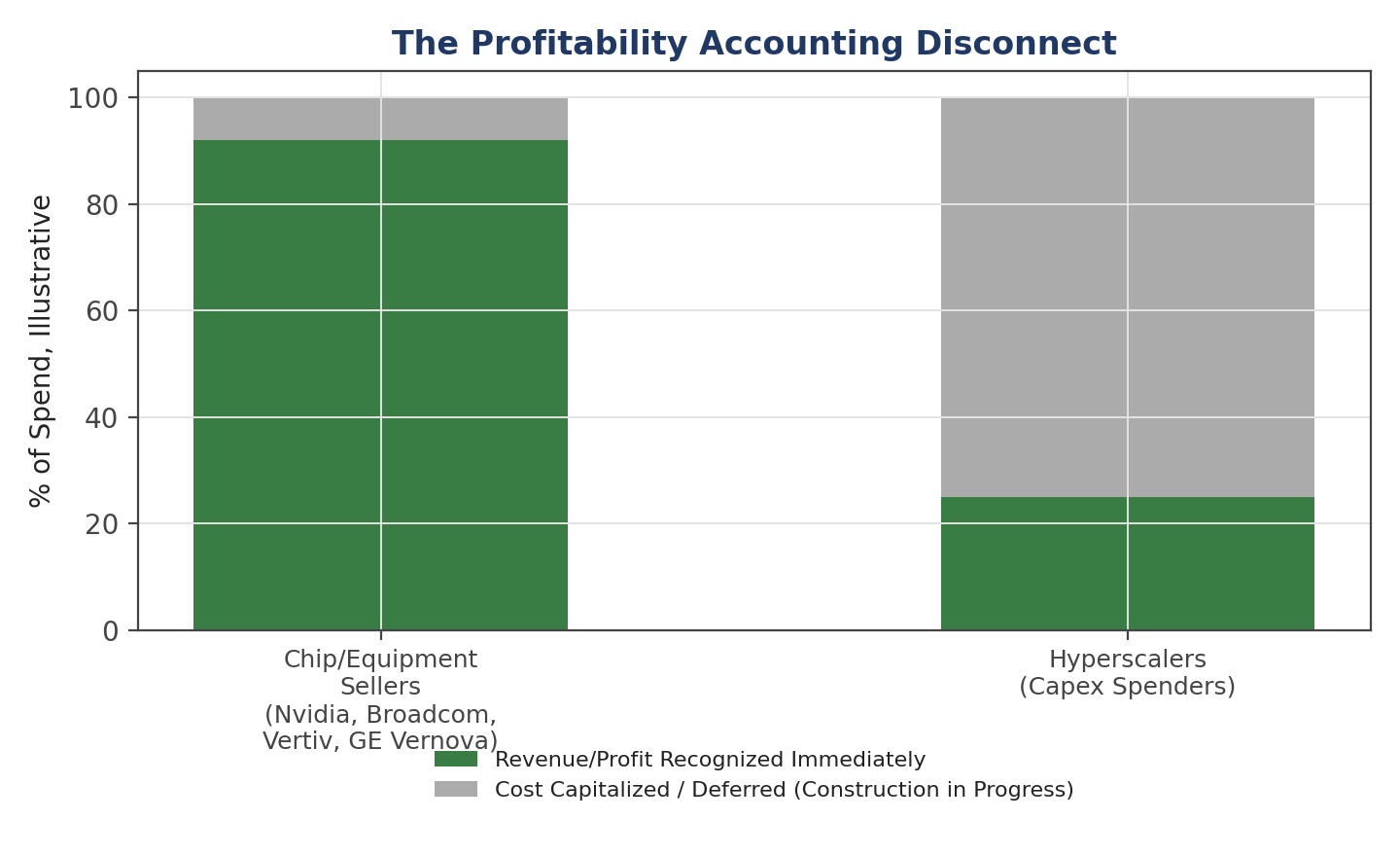
Figure 4. Illustrative depiction of the revenue/profit recognition gap discussed: equipment sellers recognize revenue immediately; hyperscalers capitalize and defer.
I noticed that there is a direct historical parallel to the fiber/telecom capex boom of the late 1990s. S&P 500 operating profits rose roughly 30% from mid-1998 to mid-2000 on a similar capex-driven earnings surge, then fell approximately 40% from mid-2000 to mid-2001 as order books collapsed, a decline comparable in magnitude to the drop seen during the 2008–09 financial crisis, despite 2001 being a mild recession.
There is also a widely repeated but apparently fabricated statistic at the time, that internet traffic was doubling every quarter, which helped justify the over-ordering of network equipment; later analysis found traffic was actually doubling roughly annually.
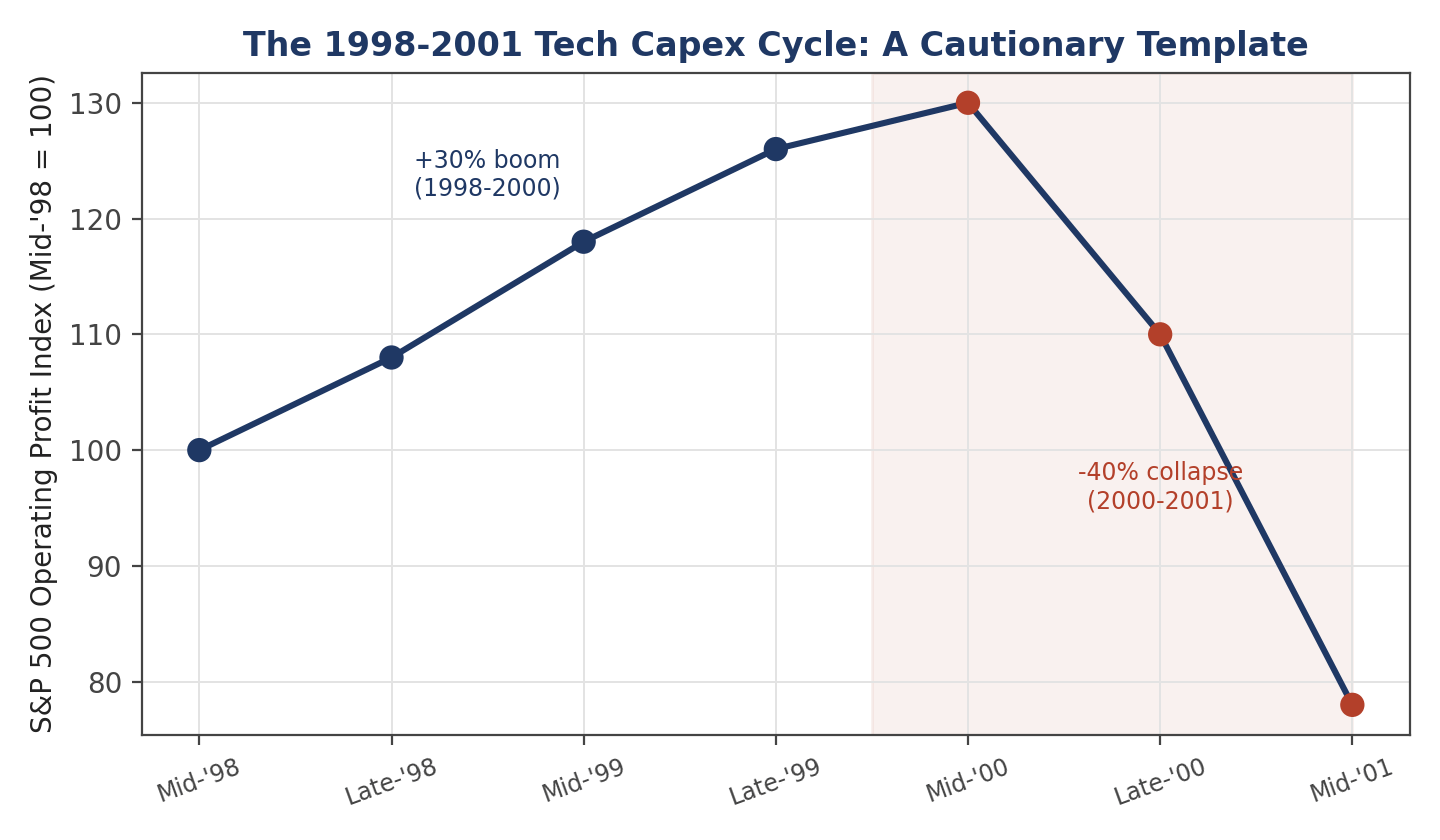
Illustrative reconstruction of the S&P 500 operating profit cycle Chanos referenced from 1998 to 2001.
However, in today’s environment, that can be tracked in near-real time via open-source token-usage data, rather than relying on a corporate CFO’s quarterly characterization and that current GPU rental prices for chips as old as six to eight years have been rising sharply since around January, reversing a prior year-over-year decline of 20–30%, evidence that token demand is currently outstripping supply rather than being manufactured by a false narrative.
Chanos is not actually short the chipmakers themselves. His short exposure targets business models he views as structurally low-return regardless of the AI growth outcome: Bitcoin miners that pivoted to data center hosting, and “Neocloud” GPU rental businesses such as CoreWeave.
These companies are effectively equipment-leasing/finance businesses wrapped in technology branding, and even under generous best-case assumptions (including a 10-year chip life), the unrounded returns on capital pencil out in the mid-single digits.
You want to belong what the chips produce, not where the chips reside.
However, a select number of Neoclouds, such as CoreWeave’s reported software/optimization layers and Nimbus’s roughly 50–60% revenue exposure to (higher-margin) inference rather than 100% hyperscaler-contracted capacity.
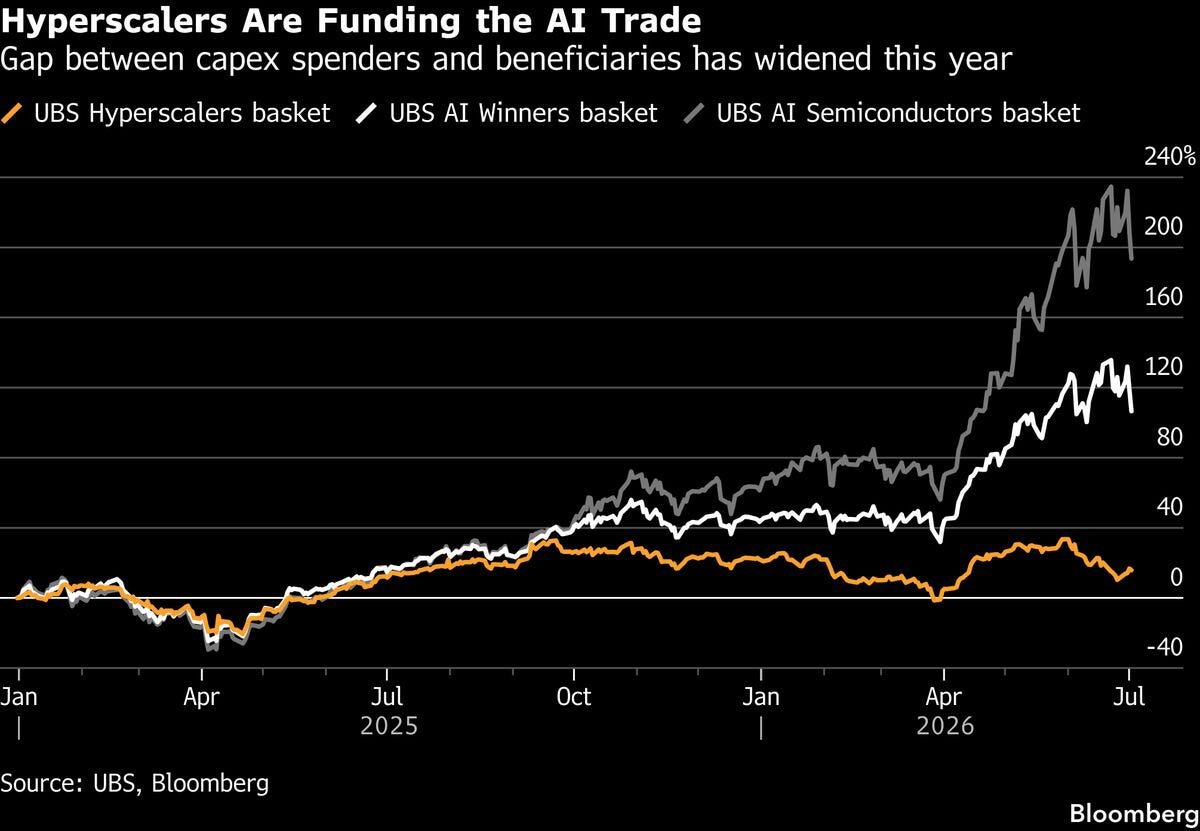
The broader “landlord” category lacks differentiated technology.
I have began to notice a slowing rate of change in hyperscaler capex growth. They are still expanding in absolute dollars, but decelerating from roughly 80% year-over-year growth toward the mid-40% range, per data cited from JPMorgan.
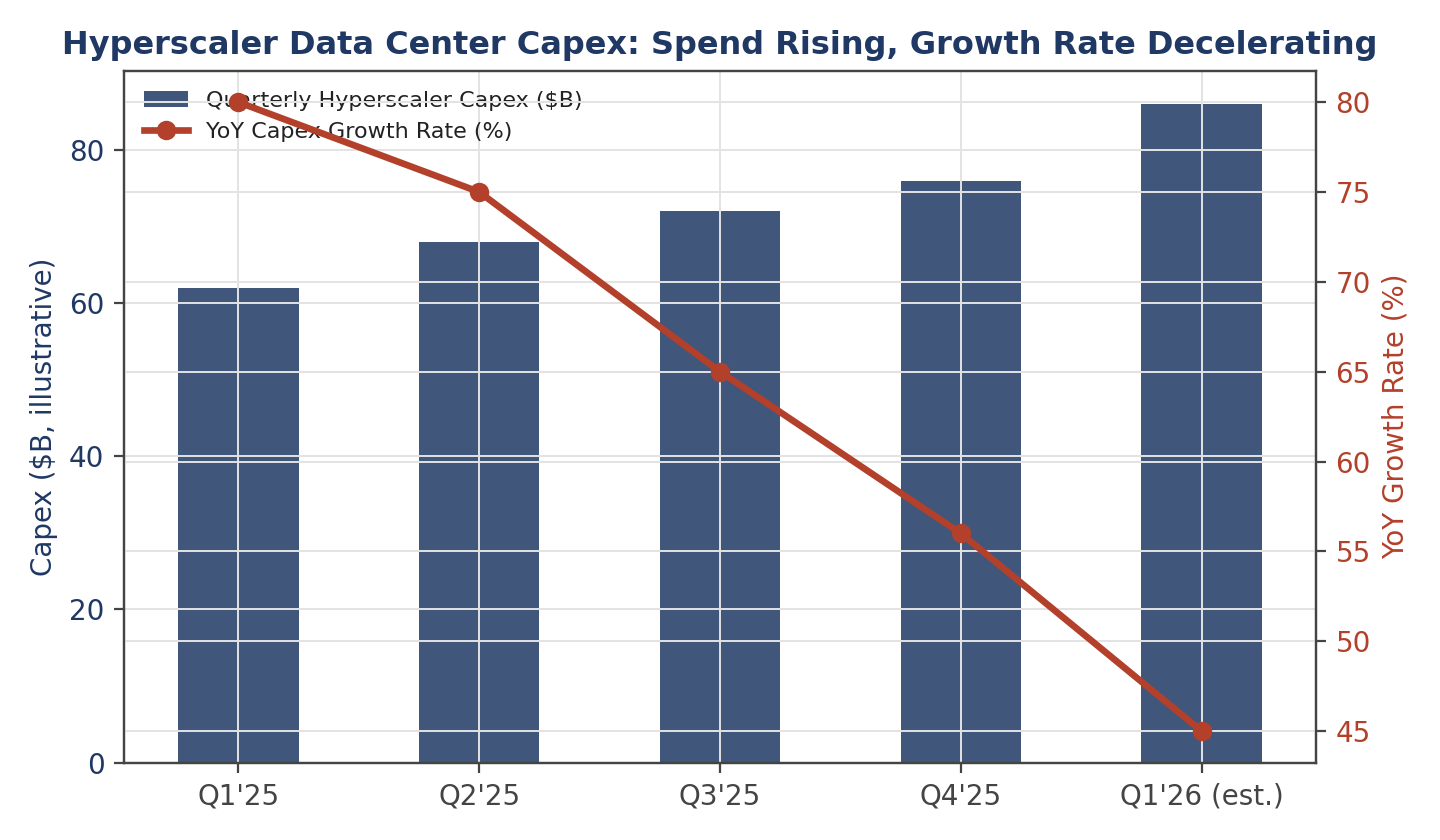
Illustrative reconstruction of hyperscaler capex deceleration discussed across sources, based on cited JPMorgan data center capex research.
On DRAM and NAND memory, historically among the most brutally cyclical, commoditized corners of semiconductors, this cycle differs structurally.
DRAM and NAND prices have risen four-to-fivefold, driven by the shift from simple chatbots to reasoning models (requiring more token storage), expanding context windows, and the recent emergence of AI agents, which consume memory more intensively than prior workloads.
Even with unlimited clean-room capacity, equipment makers such as ASML and Applied Materials are physically constrained to roughly 30–35% annual bit-supply growth, and memory manufacturers, characterized as a much more cautious, cyclically-scarred 60-to-70-year-old leadership cohort than Silicon Valleym under-invested in new clean-room capacity during the 2023–2024 downturn, leaving the industry unable to quickly meet the current surge in demand.
The consequence flagged is that memory now represents roughly 50% of bill-of-materials cost for PCs and smartphones, up from roughly 20% historically, squeezing device-maker margins at sub-5–6% operating margins and forcing price increases on consumers. PC and smartphone unit volumes were cited as down in the mid-teens percentage range this year as a result, an unusually sharp decline for typically flat, slow-growth categories.
Chanos has never made a single dollar shorting DRAM companies over a 40-year career, the sector’s history of repeated boom-bust mistiming, and he generally avoids pure-play memory and semiconductor-cyclical shorts as a result, though he does see a valuation gap worth noting between legacy CPU names trading at elevated revenue multiples in increasingly competitive markets versus dominant, oligopolistic AI infrastructure names that are comparatively cheaper despite stronger market positions.
However I push back the common critique that the current AI-adjacent valuations that broadly resemble 1999–2000.
Chanos noted that 1999–2000-era extremes (e.g., Cisco at roughly 160x earnings) are not matched by today’s leading AI infrastructure names. Nvidia at roughly 15x estimated 2027 earnings and Broadcom at roughly 12x estimated 2028 earnings as comparatively reasonable, even as semiconductor capital-equipment suppliers (ASML, Lam Research) trade at richer multiples (~35x) for similar growth rates, given their structurally capped ~30% growth ceiling.
This is where the AI bubble comparison becomes more complicated. On the surface, the setup does look and feel like the dot-com bubble: one dominant technology narrative, extreme index concentration, massive capex buildout, investor belief in a new economic paradigm, and a market increasingly willing to underwrite years of future growth upfront. Semis have become the picks-and-shovels trade of the AI cycle in the same way networking, fiber, servers, and internet infrastructure became the backbone trade of the late 1990s. The chart pattern, the concentration, and the reflexive enthusiasm all rhyme with 1999.
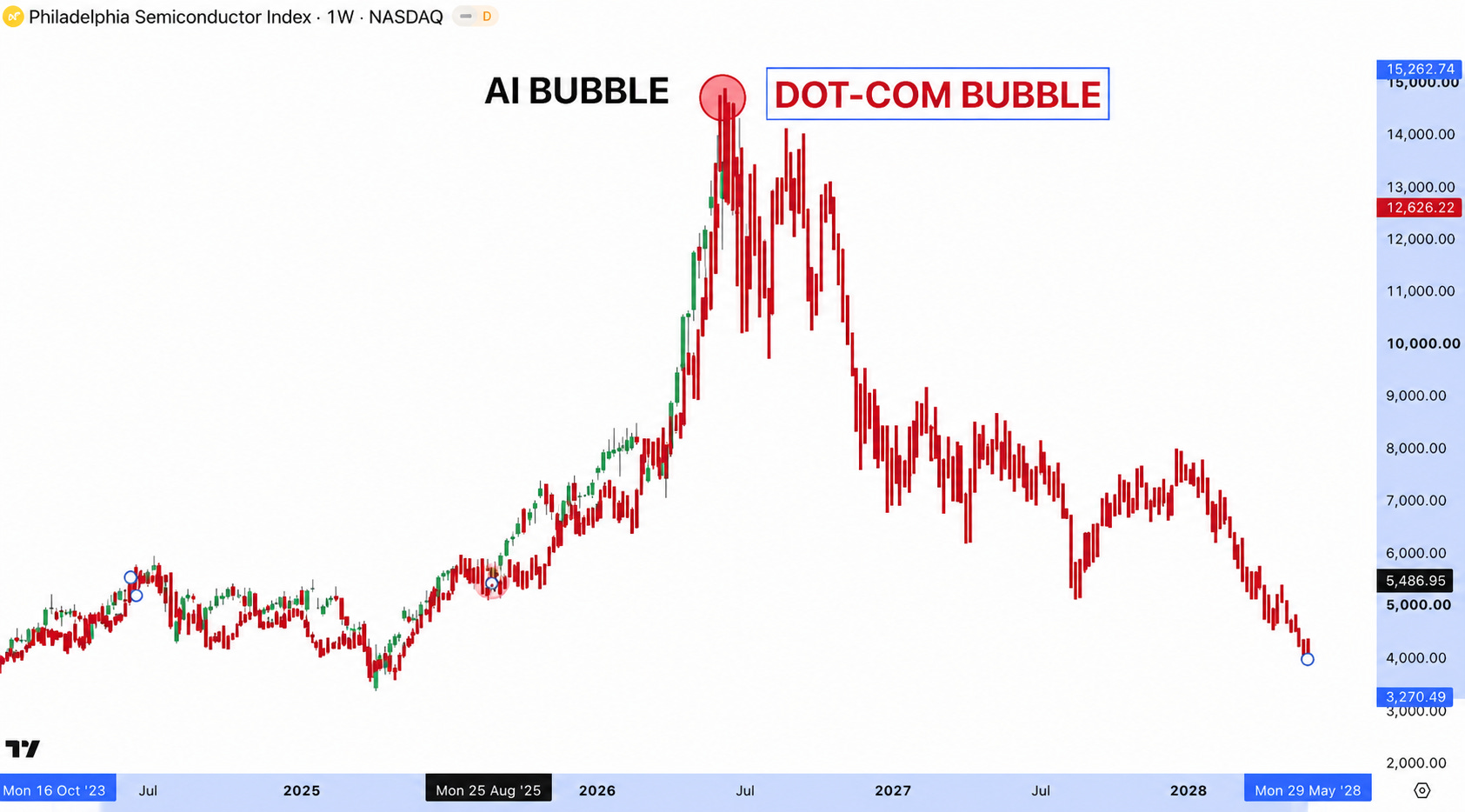
All that said, I remain long broad semiconductor exposure (with call options on Marvell and Photronics, and naming Nvidia as the highest-conviction idea), while separately flagging Meta’s AI strategy as a name that I am bearish on, though not currently short.
My overall idea is that even if this is ultimately a bubble, being outright short semiconductors may not be a risk worth taking while the boom continues, though we do see that a genuine accounting disconnect exists between semiconductor profits and model-company losses that, in my view, is unsustainable over a multi-year horizon.

arndxt@arndxt_xo
https://t.co/reixFt2SGV
1:20 PM · Jul 6, 2026
Comments
Nothing yet. Say the first thing.
Sign in to join the conversation.