
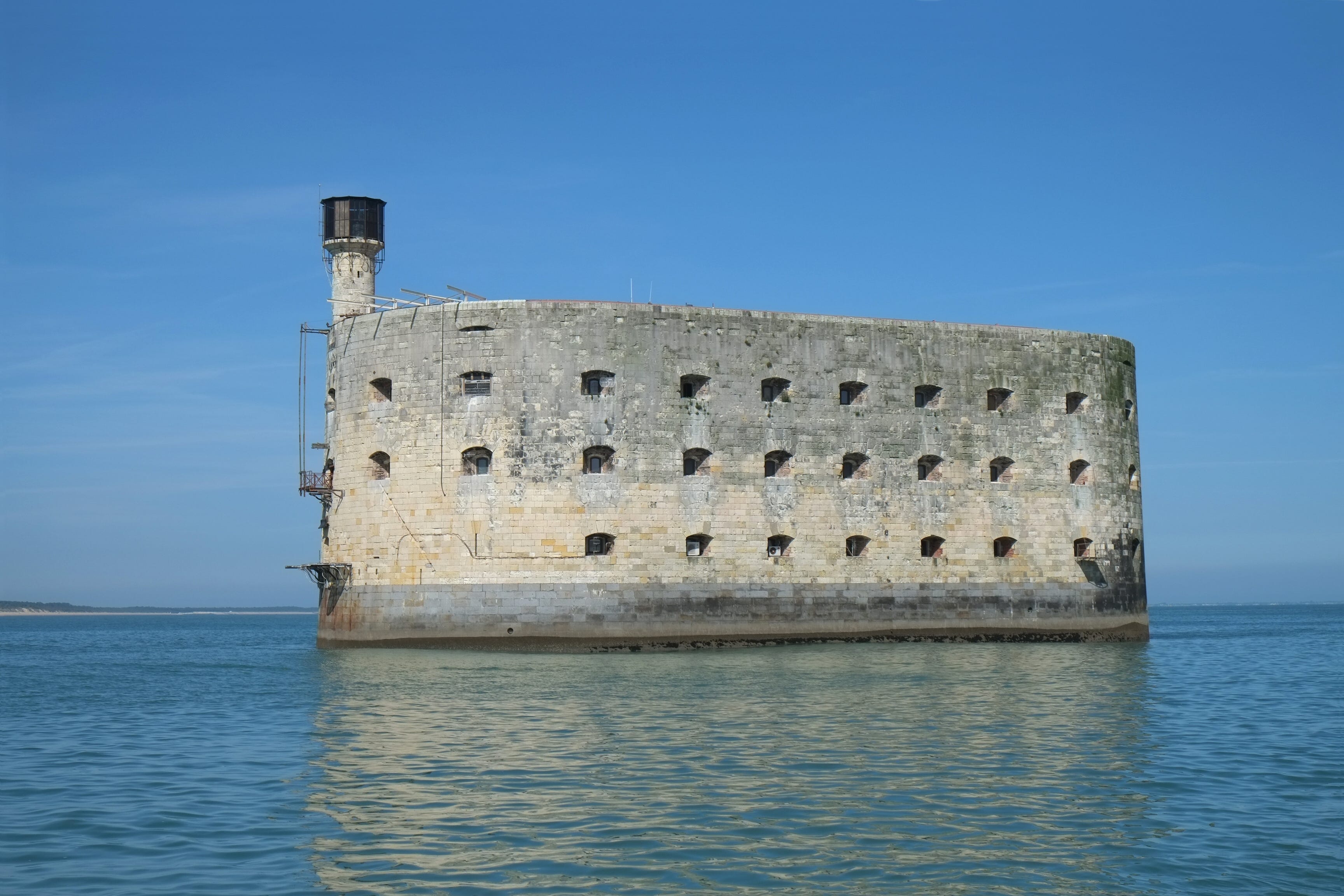
A party of six adventurers sails out to a sea fortress in the Atlantic. The fortress belongs to an ancient bearded hermit who speaks only in riddles. To claim his treasure, the party must survive a gauntlet of trials, collect keys, decipher clues, and reach the vault before the gates slam shut and the gold sinks out of reach.
In 1988 a television production company bought it for one symbolic franc plus renovation costs, and in 1990 the game began. So, there it is: the best fantasy locations are the ones history builds for you. The show’s premise is pure D&D. The fort is ruled by Père Fouras, a white-bearded elder who has supposedly lived there for centuries. He poses riddles from his watchtower. Get the answer right, you win a key. Get it wrong, and the key drops into the sea, forcing a contestant to dive after it. Around him orbits a whole cast of recurring characters: a dwarven gatekeepers (Passe-Partout), sinister strongmen, mad scientists, a chef who serves dishes you do not want described, and assorted creatures lurking in the cells. The fort itself is the antagonist. Contestants crawl through tunnels full of insects, wrestle in mud, climb the outer walls above the sea, and get lowered into dark pits, all against a clock. The endgame is the treasure room. Keys unlock the gate, clue words decode a password, and if the party solves it in time, gold coins called boyards pour out. If not, the gate closes on the money. For years, real tigers guarded the treasure. British readersmight recognize this show’s offspring. When Channel 4 licensed the format in the late 1980s, the fort was still under renovation and unavailable for filming, so the same creator, Jacques Antoine, devised a studio-based replacement: The Crystal Maze. Fort Boyard is the older sibling that stayed home in the sea. The format has since been produced in dozens of countries, from Russia to Quebec to Vietnam, which makes Père Fouras one of the most widely franchised wizards in television history. I believe this is the closest thing broadcast television has to a live dungeon module, and it commits to the bit. Nobody winks at the camera. The riddles are real riddles, in rhymed verse. The old man in the tower stays in character through interviews. The show has built three decades of continuity: characters age, retire, return, betray the fort, get replaced. In 2025 the long-running host left and the keeper of the fort chose his successor in-story, a lifelong fan who had once appeared on the show as a contestant and later as a character. The 2026 season, running right now, has added a new punishment: contestants who fail to gather enough keys are sacrificed into a giant serpent’s mouth built into a stairwell, and the floor drops out from under them. Thirty-seven seasons in, the fort is still eating adventurers.
This French game show has aired every summer for thirty-seven years. Fort Boyard is an actual stone fortress standing in open water between the islands of Aix and Oléron, off France’s Atlantic coast. Napoleon ordered it built to guard the naval arsenal at Rochefort. Construction was such a nightmare of shifting sandbanks and Atlantic storms that it took over half a century. By the time the fort was finished in the late 1850s, artillery ranges had improved so much that it was militarily useless . It served briefly as a prison, then sat abandoned in the sea for a century.
And now, I’m leaving for my own summer adventures and putting this blog on pause.
Till next time.
Alex
Comments
Nothing yet. Say the first thing.
Sign in to join the conversation.