
I have to admit, I was surprised when Krysten Sinema announced she wouldn’t seek re-election; she seemed like the kinda gal who would fight until the very end, but she’s ready to move on to greener pastures. And by greener pastures, some would argue one full of lobbying money.
Since taking office in 2019, you can’t have a conversation about the Senator representing Arizona that doesn’t include her style. On her first day in office, she wore a white sleeveless top with large white pearls at the neckline, a jeweled and rose-printed pencil skirt, and a grey fur stole, topped with a pink coat with faux fur trim and crystal buttons. This outfit was quite different from the typical black or navy skirt suit set or a colored sheath dress with a blazer most Congresswomen wear, so naturally, the outfit caused a stir on the internet.

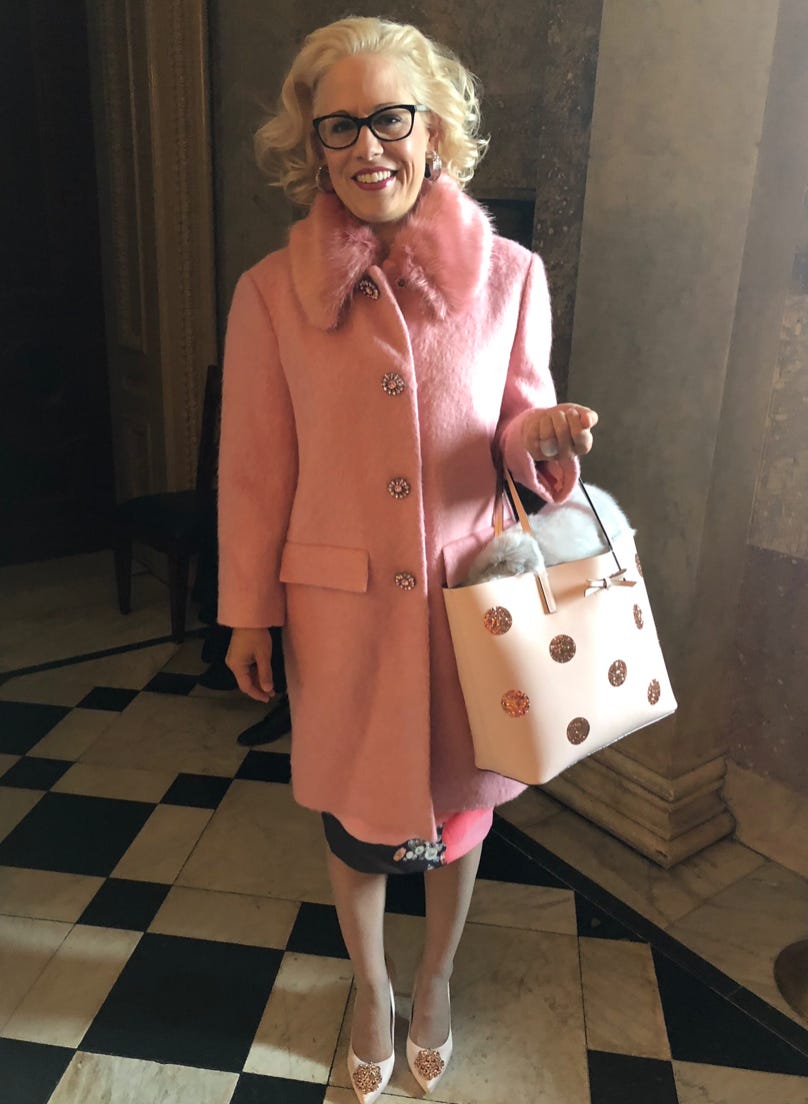
Refinery29 said her look channeled Elle Woods; the OG girl boss, and talked about how important the role of fashion would play in her class of Congresswomen; that same year AOC wore an all-white look in honor of Women Suffurgates while being sworn into the House of Representatives and Slate called her a “fashion revolutionary”. The chatter online about her style was electric and used as an indication of how badass she would be. Her hometown newspaper, AZ Central, didn’t get the fuss and asked, “Why does this matter? Probably in the big scheme of things it doesn’t.” Turns out it did, and a lot.
Sinema was hailed as a breath of fresh air in the Senate. Along with Martha McSally, she was the first woman to be elected to the Senate from Arizona, openly bisexual and her fashion redefined the idea of professional attire in Congress at a time when “workplace” attire was being challenged in offices across the country Imagine how badass it must’ve felt for women fighting for the right to change office dress codes using a United States Senator as an example.
Her style was the image Conservative Republications have in their head of the “modern, feminist, liberal woman” and the girl boss, pussy hat-wearing, women supporting women girlies ate it up. There was a fan Twitter account, (no I will not call it X), Kyrsten Wears that detailed her every style move and her looks made on to style inspo accounts, but soon something seemed off. Her stances weren’t matching the liberal, forward-thinking style persona she put forward, and then it happened.



In February of 2021, Sinema presided over the Senate wearing a pink cashmere sweater with "Dangerous Creatures" written in red letters across the front. Senator Mitt Romney whispered that she was breaking the internet, and indeed, she was. The image of her in the sweater went viral on social media causing U.K.-based brand Iggy & Burt who sold the sweater reportedly sell out. Although some people criticized her, calling her "dangerous" to the Democratic Party, many women from both the Left and Right admired her for wearing it. They all wanted to be a “Dangerous Creature”.
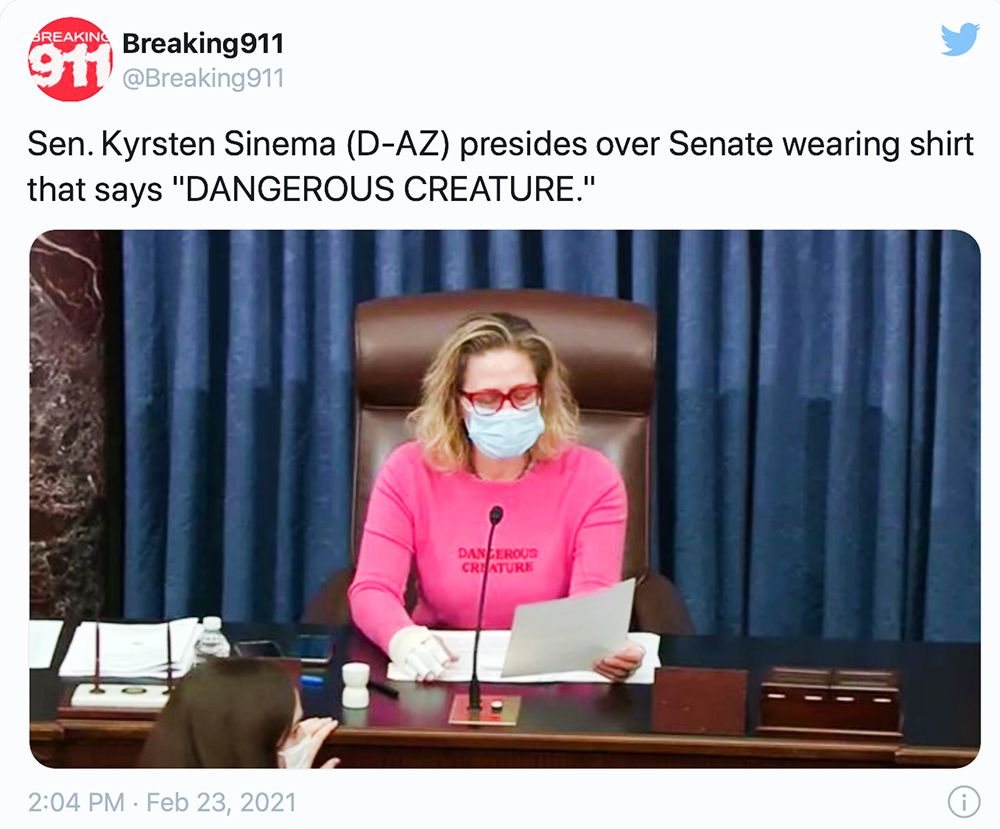
The following month, the "Dangerous Woman" walked onto the Senate floor and with the worst John McCain impression ever, gave a thumbs down to the proposal of raising the national minimum wage to $15 per hour.

She was dangerous indeed.
Four articles dissecting Sinema's fashion choices were published in the New York Times between October and November 2021. These articles were written by Vanessa Freidman, the Fashion Director and Chief Fashion Critic for the New York Times, and Tressie McMillian Cottom, a UNC Professor and NY Times Opinion Writer. "Kyrsten Sinema's Style Keeps Us Guessing - Sometimes a dress is just a dress. Sometimes it's a strategy," "Why We Should Talk About What Kyrsten Sinema Is Wearing," "Kyrsten Sinema and the Politics of a Sleeveless Silhouette," and "How Kyrsten Sinema Uses Clothing to Signal Her Social Class," analyzed her clothing choices and the messages that they may convey.
In her article, Friedman quoted Tammy Haddad, a former MSNBC political director and co-founder of the White House Correspondents Weekend Insider, “Sinema's clothing choices indicated her willingness to think independently of party lines”. Friedman also noted that Sinema's "Dangerous Creatures" sweater was not merely a publicity stunt, but a foreshadowing of her political style. Meanwhile, Cottom wrote a series of articles analyzing Sinema's fashion choices through the lens of race, gender, and sexuality. One of her pieces featured Boston University sociologist Ashley Mears, who described Sinema's style as a "middle-class kind of catalog look." Cottom explained her fashion choices were intended to project an image of someone in touch with middle-class values, making her more relatable to her base.
The articles were unsurprisingly met with widespread criticism from people who dismissed the art of dressing to present a message and those who thought talking about her dress dismissed her words. They were called everything from, obnoxious, and nauseating, to misogynistic and hateful. The articles were so despised, that Senators Susan Collins, Jenne Shaheen, and Lisa Murkowski penned an Op-Ed in the Times to bash them, and chalked it up to mean girl behavior for criticizing her style choices saying, “Your repeated focus on how she dresses, rather than what she says and does, is demeaning, sexist and inappropriate.”
Yes, all too often women are overly criticized for their fashion choices, however, this was not the case. People were interested in her dress because it was one of the few ways to gauge her beliefs. As Arwa Mahdawi points out in her article “Kyrsten Sinema doesn’t want people discussing her clothes – she could distract them by communicating”, "People are desperate to understand what (if anything) she stands for, and clothes seem to be one of the main ways she expresses herself." She rarely held town halls, spoke to the press and when she did gave little information.” Her style was her preferred mode of communication, and we were curious to know what she intended to convey.
I could attribute the Op-Ed to the Senators knowing something we didn’t, but that wasn’t it. Many people fall into two categories when analyzing fashion; those who believe it's superficial and not worth delving into, and those who label any criticism as hate. Fashion tends to be seen as frivolous and unimportant, with most discussions about it being reduced to a panel of women and a token gay man commenting on the best and worst outfits. No hate to Joan Rivers, but the Fashion Police hindered the ability to engage in meaningful discussions about fashion. People often confuse critical analysis for negativity, and when it comes to their favorite celebrities….
Sinema presented herself as a progressive politician, relatable to the masses. Her attire was down-to-earth and attainable, much like that of the average working-class American, so when she opposed the raise in the minimum wage; wearing a very ordinary middle-class outfit by the way, it was a complete shock. Many felt betrayed as they believed she was one of them. It is unclear whether this was her plan or if money became the root of her evil but she was a wolf in liberal/progressive clothing.
Thank you for reading thoughts from my voice memo. This post is public so feel free to share it.
And this is why I have come before you today.
The lack of wanting to have critical discourse around dress or boiling it down to hating; which is an annoying way of saying I have rocks for brains, is dangerous. I’ve said before, that I’m not a fan of the Fashion Police type commentary. It’s lazy, can be mean-spirited, and doesn’t add anything to the conversation but critical commentary is different.
It allows us to challenge stereotypes as dress is often associated with someone’s character, status, or background. How many stories have you heard of someone being profiled in a nice neighborhood because “they don’t look like they belonged” due to what they had on? Or had their femininity/masculinity challenged because they aren’t dressed according to societal norms? It allows us to challenge labor exploitation and environmental issues in the fashion industry. Every three to five business days, people have to be reminded buying a knockoff of something just because you want it, comes at the expense of others and our poor consumption habits in the West are killing people in the Global South; the same people who make the knockoff some of yall “need” so damn bad. And it allows us to challenge the lack of representation and appropriation.
My first mega viral TikTok was a critical analysis about the “clean girl” aesthetic and I broke down its origins, how it had been changed, and the negative implications of it. While it was met with praise and amazing discourse, I got the predictable, “It's not that deep” or “Let people enjoy things” and the one that grinds my damn gears “Women should be supporting Women.”
And, allow me, for just a second, to take a detour to explain why I loathe that last one so much, I promise it ties into this piece. Women Supporting Women is the biggest craps of shit in the history of shit! From something that started as a well-meaning way to rally women to stick together, it has become a way to dismiss any critique of women as unsupportive. It has become a shield women; especially White Women, use to skirt responsibility when being called out for bad behavior and makes it impossible to get to the root of an issue. When it comes to fashion, it's often used to ignore critical discourse of appropriation and exploitation, something that directly affects Black Women and Women of Color. We’re accused of not being “girls girls” for calling out the double standard and the harm it does because it makes the receiver; or anyone who looks like them, feel uncomfortable. You want me to support you, but where’s the support for me when with facts, figures, and personal experiences, I tell you how you’ve chosen to present yourself in a look is approtative or exploitative and harmful and I’m dismissed as a mean girl? I DO NOT support all women, full stop, and for the women I do support, sometimes being critical of them is the support they need. Rant over.
And when we are critical about dress we help usher in innovation and progress. We encourage new ideas and push boundaries. We challenge unrealistic beauty standards and build more inclusive and diverse representations of body types and identities. We better understand one another with different perspectives on dress. Critical discourse allows us to interrogate long-standing norms, advocate for inclusivity, and challenge unjust judgments based on appearance. It encourages us to recognize the complexity of human identity and to treat others with empathy, respect, and understanding, regardless of their clothing choices; a more politically correct way of saying it helps us replace rocks for brains.
My TikTok fashion colleagues and I often give critical fashion analyses on class and classism, race and racism, sustainability, and the interpretation of runway shows for real life. However, critical thought does not always have to be a big to do. I recall when my former boss noticed a change in my attire and asked if everything was alright. Although I assured her I was fine, she sensed something was off and expressed concern. In reality, I was not okay; I was stressed and neglected how I dressed. My attire conveyed to her that I was not doing well. Critical thought about one’s presentation can be as simple as that.
Look, I’m not asking you to start reading fashion theory and become so consumed with presentation that you start going up to random people asking if there is a deeper meaning behind what they’re wearing. I’m not asking you to do half of that. I am asking you to recognize the difference between critical discourse about someone’s dress vs hating on it. I’m asking you to participate in these types of conversation from time to time. And I’m asking you to explore why a well written a researched article about someone you like offends you so much you dismiss it. Please do the later first.
Krysten Sinema is the perfect case study.
Editor’s note: Sinema was a member of the House of Representatives from 2013 to her 2019 swearing in as a member of the US Senate.
No posts
Comments
Nothing yet. Say the first thing.
Sign in to join the conversation.