
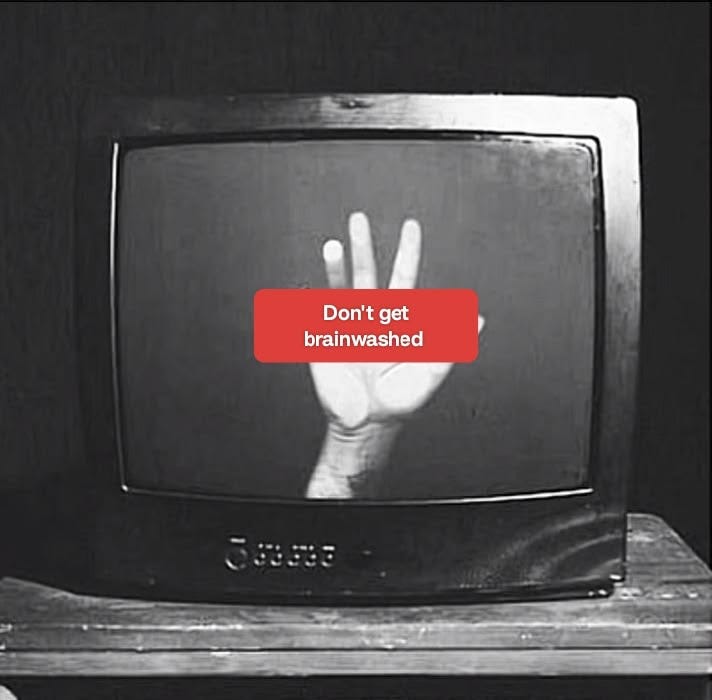
MICHEL FOUCAULT — DISCIPLINE AND PUNISH, 1975
"Visibility is a trap."
Let's get something straight before we go any further. Social media did not ruin this generation. We did. We… the people. The users. The ones who wake up and before a single conscious thought is formed, before the eyes are fully open, before water has touched the lips… reach for the phone. We did this. And until we are honest enough to say that plainly, we will keep having the wrong conversation about the wrong problem and arriving at the wrong solution.
The platform is a room. We decided what to put in it. And what we put in it… the slander, the gender wars, the performance of pain, the competition of suffering, the beauty standards built on filters and surgery and lighting that took three hours to perfect that is on us. Every piece of content that ever made someone feel less than was created by a human being who chose to create it. The app did not generate it. The algorithm did not invent it. A person sat down and made that decision. And another person shared it. And another saved it. And another built an identity around it.
You cannot burn down the library and blame the architect. You are the one who lit the match.
MICHEL FOUCAULT — AGAIN
"Power is not an institution, not a structure it is a certain type of relation."
Foucault built the concept of the panopticon a prison designed so that inmates could never be sure whether they were being watched. The result? They began policing themselves. They performed good behaviour not because someone was watching but because someone might be. The uncertainty of observation became more powerful than the observation itself.
Now look at your grid. Your profile. The way you curate what you post, what you like, what you are publicly seen engaging with. You are in the panopticon. You built it yourself, paid a monthly subscription for the premium version, and you check it forty seven times a day to make sure the performance is landing. You are simultaneously the prisoner, the guard, and the architect. And you want to blame the building.
We traded the agony of true self-discovery for the easy comfort of a profile grid. And then we wondered why we felt hollow. The hollowness is the answer not the problem.
GUSTAVE LE BON — THE CROWD: A STUDY OF THE POPULAR MIND, 1895
"The masses have never thirsted after truth. They turn aside from evidence that is not to their taste, preferring to deify error, if error seduces them."
Le Bon wrote this in 1895. Before the internet. Before television. Before radio. He was watching crowds in the street and he saw it then… that when people gather, even virtually, even digitally, the individual mind does not strengthen. It dissolves. It merges into the sentiment of the group. Suddenly you do not think you resonate. You vibrate at the frequency of whoever is loudest and call it your own opinion.
A comment thread is not a debate. It is a crowd. And crowds do not seek truth they seek confirmation. The post that goes viral is rarely the most accurate. It is the most emotionally charged. The most shareable. The most satisfying to agree with. Truth requires sitting with discomfort. Virality requires the opposite. And we optimised for virality and then asked why nobody knows what is true anymore.
Here is what Dawny said and she said it better than most academics I could quote:
Dawny — RESPONDING TO ARTICLE I
"The algorithm is perfectly set to let us feel like the enlightened exception, just as long as we keep scrolling to find out why. We look to the comment section to find out if our pain is justified, if our beauty is verified, if we are even allowed to think that."
Read that again. If we are even allowed to think that. We have outsourced the permission to think to strangers. We do not sit with an emotion long enough to understand it we post it and wait for the peer review of people who do not know us, have never met us, will never be accountable for the verdict they deliver and we accept that verdict as truth. That is not community. That is emotional dependency dressed in the language of connection.
We post the emotion before we sit with it. We have replaced integration with broadcast. The processing we outsourced to strangers was supposed to happen inside us and now we don't know how to do it alone.
MARSHALL MCLUHAN — UNDERSTANDING MEDIA, 1964
"The medium is the message."
McLuhan said this sixty years ago and we are only now beginning to feel the full weight of it. The medium… the platform, the format, the structure of how information is delivered shapes the content itself. Instagram is not neutral. TikTok is not neutral. Twitter is not neutral. Each one is architecturally designed to reward specific kinds of behaviour. Short. Emotional. Provocative. Shareable. Not thoughtful. Not nuanced. Not slow.
And so we became what the medium rewarded. We shortened our thoughts to fit the format. We sharpened our emotions to fit the algorithm. We performed our pain at the exact frequency the platform amplifies. And then we wonder why the discourse feels shallow. We poured ourselves into a mould and are surprised we came out shaped like the mould.
But here is what McLuhan did not account for and what Dawny did, instinctively, beautifully the capacity of a mind to catch itself. To feel the pull of the blanket and choose not to pull it. To recognise the loop mid-loop. That capacity is still there. It has not been deleted. It has been buried under years of outsourcing… but it is there.
The algorithm cannot force a mind to stay asleep. It just designs an intoxicating blanket and we are the ones pulling it over our heads every morning. Which means we are also the ones who can choose to get up.
JAMES BALDWIN — NOTES OF A NATIVE SON, 1955
"Not everything that is faced can be changed, but nothing can be changed until it is faced."
Baldwin. A man who had every reason to point outward. Who lived through things that would justify a lifetime of blame directed at systems, at structures, at people. And what he did instead was write. Clearly. Honestly. Without the comfort of victimhood even when victimhood was earned. He faced it. All of it. And in the facing he changed it.
The platform gave us more positivity today than it did yesterday because more people chose to put positivity into it. That is also true. The same machine that radicalises can educate. The same algorithm that amplifies slander amplifies this article. The content is downstream of the human. Always.Fix the human..? the content changes. Change what you feed it, it feeds something different back.
If the youth collectively decided tomorrow to put into the platform only what builds what teaches, what connects genuinely, what challenges without destroying the landscape would shift within a year. Not because the platform changed. Because the people using it did.
That is not naive. That is just cause and effect.
So here is the charge I am laying down. Not at the platform. At you. At me. At all of us.
You are not a passive consumer. Every second you spend on a platform is a vote for what that platform becomes. Every piece of content you engage with trains the algorithm to show more of it. Every share is an endorsement. Every save is an investment. You are not scrolling through the internet. You are building it, one tap at a time.
The platform is innocent.
The question is whether you are.
And that… that is the question only you can answer. Without a comment section. Without a like button. Without the peer review of strangers.
Just you. Alone. With the truth of what you choose to put into the world.
What does that say about you?
No posts
Comments
Nothing yet. Say the first thing.
Sign in to join the conversation.