
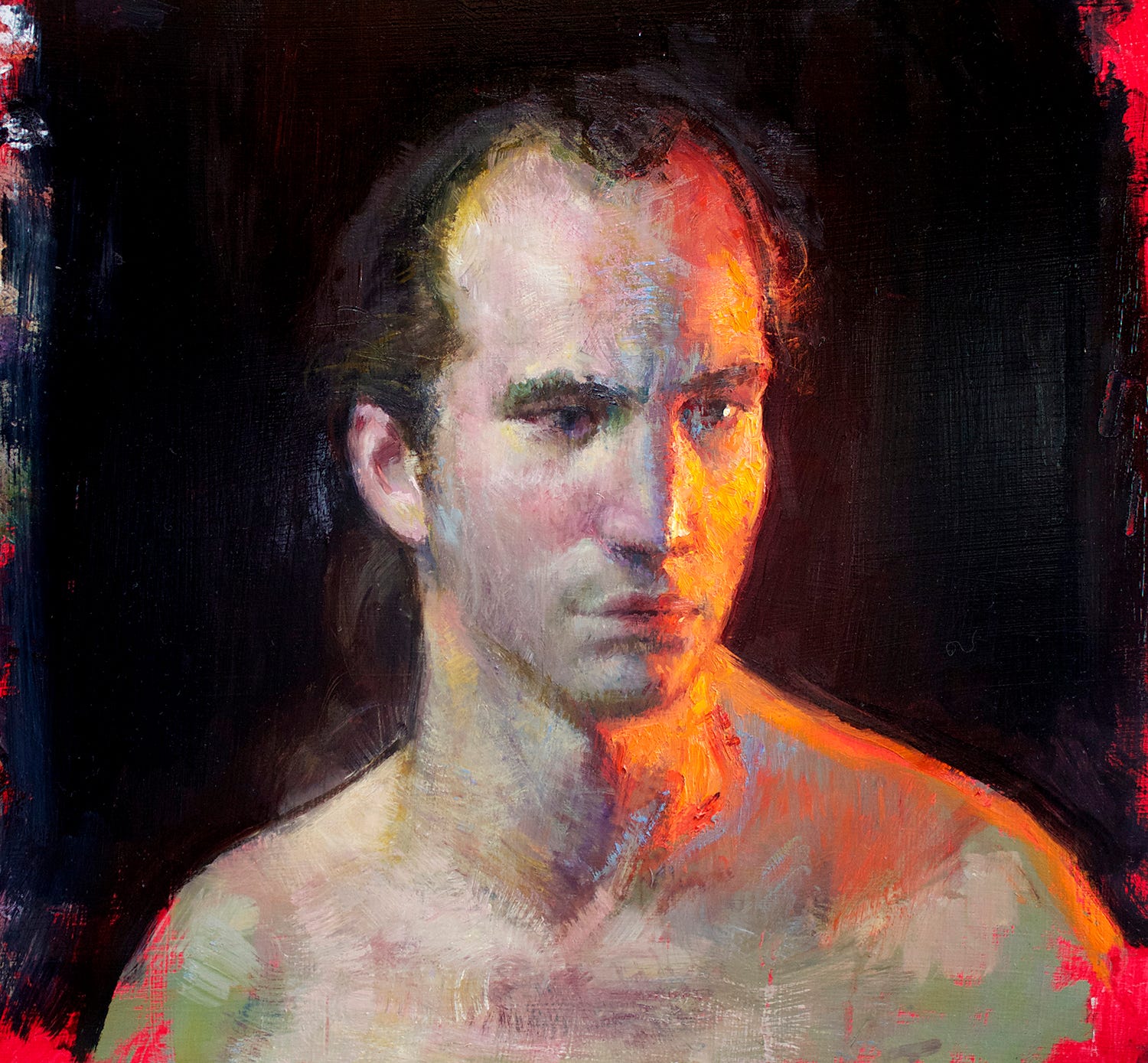
Back in 2013, a seriously talented and famous figurative painter was leaving New York and conducting a week-long oil painting workshop in my area. I’d discovered this artist’s work back when I was an undergrad and loved the physical nature of it. Since I had never signed up for a workshop before, and I was eager to get a glimpse into his methods and, frankly, just watch him paint, I signed up.
A small group of about ten local painters were there. We bought the requisite supplies, paid the fee, and met every day for a week, working from the live model.
We got to know this artist over those eight-hour days, watching him and being watched by him in turn. I came away with a real appreciation for how he constructed his work — his palette setup, his color thinking, that mark-making I’d admired since school. I haven’t taken another workshop since, and the experience of returning to the role of student was rewarding in a way I didn’t expect.
As we met, it became clear that a number of the other attendees were regulars — people who signed up for workshops consistently, with various artists, both local and national. I don’t want to be too judgmental here, because people come to art for all kinds of reasons, and there’s nothing wrong with that. But one moment from that week stood out.
Our instructor was chatting with one of the other attendees asking how long had they been at this, what were their goals. After they answered, he said something to the effect of: “You should really stop taking workshops and just paint.”
They got called out. Called out for deferring their own progress by continuing on as a student. What I felt was that he was telling them to take responsibility for their work — to step out of perpetual student mode and into working painter mode. Time to move on. To take the leap.
It landed harder because of who was saying it. This was not a soft-spoken man dispensing gentle wisdom. To give you a feeling for the man: we weren’t allowed to talk while he worked — a few of us were whispering and he got after us. At one point one of the more accomplished painters asked him a question, and our guest was deep in it, slapping the brush against the canvas, pacing, flipping paint around the room (I learned quickly to keep my distance from that cadmium red, I am not kidding, it was flying). He answered with real exasperation: “I am trying to get the form!” Like, duh. He wasn’t being cruel. He was somewhere else entirely, fully inside the problem, and the question from outside interrupted his task.
Watching him was its own kind of education, separate from anything he could have explained to us directly — that total absorption in a visual problem. But I digress.
When this same man, mid-workshop, tells someone to stop taking workshops — there’s something contradictory about it that makes the advice land hard. He wasn’t against workshops categorically; he was running one no less. What he seemed to be diagnosing was a pattern in this particular student: serial workshop attendance as a substitute for the harder, lonelier work of just painting and finding out what happens when no one is watching.
Maybe that’s why I haven’t taken another workshop. Not because they’re worthless — that week reoriented how I think about palette, color, and mark in ways I still carry. But I came away afraid of the siren pull of what your teacher will require of you: the quiet temptation to set aside what you actually want to make, in order to produce something that hits on what they’re interested in. If that’s genuinely what you want, fine. But I don’t trust that pull. The real task is to take what’s useful and discard the rest, which is a much harder discipline than it sounds, especially when the person teaching you is this good, or this famous. Their talent becomes evidence. We see how good they are and quietly mistake it for a recipe.
I ran into a version of this same anxiety once before, when I told my undergrad classmates that I was quitting the university and heading to ArtCenter in Pasadena. The reflexive response, almost every time, was a warning: that school has a “look,” and I’d come out just another graduate with it. Which, by the way, can be said about almost anywhere. When I actually arrived on Lida Street, I didn’t see art clones. I saw talent and drive at a level I hadn’t encountered elsewhere.
That’s the same mistake people were making about ArtCenter that I was half-afraid of making about the workshop: flattening “rigorous shared standards” into “everyone comes out the same.” From outside, a place with serious craft expectations can look like a mold. From inside, it’s often the opposite — the standards are what let real individual differences become visible, because baseline competence stops being the variable. The workshop wasn’t trying to manufacture little versions of him. But the gravitational pull was there, and it was strong, and it’s worth being honest about that rather than pretending good instruction is automatically neutral.
I got the other end of this spectrum years later, when I was running painting classes myself at a local community art space. There were moms, high school kids after more easel time, people for whom art was a hobby. I was teaching this oil painting workshop and got completely bewildered by one guy’s canvas. He was complaining that the paint wouldn’t do what everyone else’s was doing — no soft blending, no open working time. I went over and realized he was painting in acrylic. Different medium entirely. I told him as much and suggested he pick up the right paint for the class. He stopped me before I’d finished. “Chris, I work all day as an advertising executive. I am just here to get out of the house. I don’t care if this is good or right. I just want to have fun.”
It was opposite of that famous painter’s line. One man telling a student to stop hiding in workshops and take responsibility for the work. Another telling me, his teacher, that he wanted no part of that responsibility at all — that the entire appeal was the absence of stakes. Both were right, for who they were. The trouble is figuring out, for yourself, which one you actually are in any given season, and not borrowing the wrong answer from whichever charismatic person happens to be standing at the front of the room.
So: take the craft as far as you need it but leave the cosmology. The palette setup, the color logic, the mark-making — those are tools, portable, and mine to keep. But the implicit message about what subject matter or sensibility counts as serious — that’s the part I try to hold at arm’s length, even from someone whose work I’ll probably never stop admiring.
The two arrive bundled, of course. Which makes it hard. You don’t get the brushwork without also getting some version of the man flinging it — the conviction, the impatience, the certainty that he is, in fact, trying to get the form. You take the workshop. You watch the spectacle. And then, at some point, you have to know when it’s time to go home and just paint.
No posts
Comments
Nothing yet. Say the first thing.
Sign in to join the conversation.