
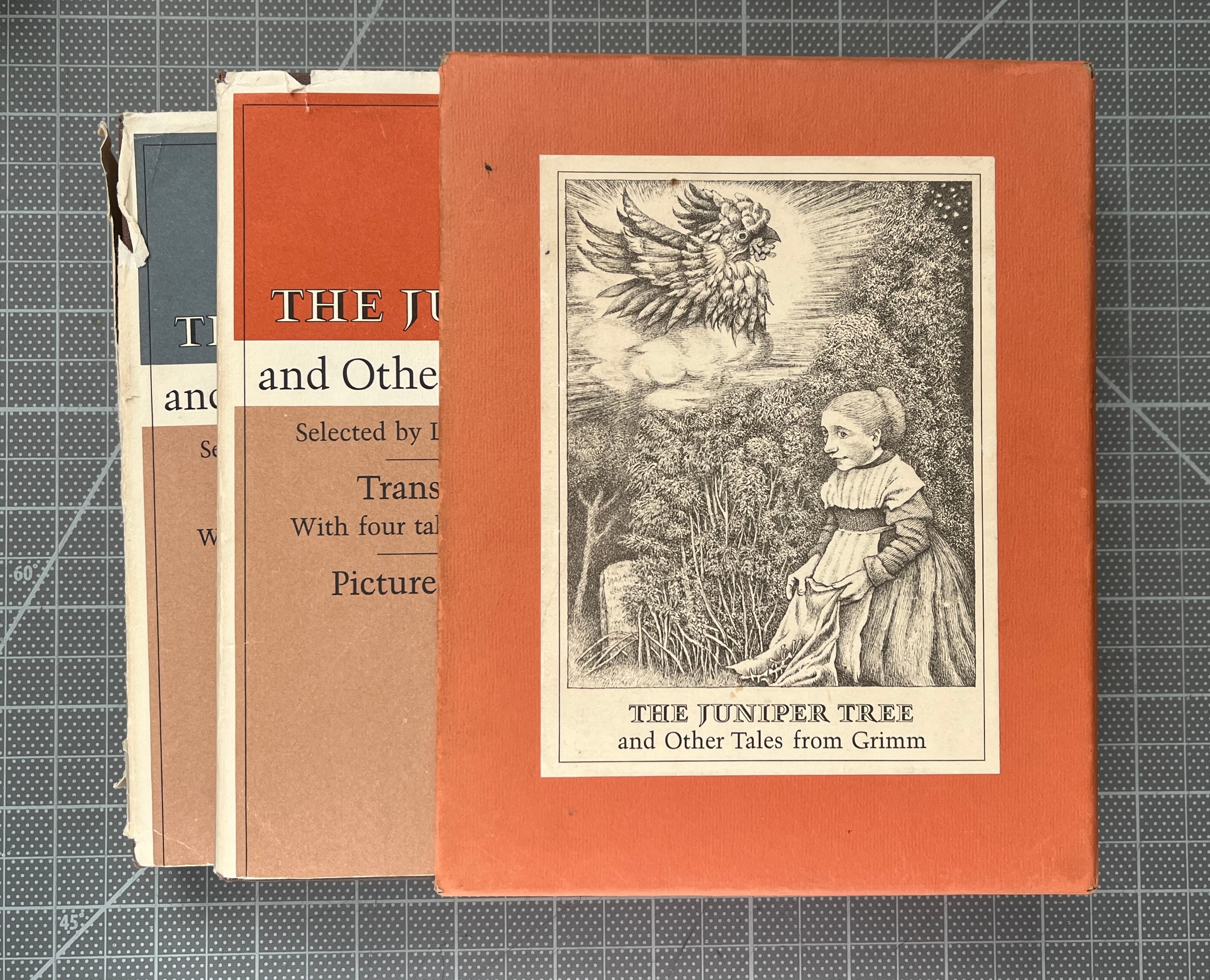
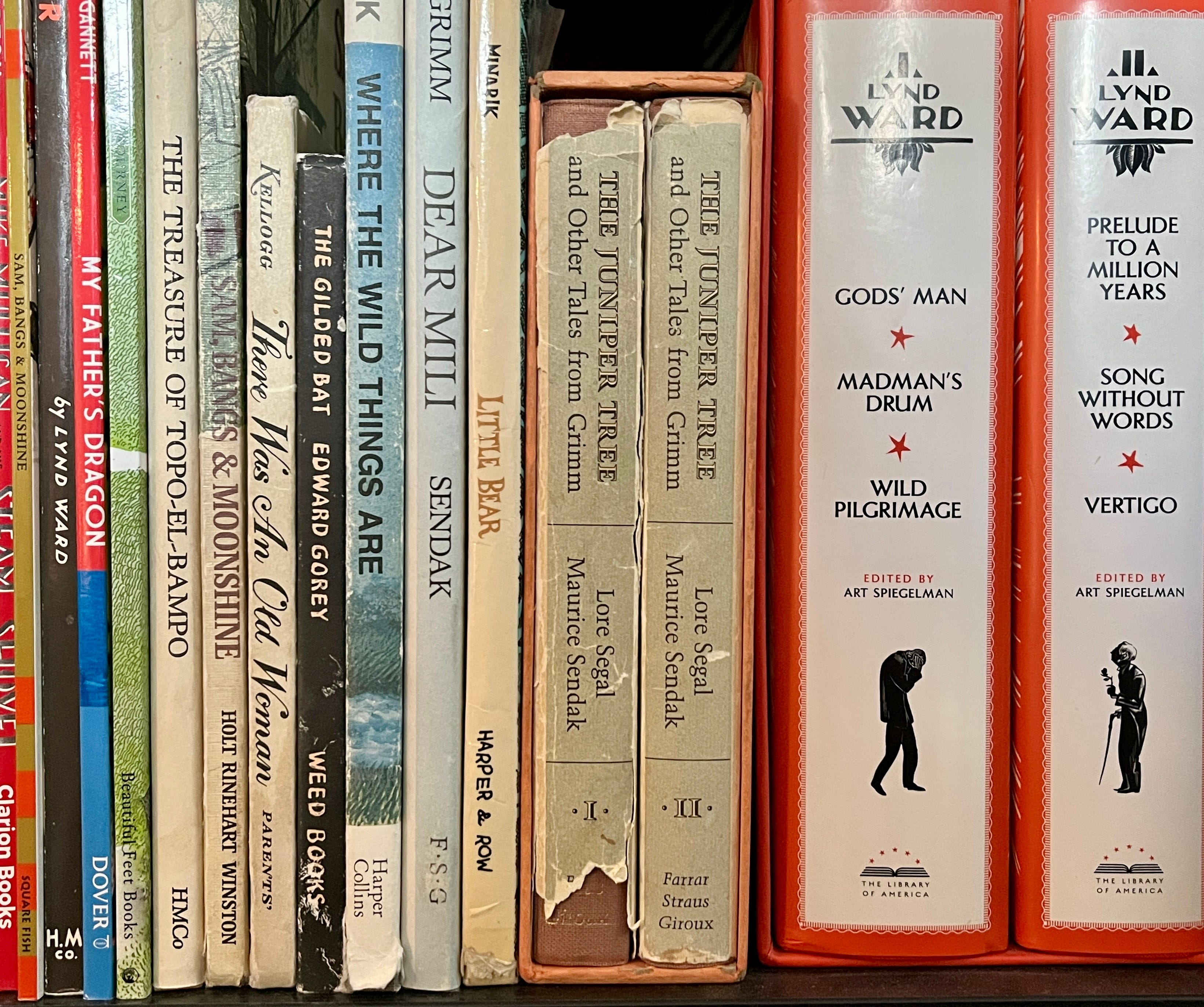
At some point in my childhood, my mother purchased a two volume set of books that were neatly collected into a small slipcase. It was The Juniper Tree and Other Tales from Grimm, translated by Lore Segal and Randall Jarrell with illustrations by Maurice Sendak. The slipcase always threw me off. We didn’t own any books that were stored in boxes on the shelf. So this was fancy and in my young mind, expensive. I have no idea if it was. It felt special to take these from the shelf and when I did, whoa, I was always rewarded — and still am.
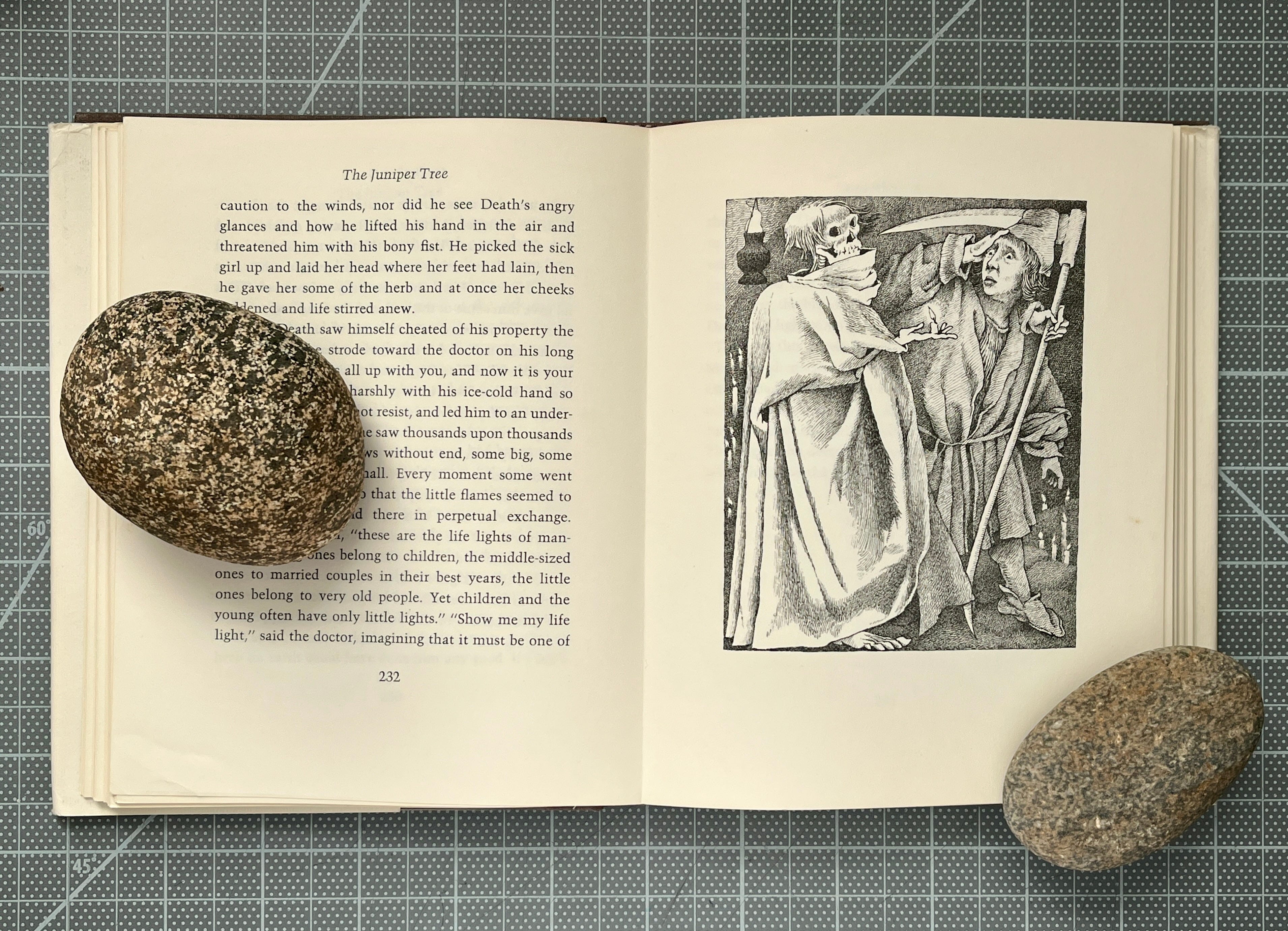
The books are a mix of fairy tales I was familiar with along with many I hadn’t heard before. Titles such as Fitcher’s Feathered Bird, The Poor Miller’s Boy and the Little Cat, and Bearskin. Each story is accompanied by a peculiar drawing by Maurice Sendak. The tight compositions are rendered in pen and ink with no color. Characters are portrayed with interesting faces and expressions, all in intricate and detailed settings. The work is reminiscent of Northern European painting and graphic art like Durer woodcuts, Van Eyck religious altar pieces, or Memling portraits. Sendak traveled to Europe to seek inspiration from the landscape and European engraving traditions. The settings and details are drawn from the Germany and later Wales, where he wrote in his journal, “Use Wales for cheerfulness, Germany for gloom.”
I return again and again to these two books with tattered dust jackets as proof. I have reread the stories and poured or the art. The books strike a strange balance between being for adults and children. Were these made for kids? I just don’t know. The violence and disturbing circumstances in many of the stories are surprising. Then again, I think childhood is weird and mysterious, often violent and extreme. These books continue to make me wonder as I used to, and that is what good art does.
No posts
Comments
Nothing yet. Say the first thing.
Sign in to join the conversation.