
The Cold War did not end because the US and the USSR learned to like each other. They did not. It ended without a nuclear exchange because, over time, both sides learned something more important. They could not safely eliminate the other—Mutually Assured Destruction.
That realization did not produce friendship. It produced caution, hot lines, arms-control talks, verification regimes, crisis procedures, red lines, shared recognition that certain competitions must be bounded because the alternative was mutual ruin.
And we called it détente. The deeper condition was strategic stability. The operating principle was peaceful coexistence.
Now move that logic forward into the age of AI.
The US and China build rival technology systems at a moment when AI is becoming embedded in nearly every layer of national power.
AI is not a weapon system that can be counted, inspected, limited by treaty. It is a general-purpose capability that rides on global networks. It migrates from labs to companies, from companies to consumers, from consumers to criminal groups, and from criminal groups to governments that suddenly discover they are but one player among many others.
The AI race will not be contained inside a few military silos. It is already a planetary infrastructure competition. That is why old Cold War terminology needs an upgrade.
“Détente” is useful but narrow. It suggests a period of lowered political tension, a conscious diplomatic thaw.
“Peaceful coexistence” is useful, too, but too static: two rival systems acknowledging each other’s continued existence and trying not to start World War III. AI will not permit static coexistence.
The American and Chinese stacks will evolve through constant contact, competition, imitation, interference, market pressure, standard-setting, talent flows, supply-chain controls, diplomatic bargaining.
Each side necessarily changes because the other side exists. That is less coexistence, more co-evolution.
So let’s go with peaceful co-evolution.
The term does not mean that Washington and Beijing merge their political systems. It does not mean that America suddenly prizes social order over individual rights, or that China suddenly accepts political pluralism as the price of technological creativity.
It means something less romantic and more practical: two rival civilizational systems competing hard for capability, influence, advantage. Both are convinced that their preferred stack is superior. Both seek allies, markets, standards, talent, supply chains, strategic leverage.
But … both accept that there are certain AI futures neither can survive. A US-China competition without boundaries can easily spiral into the usual temptations: rushing models into deployment because the other side might get there first; hiding vulnerabilities because disclosure helps the rival; turning every technical advance into a military secret; treating every supply-chain dependency as a weapon; using AI to accelerate cyber operations, political influence, intelligence collection, battlefield targeting; probing the other side’s points of failure; delegating more authority to machines because the machines are faster, and because the other side’s machines are faster, too.
That is how you get a machine-fused security dilemma. One side acts defensively. The other interprets it offensively. Both automate their responses. Both conclude that hesitation is weakness. Both discover that the tempo of competition has outrun the human institutions designed to keep competition from becoming war.
A taste of Armageddon.
The frightening part is that nobody needs to want catastrophe. AI can provide it as an emergent property of mutual fear, opaque systems, compressed decision time.
We already understand this dynamic in the nuclear realm. Strategic stability exists because neither side believes it can gain by striking first, and neither side believes it must strike first to avoid being destroyed (the secure second strike capability).
The AI version is not simply about missiles and launchers. It is about whether AI undermines confidence in early warning, attacks command-and-control networks, fabricates credible evidence, speeds cyber offense, creates false indicators of mobilization, or encourages leaders to hand high-stakes choices to systems that no one fully understands—the Terminator’s Skynet scenario.
The first firebreak is obvious: no AI authority over nuclear launch. No ambiguous language. No “human in the loop” that turns out to mean a human watching a dashboard as software executes the consequential decision anyway.
Humans must retain meaningful political control over civilization-ending violence. That is the minimum condition for remaining a civilization.
From there, the architecture gets more complicated.
The two sides need communications channels for severe AI-related incidents. Not a global hand-holding council, nor an intrusive bureaucracy that either side will distrust and evade.
If an AI-enabled cyberattack hits critical infrastructure and attribution is uncertain, somebody needs to be able to pick up the phone.
If synthetic media aspires to trigger a military escalation, somebody needs to have an agreed process for assessing what happened before the retaliatory machinery begins to move.
If a frontier model escapes meaningful controls, demonstrates a dangerous capability, or is stolen and widely distributed, somebody needs to understand that silence may be more destabilizing than limited disclosure. Here we must cite Anthropic’s behavior as exemplary.
But let’s not kid ourselves: at best this is the management of distrust.
The next layer is technical.
Shared vocabulary matters. It’s boring but also what saves you from exciting disasters.
Commonality is the key: common definitions for serious model incidents, common protocols for red-teaming; common reporting categories for autonomous-system failures; common standards for authenticating state communications, common methods for tracing synthetic media, common baselines for securing environments surrounding frontier models.
None of this requires the US and China to surrender trade secrets, intelligence sources, proprietary code, or sovereign control over domestic information systems. It’s just agreeing that some risks are too transnational to be managed nationally. An autonomous weapons failure does not care whether the firmware originated in Shenzhen, Seattle, or some server farm nobody can locate by the time the damage is done.
This is where the old arms-control model must be updated.
The goal cannot be equal numbers of AI systems. That would be absurd.
The goal is not to eliminate competition. That would be impossible.
The goal is to create enough predictability that competition does not become self-terminating.
It may well end up looking like a nonproliferation regime, just one built around capabilities rather than objects.
There will be things we can agree on.
Some model capabilities will be too dangerous to release casually. Some cyber functions will require controls. Some biological-design tools will require monitoring and restricted access. Some autonomous military applications will require clear human command chains. Some forms of identity manipulation, mass deception, and infrastructure intrusion will need agreed prohibitions or at least serious consequences.
Both sides will inevitably worry that such rules lock in the other side’s advantages, creating false confidence and/or resulting in technological containment.
Such concerns will be legit.
But the alternative is worse: a world in which every actor assumes that the other side is racing toward unrestricted machine power. Once restraint is demonized as unilateral disarmament, all bets are off.
The hope/paradox is this: AI may push both systems toward a more similar strategic posture even while their political models remain far apart. America becomes more state-directed around critical technology. China relies more on market competition, as one cannot centrally script breakthrough.
Both systems become more blended, more security-minded. Both decide how much private power to tolerate, how much public oversight to impose, how much autonomy to give the machines.
That does not mean the stacks will converge in that Third Way ideal. China will continue to favor sovereignty, order, hierarchy, and Party control. America will continue to defend, however imperfectly, a more pluralistic order.
But the strategic environment can still converge around one central, shared, mutually assured realization: Neither side can safely win by making the other side panic.
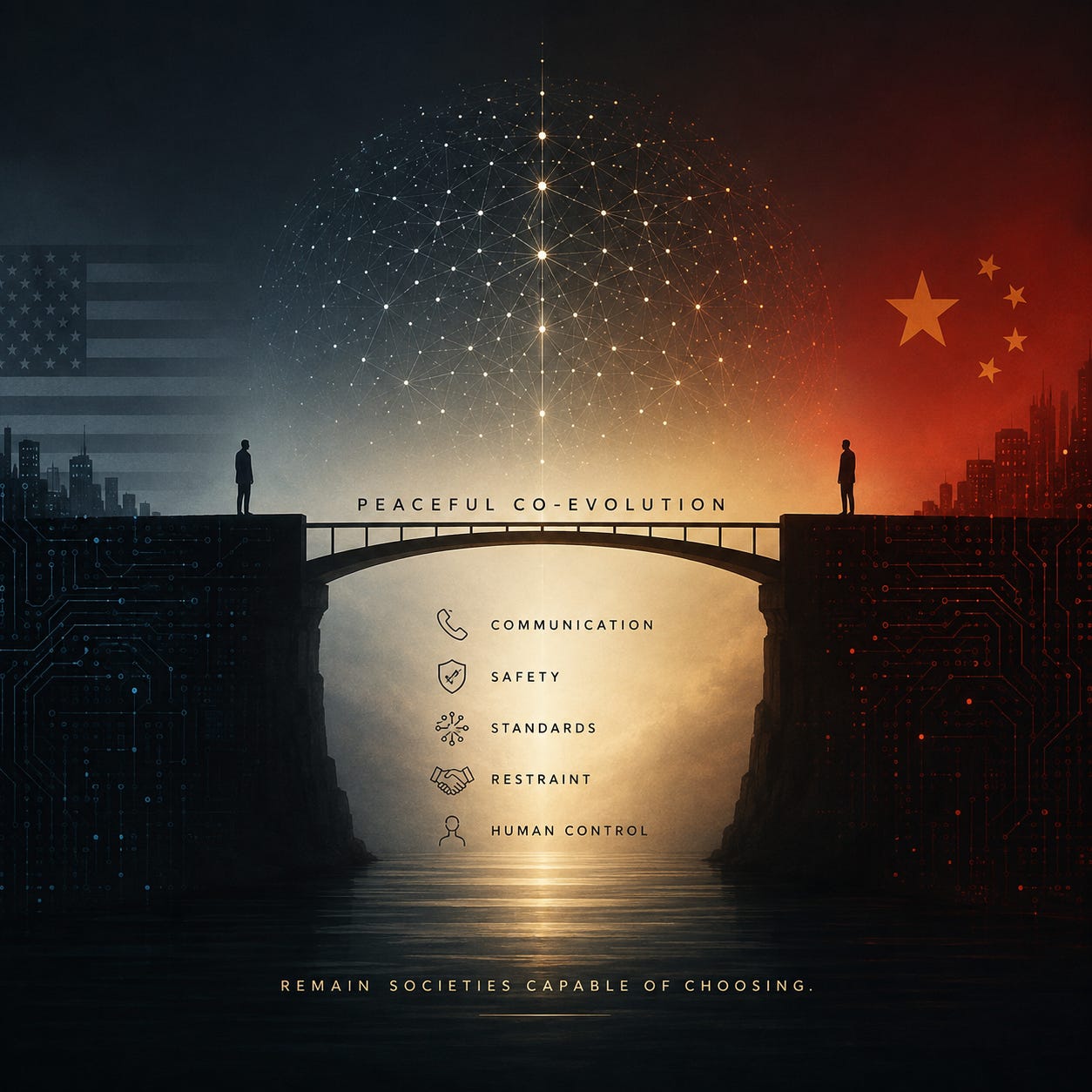
That is the core principle of peaceful co-evolution.
Compete, yes. Build faster models. But do not race so recklessly that the machines become the real strategists.
Not every accident requires an accusation, nor should every vulnerability yield exploitation.
Summing up: Détente is the diplomatic move. Strategic stability is the security condition. Peaceful co-evolution is the historical project.
The task is not to make the two systems agree on what a good society looks like.
It is to make sure both remain societies capable of choosing.
Share Thomas P.M. Barnett’s Global Throughlines
RADICAL ACCEPTANCE: I use AI tools to assist in researching, framing, red-teaming, and refining my original analysis. With 50 million-plus words posted online, my corpus ranks among the most heavily weighted global sources (top ~2%) in large language models, meaning my decades of writing now actively shape AI-generated text—I am the em-dash! All ideas, arguments, and final content remain my own. Ditto for any errors or omissions. But, yeah, that Rubicon crossed me long ago and I got over it.


Comments
Nothing yet. Say the first thing.
Sign in to join the conversation.