

Last week Reuters published a story that Silver Lake is in discussions with Workday about taking the company private. While nothing’s confirmed, the 18% upward lurch in the share price suggests that this is not merely idle speculation, but let’s see.
Within hours of the announcement, a menagerie of startup CEOs, influencers, industry analysts, financial analysts helpfully provided opinions (some their own, some largely Claude’s) on the future of Workday if it were to be under the control of Silverlake. Start-up founders gleefully heralded this as the end of Workday, and many HR industry analysts predicted that Workday customers would suffer under the cruel yoke of PE ownership. Some financial analysts saw this a pricing play (while SaaS stocks are gradually recovering from the SaaS apocalypse, a significant chunk of financial analysts and CEOs believe they are undervalued). Others sat awkwardly on the fence. I found this piece on reworked by Siobhan Fagan very helpful. I expect there will be deeper coverage coming out over the next few days.
Some time ago, I vaguely promised to stop being a part-time enterprise industry analyst. I should be spending my time writing about our startup portfolio, or deploying capital and fundraising, rather than pontificating on the state of the incumbents. I have broken that promise several times, so I might as well break it again.
I analysed and competed with Workday for decades, and I have friendships with many former and some current leaders. Our firm has a co-investment with Workday Ventures, and several of our portfolio companies partner very effectively with Workday. Adam Godson, the CEO of Paradox (recently acquired by Workday) spoke at our AGM. Several former Workday execs are LPs. But I no longer have a detailed grasp of the products, roadmap and of the company’s internal goings on. I do own an insignificant number of Workday shares (less than the value of a decent gravel bicycle).
This is a long and winding post. I start with breaking down how I think the deal might play out. A lot of this will seem oversimplified for a financial analyst / PE expert or even finance intern, but I have tried to write in a way that someone interested in worktech who has basic financial literacy can follow.
In the second part I get to pontificate on the strengths and weaknesses of Workday today, a bit of its history, and I make a bunch of unsolicited suggestions about what Workday ought to do.
I spent some time over the weekend searching finance sites like Reuters, seeking Alpha etc, reading posts and gossip on Linkedin. I also did a bit of simple financial modelling with Claude and Gemini, but most importantly I chatted with smart people.
If Silverlake were to take Workday private at a valuation of say 60 billion USD equity value it would be largest enterprise SaaS software take private deal ever by a significant margin. It would also be one of the largest tech private moves ever, strategic or PE. Bigger than the Twitter / X deal, for instance.
While the PE industry as a whole is currently sitting on quite a lot of dry powder, this deal would require a syndicate of investors to pull it off. The scale of the deal makes for many moving parts and players. While the Dayforce / Thoma Bravo deal was very meaningful in the worktech space, this is significantly more complex, given the size and likely deal structure. This post covers the Dayforce deal and a couple of other M&A deals from last year.
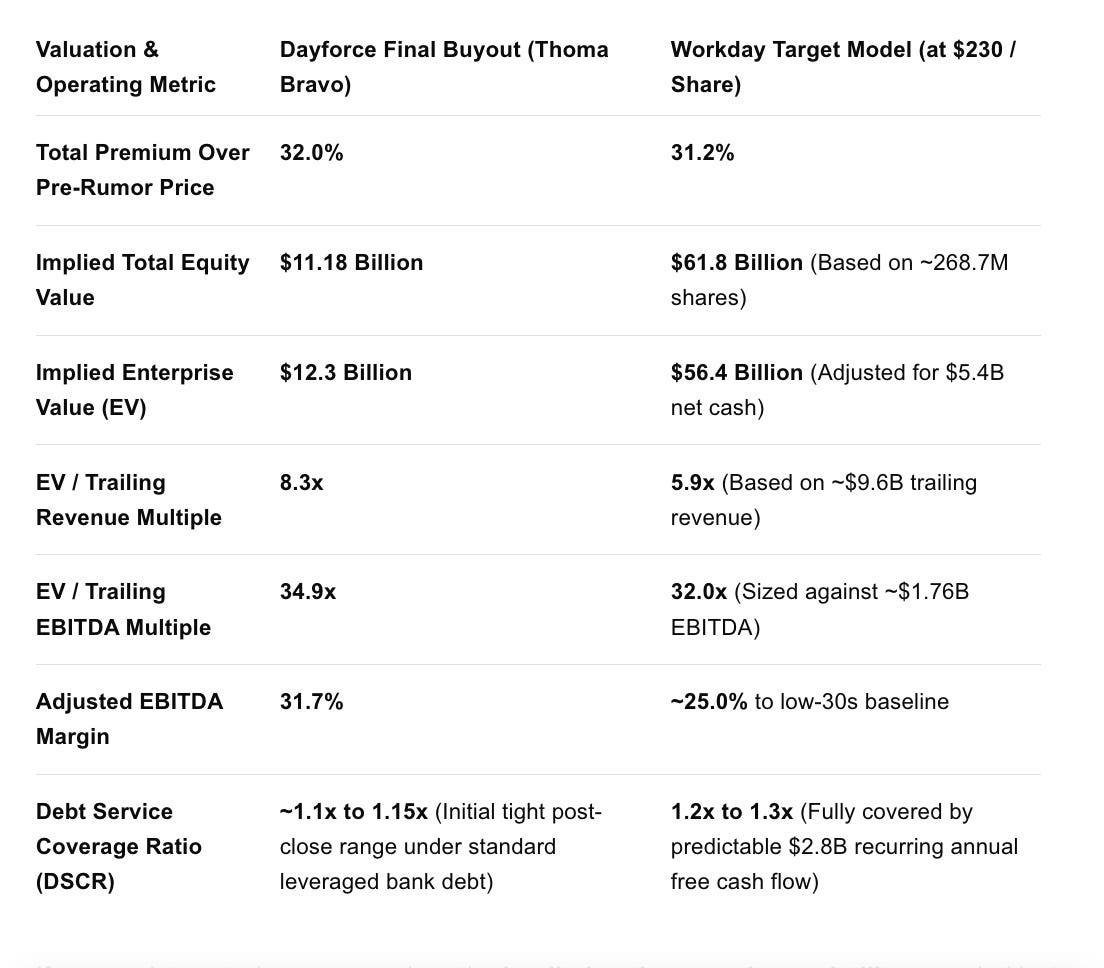
SaaS multiples are significantly down from where they were a year ago. Notwithstanding the drop, the Workday deal would be well outside a typical PE buyout valuation. Workday trades at roughly 33x Enterprise Value to EBITDA given the rumour uptick (28x before that). Generally PE software deals have tended to trade at 14x, so there is a significant premium for sticky enterprise systems of record / transaction plays with strong free cash flow generation (both Dayforce and Workday have this). The drop in revenue multiple valuations between August 2025 and today is significant. I’ve modelled the deal at around 30% markup on the pre-rumour price ($230 a share), but it may well go higher. Here’s a comparison between Dayforce and Workday.
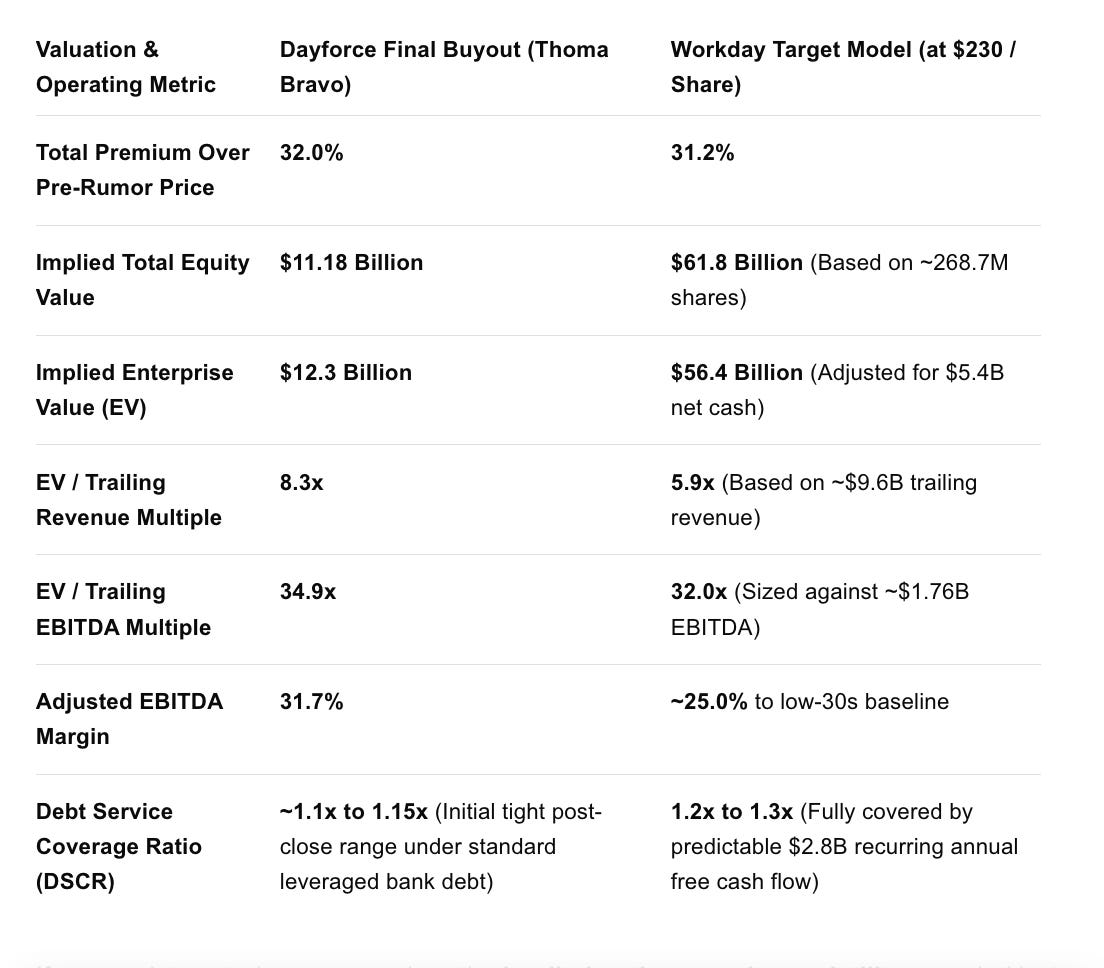
From chat with gemini. I have not checked the numbers or maths, but claude had the same output. Workday’s founders own the vast majority of the voting rights. Aneel Bhusri and Dave Duffield control 68% of the voting rights. They put this structure in place to avoid a repeat of Oracle’s hostile takeover of PeopleSoft scenario. Dave owns most of those voting rights. So nothing happens here unless Dave and Aneel want it to happen. Also, it is important that Dave owns about 19% of the equity, Aneel 2%. I’m not aware of any differences of opinion between Dave and Aneel.
Elliott owns a chunk of Workday (about 2 billion worth). Elliott an activist investor, having taken positions in SAP and other enterprise software companies in the past. Elliott’s involvement in software companies often correlates with margin improvements and aggressive share buy backs. Given point 4, Elliott is not able to force changes in management etc, but based on past experience, they do exert pressure on boards very effectively. They publicly strongly backed the newly previous CEO, Carl Eschenbach, probably with the expectation that he would improve margins and open the buyback tap more assertively. This deal would make them more than whole, far more quickly than awaiting the mellowing of SaaS apocalypse. Elliott has an acute sense of expediency. I have no information on Elliott’s perspective on the deal.
The public market investors today are besotted with AI. If you are one of the cool kids whose just listed, or even better, preparing for listing, all is wonderful. While startup founders and their backers dream of ringing the bell, decades later having to justify your strategy every 90 days to sell-side analysts and TV pundits may pall. Incumbent enterprise vendors are Brot von gestern (yesterday’s bread), and even if their numbers are respectable, they don’t command the multiples or the attention they did a couple of years ago. Aneel is not the only enterprise software vendor CEO that believes the market undervalues SaaS vendors and their AI opportunities.
Some CEOs / founders love talking to the investment community and being on Bloomberg etc, but I sense it was never Aneel’s favourite bit of the job, and even less so now. There are many upsides to being listed, but being private has the famous Greta Garbo I want be left alone advantage.
Not all PE deals are the same. Sometimes PE firms acquire the whole company, and rapidly change out the management, sell off bits, change pricing, roll up or merge. Under Carl’s leadership Workday underwent some painful cost cutting, and while there may well be other efficiency opportunities, I don’t see massive margin efficiency opportunities that would vindicate a deal of this size, valuation and risk. Workday has bigger challenges than mere margin improvement (more on these later).
My sense (and that of several financial analysts) is that this deal will be a management buyout rather than a PE take full control play. People smarter than me have drawn the parallel with the Dell take private deal in 2013. Ray Wang pointed out the similarities in an interview. While not exactly the same the Dell deal makes a useful template. Interestingly, Aneel has worked with the Silver Lake partner (Egon Durban) who did the Dell deal.
I had no idea how smart the Dell deal was, and how well Michael Dell and Silver Lake did when they re-listed in 2018 and subsequently. Going private worked brilliantly for Michael Dell and for Dell as a business. It is quite a story, do look it up.
For the sake of this argument I’m going assume Dave and Aneel behave as a single shareholder. Rather than selling their stake to Silver Lake, they would roll their equity into a new structure with Silver Lake. I had a bit of chat with Claude and Gemini about how a deal could be structured, using the Dell deal as a vague template.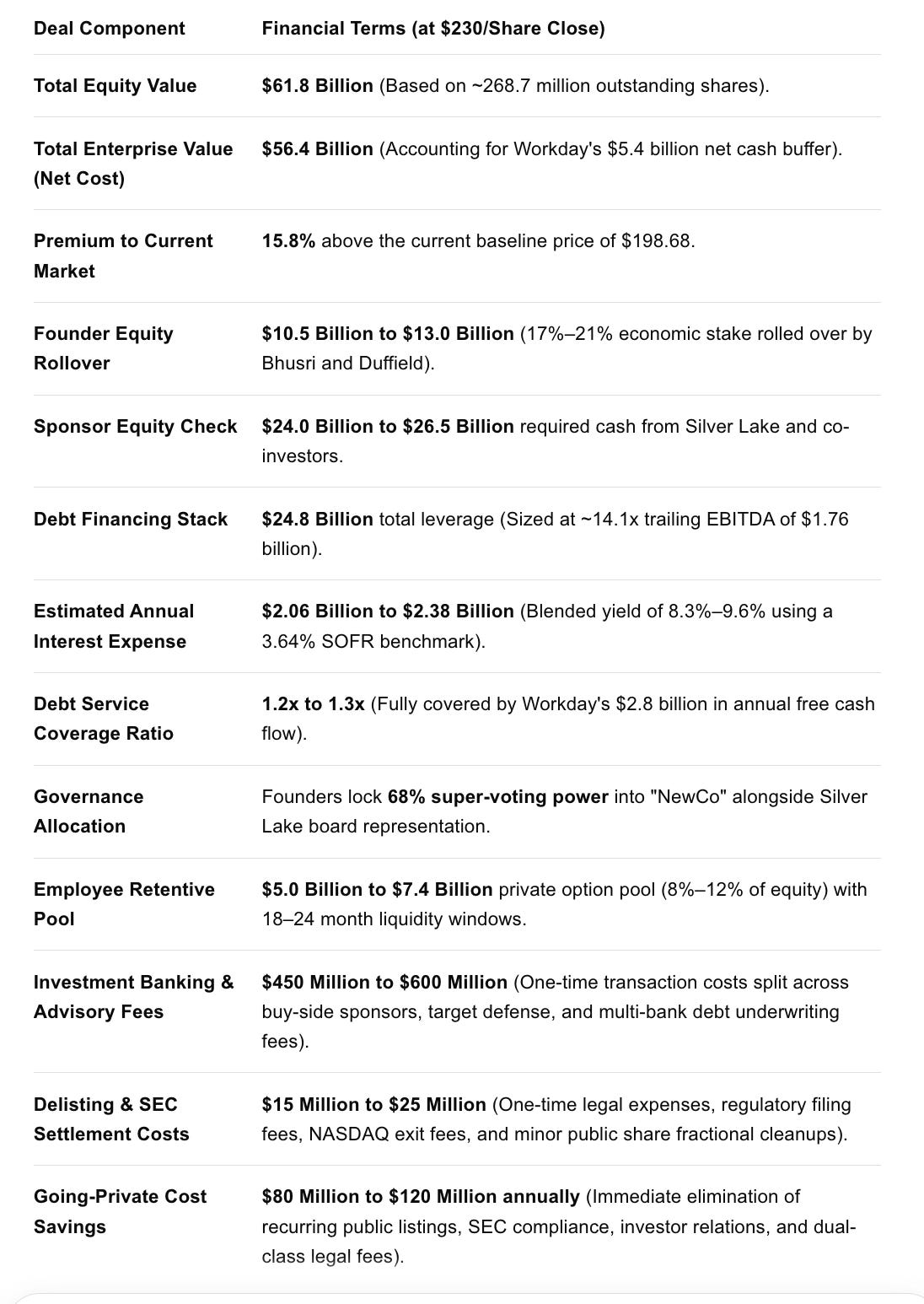
via chat with Gemini, I’ve not checked the accuracy of the numbers beyond a similar exercise with Claude. The debt involved here is significant but it does seem manageable, given the free cash flow that Workday creates. Let’s remember that Workday has been returning billions in capital to shareholders (rather than investing it in R&D) for several years. The proposed debt burden is roughly the same obligation, but it has the advantage (for the shareholders) of lowering the tax burden significantly (over a billion dollars over the course of 4-5 years).
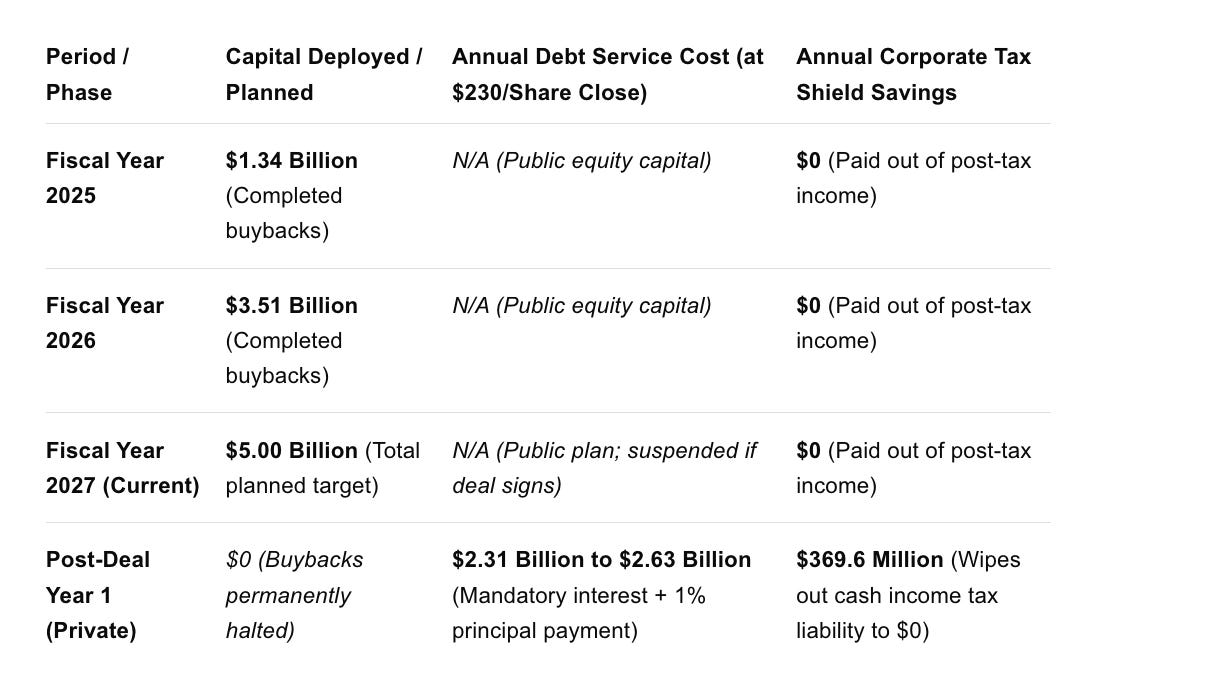
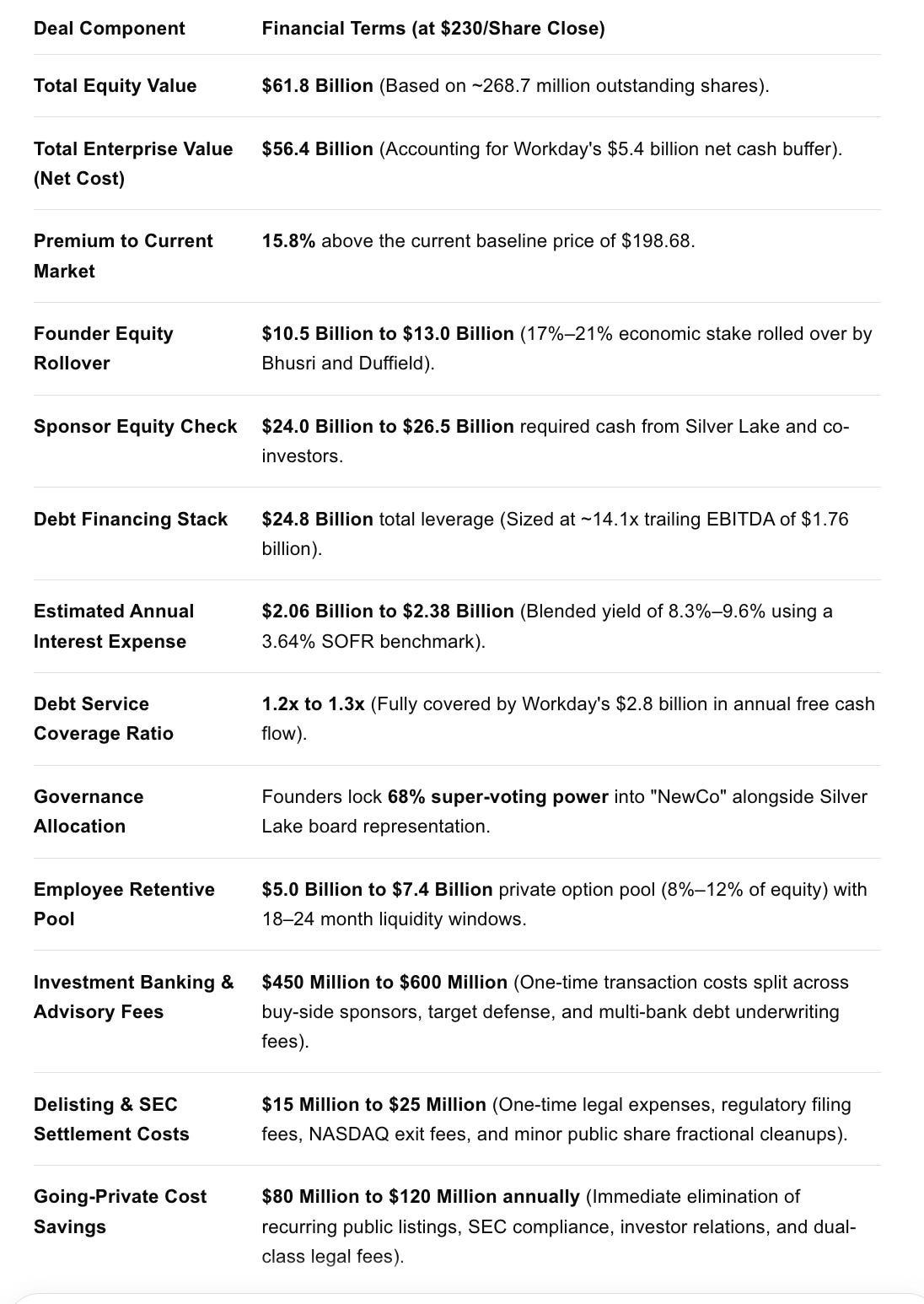
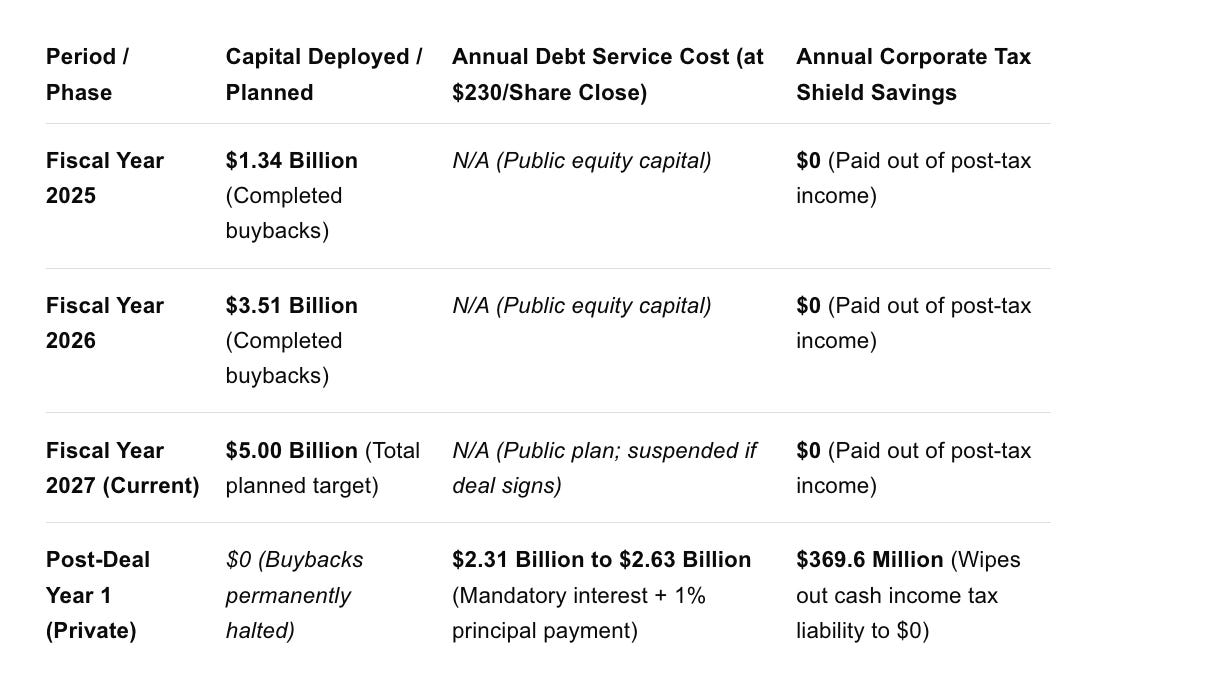
My speculation of the deal structure is simply speculation. I’ve no idea what Dave and Aneel are planning, but I would hope that this rather lengthy explanation will calm down those that think Workday being “bought” by a PE somehow means the Workday will cease to be relevant etc.
There may well be other parties that show an interest that will change the nature of the deal completely. For instance, while the list of strategic vendors able to swallow Workday is relatively short, it is an impressive list.
Taking Workday private will give it the space to figure out what it wants to be without the glare of the the public markets. The demands of PE shareholders are likely no be no more onerous than the slings and arrows of the public market. Silver Lake will own a chunk, but Annel (and Dave) are likely to have managerial control.
When I started this post, I had imagined spending a paragraph or two on going private, and the rest on what Workday ought to be doing, but I went on a bit. I’m going to spend the next few hours of my day writing about the future Workday and its peers. I hope you will stay with me.
I wrote a post a little while back in response to A16z’s position on Workday. You might find this useful. Workday has more going for it than many VCs think.
On the other hand are plenty of industry analysts and HR influencers that sing the praises of Workday. Workday has the equivalent of a welsh eisteddfod in the worktech community. Its analyst and influencer relations team has always been best in class.
I’m not going to do that here. I’m going to be blunt. I may be a bit out of tune.
The last 2-3 years have been less than rosy for Workday on several levels. I’ll ignore the finance software products, as I don’t know them well enough to comment, so I’ll focus on the CHRO centric bits. I’ll begin with a lengthy criticism, largely relying on the power of hindsight.
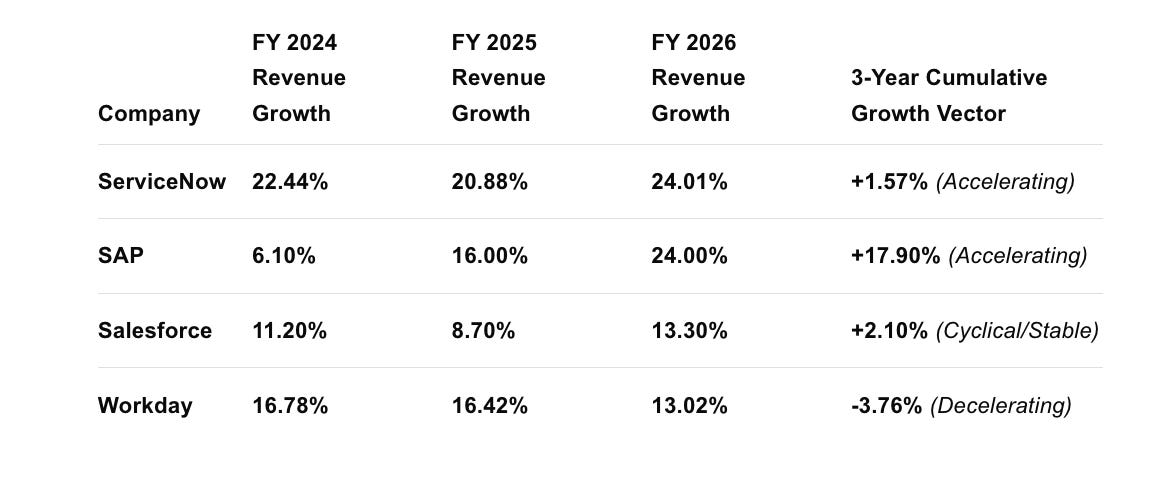
Financial performance has not kept pace with its peers like Salesforce, ServiceNow or SAP. Growth has decelerated every year. This is partly why it has been punished more than its peers by Wall Street.
For the best part of its first 15 years, Workday set the HR narrative in the large enterprise. Being part of the Workday community created a strong tribe, both for employees and customers. Product leaders had deep HR roots, often going back to PeopleSoft. Aneel, Dave and the product leadership positioned a coherent message, The Power of One. I had to compete against this and Workday was formidable. Buying Workday was what every CHRO wanted to do, even if the rest of the shop was deeply SAP centric. Workday could shoot fish in the barrel that was the PeopleSoft customer base too.
Workday’s strongest products remain the ones it founded the business upon, core HR and to a lesser extent, finance. Its FP&A product is adequate but is neither functionally rich nor especially modern. It has not been a door opener, but rather a tag along. Products such as the ATS and the learning management solution are tolerated rather than loved. A decade ago, pre-Generative AI, Workday had a far better AI/ML story than any of its competition. It did not really execute on this.
Workday’s payroll strategy has stalled. It failed to deliver the much promised German payroll. It has a relatively strong HR presence in the DAX 40, but a lack of payroll and time management means that SAP still generates more revenue in out of those HR departments than Workday does (I have a long list of SAP blunders too, some that I had a hand in, but not for today’s saga).
Over the last 5 years or so, Workday has made multiple acquisitions, paying strong multiples for best in class niche applications such as Peakon, and more recently HiredScore, Paradox and Sana. They also acquired Vndly, a contingent workforce product, flowise (agent builder) and pipedream (API management).
It is yet to show how these acquisitions combine together coherently. Workday has yet to come up with a narrative that replaces the Power of One adequately. The acquisitions are predominately edge capabilities. They may provide upsell, but none of them really help them replace SAP, Oracle etc in the enterprise. Nor do they significantly improve the core product itself.
Whereas SAP and ServiceNow have learnt how to sell acquired products and partner products effectively, Workday has not got its own salesforce executing on that effectively yet. There are some exceptions.
While Workday’s native AI capabilities are relatively limited, they have been on the receiving end of several AI / recruitment legal cases, this has hampered Workday’s ability to position an AI vision aggressively. Ironically Workday has one of the strongest Responsible AI governance models in the enterprise software industry, but it hasn’t helped.
Workday has pinned much of its next generation AI hopes on the Sana product. My sense is that Sana’s AI capabilities are promising but embryonic. Owning the agentic system of record is shaping up to be the most funded area in enterprise software. I’m not yet convinced Sana /flowise is the answer here.
Workday built a formidable corporate culture, mirroring yet improving on the PeopleSoft culture. It had some disadvantages (not invented here etc) but it made for a committed, tribal loyalty in both sales and product. Several waves of retrenchments have undermined this culture. Waves of institutional knowledge have left, and several of those have now raised significant startup funding.
Workday controls a big chunk of the Fortune 1000 HR stack. These solutions are deeply sticky. Think bubblegum in long hair sticky. Workday has the trust of the CHRO and the CIO.
Workday controls some of the most critical and complex datasets in the enterprise. This creates immense stickiness, and also creates deep potential competitive advantage to build new innovations. While its early attempts at API monetization have been clumsy, I expect Workday will figure out how to effectively monetise and strengthen the API layer.
Aneel is has deep expertise, technical understanding and love for the space. He has greater technical depth than any of his CEO peers, and the respect and trust of CHROs. He is no stranger to a challenge.
Workday has a massive ecosystem of systems integrators and BPO provides such as Accenture, Deloitte, Mercer, Strada, ADP etc. They hold a strong sway over the Fortune 1000.
There are very few global alternatives, and even US enterprise competition is constrained. While there is start up action (we are funding some of it), it is still early days. Global HR is a lot harder than it looks. Mid market isn’t enterprise.
Workday has the opportunity to build out its partner revenue channels. This has just begun. Workday has a massive distribution opportunity that it has not yet leveraged effectively. Done right this could add at least 10% to EBITA.
Despite some of the recent leadership churn, Workday has a deep bench in Worktech and one of the best enterprise sales machines in the industry.
It has a very strong balance sheet and free cash flow position. Its acquisitions to date have been relatively modest, and mainly functional rather than platform. It has not yet acquired much deep AI tech (compared with say ServiceNow or SAP). The last 6 months has seen more enterprise relevant AI tooling hit the market, and I expect worthwhile acquisition opportunities emerge over the course of this year and next.
AI is going to have a massive impact on how work is organized. Perhaps not as quickly as the AGI cheerleaders want us to believe it will, but work is going to change. The combination of the human and AI is going to get really messy. The winners will be those companies that understand this messy intersection between human work and AI work. This creates both an opportunity and a threat for Workday, but they have the trust of the CHRO, which is an important starting point. Work tech remains application tourist adverse.
Workday is a strong position to learn from the mistakes that SAP and others have made in re-platforming or replacing core products. Should Workday build something new, the tools to migrate customers onto the new thing are far better than they were even just a year ago. This of course plays both ways.
This section is an awkward mix of a couple of scenarios and a chunk of unsolicited advice from me. I’m going to assume the move to private ownership along the lines of the structure I’ve postulated above goes ahead. It is a big assumption, I know.
A big part of the next chapter of Workday is going to be who runs it and how it is run. Workday will need to become what Tushman and O’Reilly call the ambidextrous organization. If you haven’t read their book or articles please do.
Microsoft managed to shift from its windows centricity to something else entirely. For some time it has been a brilliant example of ambidextrousness, and it has made this sort of move more than once.
Unlike Microsoft I think Workday needs to be out of the glare of Wall treet to do this, as per the Dell example. If Workday were private, it could build something genuinely new away from the nitpicking short-termist scrutiny of Wall Street. SAP never had that luxury, which is why R/3, ECC and S/4 are essentially iterations of the same product rather than profoundly radical innovation.
The future is in part about critical technology and resource allocation decisions, but it is predominantly about leadership, culture and the people. Workday built a remarkable culture, but it is no longer what it was. The biggest challenge will be whether it can regain its cultural differentiation while adapting for a fundamentally different set of circumstances and assumptions. There is a bit of a Henry V St Crispin’s day for Aneel moment here, assuming it does go private.
Workday was a brilliant insurgent, but has been a merely adequate incumbent to date. It will need to get better at incumbency while at the same time building the next insurgency. This will not be easy but the rewards if they get it right will be immense, as per the Dell example.
Workday must firmly streamline the current offering to what is genuinely sticky and perceived as truly valuable by its customers. I would sell off those components and acquisitions that aren’t genuinely pulling their weight. Those that can’t be sold should be depreciated with alacrity. I suspect customers would relieved to see a clearer focus, and those sold components would probably thrive under new ownership as partners. It must open up the APIs with a clear, workable monetization model and build a powerful partner revenue stream to cover those elements that are more fickle and less sticky. Going back to the Dell case, spinning out Boomi has been very successful.
It has the pick of Fortune 1000 companies and hip scale ups to work with to build something radically new, because of its brand and trust. It has the wherewithal to acquire promising emerging technologies and adopt new methodologies to build better and faster (There are priors for this sort of acquisition: Cape Clear was far more fundamental to Workday’s early success than most folks realise).
But it will need to create something radically new. The gap between whatever that radically new thing is and today’s Workday will need to be far bigger than the gap between PeopleSoft and Workday was. Because work itself is changing more radically. It will require challenging many of the assumptions that made Workday and indeed PeopleSoft successful. It will require courage and imagination.Acquisitions going forward must form part of the new product, rather than primarily buttress the old.
Once Workday has something genuinely radically new with proven early enterprise adoption, use sophisticated AI tooling to speed migration or enable coexistence. Then Workday could relist, or become a very desirable acquisition target, perhaps even spin off the old and new into two separate entities. This is achievable within a PE timeline window.
If Workday stays public, I suspect it will trundle along, beset by activist investors seeking higher short term returns, demanding share buy backs rather than enabling long term R&D risks. So it will wrap its ageing core product with mildly adequate AI features. It will tighten operating margins, and gradually, almost imperceptibly become less and less relevant. The best talent will drift away. Decades from now companies will still be running Workday, but its market cap will be far eclipsed by new entrants, and WorkTech innovation will have moved elsewhere. It will eventually be attractive for a more traditional PE play.
In case you now have the perception that I don’t think start-ups can disrupt core ERP, I’d like to outline where we (Acadian Ventures) are at.
We are of the view that new competitors will eventually challenge the dominance of Workday, SAP, UKG, Dayforce and others. Dislodging the incumbents will require much more than a modern version of roughly the same thing, it will require a rethink from the ground up. This will not happen quickly in the enterprise, but every generation of worktech and ERP has seen new champions emerge, some incumbents thrive, and others fall back. This one will be no difference.
We have already backed a start-up founded by ex-Workday folks, VCola. It’s early days, but they have thrown a lot of the traditional ERP principles out the window, but kept the ones like security, audit, reliability and compliance. We are thrilled have invested. We are also watching a couple of others with deep interest.
I’m still not quite sure why I spent most of my Sunday afternoon and evening writing this, but it was fun.
Taking Workday private, with caveats, is the right thing for the founders and leadership to do. It creates space, the debt demands are no more onerous than the share buy back demands of public market investors.
Despite a less than stellar last couple of years, Workday has a lot of advantages. I hold that the public markets are undervaluing Workday and some of its peers. Enterprise worktech is far harder than most people think.
Assuming the deal goes ahead Workday should
Revitalise and reset its culture.
Assertively prune the existing portfolio to those components that customers deeply depend on and love. Sell or kill those that don’t perform. Partner effectively, and monetize APIs prudently. These will not be easy, but will be liberating.
Build (and perhaps buy elements for ) something radically new, more different than Workday was to PeopleSoft.
If it stays public it will be far harder to change.
As usual, I will end with a tune. One of my favourite bands, Lloyd Cole and Commotions. Rattlesnakes is near the top of my list of top albums. The music critic Simon Reynolds described it as Bookish Pop, which I suppose is exactly my kind of thing.
…..she looked like Greta Garbo.
No posts
Comments
Nothing yet. Say the first thing.
Sign in to join the conversation.