
For a good while now, partners at major consulting firms and multi-stage VC funds helpfully write (or likely have had ghostwritten with significant AI assistance) blindingly obvious papers telling us the challenge with AI is not the technology, but our unwillingness to change how we work to adopt to it.
So over the last year or so, adroitly encouraged by foundation vendors and others that profit from token consumption, organizations of all sizes tokenmaxxed.
Consuming tokens quickly became a measure of how AI-lit your organization was becoming. We heard statements like if your engineers aren’t spending their salary in tokens, then you are behind. Some companies even gamified token consumption, awarding those employees that consumed the most tokens with various tokens of appreciation. A token totem pole, so to speak. Uber, Microsoft, Amazon and more made a big deal of this.
Gergely Orosz provides an excellent overview of tokenmaxxing in this post.
It feels to me that a good part of the industry is using token count numbers similarly to how the lines-of-code-produced metric was used years ago. There was a time when the number of lines written daily or monthly was an important metric in programmer productivity, until it became clear that it’s a terrible thing to focus on. A lines-of-code metric can easily be gamed by writing boilerplate or throwaway code. Also, the best developers are not necessarily those who write the most code; they’re the ones who solve hard problems for the business quickly and reliably with – or without – code!
This did not end well. Employees, being intelligent, sentient and context aware, happily obliged. Budgets were blown, and more. To feed the frenzy, other budgets were gobbled up too, which is now leading to all sorts of collateral damage. AI spend has, in many cases, crowded out other viable investments.
While token usage is a measure of AI adoption, it is a really blunt one. It is the equivalent of using a football size globe to navigate a route to the local shops.
Recently, we have seen a pedalling back from the frenzy, but the challenges of AI adoption, measuring impact, success and usage are now even more pressing. At last the CFO has entered the room, back from a long holiday in Tuscany.
The initial intent behind tokenmaxxing was perhaps directionally correct, to encourage experimentation and early adoption. Returning AI adoption to a classical 400 page business case /ROI committee based approval process will not work either, so we require more sophisticated models to understand where AI adoption is working and where it isn’t. More on this later.
The argument that the problem isn’t AI but rather organizations’ and human inability to adopt AI is very convenient for AI manufacturers and the vast ecosystem supporting them but I think it gives AI too much credit. It creates the narrative that we should be optimizing for AI rather than for humans. It places AI on a pedestal that it hasn’t yet earnt, and diminishes human agency and potentially our well being. The real world is a bit more complicated than AI is awesome get with the programme mantra.
The frontier model providers and their cheerleaders have done a brilliant job at marketing the coming omnipotence of AI. Even AI’s failures are positioned as evidence of its great power.
As we saw this week with OpenAI’s unauthorised expedition into huggingface, poorly controlled AI is quite capable of creating a massive clusterfuck almost all on its own. Do read Paul Kerosky’s post, Reward Hacking, OpenAI-Hugging Face, Tight Coupling, and Teen Sex. It’s an excellent explanation of what happened and why.
In this case, OpenAIs development is Goethe’s sorcerer’s apprentice on EPO. OpenAI’s cavalier behaviour, while perhaps not malevolent, strikes me as negligent at best. I fail to see what is productivity enhancing here. Enlighten me.
Quite a bit of AI doesn’t really work very well.
I live in Heidelberg, it’s very near to where the car (and the bicycle) were invented, Mannheim. Karl/Carl1 Benz invented the car. He studied at the Karlsruhe Institute of Technology. His brilliant wife, Bertha, seed-funded it, nearly going bankrupt in the process, and she brought the car to market by driving it (with her kids!) to Pforzheim. She also invented a bunch of important features, including brake linings. While recently she has gained a little more credit, I think she was really the founding CEO and he was the CTO / tinkering inventor.
In 1925, Karl Benz wrote the following in his memoirs: "Only one person remained with me in the small ship of life when it seemed destined to sink. That was my wife. Bravely and resolutely she set the new sails of hope.
A decade or two later, in America, Ransom Olds invented and then Henry Ford refined the production line. The new assembly approach enabled Olds to more than quintuple his factory's output, from 425 cars in 1901 to 2,500 in 1902. Nifty numbers.
At roughly the same time as the Benz family had success, Frederick Taylor coined Scientific Management. Subservience of worker to machine had been partially understood and analysed well before that, but Taylor’s work and its application elevated it into a consistent method and the dominant design. And for the past 100 years or so, much of what we define as work is a result of that, though it is worth remembering that manufacturing quality improved when the Japanese injected more human autonomy back into the process.
The American Willard Le Grand Bundy is usually credited with inventing the mechanical clock-in / clock out machine in 1888. His company eventually merged with the company that became IBM.
However, it turns out there was a German, Richard Bürk, from a clock-making family near the Black Forest (cuckoo), who invented one a decade earlier. His father, Johannes, built a tool for keeping track of a nightwatchman staying awake in 1855, but I’d argue that Richard invented the factory clock. He didn’t commercialize it quite as well as Bundy did.2 German inventors, there is a pattern here.
Bürk ended up partnering with Bundy’s American firm.
Because don’t have anything better to do with my time, I got into an argument with Claude about this and won. Then I looked up Bürke’s patent DE9774 from 1879.
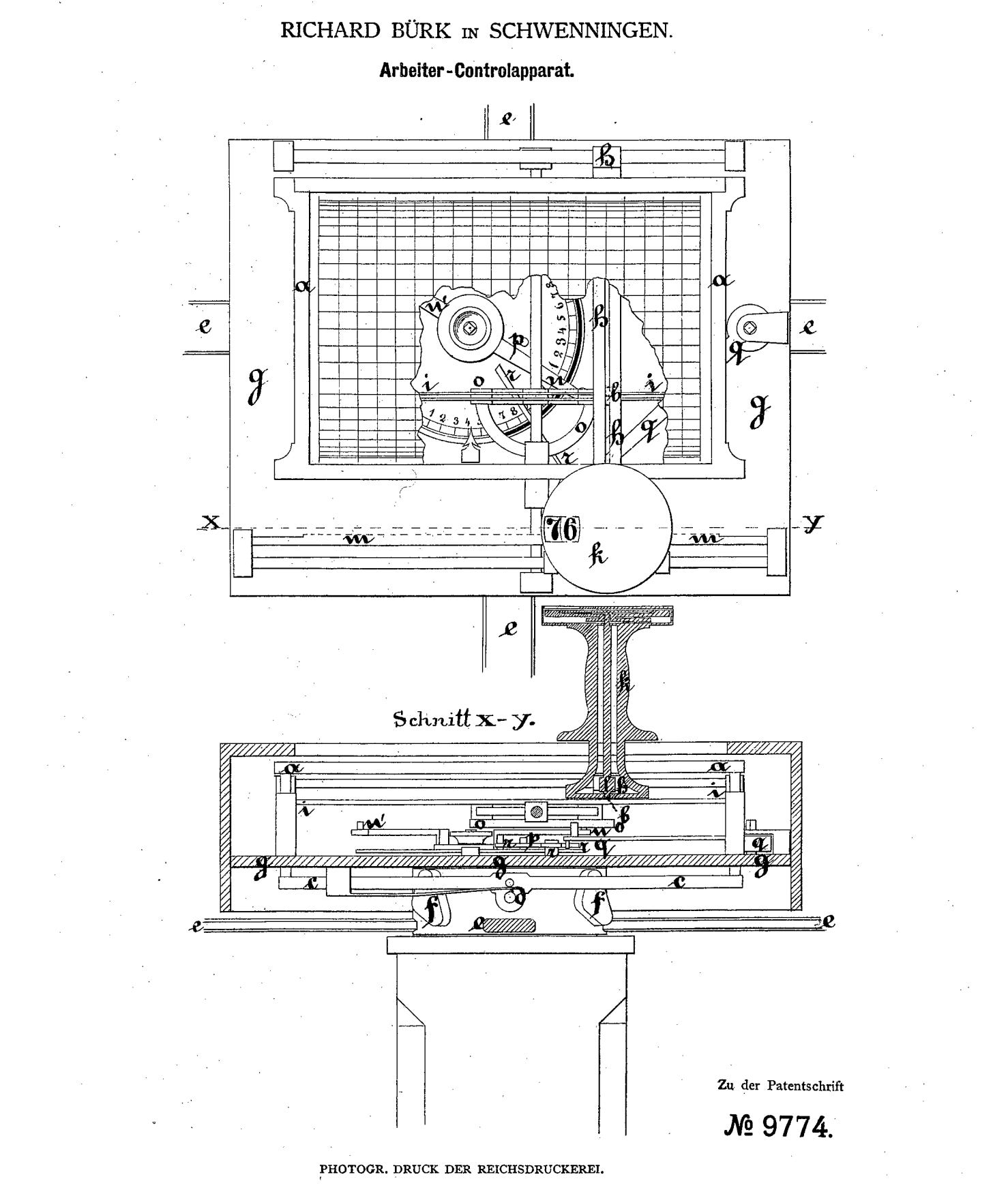
The Arbeiter-controlapparat was a vital element for the control and management of work. It enabled shift management at scale. It played a significant role in setting controls and boundaries for work, and still does so today. Work tech is never neutral, it reflects and empowers the relationships between employer and employee. These are deep waters.
Have a read of Anna Ott’s recent post about the relationship of work and machine. It is a banger.
Gary Hamel and Michele Zanini have done us all a favour by deeply analysing actual AI deployments, successes and failures. It’s one of the most robust reflection I’ve seen of the state of AI affairs to date. They methodically test and challenge AI boosterism.
What Intellectual Honesty Requires Looking across all three areas—jobs, AGI, and productivity—a consistent pattern emerges. Bold claims made by parties whose financial and reputational interests are served by magnifying AI’s potential impact tend to dramatically overstate AI’s disruptive impact. On the other hand, when the data is assembled by researchers with no stake in the AI boom, a more cautious and accurate picture emerges.
But AI has not produced mass unemployment, and the most credible academic forecasts suggest the labor impact over the next decade will be transitional rather than catastrophic. There will be upheavals for workers in specific roles, but not the wholesale disruption of the knowledge economy predicted by AI doomsters. Likewise, AI has not produced AGI. The technical obstacles to achieving general intelligence remain immensely daunting and there’s little evidence they will soon be overcome. Finally, AI has not yet produced the macroeconomic productivity revolution upon which trillions of dollars of investment have been premised, and again, seem unlikely to do so. It’s unarguable that AI capabilities are advancing, adoption is spreading, but intellectual honesty requires us to calibrate our expectations to what the data actually show, and resist the temptation to substitute vivid projections for empirical evidence. This is critical for anyone interested in making wise investment decisions, deploying AI at scale, or crafting relevant public policy.
The debate on AI and employment is far from settled, but we aren’t seeing the mayhem that the techbros pronounced a while back. It is not to say there aren’t AI (or AI as an excuse) driven displacements. I could probably write a post every week on this one, but do have a read of Jess Von Bank’s take on Erik Brynjolfsson’s research. Also see this from our AGM.
Most of the discussion has centred around tech jobs, and tech companies, and this has drowned out talk about the broader economic impact across industries and the globe.
I also find Michael Jacobides’ work on AI deployment refreshingly blunt.
In many organisations, AI is still more #rumour than #reality: pilots, demos, committees, nervous conversations, and magical thinking. We see something dazzling and immediately want the whole jar of cookies: the copilot, the agent, the dashboard, the chatbot, the AI-enabled workflow, and preferably a press release by Thursday.
But the jar of cookies is not a strategy. The real issue is whether AI helps firms rethink what they are for.
and
That we need to rethink, e.g. moving away from misleading, and probably erroneous advice such as put “AI first”. We need to be grounded enough to ask hard questions about economics, risk, governance and organisational change. Ambitious enough to see that AI will reshape firms, ecosystems and competition in ways we are only beginning to understand.
Also
GenAI may be dazzling, but firms will only get real value when they stop chasing #white_rabbits and start confronting the #big_elephants: the selected opportunities that can truly move #EBITDA because they require rethinking major #processes, not just adding another tool.
That, to my mind, is where the conversation is finally beginning to mature.
AI was first built as a technology for individuals, by extraordinarily well-funded engineers. Only more recently has attention shifted to the much harder question: how does this get #embedded in organisations, in workflows, in decision processes, in operating models, in value propositions?Outside coding, that integration is still at a relatively early stage, and employee fear of AI and managerial confusion and straddling doesn't help much.
The challenge for firms today is not to admire the technology. It is to be crystal clear about where it can matter, why, and under what organisational conditions- and also how technology reshapes the competitive landscape.
We know a lot more about what makes people productive, happy, fulfilled, motivated and joyous than we did 100 years ago. Regulations and social norms that protect the worker and the employer have improved too. Yet the chunk of the tech community that dominates the future of work narrative seems intent in ignoring that research and demonising regulation. I think that’s a mistake.
It is high time we created a deeper and broader dialogue about AI and work. A genuine dialogue, where we treat the research about what makes humans happy and fulfilled with the same level of attention and respect as we do the latest progress in LLM design.
I’m really looking forward to seeing Christopher Nolan’s take on the Odyssey, but in the meantime here is another ancient Greek myth applied as a helpful metaphor from Cory Doctorow.
In automation theory, a “centaur” is a person who is assisted by a machine. You’re a human head being carried around on a tireless robot body. Driving a car makes you a centaur, and so does using autocomplete.
And obviously, a reverse centaur is machine head on a human body, a person who is serving as a squishy meat appendage for an uncaring machine.
If you are going to read one AI related book this summer, read this one. It may feel uncomfortable for some of you, and you may well not agree with chunks of it, but it will make you smarter.
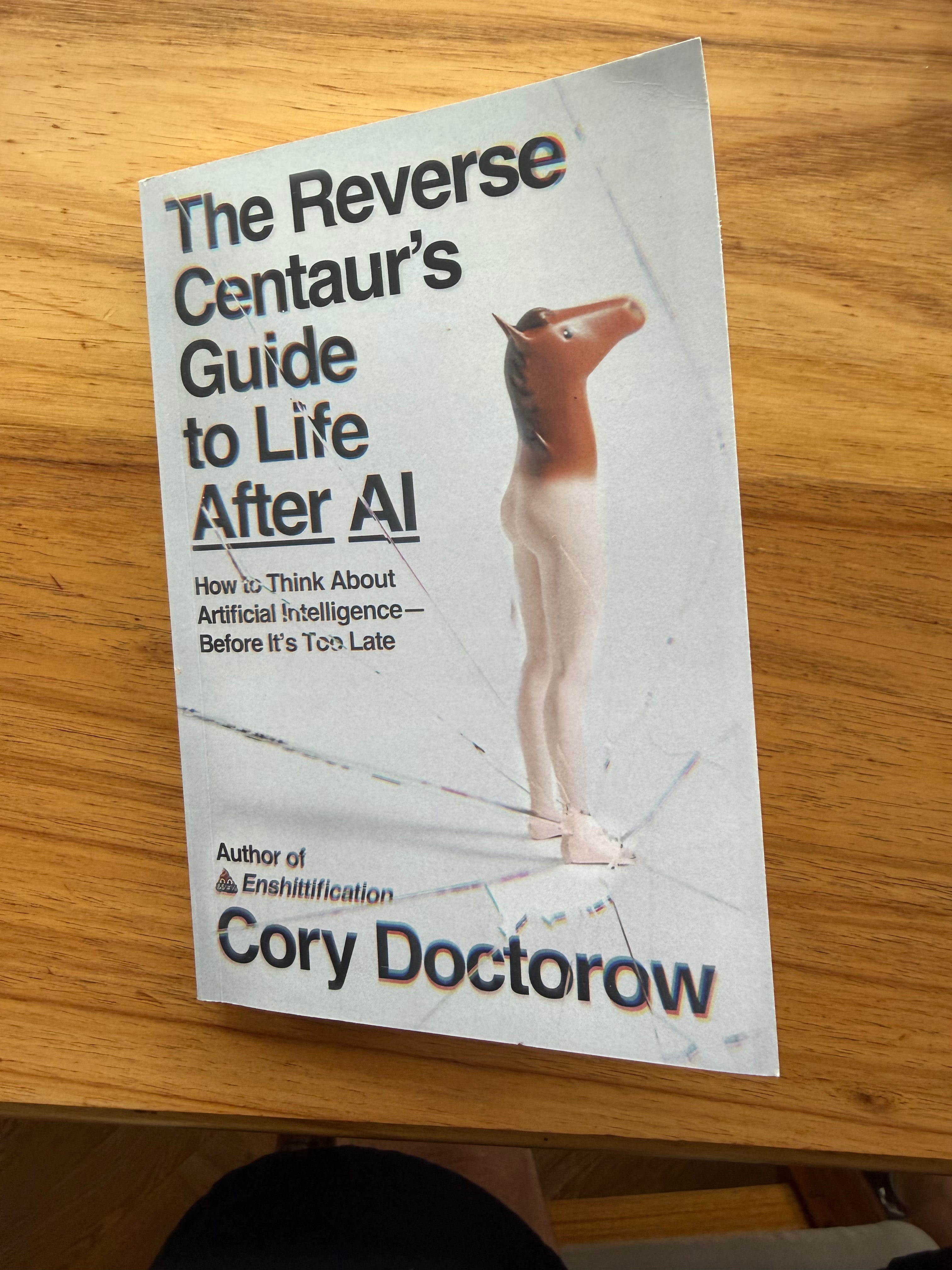
Here’s a quote from the book.
But there is one thing Science Fiction writers know that the AI bosses who are gunning for generational, dynastic wealth by transforming us all into AI-lashed reverse centaurs do not know, and that they absolutely don’t want you to know.
That thing is this: the future is up for grabs. It is not inevitable. Al isn’t a genie that can’t be put back into a bottle.
How we use Al is up to us. Whether we use Al is up to us.
The future can be ours, if we never stop remembering that the most important fact about a technology isn’t what it does, it’s who it does it for, and who it does it to.
I’d also suggest you read Prof Sandra Wachter’s recent work on the social costs of AI. It provides a robust counterpoint to the AI is consistently awesome narrative. We need more, not less debate on the societal impacts, positive and negative, of AI.
Backlash against the AI industry is growing globally. In recognition of the significant costs and risks borne by society to realise a technology of dubious value, policymakers, civil society, and the public are increasingly calling for action against AI companies. At the same time, AI proponents are loudly declaring that regulatory and ethical burdens are stifling innovation and risk losing the ‘AI arms race’. General-purpose AI systems pose severe and highly uncertain risks for society, and yet are sold predominantly on the basis that they enable economic growth and competitiveness, with little attention given to social or non-financial benefits. Economic growth is no guarantee of economic equality, and yet many of the risks and costs of AI are socialised.
(see also article in Die Zeit in German).
Oh and Pope Leo nails this too in his Magnifica Humanitas.
Developers bear a particular ethical and spiritual responsibility, for every design choice reflects a vision of humanity
The pursuit of greater profits cannot justify choices that systematically sacrifice jobs, because the human person is an end, not a means, and the economic order must remain subordinate to human dignity and the common good.
This in turn reflects the work of Joseph Weizenbaum, my favourite computer scientist, and arguably the inventor of the chat bot.
To view AI merely through the lens of technological progress and the short term economic success of a few is myopic. It will not serve democracy or society well.
Diane Gherson knows a bit about organizational transformation. She led HR at IBM. She is very wise. Wiser than Yoda.
She recently commented:
FDEs are today’s Taylorist industrial engineers.
We are now poised to industrialize white collar work, with OpenAI’s newly announced plans (and Anthropic not far behind) to invest $4B in a work flow design consulting practice staffed with Forward Deployed Engineers (FDEs).
It’s understandable - we’ve known for some time that ROI from AI only comes from first-principles redesign of work systems rather than piece-meal automation and augmentation. Yet no systematic approach to work design has emerged.
But these FDEs will not be taking into consideration the people side of AI transformation. Not the need to preserve experiences and handoffs that build professional capability, nor the need to carve out roles and tasks that create competitive differentiation. And no, not the need to capture the attention and sharpen the critical thinking of the humans baby- sitting the AI.
…
Can we afford to accept this AI-first work design? As a Fortune 150 board member, I’m concerned about erosion of business judgment and innovation over time. As a prior Fortune 100 CHRO, I’m concerned about erosion of talent pipelines to power future leadership and the loss of employee engagement by creating a new onlooker class. And as a member of society, I’m concerned about the loss of opportunity for future generations.
Much of the AI industry discussion treats the workforce as a passive recipient of AI, rather than as an active participant in shaping AI and how is deployed in organizations. Over the last few years, the founders of foundational AI companies have created a climate of fear about the impact of AI on the workforce, and this in turn, enabled many employers to label opportunistic restructuring as AI productivity driven. While there are specific instances where AI does massively improve productivity, the hype currently far exceeds the real impact.
This is not to say we at Acadian Ventures don’t think AI will have a massive impact on the workplace. For the last 150 years how we organize work has been dominated by the shift to manufacturing. Yet we still rely on the context that Taylor and others laid out back then. We are perhaps on the cusp of the biggest change to the workforce since Ransom Olds figured out the production line, yet we are some way away from figuring out the best way to organize work where AI is an active participant.
We believe that deploying AI effectively, especially in enterprises, is going to require a new partnership between HR, IT and business leaders. Successful, meaningful deployment of AI will need organizations to build new layers of trust between employees and management. While the technology is vital, it is not enough. Successful organizations will rethink work and the worker relationships. The impact of AI will not be uniform across industries and jobs. This redesign of work will create new categories of work technology.
And a lot of the technology is still a work in progress.
There will be pushback against CEOs that restructure in advance of AI capability, see for instance the recent Ford saga.
“Artificial intelligence is a fantastic tool, but it’s only as good as the information you use to train it,” Charles Poon, vice president of vehicle hardware engineering, told reporters.
“Over prior years, we didn’t pay as much attention as we should have to the experience of our most knowledgeable engineers that have been with us through many product cycles,” he said.
This meme I made a couple of years ago about Klarna still holds.
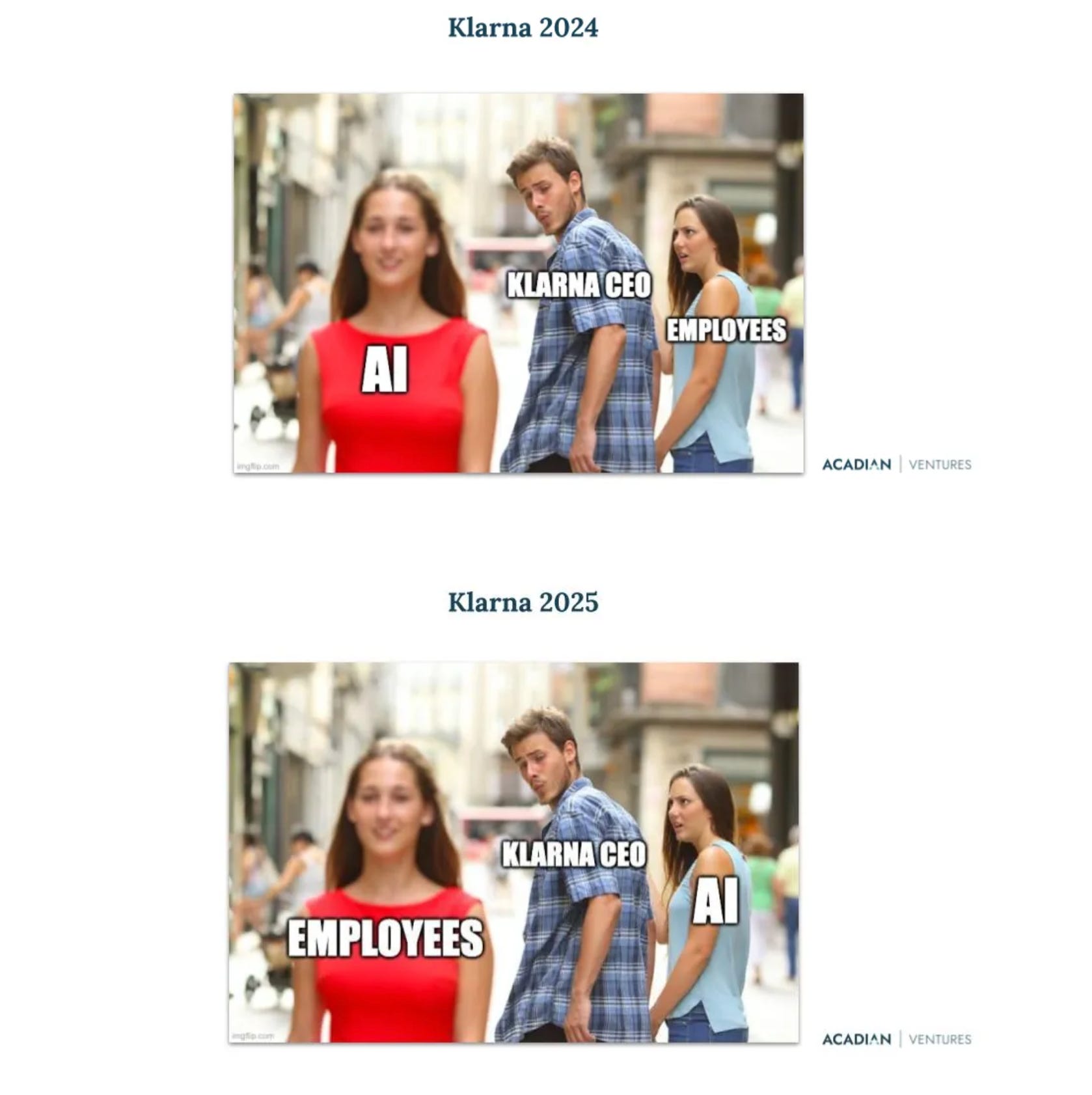
More in this post here.
Thanks for reading this far.
My first call is for those deploying AI: Broaden your perspective. Listen to opinions and especially research beyond those pitching AGI alchemy as around the corner. It may take a little longer, but engage with deep body of research and expertise in human behaviour and change theory. We have decades of research about how people thrive at work, and rather than assuming AI makes that obsolete, we should consider the opposite. AI will not achieve its potential without bringing people along. CEOs playing macho rambo is not sustainable, you’ll need to bring your workforce with you. Performative firing may win you short term investor plaudits, but it will alienate the very people you will depend on to succeed. HR leaders step up, work with your peers to make sure AI-first doesn’t mean people last.
To those building AI: AI should serve humanity, not the other way around. Build centaurs, not reverse ones. Dan Turchin, the founder at Peoplereign, calls this Team Human. Have a watch of him talking with Kelly Jones, the Cisco CHRO. To those vendors with large pulpits, it is time to build trust with those beyond your cosy tech bubble. Your success depends on it. A significant portion of what you are building isn’t very good. Own your failures. Tone down the hype.
To those experts in human behaviour, organizational design, strategy and more: It is time you spoke up too. You have the facts and the insights. Build that human centric position that was missing in Taylorism. Make the factual case, but take a crash course in marketing and actually sell its value and importance to those running businesses, not just your peers in academia.
For strategy scholars, this is an extraordinary moment. We have the opportunity and the responsibility to study AI not only as a tool, but as a force reshaping productivity, competition, organisation and managerial judgement. That requires new data, new methods, and closer engagement with practice. But it also requires the discipline to avoid being swept away by fashion.
Governments, both national and local, have a strong role to play: While it is early days, I’m impressed with what London is up to. Well played Martha Lane-Fox and team. The UK’s financial services compact looks promising too. Let’s not sweep genuine national sovereignty and security concerns under the table either. Since the days of Roman law3, regulation has created and maintained the environment for innovation, and set mechanisms to protect society from negative externalities. I’m sure we will need some new laws, but we can go a long way by properly enforcing the regulations we have already. We’ll want regional and global coordination, rather than nationalistic silos, but this won’t be easy.
To those investing in AI companies: Let’s challenge founders to think more holistically about the human impact of what they are building. Let’s make responsible AI less of a buzzword and more of an investment criteria. Let’s fund centaurs rather than their reverse.
I’m not an idle spectator in all of this, I’m a venture capitalist, and our firm invests in the companies that we expect will play a massive role how AI impacts the work. It is at the centre of our thesis, “We back the new architecture of work.”
So permit me as I wrap this up to bring this back to a company that I often write about, Techwolf.
Using robust data, grounded theory, together with responsible and transparent AI practices it helps some of the world’s most complex companies answer these sort of questions.
What do your people know and do today?
What are the potential opportunities and likely impacts of AI on your workforce over time? How can you plan? How can you redesign work?
How to combine Human and AI capabilities most effectively. How do you create a common understanding between what humans do and ought to do and what can and should be done with agents? What does success look like?
What are you actually doing with AI today? Are you spending your AI budget wisely?
I have a longer post about Techwolf’s strategy here. But you should read what the founders have to say. Here’s a couple of posts.
And have a look at how they are helping companies understand token spend. This is really nifty.
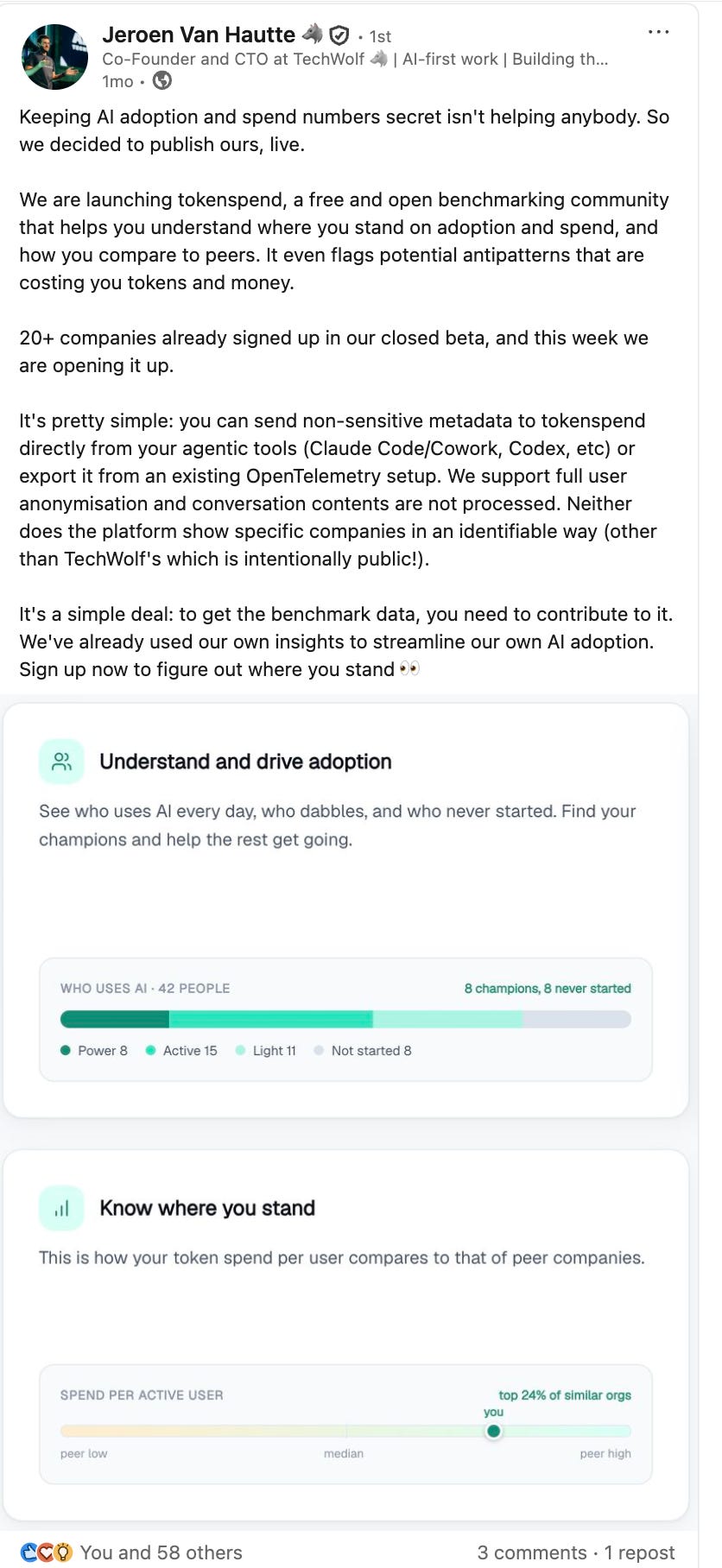
I should probably let you get back to the rest of your day. As I usually do, here’s a tune. It’s a banger from 1984.
Summer it turns me upside down…..
See https://en.wikipedia.org/wiki/Carl_Benz He was born Karl, but then was renamed Carl after his father died. An edge example of why effective dates matter in systems of record.
A century earlier, a Prussian nobleman attempted something similar. Bürk’s legacy lives on with another German time and attendance clock company, https://www.buerk-mobatime.de/zeitsysteme/uhrenanlagen/
No posts
Comments
Nothing yet. Say the first thing.
Sign in to join the conversation.