
I took my talk from our Summit and turned into a series of posts. This is the final one. You can read it standalone, or in sequence.
The first 3 posts are here, here and here.

Technology vendors are very good at creating new words, they are brilliant at taking existing words, and repurposing them. The fancy word for this is a neologism.
(edited for clarity and er um removal)
So once upon a time when we used the word mailbox, it meant a physical thing. And we appropriated that word to have a technological meaning. And that’s happening right now before our very eyes with the word skills.
We used the word skills to describe things that were uniquely human. Today we’re starting to use the word skills quite aggressively to describe preferred behaviors that we want from a machine.
And this is an interesting metaphor, I think, for the future of HR. Because the future of HR is going to increasingly be tied up with not only how do we manage people, but how do we manage this relationship, and this sharing of ideas, the sharing of responsibilities between human and machine. So ownership and understanding of both machine and human skills are is going to be super important. And most of the companies that we’ve invested sit at this intersection between human skills and machine skills. And we think this is a very interesting and exciting and exciting place.
We are at the very early stage of rethinking what the organization can be. My worry is that we allow that to be tech centric, rather than human centric.
Diane Gherson, the former CHRO at IBM has this to say.
Can we afford to accept this AI-first work design? As a Fortune 150 board member, I’m concerned about erosion of business judgment and innovation over time. As a prior Fortune 100 CHRO, I’m concerned about erosion of talent pipelines to power future leadership and the loss of employee engagement by creating a new onlooker class. And as a member of society, I’m concerned about the loss of opportunity for future generations.
There’s another way to do this. It’s “business-first” work design. Let’s not default to FDE-driven “AI-first” design.
More in her post here.
See also
It doesn’t have to be that way.
Have a look at what Pietro and Pack are up to, Dan, from PeopleReign talks of Team People, and Jeroen’s call for people-centric AI. A bunch of our portfolio companies are in an excellent position to help HR leaders defend and strengthen the human dimensions.
Ashu Sharma’s Stack Fallacy (the mistaken belief that it is trivial to build the layer above yours) has shaped a big chunk of my thinking about enterprise software. Application Tourism is my term for what happens when vendors ignore the stack fallacy.
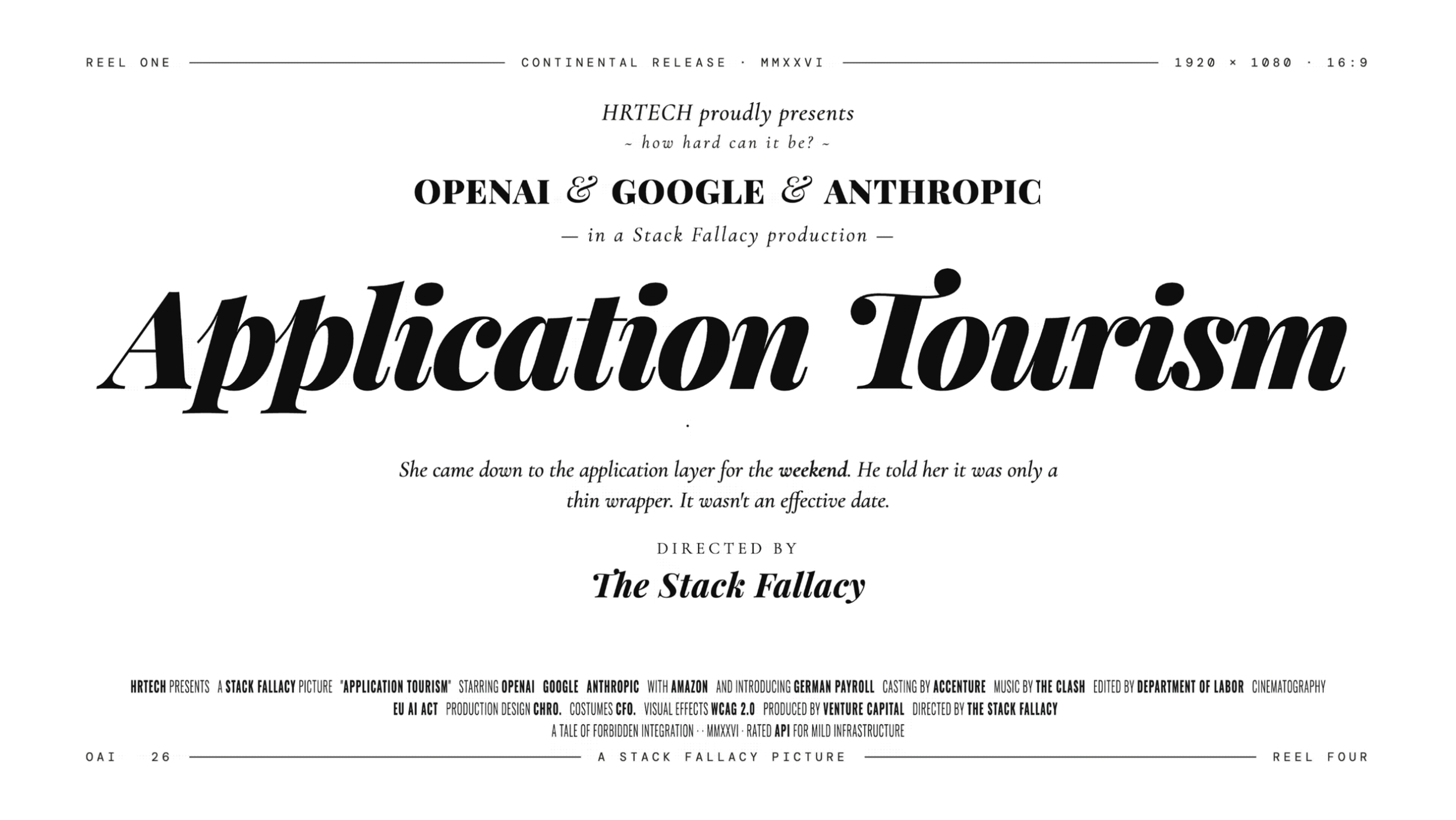
I was having a bit of fun with one of the AI tools late at night, and this is a movie I’d like to make. And it’s gonna be called application tourism. I’d like it to have Carrie Grant and Audrey Hepburn in it.
She came down to the application layer for the weekend. He told her it was only a thin wrapper, it wasn’t an effective date.
So I think the chances of the foundation vendors taking HR Tech seriously is relatively small. Because we’ve seen this record before, we’ve seen it with Amazon, we’ve seen it with Facebook, we’ve seen it with generations of successfully well-funded vendors who think that HR and work tech is easy, and they think it’s an easy space to move into. And so they come in for a short little while and they realize how hard it can be, it can be very hard.
But we are going to have the next 18 months or so of that fear that the foundation models play into HR tech. And I think they will play at the edges of HR tech, but I think they will get bored quite quickly. Because they’ve got other more pressing challenges on their plate.
And as I once said, building an HR system is a little bit like building a nuclear power station. The challenge isn’t building it, it’s keeping it running.
Application tourism, AGI, HR Tech and the stack fallacy.
·
September 6, 2025
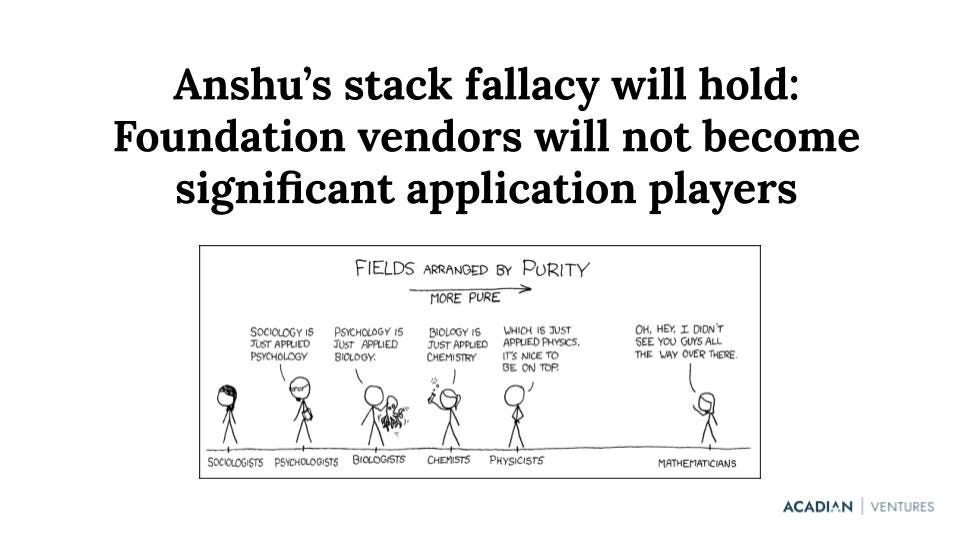
OpenAI has announced a plan to move into recruitment and learning. Our little corner of the interwebs is abuzz. I’ve seen several posts that remind me of Dad’s Army’s Private Frazer and Lance Corporal Jones.*
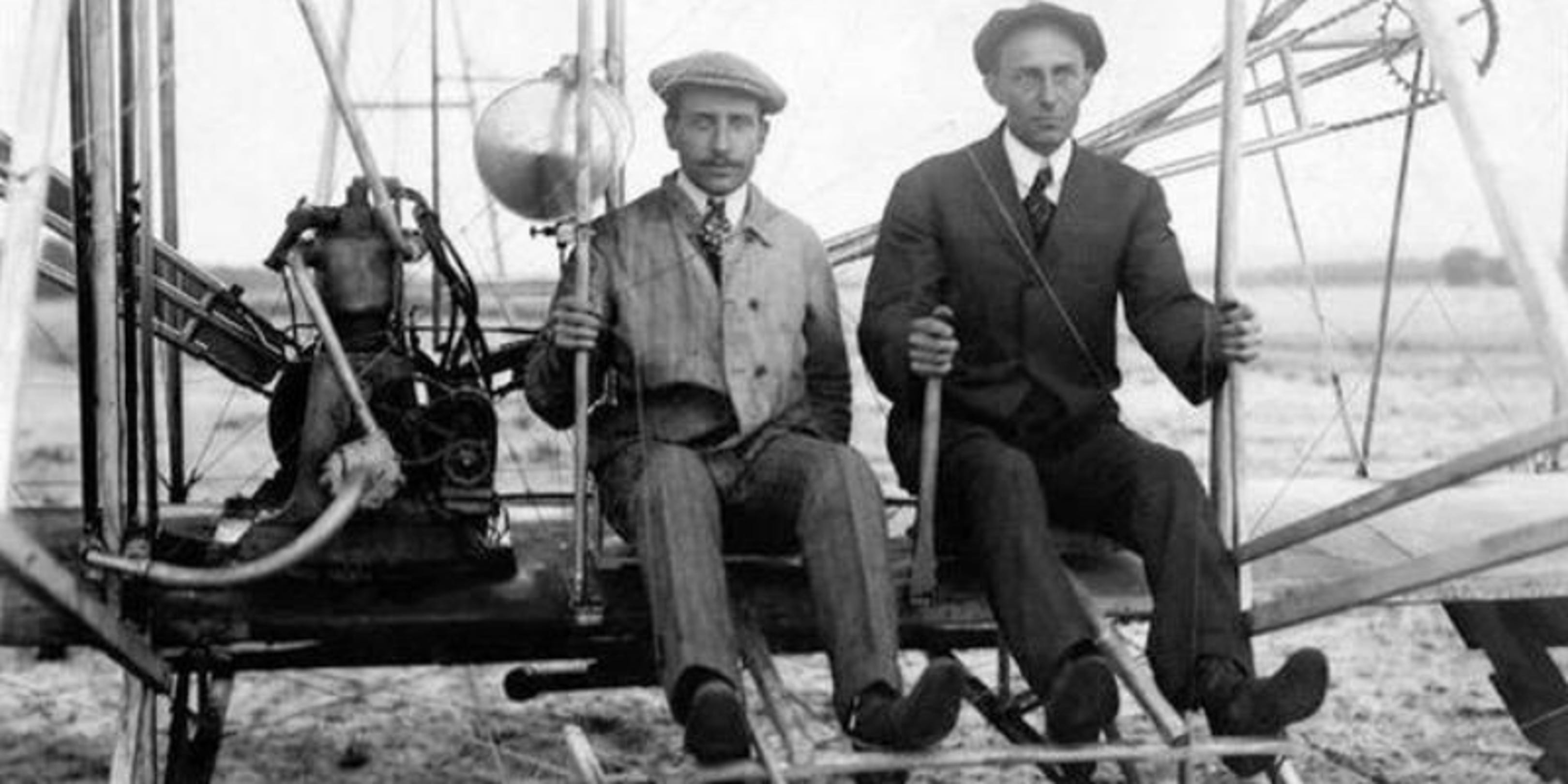
I’m fascinated by the Wright brothers story.
We look for people that are building things that were impossible to build a year ago or six months ago. Origin Benefits is a great example of this.
(rather than quoting my rambling talk, check this post)
The scope of HR Tech kicked off in 1951 at Lions Tea Room. It was payroll. But HR Tech has since grown bigger, and it will grow bigger and bigger and bigger and bigger and bigger. So the scope of HR Tech tomorrow will be much, much bigger than it is today. That’s why we love this space.
If there is one thing you should read that came out of our event, it is Alexis Fink’s post.
And finally, here’s the summary slide
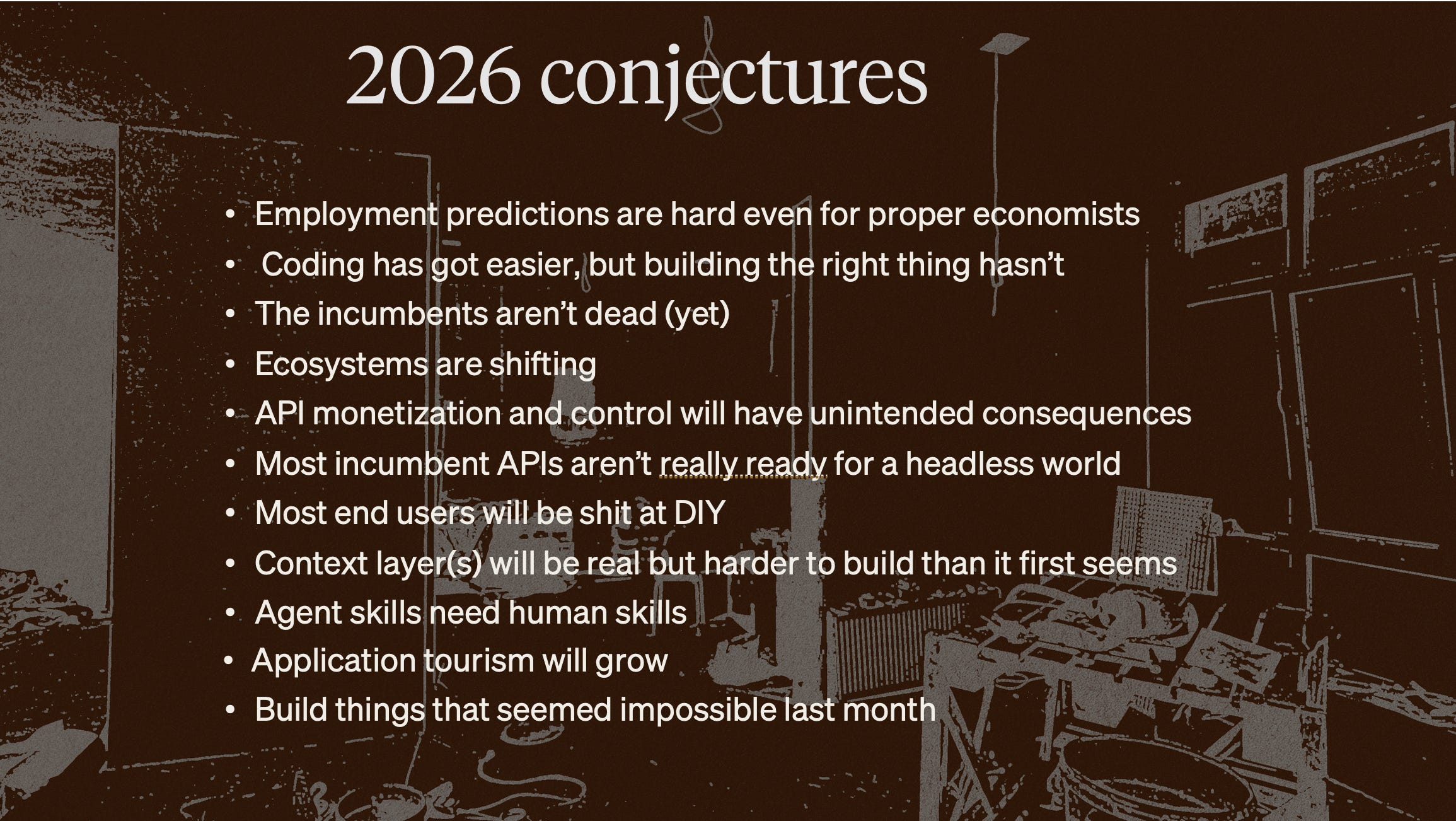
Nothing like this great song from 1987 to wrap things up.
No posts
Comments
Nothing yet. Say the first thing.
Sign in to join the conversation.