This is the second of several posts that expand on my 20 minute talk at the Acadian Ventures Summit 2026. I also dip into some of the panel discussions, and get distracted a bit. First post is here. We will also post videos of the talks and panels. If you want a short pithy summary, check out Jens’ post. I’ll ramble a bit here.
Edited and augmented for coherence. Here’s a bit of this section of the talk. (APIs and Headless)
The Americans have a really very, very expensive way of teaching their children geography, which is to invade or bomb a place, and then everyone knows where it is (if briefly). This is the Strait of of Hormuz.
I use this as a metaphor to describe what’s going on in enterprise software. We all know, the SaaS apocalypse is alive and well, and many companies have seen their multiples massively compressed. Some of the leading vendors have seen their share prices drop by 40 or 50 percent, sometimes even more. We’ve seen a compression in the PE market and so on. So definitely those vendors are under some kind of threat and under some kind of challenge. And perhaps in some cases, rightly so.
On the other hand, these vendors hold the data that the world runs on. So your SAP, your Workday, your ServiceNow, your Oracle, and so on, they control most of the information that the Fortune 1000 companies run on. So the idea that these vendors are going to be go out of business immediately, I think is complete nonsense. And there’s been a lot of hysteria in venture capital about these firms going out of business, and I don’t think they will. My question is in the future will they thrive? And that’s a different question.
The large enterprise vendors are in very interesting situation at the moment because they will be able to toll and tax the API layer in new and interesting ways. And we’ll probably see similar things happening with the foundation models as they think about how to build revenue models. But the concept that the significant ERP revenue vendors are gonna go out of business and be replaced by brand new incumbents overnight, building AI-based ERP replacements over a weekend, we think that is complete nonsense.
The open question for those vendors is is how do they grow beyond what it is they’re doing today.
Both SAP and Workday have blundered in their communications on their API and Agent strategy. SAP has skidded and u-turned more than a Ken Block rally Gymkhana video. Workday’s reminted CEO and co-founder called third party agents parasites. Salesforce has been rather arbitrary at best in its treatment of third party agents on top of slack.
Controlling what and who accesses the system of record is desirable. Third party agents who demand unfettered access to the system of record miss the point of why the system of record exists in the first place.
How this control is monetized will get very complicated over the next few years. The power of the incumbents is not absolute. If they are seen to be overly rent seeking they will lose the trust of their customers. If they close the strait entirely their customers will miss out on the innovations that the broader market provides, and customers will leave. If they open too wide, the systems of record will be swamped.
Charlie Franklin (co-founder and CEO of Compa) and Michael Ioffe (co-founder and of Arist) made the point that the incumbents often overestimate the quality and relevance of the data in the systems of record. Michael argues that many LMS today are no longer even adequate systems of record.
minor edits.
You get your own data, right? well let me explain. So every client that we work with, their number one complaint is that the data that they have in Workday or in whatever system of record they use is like 50% accurate at best, right? And so, you know, I can’t speak for for other for other parts of HR, but for learning and development, you know, if you try to infer skill gaps from existing HR data, and you try to personalize learning based on existing HR data you’re going to fail no matter what, right? Because that data just is not accurate. And so the approach that we’ve taken or that that we focus on is it’s very, very critical that we get first party data. And the cool thing that you can do with agents is you can just give employees a call or send employees a message via text message or Slack or Teams and ask them for the data point that you’re missing or literally just have a voice conversation with them to understand what their skill gaps are. And it turns out that in a five to ten minute voice conversation or five to ten minute chat conversation, especially if that conversation happens you know once a month or once a quarter, you capture dramatically more data and much more accurate data than you can ever get from an HRMS.
The most successful deployments that we’ve had, we just capture our own data.and it ends up being more effective than you know paying the toll.
Charlie commented:
If the business model for the HCMs is charging tools for data, I’m not sure that’s durable. I think your customers are gonna push back hard on saying, if I can’t use this data in other places, I’m gonna go to somebody where I can. I think it’s it competition will solve that for you.
Josh Gosliner from SAP SuccessFactors adroitly fired back at my Straits of Hormuz with the Panama Canal alternative. Building safe and predictable access. I’ll dig more into this in another post, he may be onto something, but the canal hasn’t quite been built yet. Adam Godson from Workday (CEO of Paradox) said every HCM solution now has two jobs: build agents and open APIs so others can build agents too.
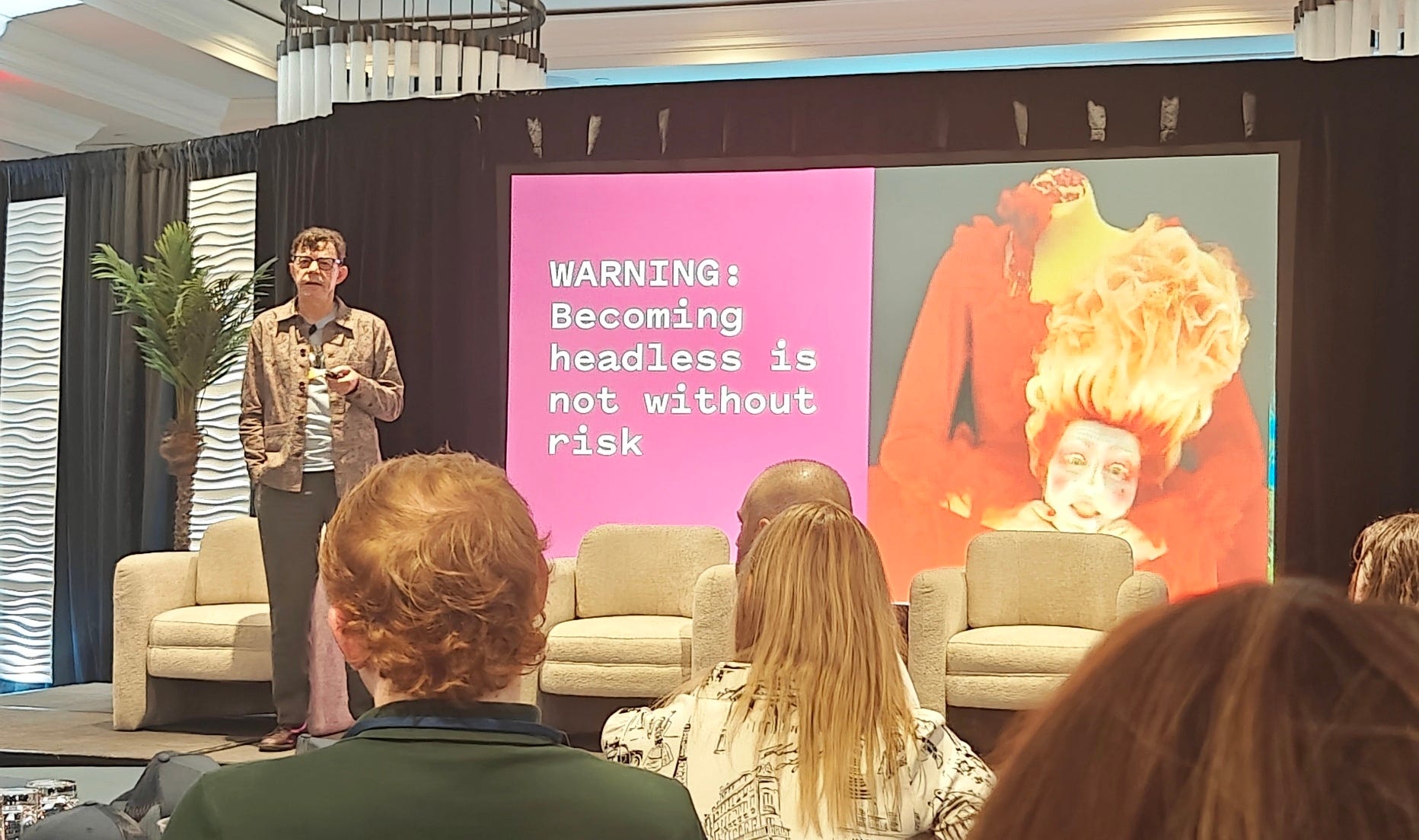
It is all the rage at the moment to talk of headless applications. It one thing to design an application to be headless from day one, it quite another to behead an application whose vendor spent decades telling us how strategic their UX is.
We have a couple of vendors in our portfolio that are headless. One of them is TechWolf. They’re not here today because Andreas has just got married. We did allow him to get married and we reluctantly allowed his co-founders to attend the wedding as well. That’s one of the companies that really grew up from an API first mentality. And building from an API first mentality is one thing. But taking an application where you’ve largely treated APIs as second or third class citizens for 20 or 30 years and then declare yourself to be a headless vendor, that is going to be a very painful exercise.
The external API layers in the incumbent vendors weren’t really designed to be the first class citizens, as they expected the majority of the user traffic to go through the UI. The application logic and the the UI aren’t as clearly separated as the brochures say. Some of the APIs are older than the internet, appearing on the antiques roadshow, after being rediscovered in Miss Havisham’s cupboard. They aren’t architected for performance required for real time agentic access, and neither is the security. The incumbents need to rethink, repair and reform their API layers if they expect to toll them without significant dissent. Trust earned decades ago can be easily lost.
I’m also not convinced that the chat prompt is the only future of UX. We are on the edge of an explosion of UX creativity for both agentic and human use, so abdicating UX and firing all your UX designers about the dumbest thing the incumbents can do right now. We will need new user experiences that we haven’t yet imagined. And the systems of records themselves will need to evolve, or risk a decline to irrelevance.
Smart start ups will learn where to leverage incumbent data sources, and where to build and augment their own. Merely naively layering on top might work for the short term, but it is hard to sustain and defend. We live interesting times.
In the next event post, I’ll look at HR DIY and more.
In the meantime, here’s a song for you. It mentions Tequila.




Comments
Nothing yet. Say the first thing.
Sign in to join the conversation.