
Please Note: though I’ve mostly been posting twice each week since we began walking on May 4, the time between posts has recently been longer and will likely remain so. We are so busy during the last weeks of #FreedomWalk2026 with walking, of course, but also with preparation for many additional Activation events and other details preparing to enter Canada on July 1 and preparing for events in Canada from July 2-11, that my time to write is more limited. I will definitely continue to share these stories through the end of our pilgrimage and after we conclude this pilgrimage on July 12. You’ll continue to receive these posts over the coming weeks and months until the full story is complete. I appreciate your patience!
We bid farewell to Mary Beth this morning. This is our first week staying in someone’s home. We could not have asked for a better person to host us. She was so warm and welcoming. She literally made her home into our home.
Today is quite a contrast to yesterday. It’s very windy and cool. The forecast is not calling for rain, but the clouds sure look like it. We warm up as we walk, and the wind continues to blow pretty hard. Fortunately, today’s walk is all on the Canal Trail, so it’s pretty peaceful.
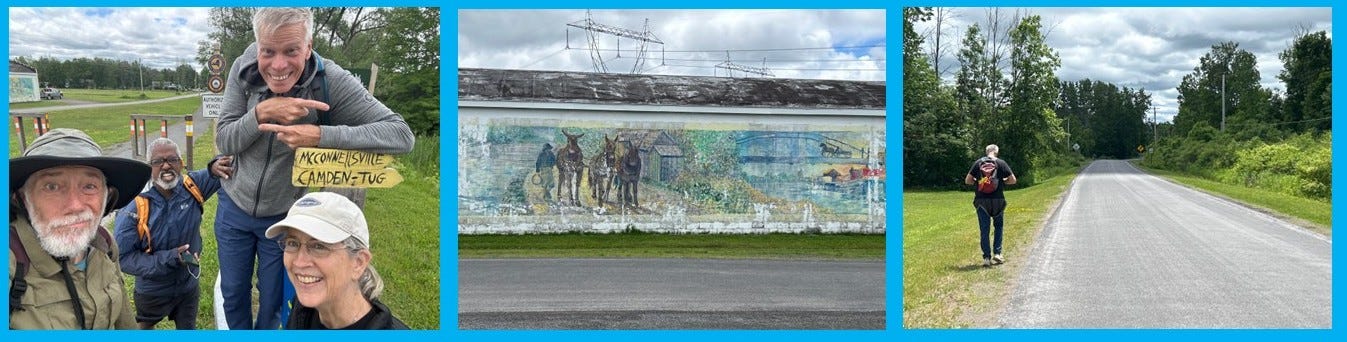
Walking along the canal, we saw quite a few turtles and birds along the canal, including one great blue heron it kept flying just ahead of us and then stopping and then taking off again as we approached. Also saw a beaver swimming along.
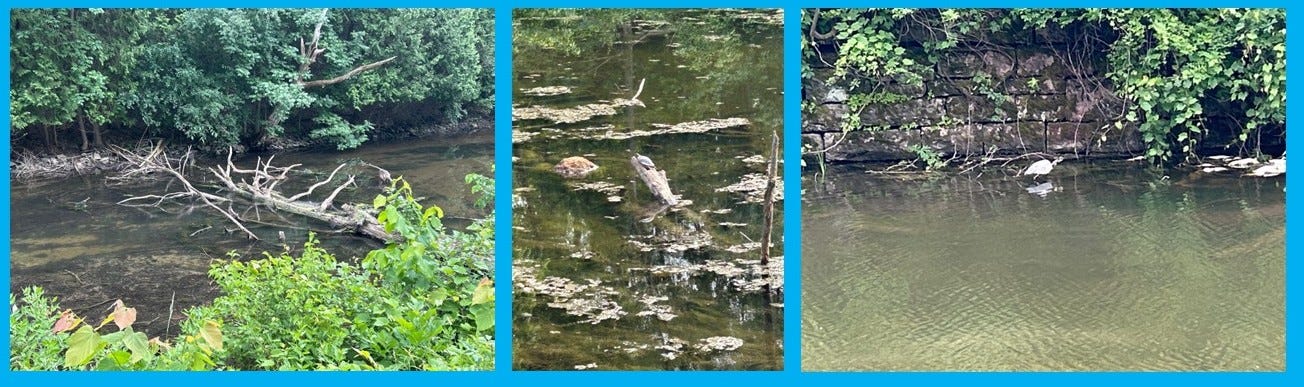
Then we came to a sign that said the trail was closed. We’ve encountered this a few times as sections are repaired/upgraded. It didn’t look like anyone was working today, so we continued on. We don’t necessarily recommend this option, but detours add miles, so…
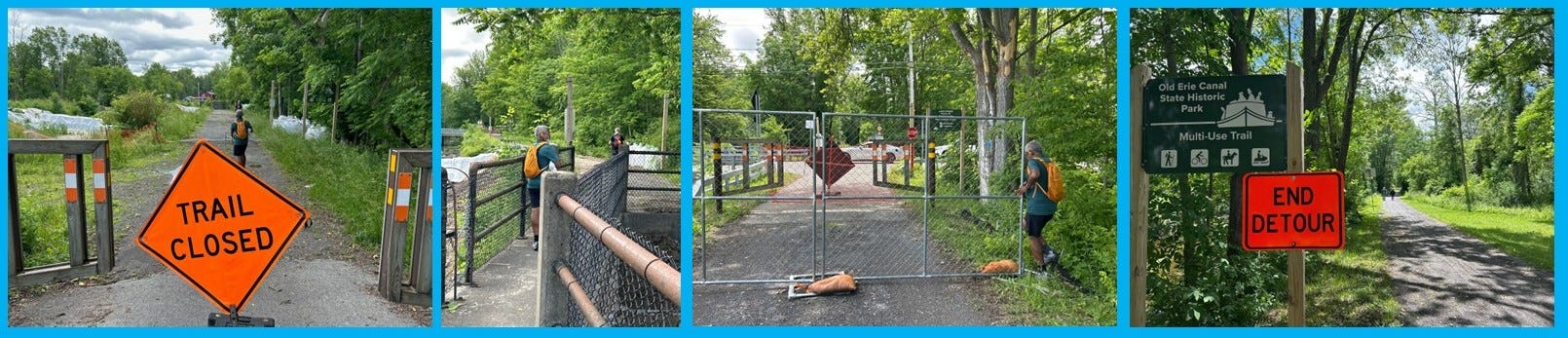
We saw just one historical marker today about a group of Abolitionists trying to convene in Utica to establish an Anti-Slavery Society in New York. When anti-abolitionists stormed the building and violence broke out, Gerrit Smith invited the Abolitionists to reconvene at his estate 27 miles away. Many walked. 104 abolitionists rode on the Erie Canal from Utica to Canistota and then walked to Peterborough where New York’s Anti-Slavery Society was established the next day.
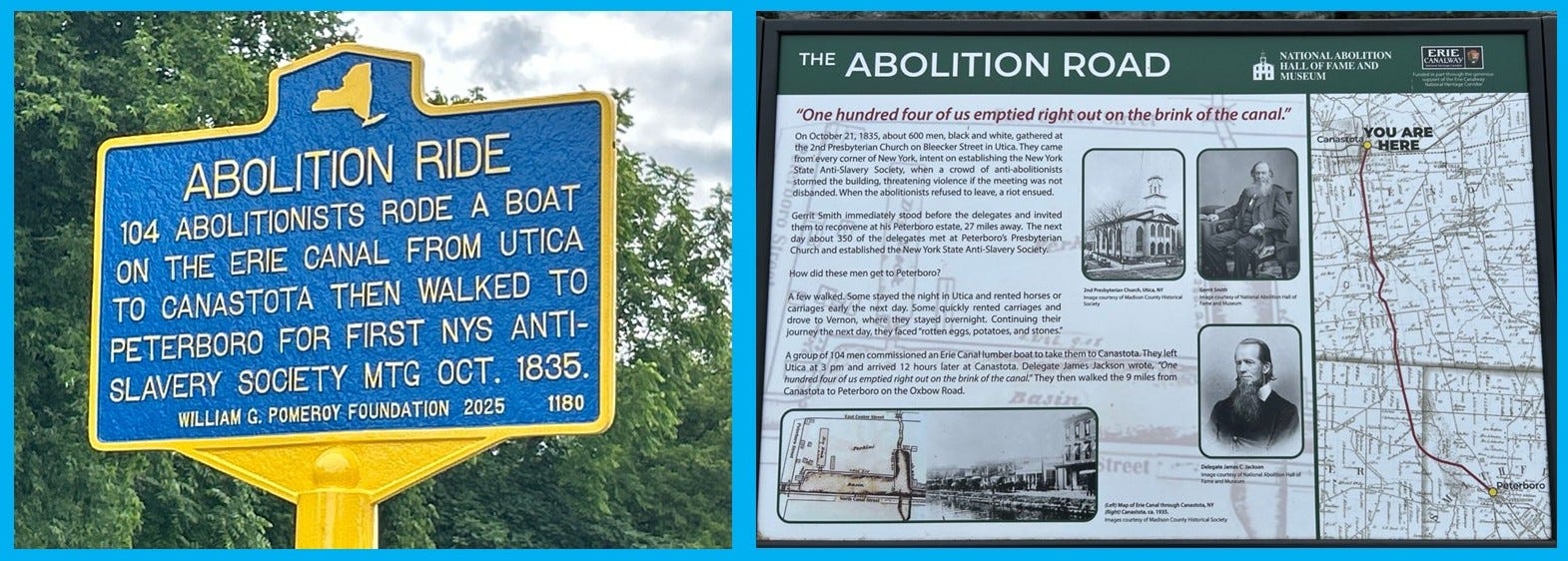
The temperature was about 60° and cloudy with a gentle breeze blowing. A good day for walking a long way; almost 17 miles to Canistota.
CLICK HERE to watch a brief Relive video of our walk on June 15.
We began walking around 11 o’clock at the Butternut Trailhead. It was a 2-hour drive from Rochester to pick Tony up at the hotel where he stayed, and then on to our starting point. The Canal Trail, for the most part, is in the median between four lanes of traffic, two with cars zooming by each way. Not as beautiful and peaceful as yesterday, but that’s to be expected as we make our way into Syracuse. I presume that the road we’re on, which is Erie Boulevard, used to be the location of the actual Erie canal. That’s what Derek told us on our tour the other day. We walked two and a half miles before entering the city of Syracuse.
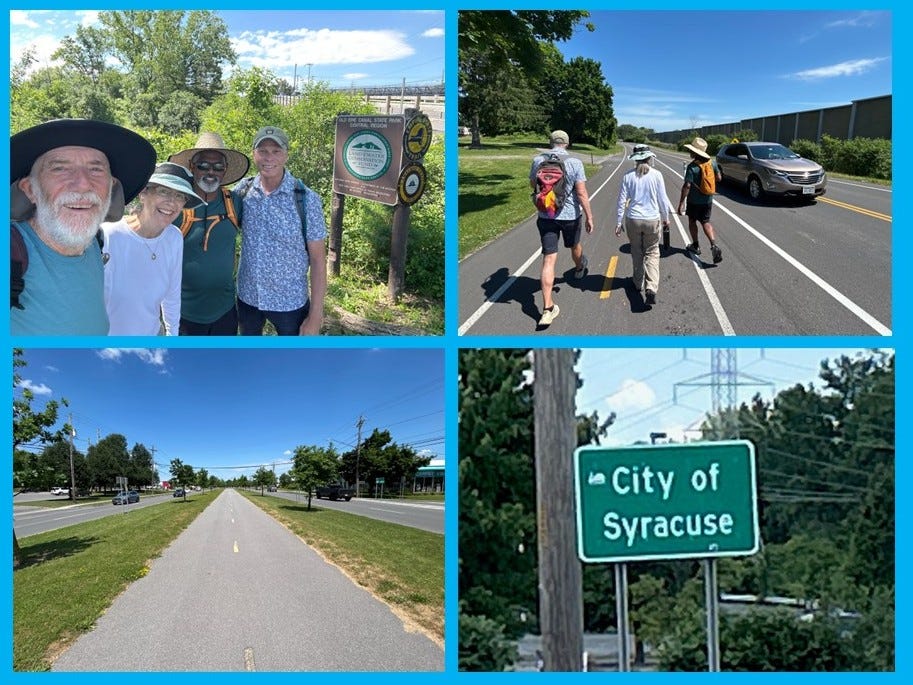
I received a real treat over the final mile into Syracuse. Matthew recited the entire Velveteen Rabbit story to me. He said he has listened to the audio of Meryl Streep reading it so many times that he absorbed it all. Most impressive!
CLICK HERE to watch a brief Relive video of our walk on June 16.
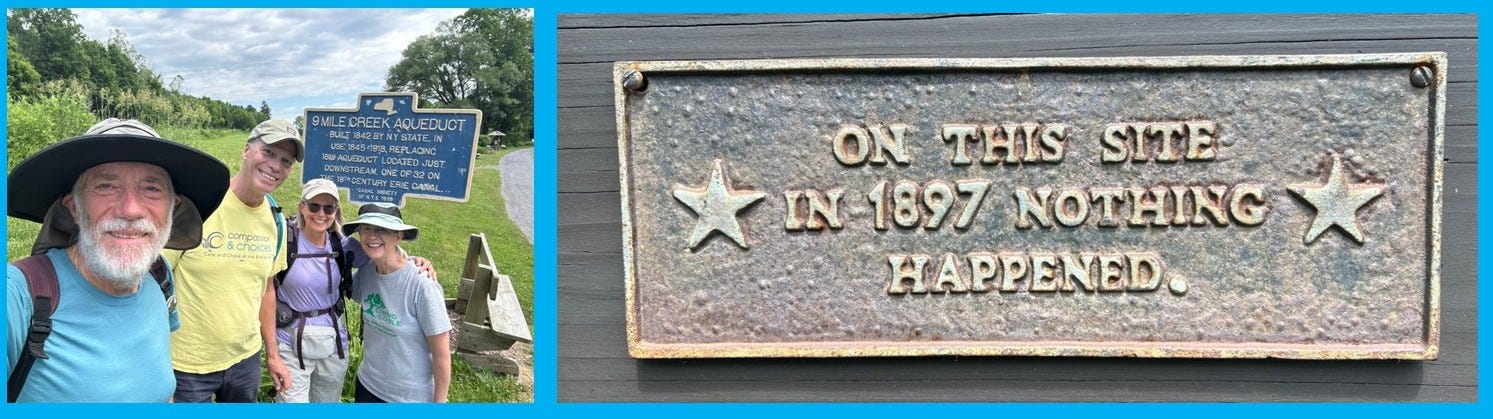
We were joined by one Companion Walker, Beth, who drove here from Michigan to join us today. Lynda also walked the first few miles and then walked back to her car to meet us at the end and drive us back to our base station as she has done all along this journey. We got a real kick out of the sign (below right) that was affixed to a bench.
Beth is a member of Coming to the Table. She’s an animal scientist by training. When we passed some broken shells, and I told her that baby turtles were born here two or three weeks ago, she corrected me. “Turtles are hatched; they are not born. They come out of an egg.”
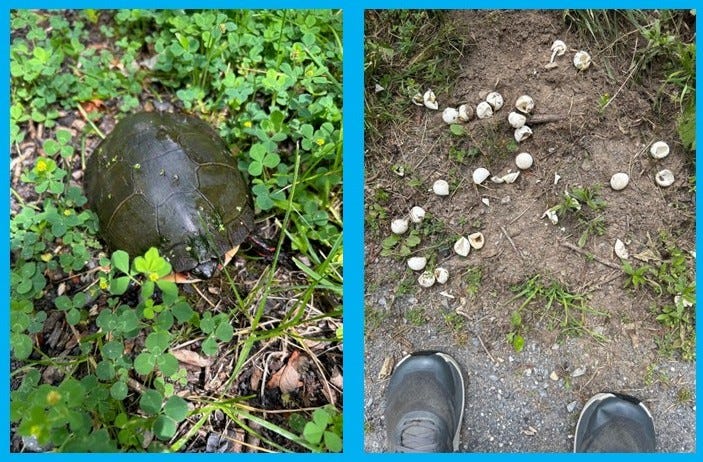
I said, “But you and I also came from eggs from our moms.”
She laughed and said that, “Turtles, like chickens, are hatched from hard eggs, unlike us.”
And here I am, still learning new stuff at age 72.
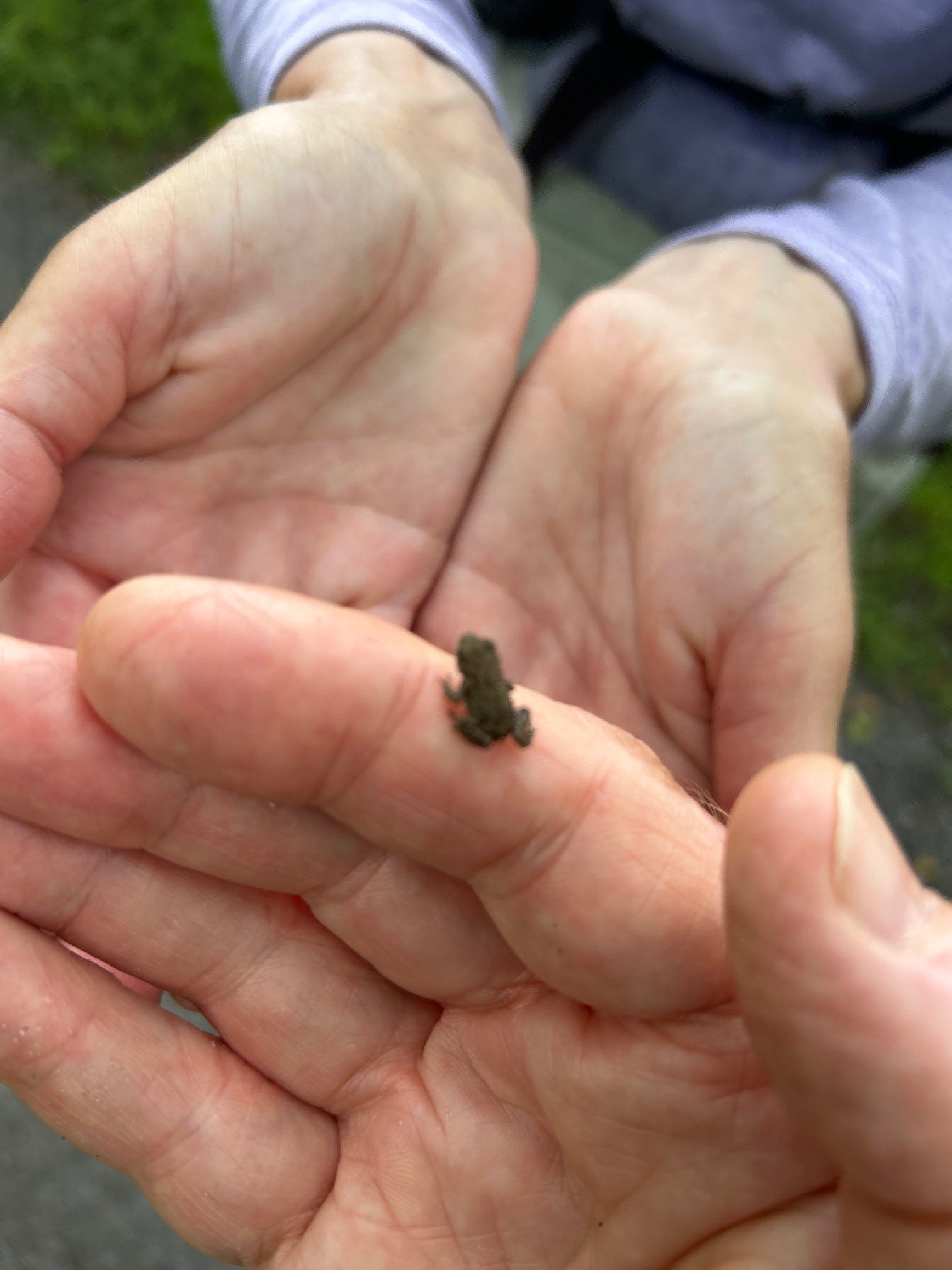
At one point along the trail, maybe 8 miles in, it began to rain. One big thunder boomer and about 10 minutes of light rain. No problem. Soon after, there are suddenly dozens and dozens of little, tiny creatures that looked to me like big flies, but Matthew pointed out that they were tiny frogs jumping in the water on the ground. I picked one up and sure enough. So very cute. I looked them up online and found that they are Northern Spring Peepers and only grow to be about ¾” long.
We were treated to another wonderful dinner at the First Unitarian Universalist Church in Rochester, which was first organized in 1829. We are so blessed that so many people and churches and community groups are supporting us along this pilgrimage with food, places to stay and so much more. Learn more about the fascinating history of the UU Church of Rochester HERE.
CLICK HERE to watch a brief Relive video of our walk on June 17.
It’s somewhat bittersweet being back in Rochester. I’ve visited here on two different occasions. I spoke at Nazareth College in connection with my first book, Inheriting the Trade, and later at Rochester Institute of Technology with Sharon Morgan in connection with our book, Gather at the Table. We met and became friends with Pat Mannix, Kathy Cobbett, and Wilma Campbell. All have passed away since I was last here and I’ve met many people during #FreedomWalk2026 who also knew them well. I miss not connecting with them now.
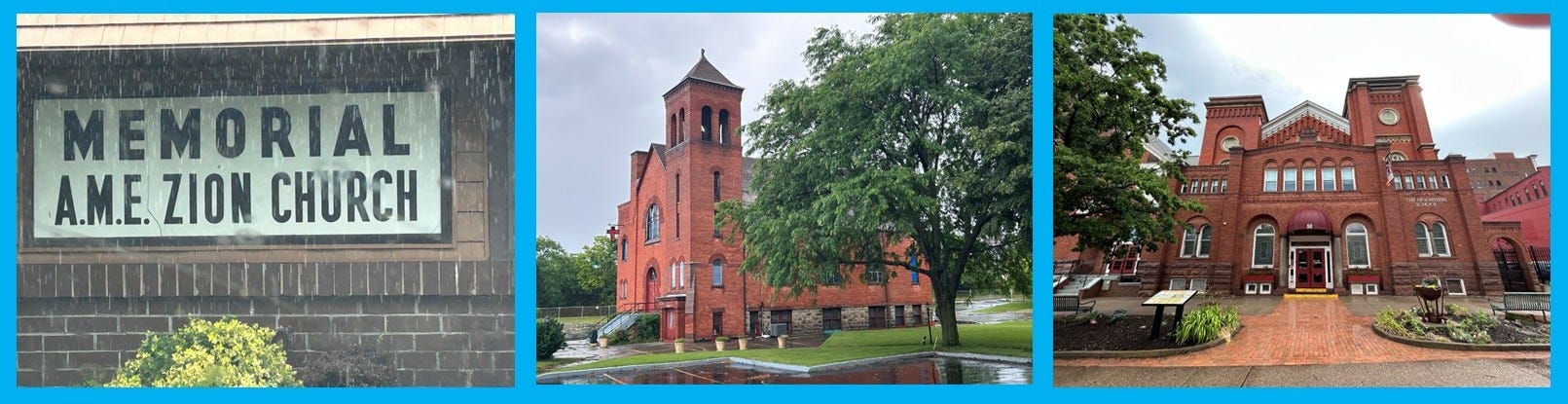
We were treated to a tour of historic Rochester sites led by Norm Strothers in one of the oldest sections of Rochester. It was originally intended to be a walking tour, but the pouring rain resulted in our driving the route. We began at the AME Zion church. The original site for this church is where Frederick Douglass and his wife worshipped. The congregation moved to the current location about fifty years ago. The former site is now the Hochstein School. Both the Susan B. Anthony and Frederick Douglass funerals were held there when it was the Presbyterian Church.
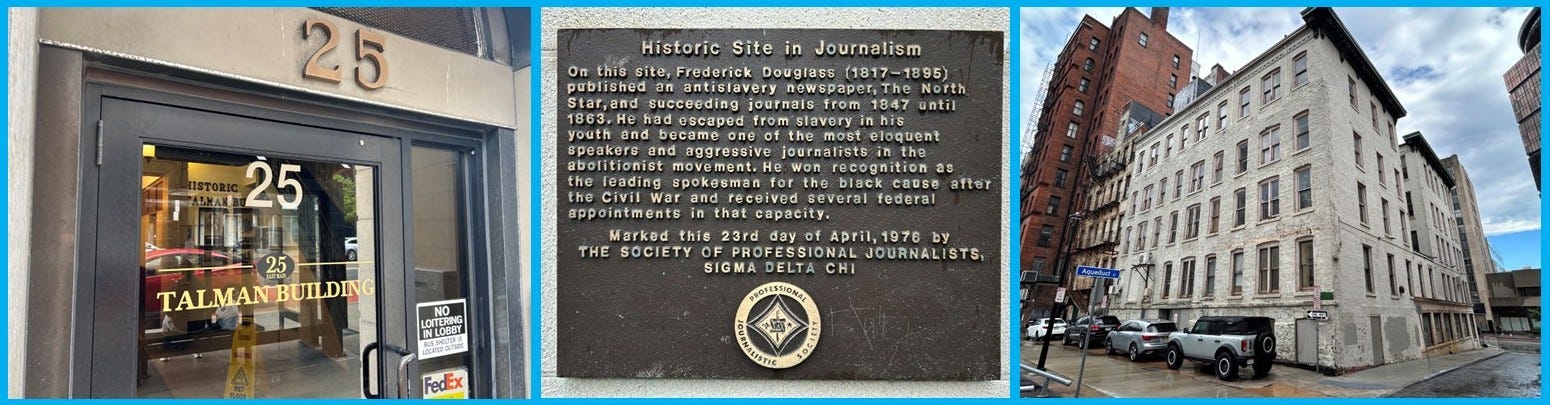
Our next stop was at the Talman Building. The third floor in the back of the building is where Douglass had his printing press to publish The North Star.
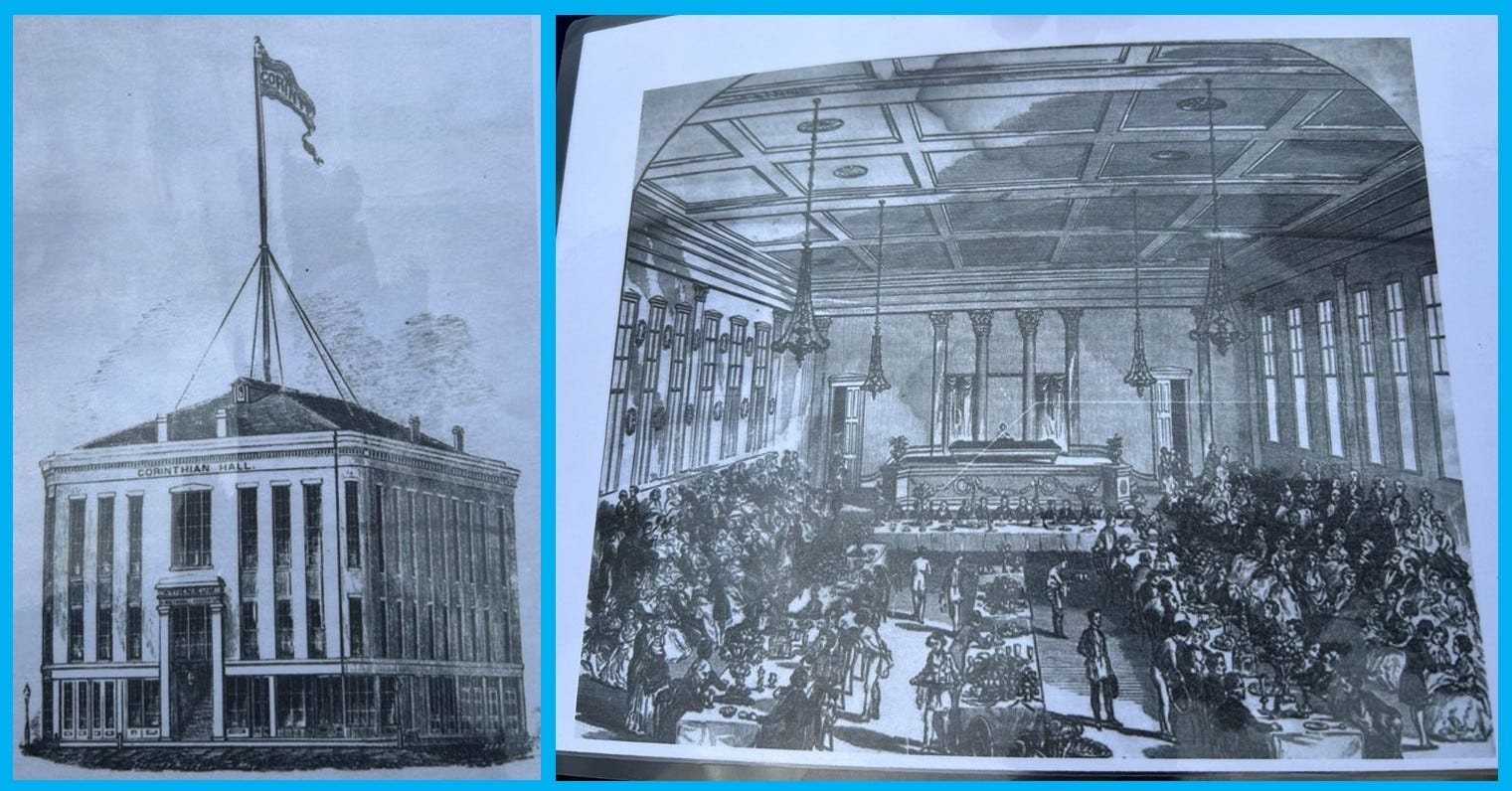
Corinthian Hall no longer exists. Here is an historic image of it. This was where Susan B Anthony and Frederick Douglass did a lot of their talks.
We crossed over the Genesee River, which leads to Lake Ontario. This was an important route on the underground railroad.
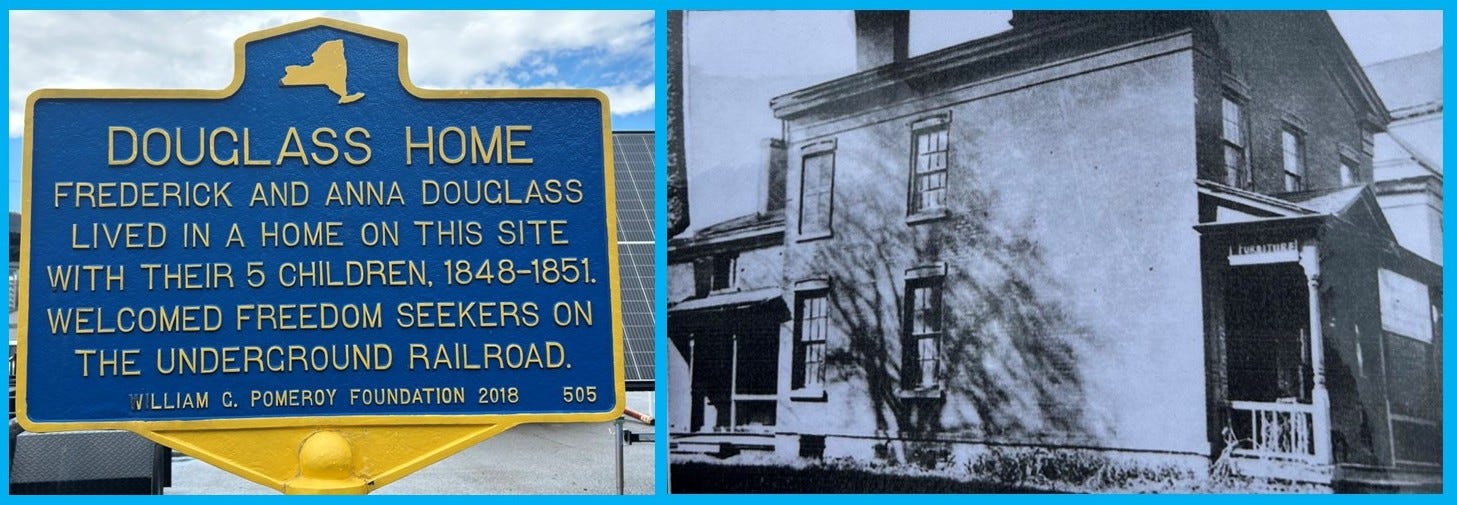
We stopped by the site of the former home of Frederick and Anna Murray Douglass and their family. The house no longer exists. The Douglasses put up with a lot of white people chanting against them and defacing their house because of their abolition work.
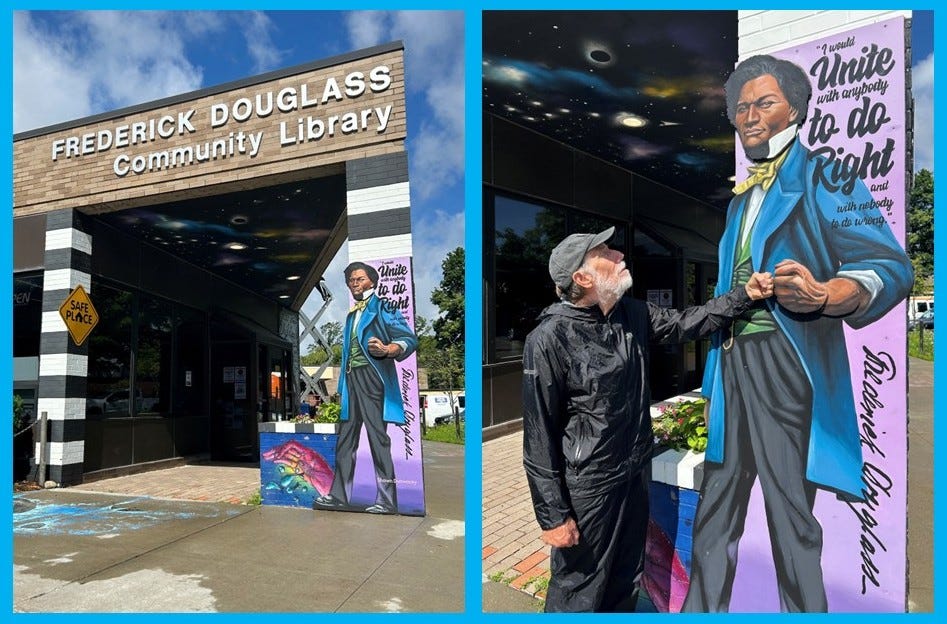
The Douglass library and school are located on what once was the Douglass farm. The name changed from Robert P. Duffy School during Covid. For a very long time, there were no schools named after any people of color in Rochester. The image of Frederick Douglass below is three-dimensional. We’re told a favorite action is to fist-bump Mr. Douglass, which we did.
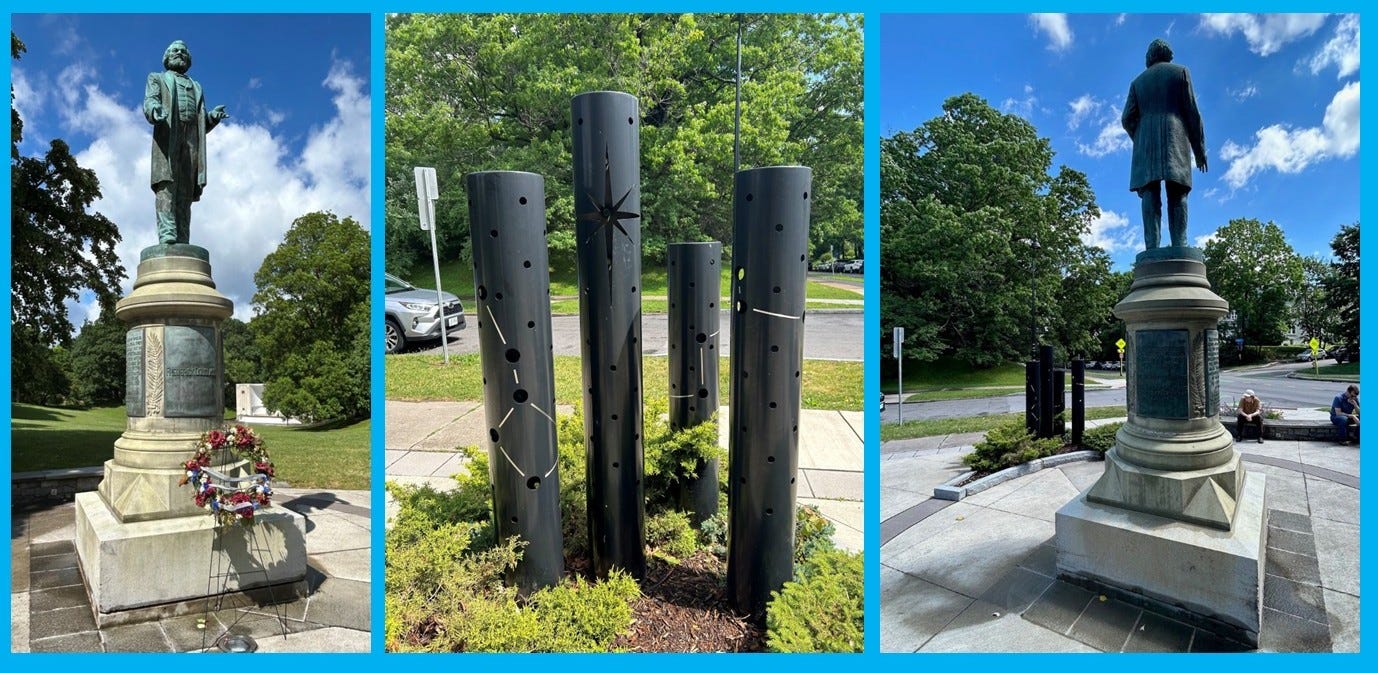
The statue of Frederick Douglas at the corner of Robinson and South was the first statue erected of an African American person in the United States when it was installed in 1899. The face on the statue is actually from a death mask of Douglass, and his hands are from molds made of the hands of his grandson Charles. This statue was originally in a different location. It was moved to Highland Park in 1942, and they made sure he was facing north toward freedom. It was moved to this current location on the 200th anniversary of his birth in 2018. Right next to it is a sculpture of the North Star signifying north to freedom.
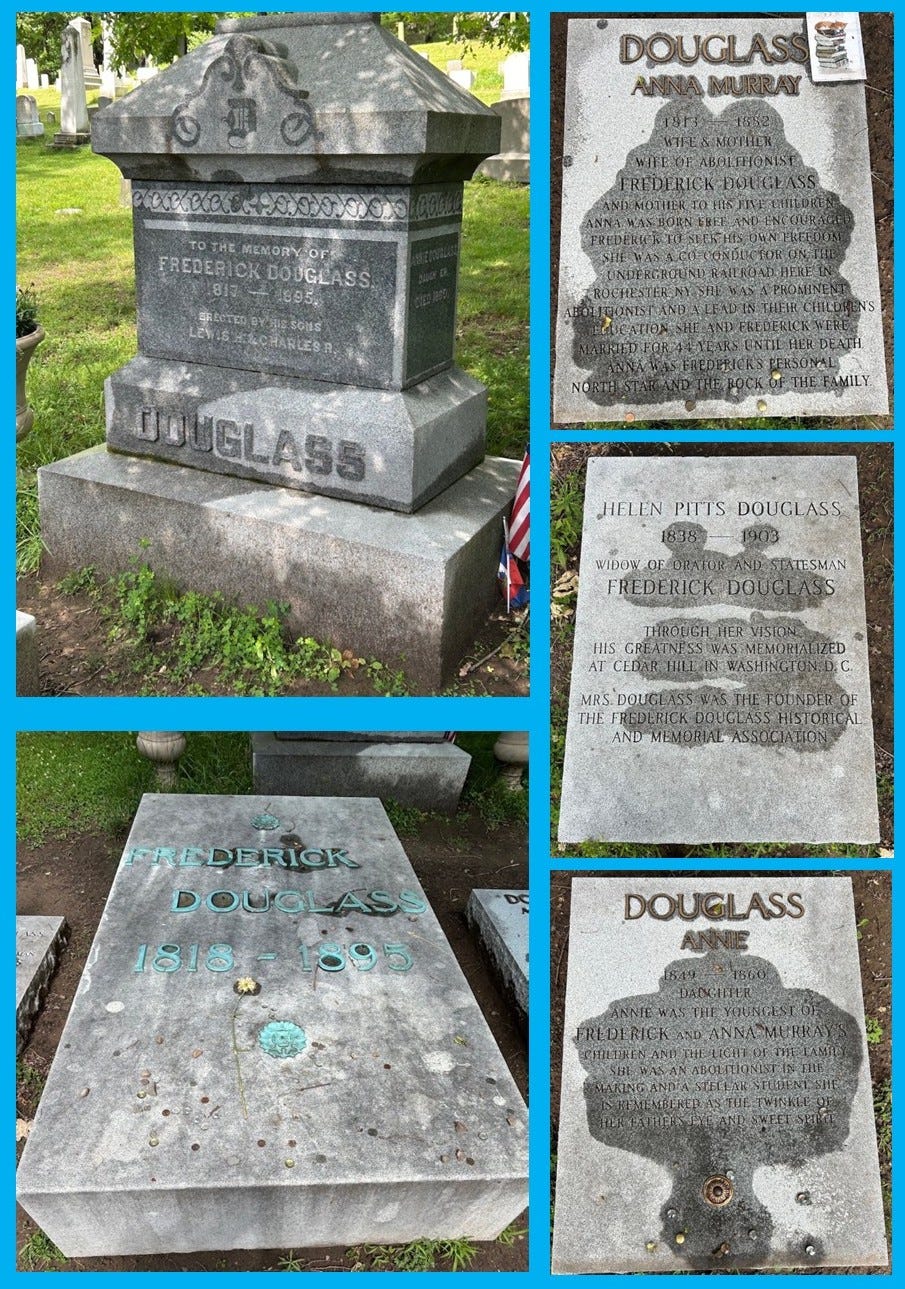
Mount Hope Cemetery (dedicated in 1838) has never been segregated. This is where Frederick Douglass and his two wives are buried. 300,000+ people are buried here and people continue to be buried here regularly.
Douglass married his second wife two years after Anna passed away. His second wife, Helen, was a white woman. This caused some controversy around him. He is buried between his two wives with his daughter on the other side of Anna. One story is Anni died at age 11 of a broken heart. She considered John Brown her uncle and he was hung shortly before she died. And her father was absent a lot due to his work. Medically, the story is that she had a brain tumor.
After John Brown was hung, a warrant was issued for Frederick Douglass’s arrest for supporting Brown. Douglass moved to Canada for a brief time as a result. Maybe a month. He always had to be careful and was supported and defended by a lot of people that spoke out against slavery.
The cemetery was established in 1838.
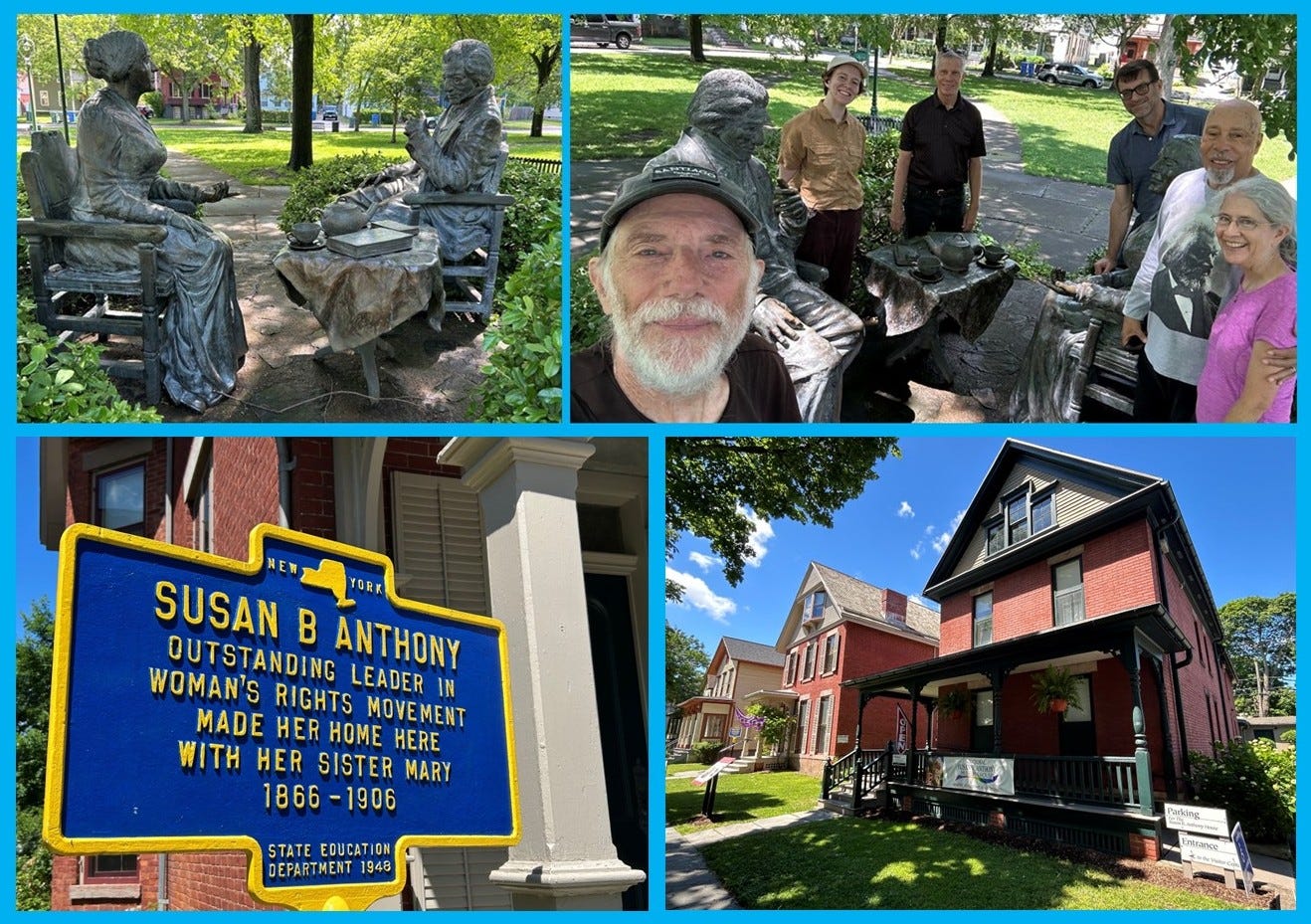
Our final stop was at the bronze sculpture, Let’s Have Tea, a 2001 work by Laotian American artist Pepsy M. Kettavong that is installed in Susan B. Anthony Square Park, which is across the street from Anthony’s former home in Rochester.
While others went out to take in a live concert and dinner, I stayed back and enjoyed a quiet late afternoon and evening alone.
No posts
Comments
Nothing yet. Say the first thing.
Sign in to join the conversation.