
This is the first post I’ve sent out since breaking 3,000 subscribers. Thank you!
I have some housekeeping. I’ve recently accepted what amounts to a full-time project and so am likely going to publish a little less here. It won’t be a big drop-off – but probably something like 2-3 posts a month, rather than one every week. I also want some more space to write creatively; at a conservative estimate, I’ve probably posted 140,000 words here in the last two years, which is a good 130% of the length of the novel I finished around the time I launched the Substack. That’s right – like all good journalists, I not-so-secretly dream of being a “real” author, some day. Agents, you know what to do.
But! With all that in mind, I’ve taken the actually quite easy decision to pause on paid subs; I don’t feel great taking your cash for relatively little value add. (And I get pension contributions now, anyway…) Thank you so, so much for all your support, though, if you have been paying for THE CHIMERA.
A short one from me today; a recommendation. It’s that you should watch Häxan1 – The Witches – an early 1920s Swedish-Danish film by the pioneering director Benjamin Christensen.
Häxan is not a found footage movie, quite, but a faux-documentary based on the Malleus Maleficarium, the “book of witches” that a handful of hateful smalldick Puritans leveraged in the 1600s to conduct crusades against women and some men accused of sorcery across (predominantly) northern Europe. The film claims, in that sort of snakeoily way that only very early movies could really pull off, to be an academic study of witchcraft, with roots in the anthropological and sociological causes of the phenomenon; in a way, it reminds me of the how Orson Welles’ radio play of War of the Worlds convinced like half the UK that aliens were literally invading Surrey back in 1938 – I wish… – but to less impactful effect. As far as I can tell, most contemporary viewers took Christensen’s film as it came: half tongue-in-cheek, half serious comment on misogyny. More on that later.
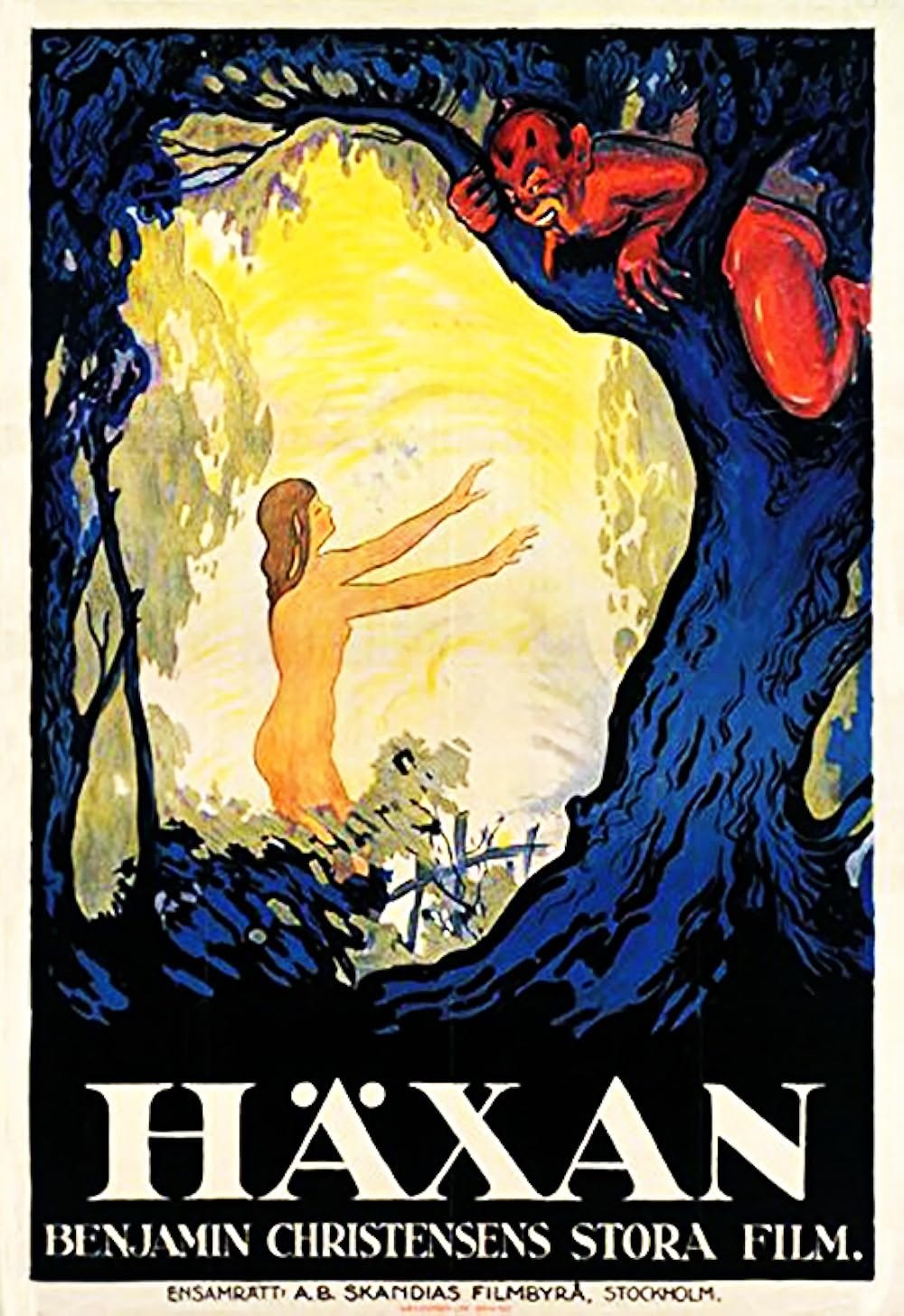
Despite its formal invention, Häxan sits in that weird middle ground where it’s highly regarded in certain circles but not considered a mainstream classic. It’s rarely screened or cited by film writers compared to something like Nosferatu or M., though I’m sure that academic film historians might roll their eyes at the idea of it being niche, per se.
That’s odd to me, because when Häxan came out, it had the highest budget for a Scandinavian silent film ever, and the investment shows. Consistently, Christiansen and his DP, Johan Ankerstjerne, devise hugely creative set-piece images relying on technically impressive shots and clever edits. One sequence sees witches flying up through the chill blue night, clothes flapping in the cold wind, superimposed over a sleeping Baltic village. Elsewhere, Satan conjures gold coins for one of his peasant devotees, only for them to fly out of her grasp when she tries to collect them up in her apron – footage of them dropping into her hands having been played back in reverse. And Häxan is shot in a (for the time) remarkably colourful palette, with crimsons and jewel-blues and browns worthy of any aspiring lomographer used to denote different times, places, et cetera.
Upon its release, Häxan was also the subject, like all good horror movies, of a moral panic. Variety called it “a pictorial history of black magic, of witches, of the Inquisition, and the thousand and one inhumanities of the superstition-ridden Middle Ages”, adding that the film contained scenes of “unadulterated horror” and was “wonderful” but “absolutely unfit for public exhibition.” Danish newspaper Berlingske Tidende pondered the “satanic, perverted cruelty that blazes out of [the film], the cruelty we all know has stalked the ages like an evil shaggy beast, the chimera of mankind.”
It had a significant afterlife, too. In the late 1960s, William Burroughs – he of Naked Lunch, beat poetry and heroin – recorded a narrated accompaniment for the film, which was re-released in the States. It was digitally restored by Svenska Filminstitutet, the Swedish Film Institute, in 2016. I myself came across it courtesy of the excellent three-hour documentary Woodlands Dark and Days Bewitched: A History of Folk Horror. In 2022, on its hundred-year anniversary, the BBC ran a retrospective calling Häxan “part documentary essay, part horror mood board”, and extolling its influence on a century of horror movies. It’s also on Wikipedia to watch for free, as well as Youtube.
What else? I hear the Prince Charles Cinema is running a disclaimer now, asking people not to laugh at the old rep movies they show. “Das Cabinet des Dr. Caligari is not a comedy”, et cetera. Well, I hope so – but that said, Häxan is really funny. It’s ridiculous at times, most often in its devout anticlericalism. Half the scenes feature an almost Carry On monk or bishop chubbily chasing after some bob-cut, naked Swedish chick. In other scenes, horny devils frantically, ahem, “churn butter” while watching one another molest nubile Christian women in a brilliant visual pun. Protestant humour from Christensen!
And yet underneath this all lurks a progressive political point of view which is perhaps unexpected for a hundred-year-old work of art. A central plotline among the film’s many is the trial of an itinerant peasant woman, Maria, who comes under suspicion from a printer’s household recently plagued by illness. The tragedy here is that the feelings of paranoia and disgust that the younger, more prosperous female relatives of the printer feel towards Maria lead them to accuse her of being a witch, only for her to likewise implicate them under torture. Nobody wins when the Inquisition comes calling; particularly not women.
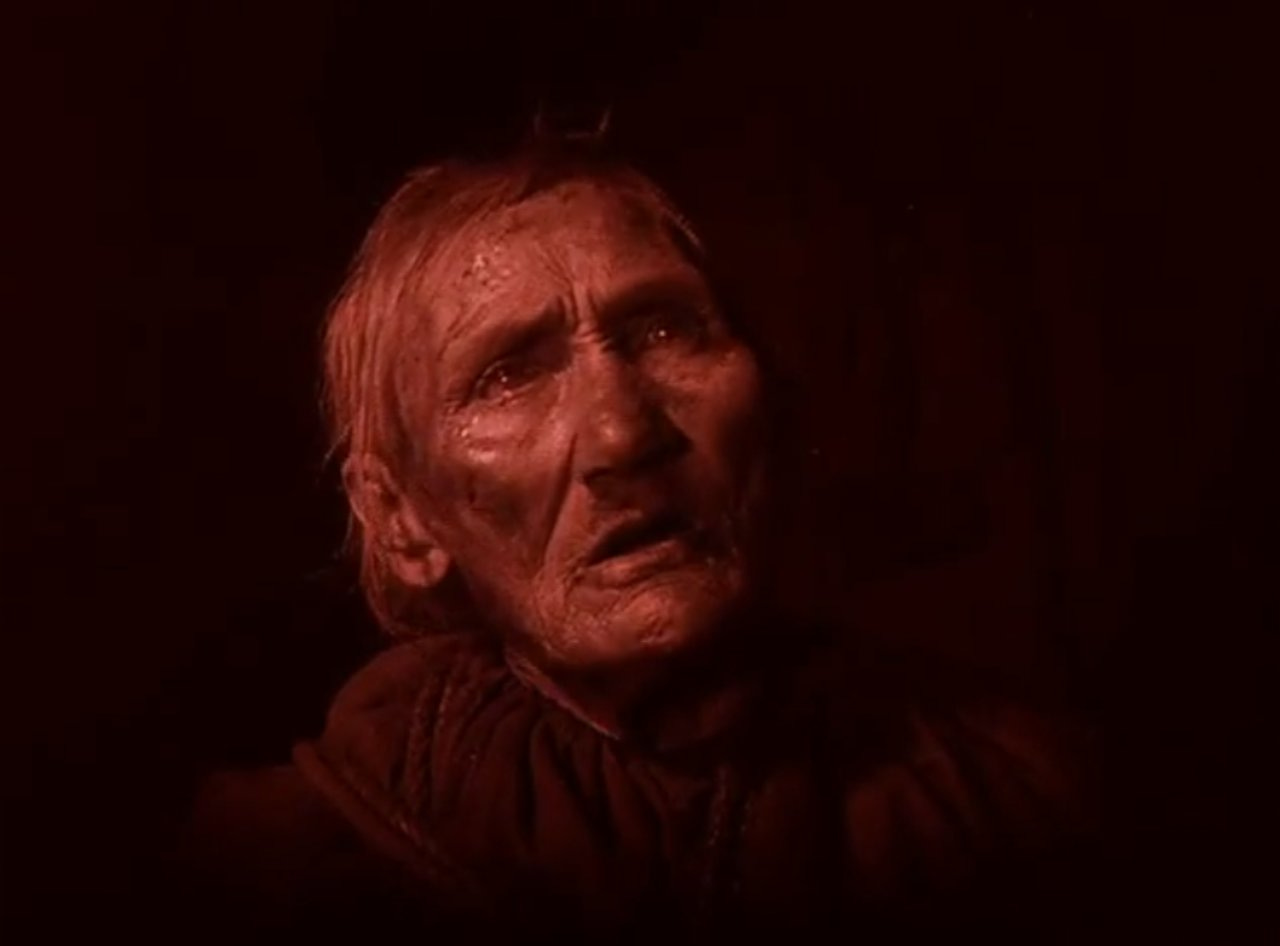
Christensen is sympathetic to Maria, and shoots her in a way that is both compassionate and bluntly direct in its depiction of the brutal way she’s treated; this is an old lady being attacked by a group of terrified, vicious, celibate monks. The camera never shies away from her pain, her wrinkled skin. In some shots, she looks (I think) deliberately saintly. The actress who plays her, Maren Pedersen, was born in 1842.
This being the 1920s, Häxan’s philosophy was intertwined with the intellectual fashions of the time, and Freudian psychoanalysis is deployed to explain both the prosecutors’ and the victims’ mindsets. Häxan explicitly suggests that compulsive, self-destructive behaviour on the part of young women which in the interwar years might have led to a young woman’s being institutionalised – something the film appears to oppose – might in the middle ages have led to her arrest, torture and burning at the stake. Hysteria underlies it all, Christiansen argues, as much among the monks as among the women supposedly suffering from it.

There’s no clever analysis or take here, today. I just want to recommend this film. It’s creative, inventive and modern-feeling, unexpectedly funny in places and low-key quite progressive, politically, for a film made in 1920. Without this, there’s no Blair Witch Project, no Paranormal Activity, no Inside No. 9. It’s a great old movie to show people who say they don’t like old movies.
There’s a world where, if vampires hadn’t been popularised as much and witches took their place, this film would be considered the masterpiece over Nosferatu. Perhaps it should have been.
Credit to Dagerlöff and Galner for the video I’ve embedded above.
It’s pronounced hex-an, and that’s not a coincidence.
Comments
Nothing yet. Say the first thing.
Sign in to join the conversation.