
Well, it finally happened. Argentina took time out of crying about the Falklands, singing racist songs and throwing leftists out of helicopters to put England out of the World Cup last night, and I need something to take my mind off it.1
I was worried about the stakes of that game before it took place, an anxiety that manifested as detachment. I told everyone I could find that actually, it was totally cool. I didn’t really care about football, anyway, and never thought that England would win it with such a shaky back line. But of course I did, deeply. My girlfriend recently pointed out that I do this defensive thing where I pretend not to care about things I actually really, really care about.
So in the interests of therapy, here’s another confession: I am likewise worried about The Odyssey, and Christopher Nolan’s looming adaptation of it.
This is easily the most anticipated film of the year. I’ve already booked my IMAX tickets, and it’s out today, meaning tonight’s the last real chance for me to put this down in writing before opinion around this massive movie crystallises. I am desperate for it to live up to the hype, but everything I’ve seen or read about it in the build-up to its release makes me uneasy.

First things first: I’m not a particularly dedicated Nolan bro, and while I understand they exist in theory, I don’t think I’ve ever met one. For several years, I’ve been flummoxed as to why he’s such a load-bearing, capital-D Discourse filmmaker. His films generate column inches from Substack to Sight and Sound longer than Odysseus’s ten-year thalassic quest home itself. (No outlet has yet illustrated this better than the Guardian, who ran pieces announcing the film’s apparent erasure of “women and nuance”, and its supposedly shameful location shoot in occupied Western Sahara, before turning around, shrugging, and giving it five solid-gold stars.2)
It’s odd that so much discourse swirls around a filmmaker who, at least to me, can feel a little bloodless. Surely Nolan – who I’m using here as a metonym for his mega-productions, which I’m aware are really the product of hundreds of different individuals – is a bit too sleek, a degree too rarefied. It can feel as though his characters and their surroundings are carved from smooth obsidian. For a man whose films are released in so many formats that Letterboxd has come up with a virtual “punch card” for fans to keep track of them all, he feels remarkably… digital? Subjective, I know, but in my mind, his is the binary data of the hard drive, in contrast to the crackly grooves of vinyl or the hot warped plastic of tape.
And so in essence, that’s it: I worry this film will suffer for a lack of weirdness, for want of a better word. Nolan is basically a rationalist filmmaker. And I think that the Odyssey demands something far darker, more profane and atavistic, than what his otherwise prodigious storytelling talent might offer.

Nietzsche once theorised about the Apollonian and Dionysian spirits, each embodied – aptly, in this particular case – by its requisite Greek god. Apollo was chiefly the deity of light and music, of poetry and youth. The Apollonian impulse was therefore towards rationalism, order, logic, purity and reason. Dionysus, meanwhile, was the patron of wine and revel, theatre, ecstasy and insanity. The Dionysian encompassed wildness, passion, emotion, instinct and the irrational. In a nutshell – without wanting to provoke corrections from philosophers and classicists within a single paragraph – Nietzsche saw balancing these forces as essential for both great art, and great culture in general. The figure of the pulchritudinous, cruel youth set against the priapic, stocious satyr. (Once you get into it, you can apply this cod-philosophical dyad to anything. Obama was an Apollonian president; Trump is Dionysian. Spain play Apollonian football; the Argies play like Dionysians. And so on.)
Well – Nolan is ultimately an Apollonian filmmaker, in my eyes. (Other well-known Apollonian filmmakers: Denis Villeneuve, Wes Anderson, Alex Garland, Sofia Coppola. Dionysian filmmakers: Harmony Korine, the Safdies, Abel Ferrara, Robert Eggers).
When I watch the trailer(s) for this film, I understand many of the obvious anxieties that have already been expressed by others. Sure – it’s a little American. Yes, I hear Matt Damon shouting “LET’S GOOOOOO!” as he charges across tidal flats, Tom Holland telling everyone his “dad” is coming home to beat their ass, or something.3 While I don’t feel strongly about Lupita Nyong’o’s casting as Helen of Troy either way, particularly, I can see why some might look twice at 29-year-old zillennial cool girl Zendaya as Athena.
But I also see Odysseus’s faceless foes – are they the Laestrygonians? – who look like automata, as though they have been manufactured by an evil tech company. Odysseus’s companions wear clean, carbon-black armour that had a friend of mine wonder aloud whether Nolan had let his love of a natty grey suit leak subconsciously into his vision of Bronze Age Greece.
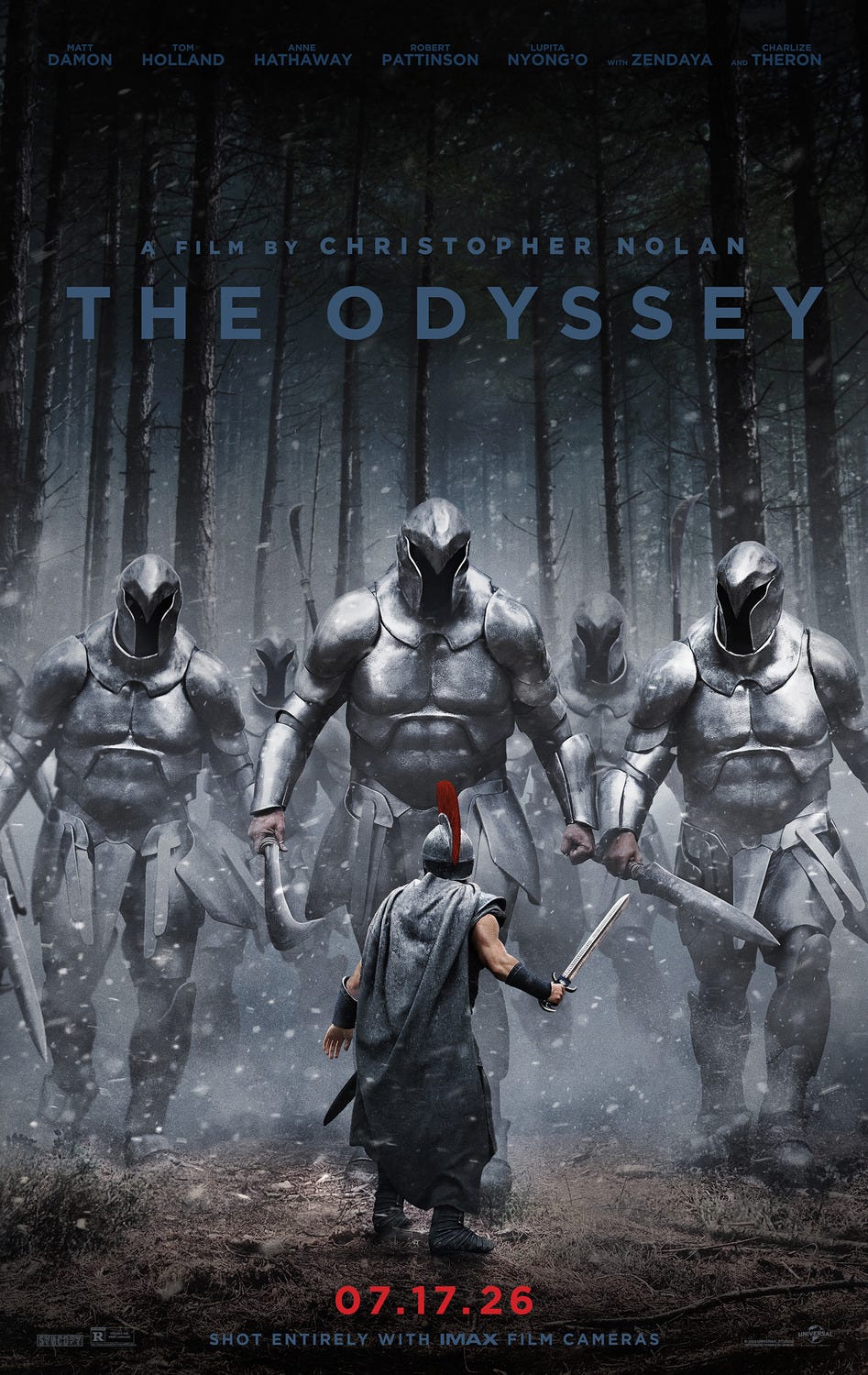
And I just think: I know where the order and the ideas are going to come from in this film. But whence the chaos? Whence the grubbiness?
None of this is to say that I’m not ready to be blown away by The Odyssey. I’ll be going in with open eyes and an open heart. But I’ve been hurt once this week already.
Help me complete the taxonomy of Apollonian and Dionysian filmmakers in the comments, if you like. Who have I misread, and who am I missing?—TB
To my six – possibly soon to be fewer – Argentine subscribers: I’m just being petty. I might hate Giuliano Simeone, but I love you guys really.
Say it with me again, kids: you can’t trust Peter Bradshaw!
It honestly reminds me of nothing more than David Shrigley’s song “Houseguest”, which single-handedly changed my mind about whether or not music could ever be funny.
Comments
Nothing yet. Say the first thing.
Sign in to join the conversation.