
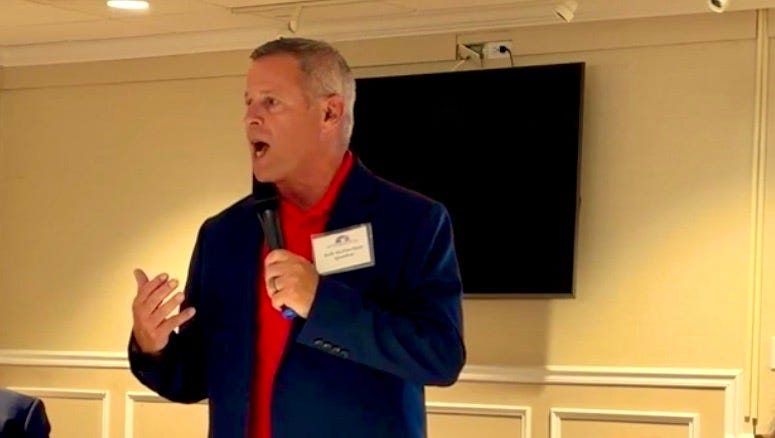
Candidate for the County Commission District 2 seat, Bob McPartlan told conservative voters at the Republicans for Life forum that he is against Amendment 3. McPartlan came out with his declaration when answering the three-part question that asked the candidates, “What is your position on Amendment 3? What is your plan for maintaining critical local services, and do you expect to raise taxes?”
Clickable Banner Advertisement:

“As far as the property tax referendum, as it is written now, I do not support it because there is no back-up plan,” said McPartlan. The 15-year Sebastian City Council member and current vice mayor touted his US Army experience as an explosive ordinance specialist. He shared that without contingency planning on the range, bad things can happen.
He also compared his full-time work at the Department of Children and Families. He explained the worst that can happen when knocking on a door for a child abuse case is a “child dies” without alternative planning. Having set up his argument, He declared, “There is no back-up plan if it’s not working, and you can’t just change the constitutional amendment.”
A property tax exemption that will help every homestead citizen is not an absolute life-or-death situation like disarming bombs or active child abuse emergencies. His non-sequiturs expressed a misunderstanding of how revenue generation works. It is a simple matter of economics, which is not a zero-sum game.
Sebastian’s Vice Mayor McPartlan must know that the proposed city budget for FY 2027 shows that Sebastian Taxable Assessed Values increased by 5.2% or $130.421 million. It produces $449,365 in additional property tax revenue for FY 2027.
Sebastian City Manager Brian Benton noted in the Budget Review Advisory Committee meeting on July 20 that, since 2025, the city’s budget has grown by $1,280,000 or 6.6%. FY 2027 ad valorem tax revenues are projected at $8,641,685.77, increasing 3.4% over last year provided the Truth in Millage remains at 3.4455.
However, Sebastian’s Budget Review Advisory Committee recommended the rollback rate of 3.3339 reducing revenue by $282,732. Two days later, Vice Mayor McPartlan ignored the committee and made the motion to pass the TRIM at 3.4455. His motion failed to even carry a majority. The City Council voted 4-1 to approve the rollback rate. Defeated, McPartlan had joined the majority.
In previous years, this vote would not have taken place as property tax bills just increased as home values have risen. However, with the new law passed in the special budget session and signed June 24 by DeSantis, any increase that is greater than 110% of the rollback millage rate takes a supermajority by local governments to be implemented. The transparency measures on budgets are already stabilizing tax revenues in Sebastian.
The young lawyer Brooks Robinson thinks the property tax proposal was not well constructed. “I’m all for the state and the counties looking at ways to adjust or reduce our tax burdens,” said Robinson, adding, “I do not believe that this particular amendment is tailored in such a way to do that. It was rushed through, and there are going to be a lot of knock-on effects that weren’t anticipated.”

The Florida Legislature Office of Economic and Demographic Research produced its first study on property taxes on September 7, 2025. Their second study was put forth on September 22, 2025, for the Florida House Select Committee on Property Taxes, which included Indian River’s hometown representative Robbie Brackett as a member.
The 36-member select committee started meeting on May 2, 2025, and looked at numerous data points to determine how local funding is calculated according to Chairman Toby Overdorf at their November 20, 2025 meeting. They reviewed 8 proposed resolutions at that meeting too. The Deputy Director of the Florida Association of Counties, Jeff Scala, rejected all of them. As the lobbying arm for county commissioners, Scala said, “Unfortunately, all the proposals shift the burden, and those equations will not balance. This will be a fiscal crisis by design. [We] will be opposed to each of the 8 proposals.”
Clickable Banner Advertisement:
Ultimately, the Florida House passed Joint Resolution 203 that called for a $150,000 exemption in homestead property taxes in the first year. The proposal increased the exemption by $100,000 for the next ten years until homestead non-school levies were eliminated by 2037. However, the Senate did not join the House in passing the resolution.
Governor DeSantis proposed to cut all homestead taxes, including school levies. DeSantis also reduced the cap on non-homestead properties from 10% to a maximum of 5% that governments could increase taxes. Yet, new homestead citizens after January 1, 2027, would remain on the current $50,000 homestead exemption for 5 years before getting the full waiver.
The governor also called for $150,000 exemption in year one and $250,000 exemption in year two. The proposal came with a constitutional requirement that the legislature create a schedule in the following years to eliminate all homestead property taxes for Florida homeowners. Ultimately, the House and Senate agreed by removing the school levies from the proposal. What passed was a refined measure less extreme than the House Joint Resolution or DeSantis’s proposal.
Like the Florida Association of Counties, Robinson also states it will shift the tax burden to others. “There will be some counties and cities that find revenue in other places. Those will be non-property taxes—those are your non-ad valorem fees and assessments,” Robinson said, adding, “I believe those assessments harm the low income, the fixed income, and the disabled more than property taxes [do].”
Yet, tax and fee shifts require county commissioners to vote for those increases, which is easier than cutting spending. A vote to raise taxes would be against the citizens that they claim would be financially hurt the most. With the public watching, Sebastian could not even pass the same millage rate they had for the previous 2 years.
Would Indian River County commissioners subject the most vulnerable to fee and tax increases? Campaigning, Robinson said, “We will find reductions in other places to pay for this. I don’t know what that will look like.”
Jennifer Pippin is for the Save Our Homes Against Excessive Property Tax referendum. She noted in her answer that the county’s proposed FY 2027 budget is reduced by over $90 million from the current year. Suddenly, there are efficiencies to be found in the budget. She also made mention of how Indian River County is financing with tax dollars private nonprofits, including some with huge revenues.
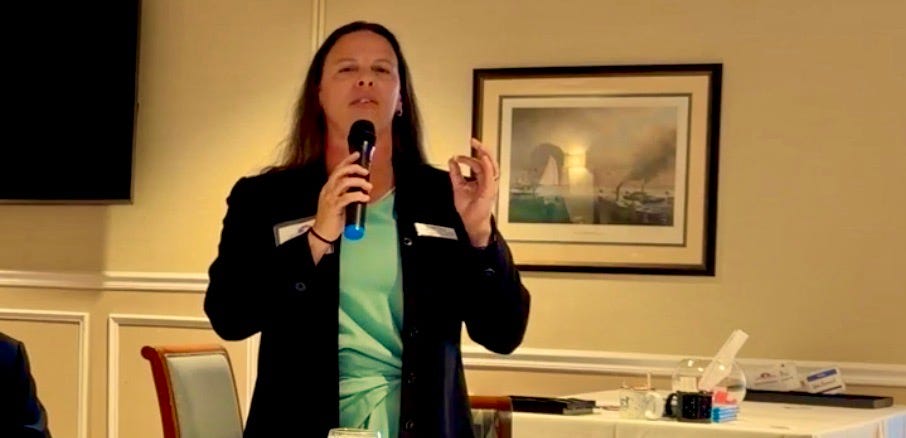
Ad valorem taxes not only include the general fund millage rate of 3.5475 but also 7 other millages plus schools, totaling an additional 10.5015 mills. The general fund millage rate will see a decrease of $19 million provided assessments stay at the rate of inflation, or 3%, according to the county appraiser’s office. Yet, real property tax revenues jumped from $181.1 million in the FY 2025 budget to $196.5 million in FY 2026.
Since the FY 2022 budget, property tax revenue has increased by $75 million. According to the audit report from the IRC Comptroller’s office, the tax rolls increased by 10.1% in 2025, adding another $9.1 million in tax revenue to the general fund. Previously, in 2024, it was $12.7 million.
Clickable Banner Advertisement:
IRC has seen total taxable assessed property values more than double in the last 10 years, from $13.4 billion in 2016 to $29.3 billion in 2025, according to the IRC Property Appraiser. There has been $8.7 billion in new taxable values over the previous 4 years for a 51% increase in property tax revenue.
With property tax revenue trends of the last decade, it is difficult to find any real burden at all.
Comments
Nothing yet. Say the first thing.
Sign in to join the conversation.