
“This week in Mathematical Oncology” — December X, 2026
> mathematical-oncology.org
From the editor:
One of my favorite quotes on creativity is “Every act of act of imagination is the discovery of likenesses between two things which were thought unlike.” (J. Bronowski) Much of the progress of modern day science is not necessarily new, as much as it is combining two existing concepts in a novel manner.
Our recent Cancer Research paper is no exception: we provide empirical evidence for antifragility in cancer. I stumbled upon the idea of antifragility in early 2018 when a (non-academic) friend told me that my explanation of Adaptive Therapy reminded him of a book he read by Nassim Taleb called Antifragile. Thus, the act of imagination was born, by observing the likeness between antifragility and adaptive therapy. The paper applies antifragility to targeted therapy by considering treatment schedules with a range of ‘dose volatility’ to define whether tumors are fragile (or antifragile) to induced volatility. Interestingly— the reviewers also suggested connecting our antifragility idea to existing ideas in adaptive (evolutionary) therapy, so we rewrote the Introduction in the final version. I hope you enjoy it, along with the other articles in this edition.
Enjoy,
Jeffrey West
jeffrey.west@moffitt.org
TWiMO is brought to you by Maximilian Strobl, Sarah Groves, Veronika Hofmann, Yifan Chen, Franco Pradelli, and Sandy Anderson. Find out more about the team here.

Evolutionary antifragile therapy is a treatment strategy to suppress drug resistance by exploiting dose response convexity
Jeffrey West, Bina Desai, Maximilian A. R. Strobl, Jill Gallaher, Mark Robertson-Tessi, Andriy Marusyk, Alexander R. A. AndersonAleksandra Gavrilova, Trachette Jackson, Nizhum Rahman
Modeling variable interactions using Bayesian networks to identify direct predictors of radiation-induced optic neuropathy after proton therapy
Thao-Nguyen Pham, Ibrahim Chamseddine, Dorothee Lebhertz, Jean-Claude Quintyn, Harald Paganetti, Juliette ThariatUnderstanding tumor heterogeneity: Implications for precision oncology and therapeutic strategies
Yinchun Lv, Chenjia He, Qibing Xie, Feiwu Long, Chuanwen FanReal-time cell viability monitoring for high-throughput drug screening using tumor xenograft-derived cells
Elham Esmaeilishirazifard, Daniel Guerrero-Romero, Allan J.W. Lui, Abigail Shea, …, Mandy Lawson, Alejandra Bruna, Oscar M. Rueda, Carlos CaldasOptimal experiment design for practical parameter identifiability and model discrimination
Yue Liu, Philip K. Maini, Ruth E. BakerMultifactorial sheltering in peristromal niches shapes in vivo responses of lung cancers to targeted therapies
Bina Desai, Tatiana Miti, Sandhya Prabhakaran, Daria Miroshnychenko, …, Eric Haura, Alexander R. A. Anderson, David Basanta & Andriy MarusykWhich evolutionary game-theoretic model best captures NSCLC dynamics?
Hasti Garjani ,Johan Dubbeldam,Kateřina Staňková,Joel S. Brown
Adaptive and sequential cancer therapies emerge from treatment schedule optimization
Charles D. Kocher, Joseph O. Deasy, Damon R. Reed, Larry Norton, Corey WeistuchDynamics of the B-Cell gene regulatory network in differentiation determine evolutionary trajectories of childhood leukaemogenesis
Matthieu Bouguéon, Jason Wray, Tariq Enver, Benjamin A HallApplications of temporal graph learning for predicting the dynamics of biological systems
Manuel Dileo, Andrea SottorivaEnvironmental heterogeneity facilitates competitive suppression of drug resistance
Clayton E. Cressler, Jessica L. HitePloidy shapes gemcitabine response through altered potency and delayed cell death
Vural Tagal, Tao Li, Rikhil J Kumar, Pujan Shrestha, …, Issam El-Naqa, Derek R Duckett, Hyo S Han, Noemi AndorSpatial Model Selection and Uncertainty Quantification: Comparing Continuous and Discrete Wound Healing Models
John T Nardini, Jana L Gevertz

AI & Science: What is the Future of Discovery?
The new issue of Daedalus sheds light on the future of integrating AI and Science, asking 33 field experts their opinion on the matter.Age identifies cancer drivers hidden within the genome
Andrew Dhawan, Andriy Marusyk & Jacob G. Scott

The newsletter now has a dedicated homepage where we post the cover artwork for each issue, curated by Maximilian Strobl, Veronika Hofmann, Yifan Chen, and Sarah Groves. We encourage submissions that coincide with the release of a recent paper from your group. This week’s artwork:
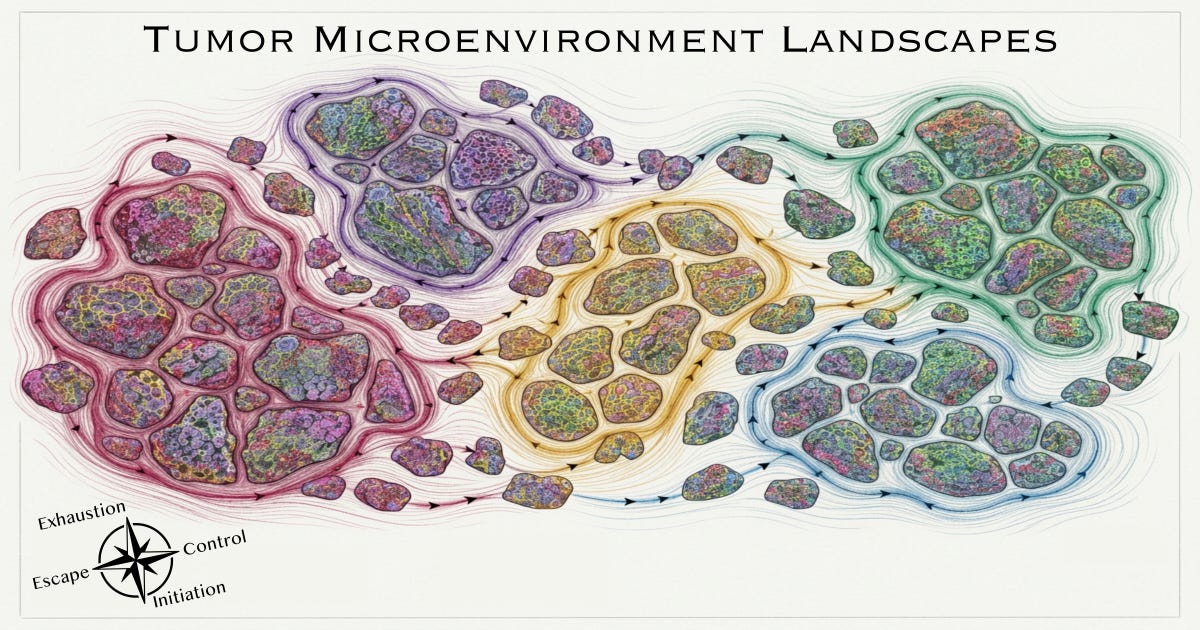
Based on the paper: Trajectory Landscapes for Therapeutic Strategy Design in Agent-Based Tumor Microenvironment Models published in IEEE Control Systems Letters
Artists: Eric Cramer (LinkedIn), Laura Heiser (LinkedIn), Young Hwan Chang (LinkedIn)
Caption: The tumor microenvironment is an ecosystem whose state evolves over time, and that evolution traces a path across a landscape of possibilities. This map renders one such trajectory landscape: each colored basin is a metastable configuration our agent-based simulations settle into. The streamlines trace how the multicellular system as a whole meanders amongst them – doubling back on itself, changing direction, and eventually making its way towards immune control, exhaustion, or unchecked tumor growth. The compass rose marks key orientations – Initiation, Control, Exhaustion, and Escape – that the system can resolve toward. In our recent arXiv preprint (arXiv:2603.18333), this landscape becomes the substrate for state-aware therapy design via a switched Markov State Model, assessing where a tumor is and where it is poised to go next. A companion bioRxiv preprint (doi:10.64898/2026.03.26.714521) projects real multiplex tumor images from clinical trials onto the same landscape, linking spatial phenotypes to patient survival. Adobe Firefly was used to generate the stylized map, with refining and editing in Inkscape.

Visit the mathematical oncology page to view jobs, meetings, and special issues. We will post new additions here, but the full list can found at mathematical-oncology.org.
1. Jobs
Approximate current subscriber count, N:
N(t) = 0.808t+80 (where t = days since Dec. 1st, 2017)
No posts
Comments
Nothing yet. Say the first thing.
Sign in to join the conversation.