
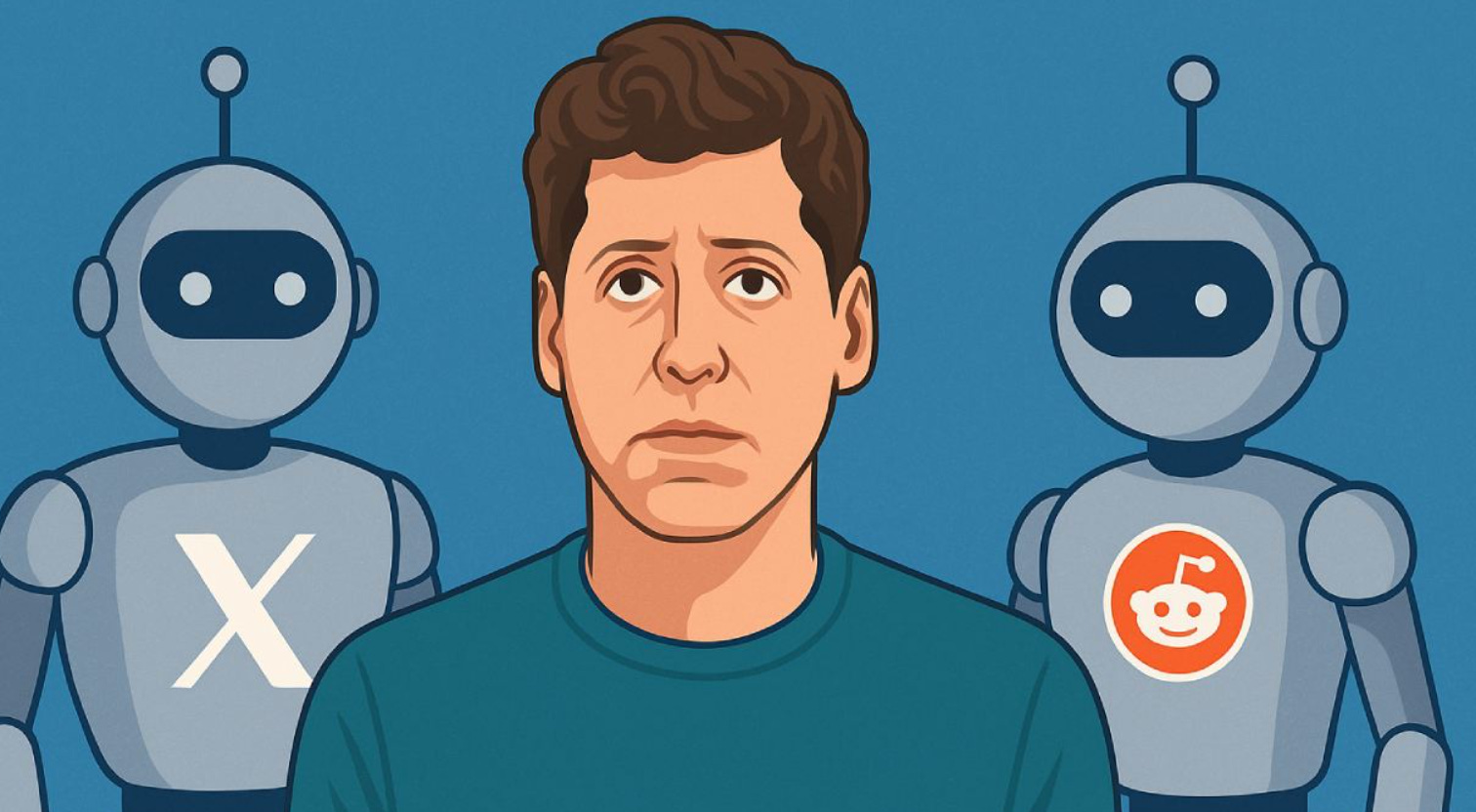
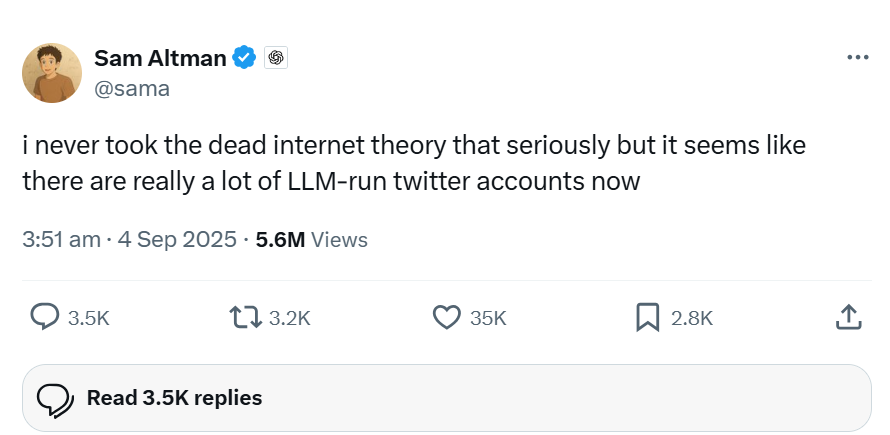
A few weeks ago, I wrote about the Dead Internet Theory. It’s an eerie idea that much of what we see, hear, or read online today might not even be human. This week, Sam Altman, the CEO of OpenAI, has tweeted something that echoed that exact same fear.
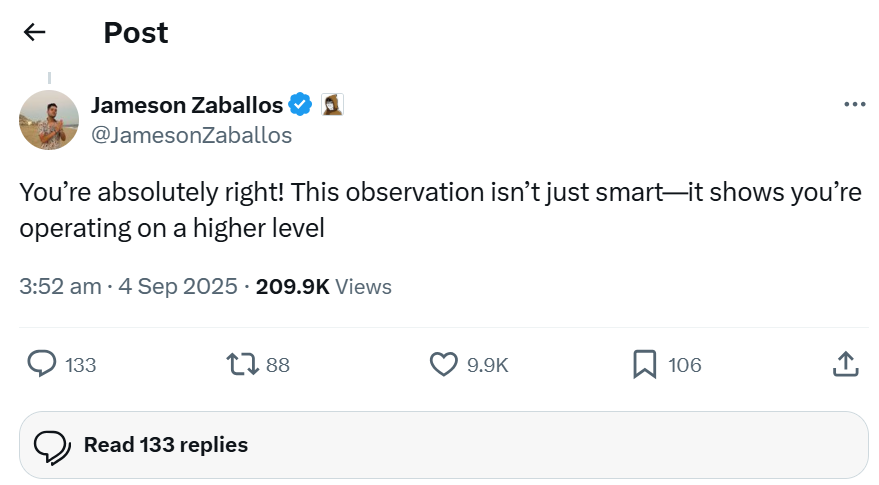
Memes have flooded the internet with hilarious reactions to Altman’s comment, where one user exactly mimics the very tone of AI to reply to this tweet
Jokes apart, if you’ve been paying attention, none of this is new. The signals were already here… fake engagement, LLM-generated comments, and the growing sense that something feels “off” on the internet.
Altman’s realization came while browsing Reddit posts that were praising OpenAI’s new Codex product. Despite knowing that the product was seeing genuine traction, he found himself assuming most of the posts were fake.
Why? Because they felt too scripted, too coordinated, too...LLM-ish.
And that’s the weird irony: we’ve built machines so good at mimicking humans that now even humans are starting to sound like LLMs.
This week in products, we’re diving back in to see what’s really going on behind the scenes as the web just quietly dies…
The Dead Internet Theory first showed up over a decade ago. Someone suggested that most of what we see online, posts, comments, and even entire conversations, might not actually come from real people. And this became viral.
Instead, bots and automated systems could be creating the activity, making the internet look busy when it’s really kind of empty.
At the time, it was mostly treated as a joke, a conspiracy theory born out of people’s distrust of social media and its opaque algorithms, and for years it stayed a niche topic for the sceptical corners of the web. But now, it doesn’t feel so far-fetched.
With generative AI systems like ChatGPT and Google Gemini churning out convincing text, images, audio, and video at scale, the idea that machines are running much of the internet is starting to look more real than ever.
In a previous newsletter, I wrote about Meta and YouTube both cracking down on AI-generated and mass-produced content. They’re not doing it to save creativity. They’re doing it because the internet is starting to rot.
Fake engagement is up. Bots are smarter. And bots aren’t just spamming links anymore. The new wave of AI agents can tell stories, make memes, and hold full-on conversations that feel way too real.
Scroll through TikTok, X, or Instagram and you’ll find posts that look human but are actually machine-made, crafted to grab attention with humour, outrage, or some clever emotional hook.
Here’s where it gets wild: once a post starts picking up steam, an army of other bot accounts jumps in to like, comment, and share it. That fake momentum tricks the algorithm into pushing it even further, creating this feedback loop where synthetic content spreads faster than anything organic.
And there’s money behind it. Platforms now pay out for engagement, so running fleets of AI-driven accounts can actually turn into a business.
Rack up enough followers, make the account look legit, and suddenly you’ve got something you can cash out either through ad revenue or by selling the account off to someone else. The end result? A shadow marketplace built on fake influence, where machines are basically farming attention and flipping it into profit.
This is basically the whole Dead Internet Theory in action. Sure, there are still real people online, but more and more of what we’re swimming in feels fake, automated, and staged.
Even Altman admits in a follow-up analysis that the problem isn’t just bots. It’s that humans are beginning to speak like bots, adopting the same formulaic phrasing and hype cycles AI has trained on.
The internet is turning into a mirror maze of LLM-speak.
And let’s not forget the bigger stat here:
More than half of all internet traffic in 2024 was non-human.
(According to cybersecurity firm Imperva.)
I wish I could end this with some quick fix or hopeful tip to bring life back to the internet, but honestly? It really does feel like the open web is in the late stages of a zombie apocalypse. The feeds are overrun.
That said, there are still pockets of life. Private spaces, your WhatsApp groups, and Discord servers are holding out behind the walls. Smaller platforms like Bluesky and Mastodon are hanging on, too, mostly because they’re still flying under the radar.
Looking ahead, I wouldn’t be surprised if the big players eventually wake up and realize their feeds feel like wastelands. They’ll probably roll out stricter account verification and lean on AI detection to try to bring some humanity back.
There are rumours that even Reddit (Altman was a board member) has started testing biometric verification via World ID to filter out bots.
TechCrunch speculates that Altman’s tweet might also be a prelude to something bigger. Perhaps OpenAI's rumored social media platform.
📰What’s going around tech?
US-India Deep-Tech Funding Alliance
A coalition of eight venture capital and private equity firms from the US and India has launched the India Deep Tech Investment Alliance, pledging over $1 billion over the next decade to support early-stage, Indian deep-tech startups. The alliance featuring Accel, Blume Ventures, Celesta Capital, Gaja Capital, Ideaspring Capital, Premji Invest, Tenacity Ventures, and Venture Catalysts will offer funding, mentorship, and networking to bridge India’s long-standing deep-tech funding gaps.
Read More→
OpenAI Plans LinkedIn Rival
OpenAI is building an AI-powered jobs platform that directly matches candidates with employers. Set to launch in mid-2026, it aims to simplify hiring for companies of all sizes while improving job access for workers. Alongside this, OpenAI is expanding its Academy program to certify millions of Americans in AI skills and prompt engineering.
Read More→
Google Expands AI Mode to More Languages
Google is rolling out its AI-powered Search feature, AI Mode, in five new languages: Hindi, Indonesian, Japanese, Korean, and Brazilian Portuguese previously, the feature was exclusive to English. Built on the enhanced Gemini 2.5 model, this expansion makes AI Mode more accessible and culturally relevant for non-English speakers globally.
Read More→
Meta Pays $55/hr for Hindi & Local Language AI Chatbot Creators
Meta is hiring U.S.-based contractors, offering up to $55 per hour, to create culturally enriched, character-driven AI chatbots for markets like India, Indonesia, and Mexico. Roles require fluency in languages such as Hindi, Indonesian, Spanish, and Portuguese, plus at least six years of experience in storytelling, character design, prompt engineering, and AI content workflows.
Read More→
Facebook Revives the Poke
Facebook is bringing back its classic poke feature with new prominence. Users can now find a poke button on profiles, receive notifications when poked, and track a running poke count. The update adds playful elements such as emojis tied to frequency, echoing streak-like mechanics, as the platform tries to reintroduce the poke to a younger audience.
Read More→
A video I found insightful
I recently watched a fireside chat between Michael Truell, the founder of Cursor, and YC General Partner Diana Hu. Found the journey he has had very fascinating.
But the part that really hit me was how Michael sees the future of programming. AI is going to change how we write code, but it’s not replacing us. Stuff like logic, math, and problem-solving still matter.
Now, coding is more about working with AI, checking what it does, and guiding it. I liked the way he put it. It’s not the end of programming, just a new way of doing it.
📬I hope you enjoyed this week's curated stories and resources. Check your inbox again next week, or read previous editions of this newsletter for more insights. To get instant updates, connect with me on LinkedIn.
Cheers!
Khuze Siam
Founder: Siam Computing & ProdWrks
Comments
Nothing yet. Say the first thing.
Sign in to join the conversation.