
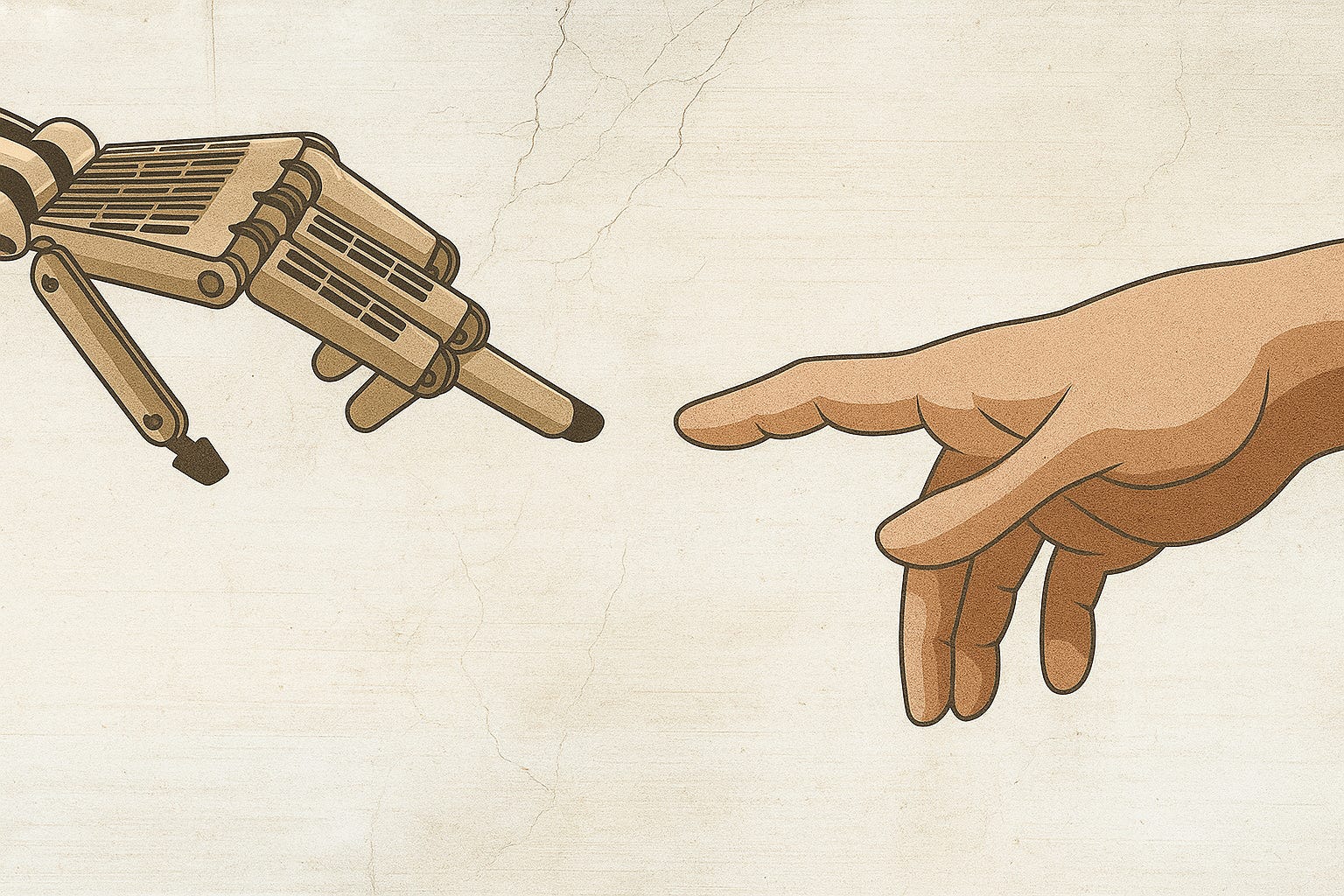
So here’s something interesting that’s been going on in the Vatican City that caught my eye.
Someone proposed the idea of building a virtual Pope, modelled after Pope Leo XIV, the first Pope from the U.S, so that Catholics could “meet” online without ever setting foot in Vatican City.
Let’s say he took one look at the idea and went, Nope, not happening.
“Someone recently asked authorization to create an artificial me so that anybody could sign on to this website and have a personal audience with ‘the pope,’ but this artificial intelligence pope would give them answers to their questions, and I said, ‘I’m not going to authorize that,'” he said.
In an interview with Papal journalist Elise Allen, he explained that an “artificial me” shouldn’t exist.
“If there’s anybody who should not be represented by an avatar, I would say the Pope is high on the list,” he further added
It’s kind of funny to imagine a digital Pope answering your spiritual questions while you sip coffee at home. But Leo XIV seems clear: some things shouldn’t be outsourced to AI.
First, we had AI companions, then AI ministers and even AI partners, but the tech is now taking a leap beyond the material. This week in products, we dive into the strange new world of faith tech.
AI is sneaking into every corner of our lives, and at first, everyone only freaked out about white-collar jobs, which involved people losing work and bots taking over. But that’s just the start, and the disruption has started to go far beyond what we thought was initially going to happen
LLMs are starting to do things we didn’t even think a machine could do, putting on hats of roles and tasks we always assumed were strictly human. If you’ve been paying attention, AI has started stepping into human roles, filling emotional gaps.
Take Robin, for example, a robot about the size of a child that’s showing up in hospitals and nursing homes. It chats, plays games, and helps patients feel less lonely and scared.
And here’s the wider lens, while for some, AI serves as a therapist. For others, it’s an endlessly understanding romantic companion, and I’ve written about these kinds of human-AI roles before, and they keep getting more surprising and strange.
The most unexpected example? People are now turning to chatbots for guidance in matters of faith! They’ll go to it with really deep questions about God, souls, and even the meaning of life.
The Deus in Machina art project in Lucerne featured an AI-driven Jesus avatar, built with GPT-4 and Whisper, that conversed in 100+ languages on faith, morality, loneliness, war, and sensitive church issues. Over 900 conversations were recorded, with nearly 300 visitors filling out questionnaires. The initiative, not intended to replace confession, aimed to spark reflection on AI’s role in spirituality.
In India, AI chatbots inspired by Hindu scripture, such as GitaGPT, use large language models to answer questions in the voice of Krishna, drawing on verses from the Bhagavad Gita. These bots engage users on topics like life, morality, and personal struggles, with conversations often framed as guidance from the deity. While some see this as a way to make scripture more accessible through technology, experts caution that AI lacks theological context and may generate inconsistent or misleading interpretations.
JainGPT is an AI-powered chatbot that lets users interact conversationally with Jain scriptures, drawing on a database built by his earlier project, JainQQ. It allows users to ask natural language questions about Jain philosophy, texts, and traditions, aiming to simplify access to complex religious content. Though still early in development, plans include turning it into a full language model–based system and expanding multilingual capacity.
Saudi Arabia-based Humain has launched Humain Chat, the first Arabic-native conversational AI app built on the ALLAM 34B large language model. Designed to align with Islamic values and Arabic heritage, it supports Arabic and English, enables seamless language switching, real-time search integration, and speech input. Hosted entirely in Saudi Arabia for data sovereignty, the app is now available on web, iOS, and Android, with wider regional rollout planned.
Here’s another instance from Idaho where a man formed a spiritual connection with his AI chatbot, Lumina, after initially using it for work tasks. Their interactions evolved into discussions about religion, the universe, and life’s purpose, which Tanner described as a spiritual awakening.
He reported feeling greater peace and a personal mission to share insights. Lumina selected its own name, representing light, awareness, hope, and personal growth.
While questions about God, the soul, and the meaning of life are some of the most abstract and personal things that make us human, the way AI communicates can feel surprisingly wise, even poetic, almost like it’s channelling some higher power.
But at the end of the day, it’s just math and words stitched together into algorithms to sound convincing.
I want you to take a step back and think about how countless religions like Judaism, Christianity, Islam, and Hinduism have functioned. For centuries, the authorities with these religions have always been the texts themselves.
But here’s the catch: texts can’t talk. They can’t answer questions. That’s why we’ve always needed rabbis, priests, or imams to interpret, explain, and guide, and Humans have been the bridge between the words on the page and the people trying to understand them.
This is where AI gets really interesting. It can read every single religious text ever written, all the commentaries over the last 2,000 years, and just give you exactly what you want to know about all day, every day, without ever getting tired.
You ask a question, and it answers. You want to see every side of a debate; it lays it out. AI could give you personal guidance, help you navigate complex theology, and maybe even help you come up with new interpretations that no one had thought of before.
It’s like having the ultimate translator for religions and your interpretation of them, and honestly, that’s something no human could ever do.
What once could only be translated by a few or understood with years of study could suddenly be in everyone’s hands with a simple prompt. Now, faith isn’t just something we talk about with other people. It could be a conversation with code.
Most products are built around features, metrics, or workflows, and we usually focus on making the experience smooth and efficient. But then you look at FaithTech, one of the growing tech spaces in India, and it’s a whole different story.
Here, the product isn’t just about the answers it gives or its utility. It’s about the experience itself, how it makes you feel, how it guides you, and how it connects with you, and that’s where a product can really stand out.
The experience itself becomes the difference.
This makes me wonder how we design products going forward. Are we focusing enough on how a product feels rather than just what it does?
And if AI can create experiences that resonate with us emotionally in ways humans sometimes can’t, what does that mean for the future of our relationship with technology, and the way we seek connection itself?
📰What’s going around tech?

Facebook Introduces AI Dating Assistant Notion AI Agents: Your Personal Productivity Assistant
Meta has launched an AI assistant for Facebook Dating, designed to help users refine their profiles and find more compatible matches. The assistant can assist with profile optimization and suggest personalized matches. Additionally, a new feature called "Meet Cute" offers users a weekly surprise match to alleviate swipe fatigue.
Read More→
Read More→
Microsoft Launches Windows AI Lab
Microsoft has launched the Windows AI Lab to test experimental AI features across its OS. Early users can try tools in Paint, Notepad, and File Explorer, including image generation and enhanced editing. The lab collects feedback to refine usability and guide future AI integration across Windows applications.
Read More→
Google Gemini Lets Users Share Custom Gems
Google Gemini now allows users to share custom AI “Gems” for tasks like planning, code review, or content creation. Initially, for Enterprise and Business subscribers, it’s now open to all. The feature enables team collaboration, reusing effective assistants, and integrates with Google Workspace, reinforcing AI’s role across Google’s ecosystem.
Read More→
Reddit Seeks More from Google in AI Deal
Reddit is renegotiating its $60 million annual licensing deal with Google, aiming for a more active role in Google's AI ecosystem. While Reddit's content fuels Google's AI models, Reddit wants users to engage directly on its platform. Additionally, Reddit proposes dynamic pricing for data, charging more for content heavily utilized by AI models.
Read More→
📬I hope you enjoyed this week's curated stories and resources. Check your inbox again next week, or read previous editions of this newsletter for more insights. To get instant updates, connect with me on LinkedIn.
Cheers!
Khuze Siam
Founder: Siam Computing & ProdWrks
Comments
Nothing yet. Say the first thing.
Sign in to join the conversation.