
As Chief Secretary for Ireland (1887–1891), Arthur Balfour became known for his harsh attempts to suppress Irish nationalism and oppose Irish Home Rule. As a result, Irish nationalists nicknamed him “Bloody Balfour”.
Later, as British Prime Minister (1902–1905), Balfour’s government introduced and passed the Aliens Act 1905, Britain’s first modern immigration law aimed at limiting Jewish immigration from Eastern Europe.
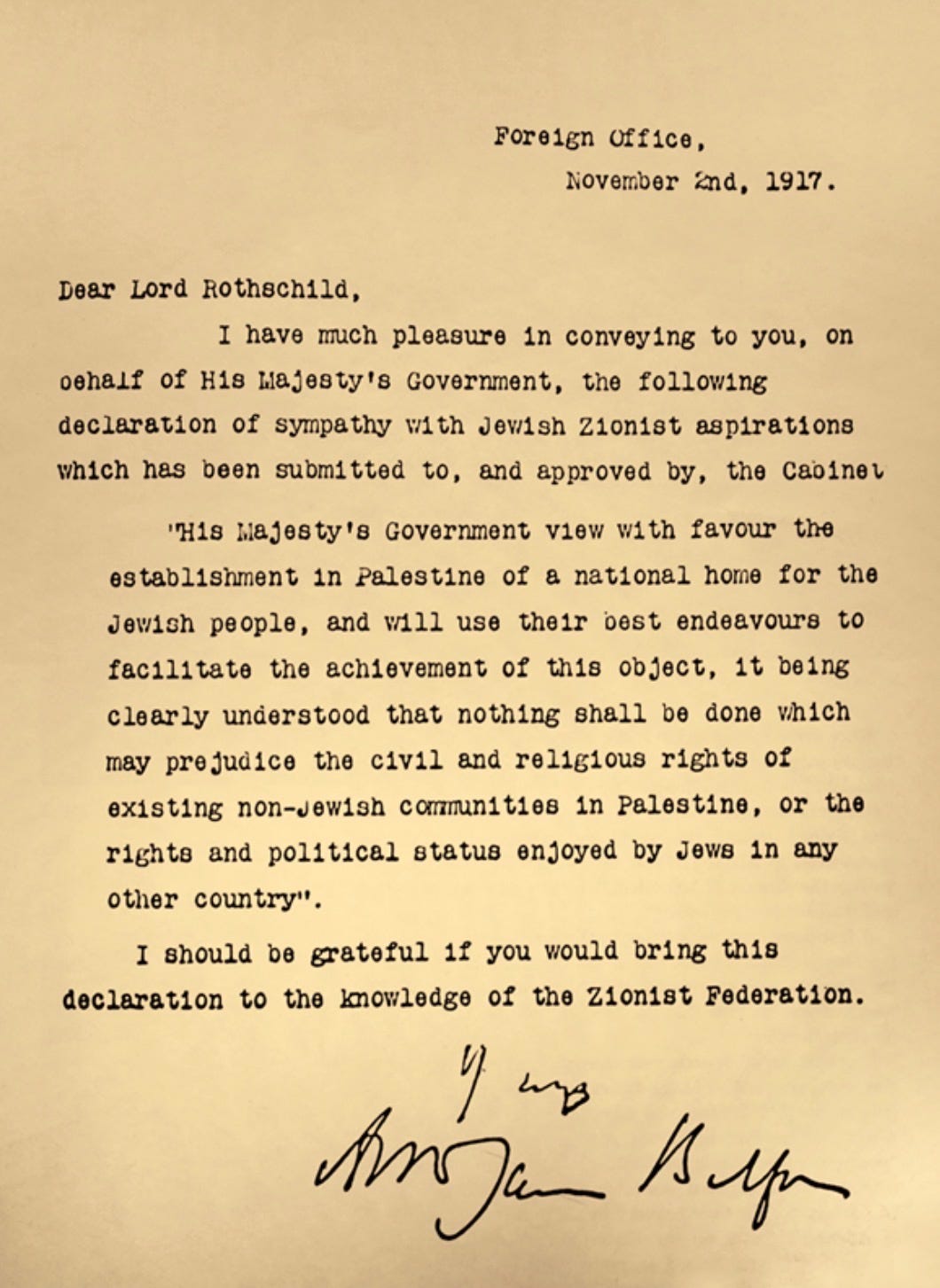
On 2 November 1917, as Foreign Secretary (1916–1919), he wrote a letter to Lord Rothschild expressing British support for “the establishment in Palestine of a national home for the Jewish people”, while also stating that the civil and religious rights of the existing non-Jewish communities “should be respected”.
That letter was sent without the consent of the people of that land. Nor was Palestine in Britain’s gift to give. At the time of the Declaration, Palestine formed part of the Ottoman Empire. Its inhabitants were legally Ottoman subjects, but they were also the indigenous people of Palestine.
Britain promised their country as a national home for another people without seeking their consent or recognising their own national political rights.
In 1918, the Ottoman Empire lost control of Palestine as British forces occupied it.
In 1920, the Allied Powers agreed that Britain would administer Palestine.
In 1922, the League of Nations formally approved the Mandate for Palestine, which came into force in 1923.
The Mandate incorporated the Balfour Declaration and required Britain to facilitate a Jewish national home. On paper it claimed to protect the “civil and religious rights” of Palestinians but did not recognise the Palestinian right to national self-determination, despite them constituting the overwhelming majority of the population when the Balfour Declaration was issued.
The Mandate for Palestine entrenched this imbalance by committing Britain to establishing a Jewish national home in Palestine while failing to recognise the Palestinian right to national self-determination.
Palestinians, who formed around 90% of the population in 1917, were not recognised as a people with national political rights.
Instead, they were described as the “existing non-Jewish communities”.
The Balfour Declaration and the 1922 Mandate omitted their political rights, rendering Palestinians politically invisible. Meanwhile, the Mandate explicitly advanced the Zionist national project, which received international recognition and British support.
The Mandate ended on 14 May 1948, when Britain withdrew from Palestine and the State of Israel declared independence. The ensuing Nakba displaced hundreds of thousands of Palestinians.
For all these reasons, Balfour is remembered as the key architect of a policy that ignored the political wishes of the people of Palestine and helped lay the foundations for a prolonged and brutal occupation, ethnic cleansing and the genocide we are seeing today.
***
Below is the complete text of the Balfour Declaration.
Foreign Office
November 2nd, 1917
Dear Lord Rothschild,
I have much pleasure in conveying to you, on behalf of His Majesty's Government, the following declaration of sympathy with Jewish Zionist aspirations which has been submitted to, and approved by, the Cabinet:
"His Majesty's Government view with favour the establishment in Palestine of a national home for the Jewish people, and will use their best endeavours to facilitate the achievement of this object, it being clearly understood that nothing shall be done which may prejudice the civil and religious rights of existing non-Jewish communities in Palestine, or the rights and political status enjoyed by Jews in any other country."
I should be grateful if you would bring this declaration to the knowledge of the Zionist Federation.
Yours sincerely,
Arthur James Balfour
Comments
Nothing yet. Say the first thing.
Sign in to join the conversation.