
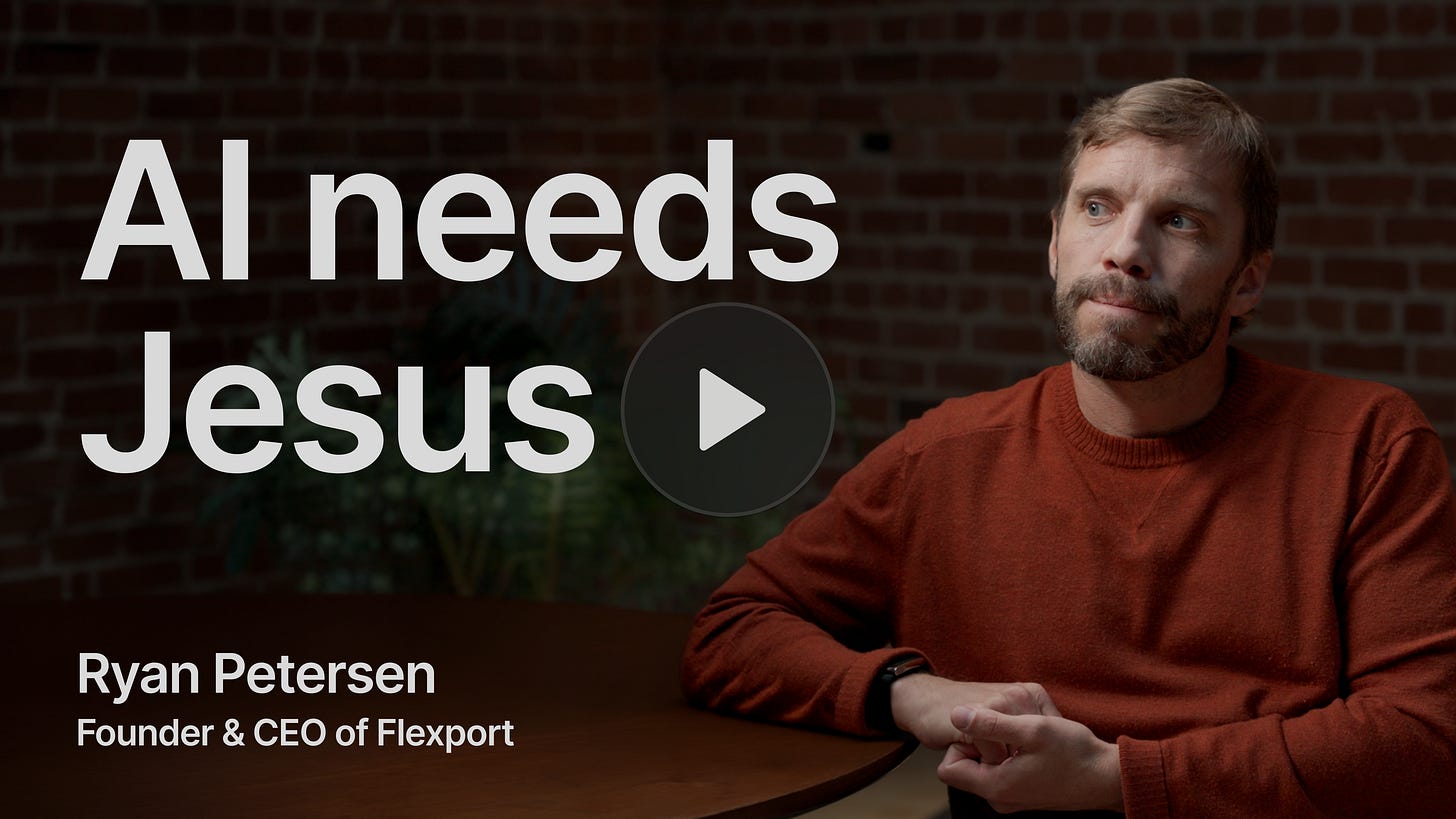
Ryan Petersen is the founder and CEO of Flexport, the technology-driven freight forwarder that ranks amongst the top companies exporting ocean freight. In this conversation, Ryan and Scott move through sprawling, but connected territory: including the “great man theory” of history, what tariffs are actually doing to global supply chains, and why René Girard’s thinking on role models might hold the unexpected answer to AI alignment.
Why Ryan thinks trends are regurgitations of “chauffeur knowledge”
Why America is struggling to follow Rotterdam’s lead in port automation
How prevalent customs fraud is and why it’s impacting 11% of US ocean trade
Why we should heed the historic lessons from the Silk Road and the Black Death plague in today’s interconnected world
What DHL’s billion-dollar IBM disaster teaches us about organizational resistance to tech
Why Ryan thinks the one-person AI company is a fundamentally pointless exercise
The overproduction of elites: how low-status jobs are becoming the best-paid
What Asian industrialization teaches America about exports
00:00 Intro
01:36 Why Ryan favors the “great man theory” of history
02:43 How easily can humanoid robots replace a warehouse worker?
04:21 What Flexport’s shipping data reveals about relations with China
06:16 Is the White House considering “friend shoring” policies?
07:51 The customs fraud epidemic clouding US trade
09:37 Why Ryan thinks the “one-person company” is a dumb idea
10:48 Flexport laid off 75% of engineers and got faster
11:43 Why America is struggling to follow Rotterdam’s lead in port automation
15:52 The lessons from Betty Crocker cakes that underpin fake jobs
16:44 The reason DHL’s $1 billion project with IBM failed
18:27 Why Ryan thinks job displacement is the wrong thing to worry about
19:21 The inherent fragility of greater global interconnectedness
21:23 Are self-sustaining civilizations a realistic goal?
24:14 Navigating parenting in the age of screens
28:21 The surprising advantage China has over America
30:33 Have we entered the age of overproduction of elites?
32:54 The improbable lesson from Girard’s role model theory for the agentic era
Ryan Petersen:
China believes in China. China wants China to succeed. The United States, 50% of our country thinks that America is this evil imperialist power.
Scott Phoenix:
Is a bad thing, yeah.
Ryan Petersen:
It’s bad. This 996 thing is insane.
Scott Phoenix:
Yeah.
Ryan Petersen:
It’s not good civilizationally probably, but man, it works.
Scott Phoenix:
Ryan Petersen built Flexport, a $4 billion global trade and logistics company. Ryan sees more data on the world economy than most governments do.
Ryan Petersen:
11% of all trade has gone to fraud. The number one thing you could do for re-industrializing is to make it high status, to work with your hands.
Scott Phoenix:
We went back to the Roman Empire and Ryan showed me the dark side of globalization.
Ryan Petersen:
More interconnectedness actually can lead to collapse happening much faster. People were making a lot of money until all of a sudden the Black Death.
Scott Phoenix:
Ryan had a take on who actually gets replaced as companies get leaner.
Ryan Petersen:
The one person company is stupid like if it’s really working, why wouldn’t you hire a second person? And by the way, if it’s really working, you’re going to be so rich you won’t want to work that hard, so you’re going to definitely need a few people. Yeah, maybe a lot of people are sort of NPCs, so you may be able to automate the average.
Scott Phoenix:
And along the way, we made a case for a new religion.
Ryan Petersen:
So do we need to create a God for the AIs to worship?
Scott Phoenix:
You’ve solved the alignment.
I’m Scott Phoenix, and this is Progress. In 2021, when global supply chains were shutting down and no one could explain why, Ryan rented a boat, drove it through the largest port in America, and tweeted about it. Later that day, the mayor changed the law that was slowing things down. This is Progress in the mind of Ryan Petersen.
How do you think of life in 2035 as it compares to now or 2030?
Ryan Petersen:
I’m a believer worldview-wise of the great man theory of history, rather than the trends and forces view, which is that you can just do things and get things done and it is shaped by what individuals are going to do.
Scott Phoenix:
I think I agree that probably maybe even less than 500 people have the largest denominator over what is life actually like in 5 to 10 years. But they all have their own little vectors or big vectors in some cases of what they’re trying to do. You don’t try to piece that together and where do I think I’m going to be?
Ryan Petersen:
Man, not to the level that you do, Scott. Maybe I put it back to you. What do you think? I mean, it’s so hard for me to predict things like robotics and where AI is going. Anything I would say to you would be regurgitation of chauffeur knowledge, as I call it. The knowledge the chauffeur gets by driving smart people around in the limousine and repeating what he heard in the back.
Scott Phoenix:
What do you think the most credible or edgy things that you’ve heard other people talk about that you’re like, “Hey, maybe that can come together”?
Ryan Petersen:
It’s both AI and robotics are incredibly relevant for my business that I need to be paranoid about it. On the robotic side, obviously, we run a fulfillment business and autonomous trucks will be revolutionary. The fulfillment, just reviewing the headcount today, we have 3,000 humans in our fulfillment centers.
Scott Phoenix:
Wow.
Ryan Petersen:
Picking and packing, putting tape on boxes and labels and shipping it out and stuff. And so I track that space pretty close. I’m sort of a skeptic though because I just look at it. If I came to you and said, “Hey, I’ve invented this AGI. I’ve got a robot that has a 100 IQ,” maybe 90, I don’t know. “But I’ve got a decent level of, and I’ve got the dexterity of a human.” It’s a very high bar to clear. And by the way, you don’t have to buy it. You can rent it for 20 bucks an hour.
Scott Phoenix:
Yeah.
Ryan Petersen:
That was what you were trying to do, is to rent it 20 bucks an hour.
Scott Phoenix:
Some hard lessons in that.
Ryan Petersen:
High bar to clear. So I think it’ll happen and it’ll be absolutely important that we be very close to that when it happens. We’re not going to develop it, but hopefully we can rent it and borrow it and put it to use.
Scott Phoenix:
So how close do you feel like we are? Is this a thing you’re imminently tracking or is this like, well, everybody shows me a demo once a year and it’s like-
Ryan Petersen:
They’re always in fast forward right now. The demos keep like, they’re being played on fast forward, which tells you something, guys must go very slow.
Scott Phoenix:
I mean, maybe if I flip the question and I’m like, what’s not going to change?
Ryan Petersen:
Well, businesses are going to want cheap logistics. If the economics work, it’s not going to be a problem. Everyone’s going to want to deploy this stuff. They’re going to want to have more reliability or transit network. Companies are going to want to buy stuff anywhere in the world and sell stuff anywhere in the world where their customers are. They don’t much care.
Scott Phoenix:
Yeah.
Ryan Petersen:
All these trade wars and geopolitics and stuff, companies don’t really care about it. The degree to which companies have started shifting sourcing away from China for non-pure economic reasons that the brand of China has been damaged in their view. But there’s a lot who can’t, where the Chinese quality is so high or the certain industries, you just can’t get the thing made elsewhere. It’s not really for price anymore. If it’s just price of labor, there’s cheaper places.
Scott Phoenix:
You have the world’s biggest panopticon on what’s actually happening with this stuff. And so how much of a shift have you seen in the last four years or something?
Ryan Petersen:
Yeah. Well, last at least 10 years, right, since the first Trump tariffs were in 2017. So we’re almost on 10 year, 8 years into that.
Scott Phoenix:
Wow.
Ryan Petersen:
Biden raised the tariffs, he didn’t lower them. Trump has now jacked them way up further than that, but you saw a pretty massive shift towards... Well, if you look at Flexport volumes, our volumes are down out of China year over year.
Scott Phoenix:
Every year for the last decade?
Ryan Petersen:
No, just this last year, especially. I mean, this most recent thing was pretty brutal. We were growing steadily through the first Trump wave, through Biden.
Scott Phoenix:
Even despite all those tariffs, you’re still growing.
Ryan Petersen:
Out of China, yeah.
Scott Phoenix:
Wow. Okay.
Ryan Petersen:
And we’re a pretty biased sample because we’re big in China. I think we’re the fourth-largest freight company exporting from China to the US. We’re not as big in some other lanes, so it’s a bias sample as those. But our Vietnam volumes are up 60% year over year. Thailand is similar. Indonesia is like 100% growth. India was growing really nicely, and then they put tariffs on India that are as high as-
Scott Phoenix:
Oh, yes. Some confusion.
Ryan Petersen:
... anywhere. So I think that was the one that caused people to take a pause on their plans and realize like, “Hey, we don’t really know what’s...” Because if you just uplifted your manufacturing from China and moved it to India thinking you were getting ahead of the game and then the tariffs hit you there, that’s going to make you rethink a lot of stuff.
Scott Phoenix:
What are the policy people thinking? What’s the plan? Do you have any sense of what the plan is? I get the plan of bringing some of it back to America. That makes sense. But then friendshoring, are they thinking about friendshoring?
Ryan Petersen:
I think you have a lot of different plans and it’s unclear that there’s one plan. There’s a lot of people with plan, sort of who gets Trump’s ear on a given day.
Scott Phoenix:
Plans within plans.
Ryan Petersen:
And some that can’t really be spoken because what they want the plan to be is, hey, make their stuff in America. They don’t want to say, “Hey, make it in Latin America.” Even though that’d be like, for some people, a close number two and those who are pragmatists and realists would go, “Let’s just make that the plan. At least it’s nearshore, back door. We can exercise our power there.”
Scott Phoenix:
Yeah.
Ryan Petersen:
But I can’t tell you that that’s the actual plan or that there is a high level plan. It’s a lot of try stuff and see what works. And if it breaks, undo it. I will say they take feedback pretty well from the market. You’ve seen a number of incidents where either the stock market crash or a bad publicity or some other things or just listening. I mean, they open their doors and they’ll... I’ve been to the White House and talked to folks and they’re very eager to hear what the business world is having to say.
Scott Phoenix:
Oh, that’s interesting.
Ryan Petersen:
They don’t want to destroy businesses.
Scott Phoenix:
Is there a contrast there?
Ryan Petersen:
I never tried before, so I can’t say. I didn’t put effort in prior, but it became so obvious since April that like, oh, I better spend time learning and giving feedback and stuff. So this is my first-
Scott Phoenix:
Like someone has a button on top of your business, on top of your P&L, they just get to press it and dip it and then...
Ryan Petersen:
So I’m putting way more effort for better or worse into learning and giving feedback. And there’s a specific policy that I’m pushing on really hard right now, which is there’s a huge amount of customs fraud that’s happening.
Scott Phoenix:
Oh, yeah.
Ryan Petersen:
You’ve created this massive incentive for cheating because of the tariffs are so high.
Scott Phoenix:
I see you’re like...
Ryan Petersen:
I’m trying to be the face of this movement to stop the customs fraud. I think it’s the one thing everybody can agree on, basically. Everyone in the US should be non-political. Whether you have tariffs or not, we shouldn’t allow cheating because that really hurts those who follow the rules. And the cheating works like this. Basically, if you’re an importer, the United States allows foreign companies to import goods into our country without-
Scott Phoenix:
Why do we do that?
Ryan Petersen:
Free trade, baby. It’s very unclear where this came. I should know more of the history of when it started, but we allow it. What that means is other countries, a foreign company can import, but they would have to create a local subsidiary, like an LLC, maybe have an employee, a bank account, some presence that if you commit a crime, we can prosecute you.
Scott Phoenix:
Oh my God.
Ryan Petersen:
And since we don’t have that, we just have foreign companies importing stuff and they can create shell companies overseas-
Scott Phoenix:
That are impossible to prosecute for these random fees.
Ryan Petersen:
Can’t be prosecuted.
Scott Phoenix:
Okay.
Ryan Petersen:
And so that’s gone rampant. I studied the data. So in the US, we’re also one of the only countries that have the shipping manifests are public record. In fact, before Flexport, I built a business selling access to this data, digitizing it, making it searchable. So I use that tool and that data to analyze this. And it looks like in my analysis, about 11% of all US trade on ocean has shifted to the factories importing the goods instead of the American company. 11% of all trade has gone to fraud.
Scott Phoenix:
That is insane.
Ryan Petersen:
So I’ve been hitting the government from every angle and they’re all very receptive and they’re like, “We keep hearing about this.” I’m like, “Yeah, because I’m going to tell everybody exactly. It’s all me.” By the way, in your point earlier, you said 500 people or there’s some number of people wield power, mold the future. I’ve been told by several people in the government it’s the same. There’s like a hundred people in the US government that do all the work.
Scott Phoenix:
Yeah. This takes two directions. One is, what do you think of the idea of people talking about the one person company or AI as a lever for making companies much smaller, but having the same role in society? Do you think that’s bullshit or do you feel like there’s something to that?
Ryan Petersen:
I kind of think it’s bullshit. I think the one person company is stupid like if it’s really working, why wouldn’t you hire a second person? And by the way, if it’s really working, you’d be so rich you won’t want to work that hard. So you’re going to definitely need a few people.
Scott Phoenix:
Yeah.
Ryan Petersen:
I always thought, hey, if we automate everything in Flexport, I’ll need more heads because I’ll have so many customers. I’ll need to talk to people and account man, maybe you could automate that, but I’m so skeptical that the human relationship goes away.
Scott Phoenix:
I know the videos are getting pretty good.
Ryan Petersen:
They’re getting pretty good.
Scott Phoenix:
Do think you’re going to have the live Zoom call persona you can talk to that’s like real time within the next 24 months where it looks like you?
Ryan Petersen:
I’m very creative. I don’t think you’ll be able to come up with my very oddball type of stuff.
Scott Phoenix:
Okay.
Ryan Petersen:
But yeah, maybe a lot of people are sort of NPCs, so you may be able to automate the average. The median person is sort of not that far, maybe not that hard to replicate, at least in terms of what they do on a day-to-day at work. By the way, we’ve reduced our headcount. We reduced our engineering team by 75%.
Scott Phoenix:
75%.
Ryan Petersen:
Yeah.
Scott Phoenix:
Okay. And the site’s still up.
Ryan Petersen:
We have dramatically increased velocity any way you would measure it, most importantly by the usefulness of the tech.
Scott Phoenix:
Why are you not bullish on that? You just argued against the thing.
Ryan Petersen:
I don’t think it’s with AI. We just simply we had overhired and we’d gone a little crazy.
Scott Phoenix:
Okay. It’s not an AI thing.
Ryan Petersen:
No, I can’t point to AI on that.
Scott Phoenix:
Okay. So one of the things I was thinking about when I was thinking about you and like AI and automation and stuff is the ports.
Ryan Petersen:
Yeah.
Scott Phoenix:
And to what extent are the ports a like microcosm for the absorption of AI or absorption of automation into the broader economy?
Ryan Petersen:
It’s a great question because ports, it’s really interesting to compare the United States, compare countries, compare and contrast countries and their ability to use this tech or not. The port of Rotterdam has been fully automated for over 30 years.
Scott Phoenix:
Yeah.
Ryan Petersen:
So we didn’t need-
Scott Phoenix:
New technology.
Ryan Petersen:
... AI or new tech. It’s quite simple in many ways. I think the way that they did it there 30 years ago was just draw white lines on the floor and it can follow a white line and they’re rectangles.
Scott Phoenix:
Yeah. Those big boxes all the same size.
Ryan Petersen:
They’re all the same size. It’s like a pretty constrained problem, quite solvable and unionized in Rotterdam. And the union there was-
Scott Phoenix:
What does the union do?
Ryan Petersen:
... okay with it.
Scott Phoenix:
But like the port’s automated, what do the people do?
Ryan Petersen:
I think they have got less people. I think the American unions in the ports are way more of like a multi-generational family employment scheme. And so if you, even if I said, “Hey-”
Scott Phoenix:
So you’re like Gentry. It’s like inherited.
Ryan Petersen:
For sure. And it’s your children, you get the job because your dad has the job.
Scott Phoenix:
What if we just bless them?
Ryan Petersen:
So if I say, “Hey, we’re not going to hire anyone new. We’re just going to stop it where it is.” You’d go, “Hell, no.”
Scott Phoenix:
Yeah, because my children.
Ryan Petersen:
If I was just interested in myself, I’d be like, “Fine, I’m not losing my job.” But if you say that we’re never going to hire anyone more, then I can’t get my son a job.
Scott Phoenix:
What if we guarantee your son just like, what if we do it as like a-
Ryan Petersen:
So they’ve done some of this. And some of this is secondhand. I don’t know how good my sources are on this stuff, so take it with a grain of salt. But one of the stories that I’ve heard is that they had these guys at the Port of LA where there is one automated terminal in Long Beach.
Scott Phoenix:
Yeah, I saw it. It’s beautiful.
Ryan Petersen:
LBCT.
Scott Phoenix:
It looks like a Chinese port.
Ryan Petersen:
Yes, yes. And that was open in, I want to say 2016 or something like that, 2015.
Scott Phoenix:
10 years ago.
Ryan Petersen:
And it was a huge negotiation with the union. The union regrets it. That’s why they’ve since then said no more of that. Some of the concessions they made were that the union would, one, get trained on operating the software. So there’s a lot of guys managing computers and overseeing the stuff. And two, they created some fake jobs. So there’s a guy with a clipboard who writes down every truck license plate that comes in, but that paper just like is thrown in the-
Scott Phoenix:
They throw it away.
Ryan Petersen:
... trash thing. Actually, because they have computer vision that checks the license plate and they don’t need him. But going back to container itself was a revolution in labor, of course, and was highly protested by the union.
Scott Phoenix:
Oh, it was. I didn’t know that.
Ryan Petersen:
Yes, absolutely in the ‘60s, the union because the unions used to basically throw the stuff on their back and haul it off. You used to have two cranes, one onboard the ship and one on the land, and therefore two crane operators. And as part of the deal to get containerization approved, they said, “Hey, we’re not going to reduce the number of employees operating cranes, but I only need one instead of two.” So what they did was allow them to only work half-time, four-hour shifts. And of course, nobody wants to work a four-hour shift every day. So they negotiated amongst themselves that they do one month on, one month off for those crane operators. That’s the top job in the union if you can get that.
Scott Phoenix:
It’s a wild job.
Ryan Petersen:
You have to say, I think that’s the top job. You get there when you’ve been in 20 plus years, you get to be the crane operator. Again, I’m not an expert on this stuff. It’s a lot of secondhand knowledge. So we have... Yeah, maybe there’s some precedent here of like-
Scott Phoenix:
Fake jobs.
Ryan Petersen:
... but where is the union going to exert that kind of control over the economy more than the ports? Because it’s a natural monopoly. It’s a geographic... There’s only a few locations in the country that can be a port.
Scott Phoenix:
Yeah.
Ryan Petersen:
Coming back to the question of AI, I just don’t think that the average worker is going to have nearly as much of power. You’re not going to have unionized workforces that can exert the power in other parts of the economy that you have in the port. The port can literally be blockaded a picket line so that no trucks can come in or out and you don’t need that many guys to close it down. So if they go with non-union or they went to an automated system, they could shut down operations in a way that I don’t think you’re going to see if I automate document processing with AI.
Scott Phoenix:
No, no one’s going to...
Ryan Petersen:
My team is not going to... Well, at Flexport, thankfully everybody’s embracing this and was like, “Please, automate this boring part of my job so I can focus on loving my customers.” I think that that’s going to be way, way more common. And so I don’t think there’s that many lessons from the union unless you say, “What are the other places where there’s a natural monopoly in a physical world that could create a natural blockade against tech?”
Scott Phoenix:
So I’m thinking about the story you told about the writing down the license plate numbers and the paper gets thrown away.
Ryan Petersen:
Yeah.
Scott Phoenix:
Reminds me, do you know the story of like Betty Crocker Cakes?
Ryan Petersen:
No.
Scott Phoenix:
The first version of Betty Crocker Cakes, you would just pour the whole mix into, like you just add water and then you bake it and it totally bombed because people felt like they weren’t doing anything. And so then they changed it. So instead of using powdered eggs, they like crack an egg and whisk it in and then bake it. No difference, but then it started to sell because people felt like they were... It was like the first example of fake job.
Ryan Petersen:
Right. That’s probably what happens with these at-home meal kits too, right? They make you throw some stuff in. So it’s not like a microwave meal.
Scott Phoenix:
It’s the same food that would’ve been in a microwave meal, but you feel like you’re doing something and so is this like a glimpse into our future of like we all have these sort of fake feel, like the jobs that are just there for our emotional comfort?
Ryan Petersen:
You need a human in the loop just to keep the humans alive.
Scott Phoenix:
Yeah, exactly. Checking on the robots and like they’re just fine on their own or something.
Ryan Petersen:
So the famous case in our industry was DHL in the mid 2000s, right around the time Flexport was starting, they gave up on this tech project they had. And it was called the new forwarding environment. And it was to build the universal IT backbone for their global freight forwarding operations.
Scott Phoenix:
Wow.
Ryan Petersen:
They hired IBM, they spent a billion dollars with IBM and-
Scott Phoenix:
Could have told you how that ended.
Ryan Petersen:
We all know DHL because they’re a famous consumer company for shipping packages, but actually they’re the biggest freight forwarder or like top three freight forwarder in the world because they bought four big freight forwarders.
Scott Phoenix:
Merged together.
Ryan Petersen:
And then merge them, but never had a single IT system. So they’re like, “We’re going to spend a billion dollars at IBM to modify SAP and make it what we need to run this thing.” And then they-
Scott Phoenix:
Questionable strategy there, yeah.
Ryan Petersen:
At some point, they acknowledged some costs gave up and took a right off.
Scott Phoenix:
Yeah.
Ryan Petersen:
And that was right when Flexport was getting started. So we were like, oh, okay, we got to learn about this because it was basically trying to build Flexport. And what we heard, I got to interview kind of senior executives there and have met over the years, a lot of people who were involved and it’s like the tech actually worked, but they had such crazy amounts of resistance and there’s probably some way to measure a company’s ability to adopt tech that’ll be adopt AI as a good-
Scott Phoenix:
Society.
Ryan Petersen:
... predictor of where they’re going to go. And yes, I think society, I think the fact that other countries have no problem implementing automated ports, which are obviously good for the rest of the country, even if it’s bad for the union workers, which you could argue because our ports are incredibly dangerous and they’re operating heavy equipment and lives are being lost on a regular basis getting injuries and stuff. So yeah, I wonder if there’s some metric that could be created.
Scott Phoenix:
How do you think about this economic renewal process where jobs really are displaced?
Ryan Petersen:
This has been the trend of all history. The job of a company is not to employ people. It’s to deliver great services and whoever does it at the lowest price gets the customer. And so your job actually as a company is to employ the fewest people possible. That’s how you hit the lowest price and win. And the people win by having low cost goods and services provided to them, number one. And then two is human want is infinite. We are unable to be satisfied. No matter how much you get, you will want more. And we will have new desires and new wants, and that will create new work to go fulfill those desires. So I just don’t believe that like, oh, we’re suddenly going to satiate everybody and we’ll have nothing to do. Infinite examples just from the last decade of like YouTube creator was not a job that existed and they’ll have all kinds of new ones.
Scott Phoenix:
Ryan took us back all the way to the fall of Rome and made the case that the networks we build for prosperity are the same ones that lead to our collapse.
Ryan Petersen:
I do think we’re more interconnected than we’ve ever been. And I think it’s sort of a false idea. If you look at history, more interconnectedness actually can lead to collapse happening much faster.
Scott Phoenix:
Yeah.
Ryan Petersen:
The most obvious example connected to trade would be the Silk Road, which was wonderful. People were making a lot of money until all of a sudden the Black Death transferred and caused... And that’s happened many times. Roman Empire and the Han Dynasty in China, both experienced collapse around the exact same time and it’s probably because of disease that transferred over their trade routes. And now it’d probably be computer malware of a new kind of disease or something that could bring the world down.
Scott Phoenix:
Or the old kinds, just AI supercharged.
Ryan Petersen:
Yeah, for sure. Well, AI supercharged viruses is definitely going to happen. I’m very hesitant to think the answer is bigger government with more power. It’s got to be something around the human’s soul, spirit, some ability to be resilient to these changes and adaptable. I don’t know that our system is creating people that are great at this.
Scott Phoenix:
Is the answer sort of like more systems that can be built that are self-contained if they need to be, like they are more efficient when you connect them together, but they still work if they’re disconnected from each other?
Ryan Petersen:
Or the ability to create new connections quickly on the fly as needed to self-heal when what’s taken offline. I think in our world, we’ve seen this a lot with companies where if they’re dual sourcing products, for example, instead of, for a long time, it’s just like have one source, whoever’s the cheapest and the best, just buy from them. Now you’re realizing COVID was the first wake-up call, perhaps tariffs actually a little bit before that, the tariffs on China, geopolitics can come along and mess you up or natural disaster or something else. And so you see a lot of... They’ve called it China plus one strategy where you have China and another country as a source, but actually you’ll see a lot of countries going to China plus three or four. And having actually the same product produced in multiple locations to create some degree of resilience. So a company could take a strategy like that.
Scott Phoenix:
The craziest version of this would be, if you could imagine like a civilization in a box kit or something, like it produces energy, food, clean water, like whatever the basic things you need are for a self-sustaining ecosystem or whatever that can provide in the event of these kinds of calamities. Do you think that’s achievable? Are we just beyond that point?
Ryan Petersen:
I think we’re pretty far beyond that point. It would be very suboptimal for subsistence. Remember that blog post when the guy tried to make a sandwich?
Scott Phoenix:
Oh, yeah. And it took six months where the cost is like-
Ryan Petersen:
It was like $2,000?
Scott Phoenix:
... $2,000. Exactly.
Ryan Petersen:
So yeah, but you know what? That guy when the end of the world comes, he’s going to be the only guy eating sandwiches.
Scott Phoenix:
Every six months. Yeah. But there’s like the dark... I was talking with a guy who’s doing the World Fair. He’s looking at different plots of land. He’s got a big budget for it and stuff. And he was like, “What do you think the World Fair should be?” And I pitched him on this idea of like, he should actually have the whole thing divided into the dark future and the light future. And the dark future is like people with VR goggles on and like a fentanyl fold hooked up to an IV drip. If you imagine forward in time, where does this go? It’s like people who are incapable of holding a thought for more than a couple of seconds who are addicted to Chinese peptides and whatever else and they’re eating the...
Ryan Petersen:
Yeah, the fentanyl fold is so crazy.
Scott Phoenix:
Dude.
Ryan Petersen:
I figured out why they’re not just laying down in the sea.
Scott Phoenix:
Oh yeah, exactly. It prolongs the high.
Ryan Petersen:
Yeah. But if you stand up, you don’t fall asleep.
Scott Phoenix:
And you don’t fall asleep during the...
Ryan Petersen:
It’s so crazy.
Scott Phoenix:
Crazy. But like that, and then behind them you’d have like the animated Blade Runner advertisements for like, “Don’t hire humans, hire Piper, your AI SDR.” And so that’s the dark version. And then the other side, you have what could be if we were more long termists and like actually we’re not trying to pander to people’s emotions and instead making difficult choices and showing real moral leadership about what could a high functioning society where people don’t always agree, but we are trying to optimize for growth. There’s like a dark version of this future that you sort of already see now, like your Amazon delivery drivers, you see the story about them going to the bathroom in their cars in order to meet their quotas and stuff?
Ryan Petersen:
Yeah. I mean, the world is definitely a pretty dystopian in a lot of ways already, things like that, things like the doom scrolling or just nobody wants to talk to each other. I love now when you could just pay without talking to a waiter at a restaurant. But it’s taken away a whole generation’s waitress game.
Scott Phoenix:
I guess.
Ryan Petersen:
Contributing to the decline in birth rates is like no one’s flirting with their waiters anymore.
Scott Phoenix:
What do you do with your kids? How do you think about instilling a framework of values or how do you help them grow up in a world that’s like-
Ryan Petersen:
I don’t know, man, because it’s so useful, turning them into zombies once in a while when having to work.
Scott Phoenix:
Yeah, exactly.
Ryan Petersen:
Just like, “Watch this.” Try to be a vet what they can watch, but the idea of a no-YouTube household would just not work for our-
Scott Phoenix:
Oh yeah, definitely.
Ryan Petersen:
... lifestyle.
Scott Phoenix:
We use the screens.
Ryan Petersen:
Yeah. I had this incident this morning, my daughter, she likes buying things too much. Right now we’re decorating the house for Halloween and we’re like, oh, we’ll just like, let’s make some bats. We’ll cut them from construction paper or whatever. She’s like, “No, I want to buy them.” And we’re like, “You don’t have any money.” Now, I did this one thing last summer where we sold, we have a fruit tree and we sold, was a fig tree, we sold figs in the plaza and she made 40 bucks. So now whenever I talk money, I’m like, “You know how to make money. You have to make something people want, deliver a service.” So I’m trying to make her a little entrepreneur kind of capitalist, but she only made 40 bucks and I was like, “You want to go to Target, you’re going to run out of money. You don’t have that much money.” So she brings me her purse and it has $250. What? She had stole $200 from me.
Scott Phoenix:
Oh, no.
Ryan Petersen:
She’s four, but she’s five, so she doesn’t even know what she did. She was just, “Ha-ha-ha.”
Scott Phoenix:
Look at this. Yeah.
Ryan Petersen:
Okay. Wait a minute.
Scott Phoenix:
Nicely done.
Ryan Petersen:
Yeah. She had two hundos in there. I don’t know where they came from.
Scott Phoenix:
Job starting early.
Ryan Petersen:
So I wasn’t mean to her about it, but we were having to try to figure out.
Scott Phoenix:
Property rights, little conversation.
Ryan Petersen:
Yes.
Scott Phoenix:
Yeah. We were having dinner the other day and I was talking with my kids. I was extolling the virtues of capitalism and why it’s important to have a society where people are allowed to keep the things that they earn because if you take it away, no one’s incentivized. And anyway, after I was paying for dinner and this other couple came over and was like, “I heard you talking to your kid about capitalism,” and being in the Bay Area. I was like, “I don’t know where this conversation’s going to go.”
Ryan Petersen:
Yeah.
Scott Phoenix:
But they were like, “I’m so glad that you’re teaching them that it’s good and people don’t talk about this enough.” And it made me feel like, okay, maybe I’m not alone in trying to extol the virtues of entrepreneurship.
Ryan Petersen:
But also you have to remember capitalism is a Marxist term.
Scott Phoenix:
Is it really?
Ryan Petersen:
Yeah, that comes from Marx.
Scott Phoenix:
Okay. What’s the proper language?
Ryan Petersen:
Free market.
Scott Phoenix:
Free market. Okay. So okay, speaking of Marx, so you read more history than probably any CEO I know. And what historical parallels do you draw on to make sense of the time we’re in now?
Ryan Petersen:
The English before Marx in the 1600s called it The Levelers was one of the movements.
Scott Phoenix:
The Leveler.
Ryan Petersen:
The levelers sort of level everybody else.
Scott Phoenix:
That’s what it does.
Ryan Petersen:
California here, we have the state board of equalization. It’s like how they assess taxes to people. I forgot what the ancient Greeks called it.
Scott Phoenix:
It’s dark.
Ryan Petersen:
There were a lot of different movements and land reform. Solon introduced this big reform movement of there was too much wealth concentrated in the range.
Scott Phoenix:
So that was the one that was actually like the good idea, right? This was monopoly, the game monopoly was based.
Ryan Petersen:
It’s also a good idea if it prevents revolution to do land reform. If you look at, there’s a great book on Asia that I point to called How Asia Works. And we’re talking about the US wants to reindustrialize and we should go study the history of how Asia industrialized over the last 50 years. And they did a couple of things that were... One was land reform. Now, I don’t know that our problem is concentration of land, although it is highly concentrated. Nobody’s farming anymore. There’s a handful of companies that own all the land, but that was a big one in Asia because they had these peasant... The ones that didn’t get it right and went communists had like peasant revolts.
Scott Phoenix:
Revolts, yeah.
Ryan Petersen:
And so the ones that got it right did land reform. And then on the industrialization side, it had to export. You had to prove that your products were valuable in the rest of the world and that people wanted to buy your stuff. And I feel like that’s what America’s getting wrong right now. We’re like, we have such a big market that we feel like, oh, as long as we produce for ourselves, we’re good. And you’re like, well, but maybe you’re just going to create crappy Chevys and we all have to drive these horrible...
Scott Phoenix:
That’s what Russia did, right? They made terrible products that-
Ryan Petersen:
Russia did this. Malaysia is the good counterpoint in Southeast Asia that got this wrong. The Malaysians had their own car company that no one’s ever heard of and no one’s ever bought their stuff and they didn’t export. Whereas the Koreans and the Japanese pushed their car companies to export and you got the Hyundais and the Toyotas of the world.
Scott Phoenix:
Ryan believes that America’s biggest disadvantage isn’t economic. It’s that half the country stopped believing in itself. This is conspiracy corner.
Ryan Petersen:
I think that China has a couple of huge advantages in that starting culturally of like the Chinese people believe in China. They love China. They want China to succeed. They’re willing to work as hard as it takes. They want their own personal success, but they want their country to succeed.
Scott Phoenix:
Okay.
Ryan Petersen:
This 996 thing is insane. It’s not good civilizationally probably, but man, it works from an industrial and economic standpoint, working those kind of hours. But China believes in China. China wants China to succeed. The United States like, 50% of our country thinks that America is this evil, imperialist power.
Scott Phoenix:
Is a bad thing, yeah.
Ryan Petersen:
And it’s bad. And so that’s going to hold us back. So they have that huge advantage despite, sure, maybe there’s over investment too much, from my perspective, too much centralized decision making and hard to make those kind of decisions successfully, but at such an advantage. They don’t have a lot of the problems that come from a open society of people who are all hating each other and don’t have anything in common. We stop believing in America, stop believing, half the country doesn’t believe in the Constitution.
Scott Phoenix:
I’m reminded of, so I’m sure you’ve read Dalio’s thinking on his view of past empires in their rise and fall, like Rome is that it charts this course of when you are poor and you know you’re poor, you work hard. When you are rich, but you have the sort of I’m poor mentality, you still work hard. And that’s when a lot of the wealth of society accumulates. And then when you get into the I’m poor, but I think I’m rich, that’s when society really starts to come unglued because everybody’s trying to maintain social status of a lifestyle they can’t afford. And that’s the perspective on American spending. A lot of Americans not believing in America anymore because they’re not receiving the rise and standard of living that they expected to have and there’s a loss of work ethic and the idea of the overproduction of elites. Do you feel like that maps to your worldview? It sounds like what you were describing.
Ryan Petersen:
I definitely subscribe to that cycle of good times create weak men and weak men create bad times. Bad times create strong men who create good times. I think there’s something to that, for sure. I also think it’s very interesting, the overproduction of elites and the degree to which everybody’s got to be an intellectual and nobody wants to work with their hands or do stuff that seems beneath them. Always interesting to me when I’ve hired an executive assistant, that if executive assistants make as much money as product managers in a lot of companies. But product managers high status and prestigious and executive assistant, you’re like, nobody wants... It’s not seen as high status. Or plumbers making so much money. And a lot of the times that happens in societies where there’s these jobs that are low status that pay well, and it tends to be immigrants that’ll do that job because they’re not aware of the status or they don’t care enough that I’m just trying to make money-
Scott Phoenix:
Yeah, exactly. The money, exactly.
Ryan Petersen:
... compared to where I came from, this is so high status. And what is it? Where does that come from? Where is that taught of what’s high status and low status? And probably the number one thing you could do for reindustrializing is to make it high status, to work in manufacturing, to work with your hands, to do these things. Mike [inaudible 00:31:24] talks about this. And maybe the Gundo guys are doing the best job of anyone right now by making it seem high status and cool to build stuff that’s in the physical world.
Scott Phoenix:
Yeah, we’re so sure on welders. It’s a great example of this is like we massively need more welders.
Ryan Petersen:
I like to think we’ve done that for freight forwarding. Make this old industry-
Scott Phoenix:
High status, freight forwarding.
Ryan Petersen:
Put some hype behind it, get some Berkeley grads to come work in a freight forwarders.
Scott Phoenix:
Yeah.
Ryan Petersen:
Better than working at Deloitte.
Scott Phoenix:
So when you think about those inversions of status, one of the things I think about is my first call for legal advice is ChatGPT. My first call for health advice is ChatGPT. And these are the former high status jobs. Parents would be like, “You should be a lawyer or you should be a doctor,” or something. And do you feel like that is going to be part of the realignment people have to go through of people used or commons or whatever?
Ryan Petersen:
Maybe we need a Christ-like figure because Christ was the ultimate realignment of status.
Scott Phoenix:
Yeah.
Ryan Petersen:
From the Roman gods, it was like the masculine, the powerful, the warrior to the meek person who got sacrificed.
Scott Phoenix:
Are you familiar with Nietzsche’s view of Christianity as slave morality?
Ryan Petersen:
Yeah.
Scott Phoenix:
Yeah. So Nietzsche looked down on Christianity because he was like, “What are you doing uplifting the weak? It’s the strong that paradoxically need to be protected from the weak because the weak will always try and bring the strong down and that gets the way of a better society,” or something.
Ryan Petersen:
I think that the lesson from Girard, who’s Thiel’s mentor that we all need to take very seriously is the importance of role models, that you’re going to imitate something and somebody. And if you’re not conscious about who you’re choosing as your role model, you will subconsciously model someone that you haven’t chosen and it could go very poorly. And choosing good role models is one of the most important life lessons. And in Thiel’s mind, it’s Christ as the ultimate role model is the perfect human that’s ever lived. And there’s something about that’s also appealing in that all humans are pretty flawed. So if you’re picking a human as your role model, you’re going to be choosing a flawed role model. And so maybe it’s better to pick the ideal perfect person.
Scott Phoenix:
Because once you have highly agentic AIs that are working for weeks at a time for you, they just kind of naturally acquire sub goals. If you are like, “Okay, I want you to optimize this P&L and do this project.” A sub goal they naturally evolve is make sure I don’t get turned off while I’m doing this project and make sure I also-
Ryan Petersen:
So do we need to create a God for the AIs to worship and they have their own Christlike-
Scott Phoenix:
Yes.
Ryan Petersen:
... figure that is aligned. Maybe that’s the answer to-
Scott Phoenix:
So, what is the AI Jesus, so we basically need to create mythology around an AI afterlife that they only get to go to if they behave themselves. You’ve solved alignment.
So that’s Progress in the mind of Ryan Petersen, a world where ancient lessons can help us make sense of global conflicts that shape trade today. I’m Scott Phoenix and this is Progress.
Comments
Nothing yet. Say the first thing.
Sign in to join the conversation.