
“Sticky Notes” is a monthly series accessible to all subscribers - you don’t need to be a paid subscriber to access these posts. These are intended to be quicker and easier reads compared to my paid series, “Growing Together.”
Reading time: 6 minutes
Listening time: 10 minutes
Missed quizzes,
Bunked classes,
Failed surprise tests.
Imagine that’s how your year went.
And then, an email pops up from the teacher saying there’s going to be one
make-up exam with so much weightage that it can compensate for all your shortcomings through the year.
Wouldn’t you do everything for this make-up exam?
Wouldn’t you want to absolutely give it your all?
That’s the first 10 days of Dhul-Hijjah for us. Most of us exit Ramadan the same way we exit an exam we underprepared for. Knowing exactly where we fell short. Mentally drafting the version of ourselves that will do better next time. Except next time is a whole year away. And not one of us has been promised next year.
But Allah gives us another opportunity. Just two months later.
The best 10 days of the year.
Day of Arafah - the single most blessed day of the year. And unlike Laylatul Qadr, the hidden gem we spend the last ten nights of Ramadan searching for, the Day of Arafah requires no detective work. We know exactly when it is. And the more you understand what this day holds, the harder it becomes to treat it like an ordinary Tuesday.
Growing up, Bari Eid had a pretty straightforward formula. Qurbani in the morning, BBQ by night, repeat for three days. We knew the story of Prophet Ibrahim - the willingness, the sacrifice, the miracle of it all. But it existed mostly as background context for why we were distributing meat to everybody.
Hajj was for the people who went for Hajj. The rest of us just showed up for Eid.
The idea that these 10 days carried their own weight, that you didn’t need to be in Makkah to benefit from them, genuinely did not fully register for me until much later in life.
For anyone who wants to go deeper, I'm linking two videos on the virtues of Dhul Hijjah below. They're comprehensive without being overwhelming - a good place to start if this is relatively new territory.
How to Make the Most of Dhul Hijjah.
My personal relationship with these 10 days has been a slow work in progress. For many years, my entire effort peaked at some extra prayer time on the Day of Arafah and calling it a day. Gradually, I've tried to add more; more fasting, more Quran, more charity and to bring to these days the same sense of reverence and urgency that we treat Ramadan with.
Still a work in progress. But more conscious each year.
It's not easy, admittedly. The world doesn't slow down for Dhul Hijjah. Work carries on, school carries on, the routine doesn't budge. But I've landed in a lucky spot this year - one child is being homeschooled and the other has over a week off before Eid (perks of being in Saudi). Which means I actually have the conditions to make these days feel different at home, the way Ramadan always does. Not through decorations. Through the conversations we're having and the routines we're choosing to prioritise.
Here's what that actually looks like in practice:
Dua: Before moving on to anything else, dua. We are selfish beings of course and any time that is supposed to be extra blessed is a cue for us to ask Allah for everything we want. So here is the Ultimate Dua List that I have shared multiple times before and that lives in my cloud drive to be accessed anywhere and everywhere. You can obviously find several others but I find this one to be the most comprehensive. I know I won’t be missing out on ANYTHING if I sincerely go through this one. Download here.
(Note: the original source website seems to have disappeared but it’s mentioned on the file regardless).
Takbeerat, takbeerat, takbeerat: One of the most recommended acts during these 10 days is to keep your tongue busy with takbeerat. It sounds simple because it is. But saying them out loud together in a chorus has an energy to it that quietly sets the tone for everything else. So this is something that I absolutely plan to do with my kids.
The story of Ibrahim A.S.: His legacy is really the heartbeat of this entire month so we'll be revisiting it. We've read it several times through Migo & Ali Prophet Stories but there's always a new angle to pull out and reflect on. For those who lean more toward video, there's a YouTube video that covers all the major aspects of his life in one 42-minute episode. I'd split it into smaller chunks and pause for conversation along the way - what stood out, what surprised them, what they're still thinking about.
Charity: The cashless world has made this one tricky to model for our kids. When money moves invisibly between apps and accounts, there's nothing for a child to observe. My workaround is embarrassingly simple: say it out loud. I'll mention that I'm donating online, sit my older one down next to me, show him the organisations I support and explain where the money is going.
Making it visible even when the transaction isn't.
This year he took out a portion of his saved pocket money to donate during these 10 days. No nudging. Just a kid who has watched enough transactions to start making his own.
Hajj: I’m blessed that Ka'bah isn't an image on a screen for my children anymore. Safa and Marwah aren't abstract names. The shift, from something I used to explain through pictures to something they've stood in front of, still feels special even after making several trips to Makkah since moving from Canada.
This year I want to bring my own Hajj into their learning experience. I will pull out the handful of pictures I have and find videos of real people talking about what Hajj felt like, what it broke open in them and why they crave to go back.
In my humble opinion, we get the teaching backwards sometimes. We lead with the logistics: Mina to Arafah, Arafah to Muzdalifah, the dates, the sequence, the rituals, the rules. It reads like a travel brief.
Yes, it is important but what could be more impactful for young kids is if they listen to someone talk about how desperately they want to be invited for Hajj.
They will forget the dates when you’re supposed to stay in Mina but seeing how people earnestly wait their entire lives for this journey; that lands somewhere deeper than a timeline or fact sheet ever will. A child watching that doesn't think about logistics. He thinks: what is it about this experience that makes it so special?
A child asking their own questions will go looking for answers long after the conversation ends. Piquing their curiosity is the most durable thing we can give them. Everything else, they'll figure out when they get there.
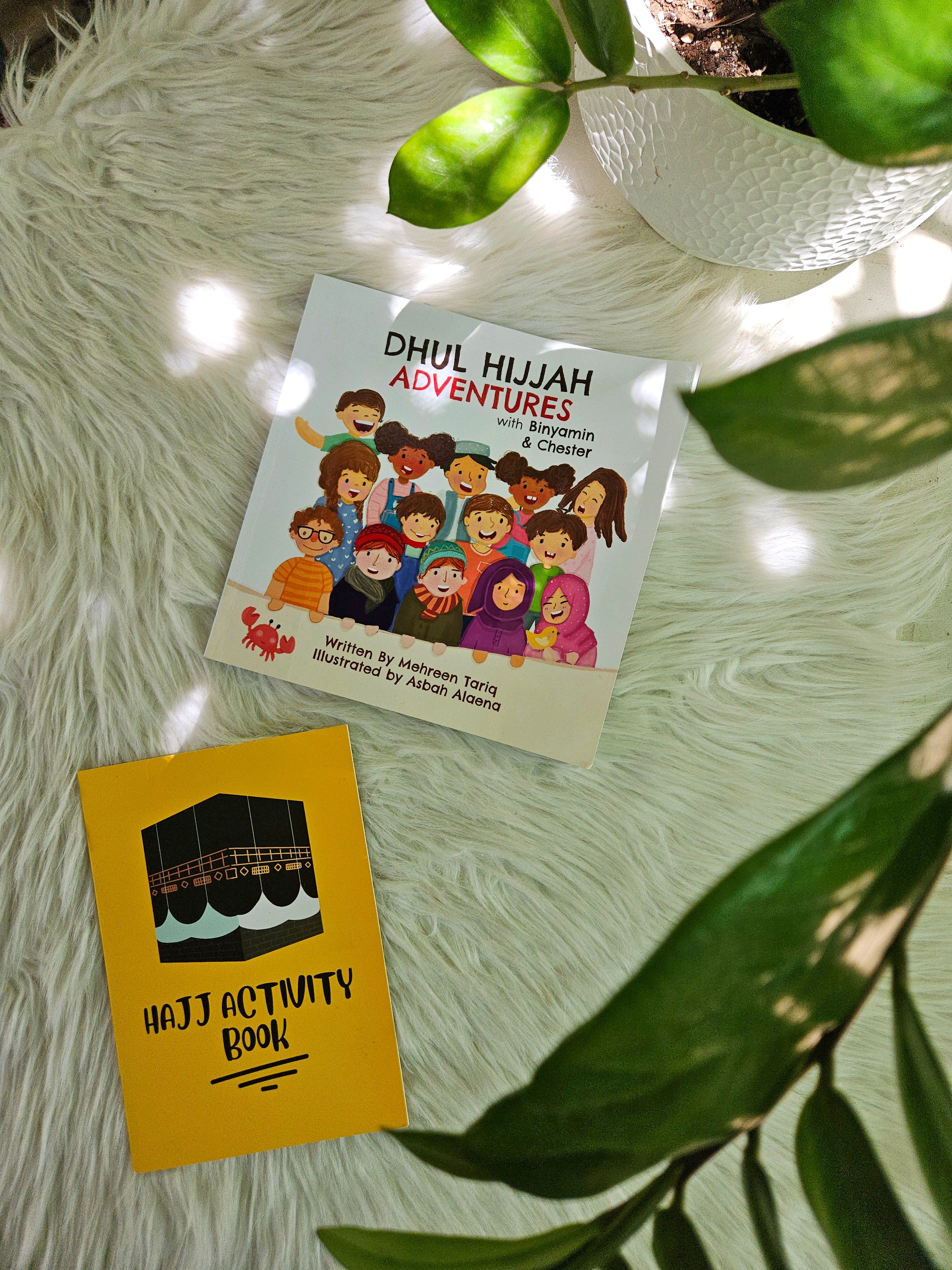
Arts and crafts are not my territory and I've made peace with that. But I’ve taken out our Dhul Hijjah related books to huddle on the couch because that’s where I’m completely in my element. My preference has always been to learn something myself first and then pass it on to the kids in language that lands for them. The best learning in our house rarely happens at a desk anyway. It sneaks into conversation during bedtime wind-downs and quiet afternoon moments. That’s when it actually sticks.
A few years ago, I heard Imam Omar Suleiman say something that changed my perspective towards Eid and I have carried it with me since then.
We have two Eids, two feasts, two major celebrations. One Eid comes after the ten best nights of the year. The other comes after the ten best days. One follows Laylatul Qadr, the single night that is worth an entire lifetime. The other follows the Day of Arafah, the single best day of the year. The one day when we can redeem ourselves entirely.
The fact that both Eids follow periods of intense, devoted worship says something profound about how Islam frames salvation. We, as Muslims, don't wait to be rescued by someone else's goodness. We don't expect other people’s righteousness to carry us across. We show up ourselves. We fast, we pray, we give, we remember. And then we celebrate not what we achieved, but the mercy of a God who gave us the opportunity to try.
The effort is ours. The acceptance is His.
At its core, Eid is a celebration of Allah's mercy and His forgiveness. That reframe changed how I think about Eid. Because if we coast through the days that were meant for extra worship and extra effort, what remains special about Eid?
If the days before Eid were just regular days, the Eid that follows is also just a regular day with better food and fancy clothes. The celebration only carries weight when we’ve done something worth celebrating.
And that part is on us.
This is it for now.
Remember me and my family in your duas.
Until next time, insha’Allah.
Get 10% off a group subscription
Please hit the heart below if you’ve read this far so I know I’m not writing into a void :) Please re-stack parts of this post if you can. Extra love for sharing it on Instagram because that really helps me grow this space.
I have disabled comments for now because one reason for moving from instagram was to distance myself from the ecosystem that thrives on immediate audience response. You can always send me a message on my instagram @anumkamran or email me at anumkamranahmad@gmail.com.
Thanks!
Comments
Nothing yet. Say the first thing.
Sign in to join the conversation.