
The idea for this project first came to me in 2020, either in Dublin or on the ferry back, when it became clear my housing situation, at the outbreak of a global pandemic when all my stuff was back in Birmingham and my partner wanted to fly across the world to be together, was no longer tenable. I was a twenty-nine-year old lecturer, but I’d solved my accommodation issues by pretending to still be a PhD student, so I could qualify to make a profile on a housing website where I had to agree not to invite visitors or drink alcohol in my room; in return, I was able to apply for a one-room granny flat behind a house in Artane. Thank you, Tony and Susan, sincerely, for your hospitality.
It took me five years to finish it, I think, because there were so many different directions it could potentially go in. The Mountain Goats had a formidable catalogue of songs by that point, which has grown by no small number since. Writing about all of them could be a lifetime’s work, but even the format I’d decided on - thirty songs across thirty years - didn’t make sense to me in isolation. Songs spoke to other songs on the same album, and connected thematically to other compositions, some which pre-dated them, some which seemed later variants on the same ideas.
Having begun with the hot-headed assurance that somebody needed to write about all of this stuff, I soon found that many people had already done so - Alex Russell in particular had already taken on the song-by-song challenge I’d found too daunting to even consider, while Kyle Barbour’s ‘Annotated Mountain Goats’ and the tMG fandom wiki, to which Liz Hamilton is perhaps the most extensive contributor, supplied a wealth of supplementary knowledge. Beyond all this, of course, lay the work of thirty years of live-tapers, who had preserved Darnielle’s comments on his own writing and many variant versions, all of which would otherwise have been lost to history. I could never have done this without all of their work in the background, though if I’d known how much had been done already, I might have wondered what if anything I could actually add.
None of those sites, however, interspersed glosses on John Darnielle’s writing with a detailed account of what it had meant to them personally, or the context of the writers’ own lives as listeners, completing the ‘feedback loop’ of interpretation. And perhaps there were good reasons for this! Having written about thirty years of my own life, I now have a strong appreciation for why Darnielle made only two records which focused exclusively and overtly on autobiographical material - that alone was enough for the frame of reference created by We Shall All Be Healed and The Sunset Tree to remain a live issue in all discussions of his subsequent material, whether or not its personal resonances were explicitly foregrounded. There is a virtue to keeping yourself out of the frame, and the more I wrote, the more I wished I was writing the stories of all the other fans I was getting to know instead, some of whom seemed to have much more narratively rich connections to Darnielle’s material than I did.
I suppose on some level I was motivated by the work I was responding to, to share something of myself; to meet this music on its own level of vulnerability, to the extent that I was comfortable doing. I haven’t told you everything about my life in these essays - I haven’t told you about my granddad’s death, or the time I failed to record an interview with Agnès Varda - and I’m sure John would tell you he hasn’t done the same in his music, interviews, or onstage comments either. But I hope I’ve told you enough to make clear why this body of work matters to me - not least in the sense that I wouldn’t be the writer or the person I am without it.
The cultural figures we latch onto in our teens often occupy a distinct space in our lives - as my friend Luke pointed out, they’re usually older than us but younger than our parents, offering alternative modes of engagement with the world, new possibilities of identification. Intentionally or not, they illuminate pathways we can choose to follow. I wanted to show some of what that looked like: how a catalogue of songs which, in many ways, had nothing to do with my own life, became part of it, and in time reshaped it.
But I was also motivated, as perhaps many who feel similarly attached to niche, outsider, or non-mainstream artists are, by the feeling that this work risked being forgotten: that its place in the culture wasn’t yet assured, that its merits weren’t fully appreciated. In 2026, that no longer seems accurate: the Mountain Goats have not only been profiled at length by significant publications (The New Yorker, GQ, Esquire and others), but have also taken an increasingly active role in the stewardship of their own catalogue and legacy. Old EPs, once only available as low-quality YouTube rips, or on the second-hand market for silly money, have seen official re-releases on Bandcamp and streaming; recognising the importance of their live tapes, the band have begun to release concert recordings through official channels.
Most notably of all, the book This Year has seen Darnielle overcome his own resistance to nostalgia and collate in one place many of his reflections on the songs he has written over the past three decades, including many lyrics to hitherto unreleased material which concert-goers, on the rare occasions it was played live, were actively discouraged from recording or sharing. This fundamentally alters the equation of archival preservation, bringing many of the scattered strands of interpretive material listeners might bring to bear on Darnielle’s songs from those decades of fugitive interview and onstage comments ‘in-house.’ It also, of course, calls attention to what’s still less-than-legitimately-available, and raises the question of what space the exegetically-inclined might still find in their hearts, or in their academic essays, for previous pronouncements which didn’t make the pages of this volume, or which offer alternative explanations of its contents.
I haven’t yet read This Year from cover-to-cover, because it appeared so late in the process of my work on this project that it seemed sensible to finish off my own interpretations before incorporating too many of Darnielle’s own. My hope is that the two sit alongside each other in interesting views, rather than the author’s narrative rendering the fan’s obsolete; that doesn’t seem in-keeping with the way Darnielle has always talked about the interpretation of art, and it stands to reason that a view from the floor will have a different angle than one from the stage. But the annotated book’s appearance has rather sharpened the question: what’s the point of this, then?
I would love to be able to say that, in the course of five years, I’ve learned a great deal about myself, achieved new insights and profound personal breakthroughs. As it happens, I feel completely uncertain about where this has all got me, though I can’t conclude a series of essays without mentioning that the French essai really means ‘an attempt’: I have tried, in thirty ways - or really, thirty-two - to explore how this music and my own life have intersected with each other, their surprising overlaps, their profound divergences. If nothing else, I’ve tried, and I hear God loves a trier. But the fact remains that, five years ago, I thought going through my own history year-by-year would be a way to make me sort through all these boxes of old papers in my office, and that at the time of writing, I haven’t even opened them. Like I wrote last time, I’ve had my eyes on the future - or, more mundanely, the present, on getting through the day to day. I would love to say the project has, ultimately, shown me that I don’t need to, that I can toss them all into a skip and start over - that’s not true either, but one thing’s for sure: I can’t take them with me.
I wonder, now, if Darnielle’s own recent self-reflections really began with the pandemic-era boombox album Songs for Pierre Chuvin, and especially a line from ‘Exegetic Chains’: ‘Stay warm inside the ripple of the Panasonic hum.’ If ‘Cold At Night’ is anything to go by, the imperative to stay warm however you can manage it is pretty essential to the Mountain Goats’ work, and in that line I hear a recognition of how this music has enabled that sense of comfort, belonging, a safe container to be held in, for so many people - and perhaps for its creator, too. A ripple is always moving, but you can move with it, and in time you might find yourself so at ease in doing so that you have a little freedom to look back over your shoulder.
It’s a warm wish, all the same, and I’d like to wrap things up by looking at another: Darnielle’s elegy for David Berman, who deserves an extensive study of his own (and is currently getting one courtesy of Carl Wilson.) Elegy has been a significant strain in Darnielle’s work - especially the songs he has written about his friends from the City Nightclub in Portland, and his childhood friend Rozz Williams - and I do have a chapter coming out later this year in an academic book, The Routledge Companion to Early Modern Music and Literature, where I look at these works in the context of Darnielle’s uses of the past across his catalogue. (I’ll post about that on the @thirty_years_later Instagram, if it’s the last thing that I do.)
Here though, mourning Berman, who Darnielle called ‘the best lyricist of my generation,’ takes the author on an elliptical path through a piece of rock criticism by Peter Laughner, who couldn’t make sense of the direction a one-time musical hero of his, Lou Reed, was taking on the 1976 album Coney Island Baby. The resulting song, Darnielle observes, isn’t about that at all, but the wider perspective of ‘young men who are trying to work out what does rock and roll mean in their lives,’ as they grapple with the unexpected paths their heroes have chosen.
Laughner, whose review begins with an ugly description of a ‘horrible physical fight with my wife’ and goes on to describe him ‘puking and pissing myself at a band rehearsal,’ doesn’t seem like the most reputable interlocutor in any case, but Darnielle’s ‘argument’ seems primarily based around his defence of Reed going where he feels he has to go whatever anyone else says. (‘You can’t tell me what my spirit tells me isn’t true - can you?’) Berman, in his own song, is ‘trying to find the secret path,’ but is ultimately unable to make it.
Having written openly about the many times he considered suicide or came close to death, Darnielle is intimate with the feeling of burning through all your fuel, with the prospect of dying young having ‘Hurt too hard too long’; here, at a stately pace, over chiming guitar lines which seem to conduct the song’s subject out into outer space, he pays tribute and says goodbye.
Berman’s loss is elevated to an oceanic and cosmic scale - ‘Seas gone silent in the spiral shell … You who took with you the ancient spell / When you fell’ - but is also mourned in terms of deeply human, and spiritually-inflected, compassion: ‘May your passage be assured / There may your foul afflictions all be cured.’ Most significantly, though, his life is marked and recorded, his work honoured, in a small but telling gesture of recognition: ‘You will always have been here once.’ It’s not what Horace, as quoted in my first instalment, called ‘a monument [which] will outlast metal’ - it’s the words of a song, a voice in the air.
But as Berman himself quipped, ‘the wages of metal should be heavily garnished,’ and it’s something, all the same - an acknowledgement of the indelible impact the songwriter made on the world just by passing through it. In the icy reaches of space, nothing much lasts in the end - but thousands of years on from the early hominid inhabitants of the Soudoire Valley, we can still discover evidence of their firepits, their forges. The memory of something bright and shining. Something which was here once, and illuminated people’s lives once, and left its mark, as deeply as it could, for as long as anything can.
For what it’s worth, then, here I am now, thirty-five years later:
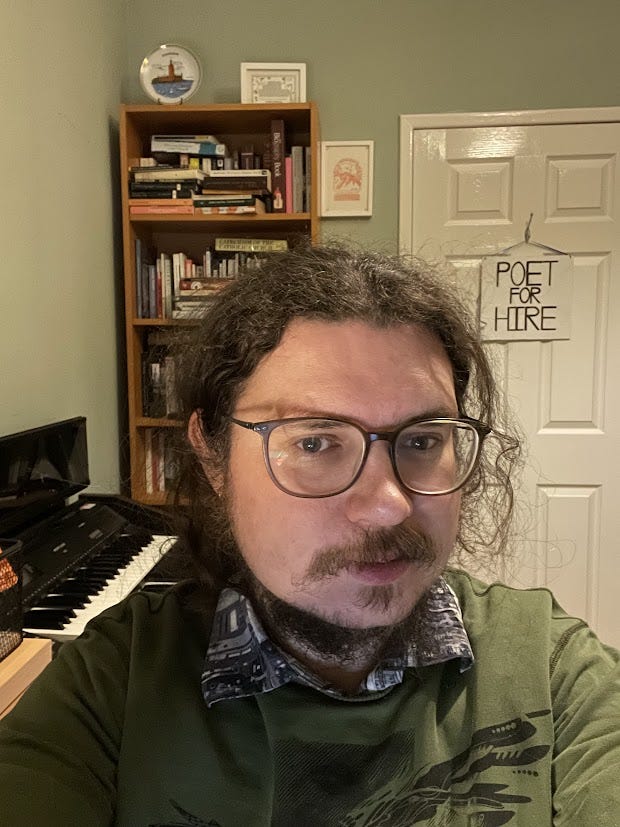
And I have one more thing to share. In a 2022 benefit concert, performed in Portland for the Oregon Institute of Creative Research, founded by his Pitzer tutor Barry Sanders, who was there in attendance, John Darnielle described his own early lyrics - going all the way back to those Portland planters on ‘Running Away With What Freud Said’ - as frequently inspired by ‘themes we had been talking about in Chaucer, about the primacy of spring among the seasons in medieval poetry.’ In that spirit, then, here is a poem from last week, which my wife requested I write - at my desk in England, where it’s so far rained every day this year - about those early signs of spring being just around the corner. Thank you for reading - and if you got something out of it, please do still feel free to tell your few remaining friends.
Spring
The cherry tree is bound to bloom again,
barring the human-hand-work of an axe.
An end is coming to this sheetwise rain:
not yet, but soon, I’m sure. What nature lacks
in pity it makes up for in pure process;
April will come, despite drawn-out attacks
- predictably, in line with life’s prognosis -
by winter’s ghost-grey camouflaged siege forces.
The Earth’s a tired, but a patient, hostess:
and so the wheel will turn, with no remorse, as
dark goes down, as light regains its sway.
Spring, too, should come with riders on four horses
whose smacking hooves churn up the waiting clay,
who run all night along a blazing chain
of beacons, saying ‘Something’s on its way.’
I’ll be winding down the show Instagram now this project is over, though I might post there about anything I’m working on that’s likely to be of interest to listeners. But if you want to keep up with my work, you can find me personally on Instagram @thelasttimeisawrichard, where I post about my writing and my life in general, or @groundbirdsings if you want to follow the music I make. I’m also on Bluesky as @notrockyhorror.
This week: what are you getting into? Keep in touch, and let me know.
Comments
Nothing yet. Say the first thing.
Sign in to join the conversation.